


5 Pitfalls of EVM


|
Or perhaps this article should be called: 5 pitfalls that can happen when EVM is not implemented the way it should be! Here are 5 things that can go wrong when an organisation chooses to implement Earned Value Management as a way of working for project performance tracking. 1. There is low organisational supportPossibly: there is no organisational support outside of the PMO. EVM is very much an enterprise-type solution so everyone needs to be on board. The whole organisation needs to know what it means for them as individuals and as a team – and you should try to bust the myth that it’s all complicated maths. In reality, most of the tools now do all the heavy lifting for you, so there’s no need to be hands on with the maths. However, the project delivery teams are going to need to understand the inputs and outputs to the formulas so they can interpret what the numbers are saying. That’s the secret: it’s making sure the wider team understands that the move to EVM is all about creating a set of essential measures to track performance and improve project control. 2. Thinking of EVM data as the answerEVM data is simply a representation of current project performance. It’s not a decision in itself. It’s not a set-in-stone forecast that tells you what is definitely going to happen. The team can still adapt and change, mixing up what they do to shape future performance, preferably in a positive way. The data should be seen as decision support information, helping the team make the right choices about what to do next in order to get the best results for the project. 3. There are poor or no decision-making processesPitfall #2 brings us on to this one: EVM implementations struggle when the organisation has poor (or no) decision-making processes. There should be some way of managing decisions as part of project control. Decisions and management responses to situations should be structured and repeatable, not knee-jerk. Proactive action taking is better than reactive ‘let’s just do something and cross our fingers’ type decisions. EVM data is good, and helpful, and informative but if the project leadership team don’t have the power or ability to do anything with it, then the data is just a set of pretty reports no one ever looks at. Decision makers should be looking for patterns, documenting decisions made and their outcomes so that future decisions can be shaped by today’s lessons learned and building credibility by using the information to improve project performance in meaningful, predictable ways. 4. Limiting EVM to a small groupWhen EVM is implemented, we talk about it being a whole enterprise thing, and that everyone needs to understand what it is and the value it brings to the organisation (as discussed in Pitfall #1 above). But making it ‘a whole enterprise thing’ actually goes far wider than a communication campaign. When EVM is implemented, it’s important that the whole team is able to see, input, act on and engage with EVM numbers. They should be responsible for their part of the system. In other words, it’s not a good idea to limit the people with hands on experience to a small sub-group of project practitioners in the organisation. It’s ineffective to ask project managers to provide time sheet information, for example, to the gatekeepers who then load it into the system and provide monthly reports in PDF format. That leads to a couple of problems. Practitioners feels like they aren’t truly included in the EVM and will probably disengage from it. For them, it becomes one more set of data points to submit to someone else for reporting; something that happens outside of their sphere of influence (or interest). It also creates a culture of auditing, where individuals feel that their work is dissected by people who lack hands on experience. EVM shouldn’t turn out to be a ‘them’ and ‘us’ experience in practice. For best results, it really does need to be a whole team process with plenty of input from everyone. Basically, it needs to become ‘how we do business round here’. 5. Not creating a common vocabularyOf all the various aspects of project management that require specialist jargon, is EVM the worst? I think it could be. There are all the acronyms (PV, EV, SPI, etc) and formulas. There are control accounts and control account managers (which must make control accounts very important if they have their own managers), plus the terminology that goes along with the WBS. The benefit of all this jargon is that when it is understood by everyone, it provides a common and clear way of talking about the same things. You avoid the misunderstanding of schedule vs plan, for example, because there is a common language with terminology that means the same thing to everyone. That’s powerful. It’s also good for decision making because clarity of understanding helps execs make the right call. Next month I’ll be looking at a few more pitfalls from EVM implementations that are not done in the best possible way, but meanwhile I’m interested in your views. What have you seen go wrong with EVM rollouts in the organisations where you have worked? Let us know in the comments!
|

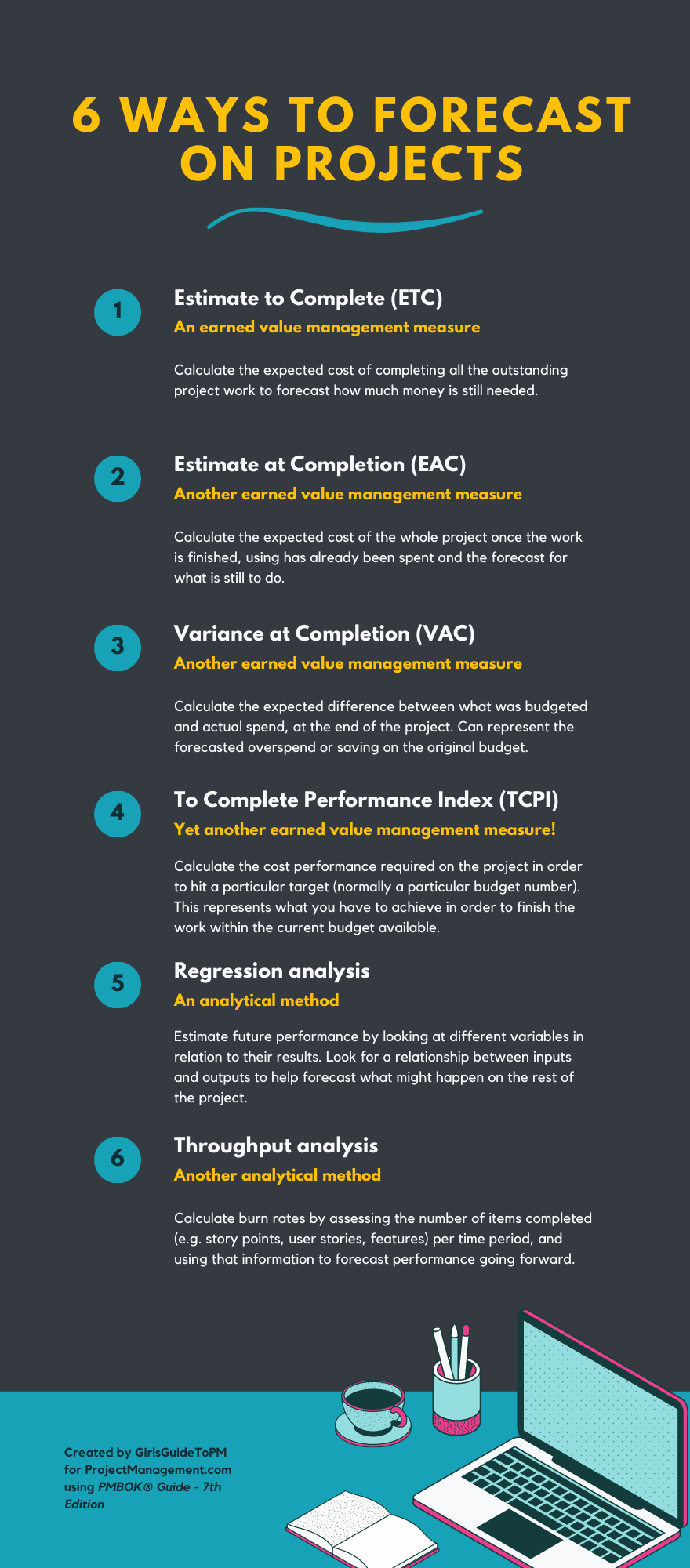
6 Ways to Forecast on Projects [Infographic]
| How to you predict what’s going to happen on your project, from the perspective of performance? The infographic below shows a few different metrics and performance measures that you can use to forecast future performance – helpful if you want to know what your project’s results might look like before the end of the project, so you can make better decisions about what to do and how to use your time and budget effectively. For more information about estimate to complete, estimate at completion, variance at completion and to-complete performance index, you can have a look at the PMI guidance on EVM and the ANSI Standard. Regression analysis and throughput analysis are other methods you could use. Infographics can only give a very headline view, so there’s a lot more to say about each of these! Which of these forecasting calculations do you use? Or do you forecast using something different?
|
5 Ways to Mitigate Risk [Video]
|
How do you actually go about mitigating risk? We talk about the need to mitigate all the time, but what kinds of things can you do to ensure that risks really are managed appropriately and mitigated to avoid the impact you think might be on the horizon? In this video, I talk about 5 different things you can try to mitigate risks. They are simple and practical, and you can easily turn them into solid actions for your risk log. If you want a couple of extra suggestions, and some more detail (or you just prefer to read rather than watch), then the original article that prompted this video is available here: 7 Ways to Mitigate Risk.
|

Review and Assurance: The secret to better estimates
Categories:
Estimating
Categories: Estimating
|
The UK Government’s Infrastructure and Projects Authority’s Cost Estimating guidance talks about 8 principles for best practice estimating when it comes to working out how much your project will cost. I’ve already written about front-end loading, and today I wanted to look at another one that is really helpful – even if you don’t do huge scale infrastructure projects (which admittedly, the guidance is aimed at). Estimates should be ‘reviewed and assured’. This is something you can implement regardless of the size of project – as long as you have more than one person in the team who has an opinion about the estimate. The guidance says: “Cost estimates that are reviewed and assured appropriately will be improved and become more reliable, further driving project discipline.” You might already be doing this informally: a quick check in a team meeting, for example: “Is everyone OK with that if I put it into the figures at £5k?” But making a review a formal part of your estimating will elevate your practice and hopefully create more robust budgets. Here’s how to do it. 1. Make it clear you will be reviewing cost estimatesAs a team, explicitly call out that there will be a review and assurance process in place. Make sure you know what that is, and when it will be used. For example, as you prepare documentation to get sign off to move the project into another phase, or during backlog grooming etc. The whole process needs to be designed to remove ambiguity, so consider outlining what the inputs and outputs of the process will be and what triggers need to be reached to kick off a review. The IPA guidance doesn’t mandate a review process but does say people in the review and assurance roles should be independent and make sure the process is robust and followed. Document the process so everyone knows what is coming. Ideally, the review team should stay the same throughout the project to provide some continuity, and now is the perfect time to plan to make that happen, allocating resources who can follow the project through its lifecycle. If there will be different types of reviews (or reviewers) for different things, make that clear. 2. Find standard methodologies to compare againstSo you don’t have any data in house to act as your benchmark? You will, with time, if you start collecting it now. Alternatively, check in with your colleagues or see if there is any available industry benchmark data that will help you assure your in-house estimates. 3. Schedule reviewsThe easiest way to review cost estimates is a simple peer review process. Get colleagues to review each other’s schedule estimates (as these translate into financial amounts if you are charging clients by the hour) and budget estimates where these are not based on formal supplier quotes. Where your project warrants it, block out the time for formal reviews. Independent assurance is particularly useful when it’s timed to coincide with ‘big’ events on the project like the approval of a business case for the next phase, for example. Make sure people know when the review is coming so they can prepare for it and resources can be available to run it. Plus, the actual process takes time and you’ll want to factor that in to your schedule so executives aren’t expecting work to continue during that time, prior to the review being signed off. 4. Act on the dataThe thing with getting other experts to weigh in on how much things are going to cost is that often experts disagree. That gives you, as the project manager, a role to play in making sure that any potential conflict is addressed and dealt with professionally, without it causing fireworks in the team. Another time to act on the data is before the project moves into the next stage, whatever that might be in your process. If the estimates have changed or need to be refreshed, this is the time to do it. It’s fine that the figures are updated: what’s important is that they accurately reflect the costs as you see them at the moment. Benefits of reviewing and assuring cost estimatesAs you can imagine, there are plenty of good things about reviewing estimates as a team, not least that you should end up with better quality data. Here are some other benefits:
As you can see, there are numerous reasons for using the principle of review and assure when producing cost estimates. How do you manage this process in your teams? If you want to read it, the IPA Guidance is here (pdf). Pin for later reading
|
Maintaining the Performance Measurement Baseline in Earned Value Management
|
The Standard for Earned Value sets out an approach for scope management with the goal of maintaining the performance measurement baseline. You need to keep the integrity of the baseline, otherwise there is no point in having it to measure against. And given that change happens, you need a plan for dealing with those changes. I was interested in finding out why there needed to be a separate scope management process in the Standard. Perhaps you manage change differently if the project uses EV methods? I suspect you don’t – but you do need a way to tie scope changes back into the time and cost baselines so your EV metrics don’t go off track. Read along with me as I dig into this Chapter of the Standard and uncover what’s different about managing scope in the world of earned value (it’s Chapter 10, if you are interested).
InputsThere are four inputs to this process:
So what do you have to do with those inputs? What to doThere are three main things that need to happen as part of this process. I think this really needs to be done, at least at an introductory level, before the CCB gets together – otherwise what will they talk about? In reality, all these things have to happen in a logical order because you might approve the change but then need to do the analysis of what happens to the project in terms of the work. For example, you need to update the baseline and the WBS to incorporate the change. The tasks to be done are added to a work package, and in EV, the process for doing that is a bit counter-intuitive. The Standard explains you close the current work package and move the money to the new work package, along with the new budget for the new tasks. The rationale for this is to maintain the integrity of the cost variance while removing any schedule variance. Create a new control account and carry on. Then, the cost and schedule baseline need to be revisited. That improves the correlation between the work to do, and the baselines for budget, scope and time. All in all, there is a surprising amount of work required for handling a scope change in an EV setting. No wonder you get the impression that it’s hard to make changes and that there needs to be adequate planning up front to avoid extra tasks arriving later. OutputsThe outputs from this process are:
I read this chapter and was surprised. I mean, not surprised that you have to do scope control or update the baseline, but surprised at the admin involved in re-aligning all the different aspects of the performance measurement baseline. I suppose I knew that it needed to be done hypothetically, but I had never unpicked what it would look like to have to do that work. I have a new respect for schedulers and project control managers. Not only do you need to deal with the change and incorporate the decision to do it into the work (which all projects need to be able to do), there’s an added level of admin required to maintain the integrity of the EV reporting. The Standard says, for example, “Budget must never be transferred simply to eliminate variances.” Well, back in the day, I did exactly that. On a project (where we were not using EV), our overall capex budget was set. I had the flexibility to move money around within the different capex lines, as long as overall we stayed in budget. So I did. It meant the difference between hospitals receiving the kit they needed to work efficiently or not, and it was never large sums of money. The budget remained overall balanced, and no one really minded how it was distributed as long as everyone got what was needed and we knew where the cash was going. I learned a lot about budget tracking from that project and I quite enjoyed it. I’m not sure I would have enjoyed it as much if I had had to incorporate EV reporting as well. There’s a worked example in the book, so if all this doesn’t really make sense to you, or you can’t see the flow of the changes, that’s helpful. Pin for later reading
|




