


Too many projects, not enough resources


| You’ve got a big pile of projects to do, and more requests coming in all the time. There’s not enough money or people to go round. What should you keep? What should you scrap? Take a look at the existing projects. Are any of them underperforming? What can you cancel? Can you salvage the work in progress to get something out of it before it’s cancelled? Are there any in-flight projects that can be suspended until more resources are available? Can you speed any of them up to make people available for other work more quickly? Look at the new requests. What can you reject straight away? What’s a good project, but can be deferred?
|

How do you calculate what project management contributes?
Categories:
ROI
Categories: ROI
| How do you calculate the contribution that project management makes to an organisation's bottom line?
Like this:
|

Managing Money Q&A (Part 5)
Categories:
FAQ
Categories: FAQ
|
Is there an industrial standard for a ball-park of the Project Management cost during estimation for all IT projects? Does it vary for Application Development projects versus Application maintenance projects? Also, does platform matter? There is no industry standard for ball-park project management costs for IT projects. It depends on the complexity of the project. A small project that requires very little oversight, with competent and experienced developers and engineers, may only need a small amount of project management time. A complex, never-been-done-before project might need project management effort at practically full time. I don’t think the type of project, or the platform, matters much. What matters is the skill of the project manager and the complexity of the project. Look back at the statistics that your PMO has about percentage of project management time per developer day. If you really, really, don’t have a clue, start with 20%, which is one day of project management time per developer week. Should I track project costs if I have never been required to do this? And if so, where would I begin since this would be for my information only, for now, with the intent of presenting to upper management (sponsors) to show value? If you want to do this as a learning exercise, then go ahead. You are not required to do it, so don’t let it take up too much of your time. Are any other project managers required to do it? If so, why? Maybe they work on projects of greater strategic significance or with higher external costs. Ask your PMO why you don’t have to track costs – you might be reassured by the answer. If you’d still like to do so, you could start with tracking your time, and then talking to the Finance department about the daily rate for resources so you can put a financial value on that. If you are only managing a project with people resources, and not other expenditure, you can track how much effort it is taking to complete the project. If you are spending money on other things, like buying computers or hiring a contractor, you can add those in too. Do you have publicly available SharePoint templates (e.g. budget tracker)? Or url? No, sorry. Although this is an excellent suggestion. I’ll see if I can sort something out. On another note, why would you want to use a SharePoint template as a budget tracker? It’s not designed to be a spreadsheet so that is going to give you a lot more work to do. Use a spreadsheet programme, and get it to do all the maths for you. Salary and contractor costs are sensitive information. How do you share the entire budget with the team without divulging this sensitive information? You don’t. Sharing capital expenditure – buying things – is different from sharing operating expenditure. To be honest, not many project mangers have access to salary information for the people on their teams anyway. That’s normally data belonging to the line manager. You may have day rates set by the company for different types of resources, which are not the same as salary figures. These will be publicly available.
You can see the whole presentation online here, via a recording of the webinar. I’ll have some more Q&A for you soon! Got any questions? Leave me a comment and I’ll answer them in a future post. |
 It seems ages ago now that I gave a webinar on managing money on projects, but it is taking a long time to answer all the questions that I didn’t get round to doing during the live session. Thanks to all the fabulous participants, who asked such brilliant questions! I am still trawling through them hoping to answer them all, and here is today’s batch of managing money Q&A.
 Is project management a cost to be reduced or an enabler for cost reduction?
|
The role of organisational culture
Organisational culture is a key driver for how project management is perceived in the business. “Project management typically requires people to have a certain level of openness,” he said. How does this work across an organisation where other departments are not like that? It certainly makes it harder, he explained. The vote
Attendees at the austerity debate were asked to vote on whether project management is a cost to be reduced or an enable for cost reduction. Some people put their hands up to show they thought it was a cost to be reduced. However, many of them also put their hands up to show it was an enabler for cost reduction too. Overall, the ‘enabler’ opinion won out, with the majority of people thinking that project management facilitates cost saving in companies. |
 Is project management a cost to be reduced or an enabler for cost reduction? This was the question asked at the Austerity Debate in London last month. Donnie MacNicol, Director,
 The Austerity Debate: What’s the cost of project management?
|
Each project has an overhead, including the cost of the project manager, the sponsor, a risk budget, the project board and any project support services.
What does it cost if you don’t do projects well? There’s rework, the cost of overruns, poor outputs, under-delivery, consequential loss, and benefits that remain unrealised.
This is the infrastructure related to managing projects and includes any Centre of Excellence overheads, the PMO, support, monitoring, tools, evaluation, assurance, the Portfolio Office and audits.
|
 Andy Murray, Director of
 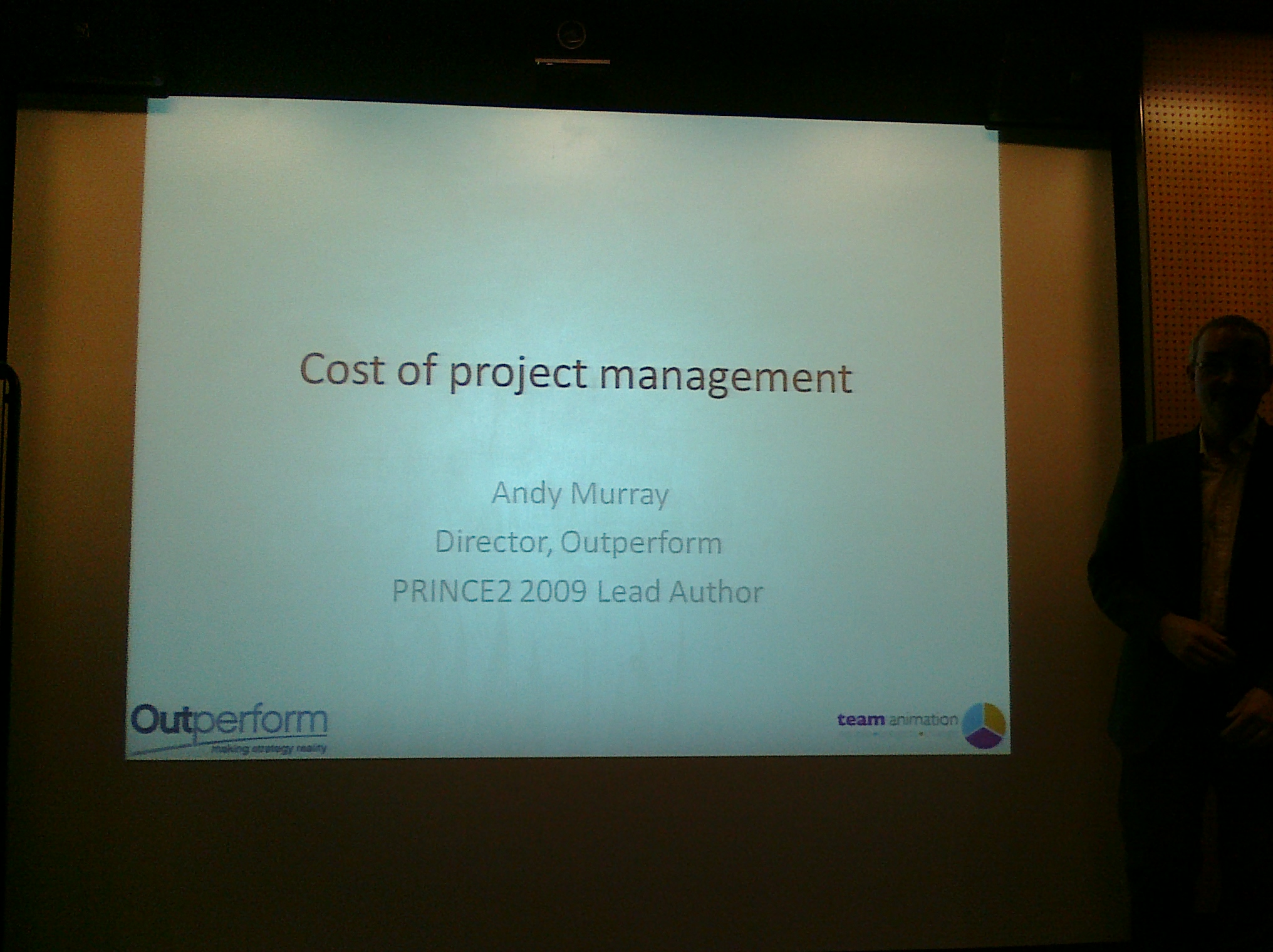 Murray said that the contribution project management offers is a mix of the value of increased performance, plus a reduced cost of failure and a lower cost projects, less the cost of project management itself. I’ve represented this as a sum in the picture here.

