


7 Types of cost for your business case


|
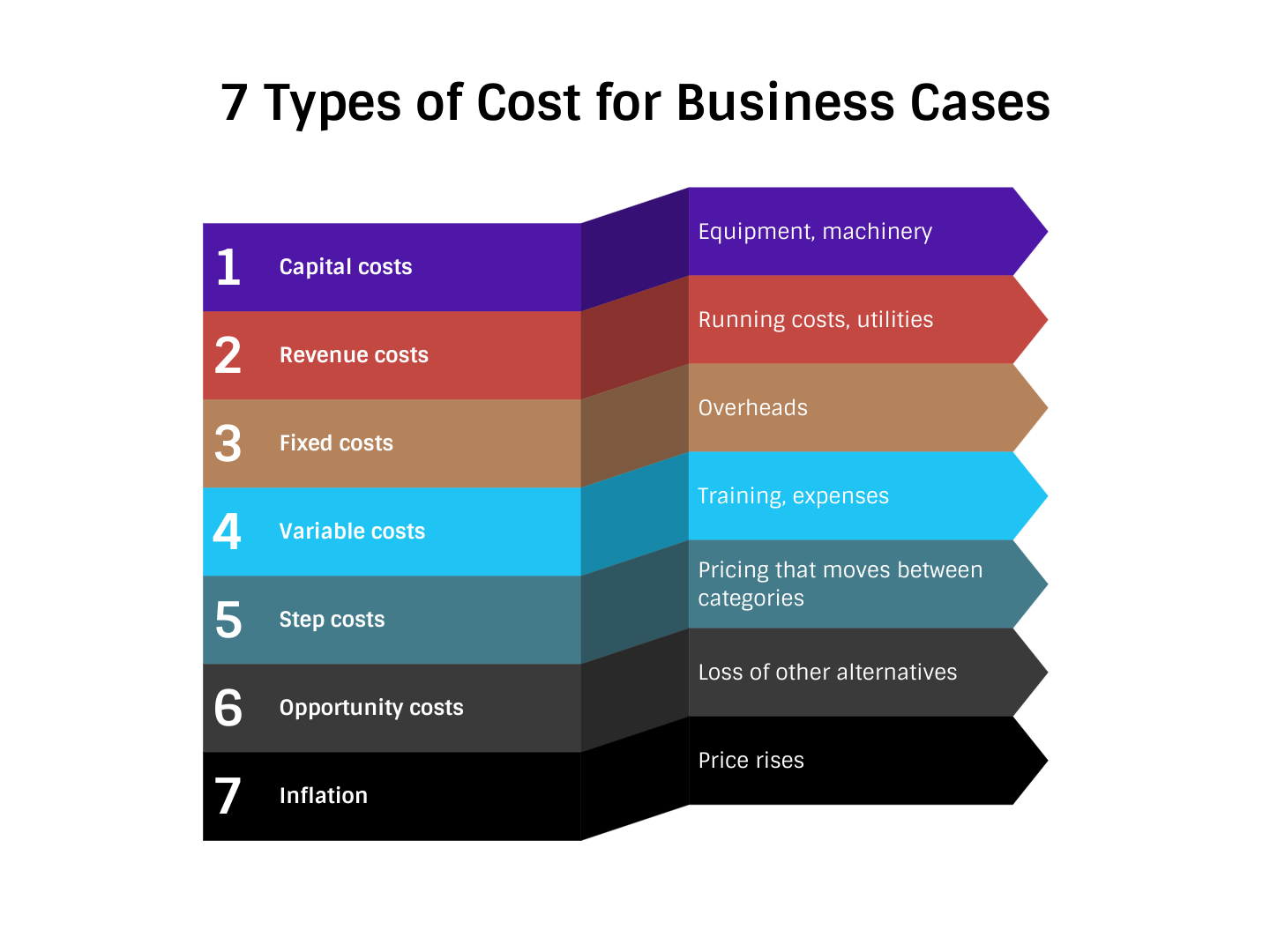
Are you putting together a business case? This is the time of year when many project teams are kicking off new work with the lovely new budgets that are available at the start of a financial year. The UK government (HM Treasury and the Welsh government)’s guidance called the Better Business CasesTM model, has a section on different costs that are helpful to include in your outline business case. Project managers don’t always get involved with business case creation but I think it helps when we are. If you are working on a new proposal, here are 7 types of cost that you can consider including as part of the economic appraisal for why the work should take place, and to show that you have fully considered all the elements. 1. Capital costsFor my projects, I’d say that capital costs make up most of the budget. These relate to buying equipment, whether that is IT kit, or in my case, machinery. They relate to costs that can be capitalised and (depending on your local regulations it might be different for you) the costs of bringing an asset into service. 2. Revenue costsAlso known as opex, these are pretty much the opposite of capital costs: things you can’t capitalise but are required for running the project. Maintenance, operational costs like some software licences, things that hit the P&L like the electricity bill and disposable coffee cups, if your project is required to pay for those. Even if they are not necessarily part of your project budget, it is worth knowing abou tthesee and including them in the business case to show you have considered the whole life, complete costs of the work required. 3. Fixed costsThese are costs that are constant over time, regardless of how long the project goes on for. Typically for me, these are resource costs that are spread over the life of the project. They could also relate to other overheads like having to hire a portacabin as a project office on site. 4. Variable costsThe monthly impact on your project budget from these costs are variable. They tend to relate to how much of something you use per month, so it could be printing, it could be downloads of something, it could be training costs or meeting room hire. 5. Step costsThese are prices that increase as you reach a certain threshold. For example, if you use project management software you’ll be familiar with the licence model for SaaS tools where if you go into the next ‘bucket’ of users you’ll be charged an uplift. Let’s say the cost for 1-10 users is a certain price per user. When you hit user 11, you’ll be charged a different price. This could also relate to items like post: as you ramp up receiving in items of post, your parcel handler changes the pricing structure and you end up paying more for hitting the threshold. 6. Opportunity costsIn a business case, you want to say what you’ve looked at in terms of other solutions. The model says that these should be explored in full and be representative of salary with all the on-cost (pension, employer’s tax contributions etc). These represent what you won’t be doing if you go with the recommendation: the loss of other alternatives. 7. InflationYes, given the rising prices we’re experiencing at the moment, it’s worth building some inflation into your financial modelling. Your Finance team can tell you what the right amount to include is for general ‘normal’ inflation and also whether there are other rates applicable to certain elements of the business case, or the cash flow projections. Next time I’ll look at another 5 types of cost you should also be including in your business case presentations, so watch this space! |
New Year Goals: 2023 Edition
| If you’ve been reading my blog for some time, you’ll remember that I’m not much into New Year’s Resolutions because they always seem hard to keep. It’s difficult to make new habits and stick to them. It’s easier – I think – to try to refocus on the core competencies and behaviours that I know make a difference but because of one thing or another tend to have fallen by the wayside as we get busier. For example, Quarter 4, the September to December period is always busy for me. Partly it’s because of family commitments: birthdays, school holidays, endless school-related events and things to remember, and of course the run up to the end of year holiday season. But it’s also because it’s financial year end, strategic planning for the next year and project review time. I’ve just filled out the 2023 annual family planner with the key dates for the year and hung it in the kitchen. It always surprises me that the gap between December and January is literally going to bed and waking up and it being a whole new year. But the effort we put into prep – like getting a new calendar and forecasting forward – feels heavy. Why don’t we plan on a rolling cycle? Why do we get to December and think, “I’ll deal with that next year”? Next year is just a couple of weeks away. If the decision had to be made in April, you wouldn’t think, “I’ll deal with that in May.” You’d just do it. So my objectives for the coming 12 months are simple, and things I have focused on in the past. There are no shortcuts in project management but there are definitely things we can do to help edge closer to successful results. I’m going to work on the following. Learning. On reflection, I’ve had a couple of years where I haven’t developed my skills in project management. I’ve been busy doing and teaching, but not learning. I think I need to find events and conferences to attend that are stretching and that will meet me where I am. In the past, I’ve ducked out of attending events because I didn’t think I’d learn anything new. That’s probably wrong: even a refresh of comfortable skills is worth doing. But I’d like to attend events that cover the topics for mid-career professionals, where I can come away with genuinely new ideas and having been inspired. If you know of any, let me know! Setting my future self up for success. In the rush, I have found myself this year making brief notes on a process or doing something without documenting it. Then I’ve come to do it again and had to start it from scratch. I need to build in time to make life easier for my future self because I’ve done it right the first time. Proper notes, documented assumptions, records of what is included in financial reports (project monthly summary slide deck: I’m looking at you) so I can easily replicate the numbers and justify them. And that’s enough. The idea of having too many things to focus on for the coming year is overwhelming. It’s enough to have one goal, or two. Or none. We’re all getting through the days the best we can, trying to get our work done, manage our relationships, support friends and family and get everyone fed and into bed at the end of every day. Are you going to make ‘professional’ resolutions? Or is this really now a thing of the past as our ways of identifying self-development opportunities have moved far beyond needing the scaffolding of a new year to set goals? And if you are going to make them, how do you decide on what’s enough for you? I’m genuinely interested in how you approach going into a new calendar year. Let me know in the comments!
|
4 Different Types of Estimating
Categories:
Estimating
Categories: Estimating
|
I’m loving PMBOK7. It’s far more pragmatic and helpful than previous versions, although speaking to other project management professionals (and trainers) they are reporting that students feel like they need the process stuff too, so they can actually get the work done. I think I’m lucky in that I’ve got my personal ways of working kind of figured out, and over the years have built the confidence to tailor what I do to fit the project, and also the amount of time I have to spend on it. I’m working on a lot of capex initiatives at the moment, so estimating projects for proposals is always top of mind. I turned to PMBOK7 to see what it had to say about estimating. The book says there are 4 different aspects of estimating, each affected by where we are in the project lifecycle. RangeRange refers to how close you can get to what might be the final estimate figure. For example, in the early stages of the project lifecycle you probably don’t have a lot of detail about the tasks and therefore you might not be able to get close to some of your estimates. Using ranges is useful because it helps present information when you still don’t have all the details. You can state a range like “between £80k and £120k”. As you get more information, you should be able to narrow the range, such as, “between £95k and £110k”. Eventually, you might be able to pinpoint an exact price. To be honest, the exact price is often where we start from in capex, procurement-led projects, as the supplier provides a quote early on. AccuracyAccuracy is how correct the estimate is; how close to being “true” it is. A supplier quote – provided you have given the correct scope – should be pretty accurate. An estimate from the IT team about how long it is going to take to connect the asset might not be very accurate at all if they’ve never worked with this technology before. If it’s something they do regularly, they can give you an accurate estimate. PrecisionPrecision is about how precise (obviously) an estimate is, or needs to be. Delivery dates for kit are often not precise at the beginning of a project, but as the stock comes in and suppliers can be more precise about when it will be shipped, the date estimates become more precise. ConfidenceConfidence levels are useful to include in your estimates, and are especially useful for influencing culture. In my experience, they are helpful when you are working with experts who are reluctant to commit to timescales and dates. You can ask, “How confident are you that you can complete the work within a week?” The more experience they have at doing that kind of work, the more confident they should be in their numbers. The more robust the estimating, the more confident they should be. Guesstimates have a low level of confidence. Explicitly mentioning the confidence levels when communicating to senior stakeholders can make uncertainly more obvious to them. I’m sure we’ve all worked with stakeholders who, when you say, “some time during the month” expect it to be delivered on working day 1. Not all projects will need all of these factors built into their estimates, and as your project progresses through the lifecycle, the way you create estimates will change. It’s worth bearing these factors into consideration so you can adjust and communicate about your estimates as you go. |

How to show your project meets strategic objectives
Categories:
business case
Categories: business case
|
Getting projects off the ground at the moment is hard: it seems to me that there is a lot more scrutiny on business cases because everything is more expensive. At least, in the UK, prices of everyday things are going up and that is hitting businesses as well as household budgets. So what can you do? When you want to prove your project is worth the investment, your business case if your first line of defence. Let’s look at how to present your project in the best possible way so you can convince everyone that it’s worth progressing. Show it aligns to strategyWe know that not all projects have to have strategic alignment: some are just tactical or must-do obligations. But if your project does align to strategy, you should find it easier to secure the commitment to progress. Provide the evidence and show that the proposal fits with the current strategic aims. Show that it is complementary within the portfolio and (ideally) fills a needed gap. If there are organisational KPIs or targets that your project could/would support, make sure those are called out. Show the change is requiredMost projects are ultimately discretionary. If you want your project to secure funding, you’ll have to show that it’s necessary to do the change – or at least highly beneficial. Evidence that you understand the business problem and that your project is the solution. Point out any current business risks or issues and explain how your project will address these. If you can talk here about the future goals for the organisation, the future business needs and link your project into those, that would be beneficial too. Be realistic: talk about the constraints and assumptions you are making, and any risks and issues to the project known at this point. Show how you get from here to thereSet SMART objectives – specific, measurable, achievable, relevant and timely – for the project and spell them out in the business case. Make it obvious that you can evaluate success and that there are clear goals. Document the project management and governance approach you plan to take to deliver the work, to show that it’s achievable. Spell out any additional resources required and show that there is capacity to deliver – or that you can source and secure the resources needed and that these are included in the proposal. Be really clear about what’s included in scope. List the outputs and provide some narrative about what the world will look like post-project. For example, talk about the new capabilities the organisation will have, and how these can be sustained over the longer term. The business case needs to be honest, but it also needs to be a well-written story that sets out the problem, the case for change, and what that change would be. There are more elements to a good business case than simply linking it to strategy, but this should be the very foundation of your documentation. If the project isn’t a good idea, or one that helps the organisation move closer to where it wants to be, the best financial analysis section in the world won’t get it through the PMO. |

Holiday season for projects!
|
Are you winding down for the end of year festivities? Whatever that looks like for you, here are 10 things to consider when heading into the holidays. 1. Thank your teamI’m sure you do this all the time anyway, but as a gentle reminder, this is a great time of year to be thanking people for the work they have done over the past 12 months. You don’t have to spend a lot of money (or any money). A digital card, a message on your corporate internal social network, a thank you in person or on email: it all makes a difference. 2. Thank your suppliersSuppliers have had a tough year, just like the rest of us. Rising costs and clients who have had to scale back their plans as a result of belt-tightening have made it a difficult economic climate for many, especially small businesses. 3. Organise a celebrationWhether it’s a Christmas jumper day, a lunch out to mark the end of another year and still being together as a team, or simply the option of meeting in person, try to find some time to celebrate what you have achieved this year. Look back at the projects that the team delivered, or the successes that have happened on your journey in your current project. Find something that everyone can do, so your celebration is inclusive. 4. Remember that payment runs are earlyBack to business: payment runs are early in December. Your Finance team might be processing everything a week or so before the normal cutoffs to account for people being out of the office or bank deadlines due to the holiday season. Make sure you get any invoices or expense claims in on time so you don’t miss out. 5. Be prepared for the change freezeYour IT department probably has a change freeze planned for the holiday period. This is a time when they won’t make changes to production systems, normally because they are running with a reduced staff due to people taking time off. It might also be because it’s a busy time of year for your business and they don’t want to do anything that would mess stuff up. If your project needs IT changes, talk to them about the dates for the freeze and get your change requests to the CAB (Change Advisory Board) as soon as you can. 6. Do your accrualsIf the end of the calendar year coincides with the end of your financial year, you might have to do accruals. This is where you financially account for items that have not yet been delivered but have been ordered, or have been delivered but haven’t yet been invoiced. Talk to your finance team about what they need from you. In my old job, we used to get a form to complete from Finance that detailed all the info they needed about open purchase orders so they could close the books for the year. 7. Send feedback to line managersIf you have benefited from having subject matter experts on your team, take a moment to send some feedback to them and their line manager about their contribution to your project. That can be included in their performance appraisal. 8. Prep for your end of year reviewOn the topic of appraisals, if you have an end of year review coming up (ours are often in January), take half an hour or so to document what you have achieved this year so you can reference it in your meeting. 9. Be mindful of other people’s leaveEven if you aren’t taking much (or any) time away from the office, your colleagues may well be. Try to bear in mind their leave dates so you aren’t bothering them with emails during their break. 10. Set your out of officeIt’s time to take a break from the office, so update your out of office message and let people know who to contact while you are away. Now all that is done, you can rest up and enjoy the holidays! I hope you have something lovely planned to mark the end of another year. |



