


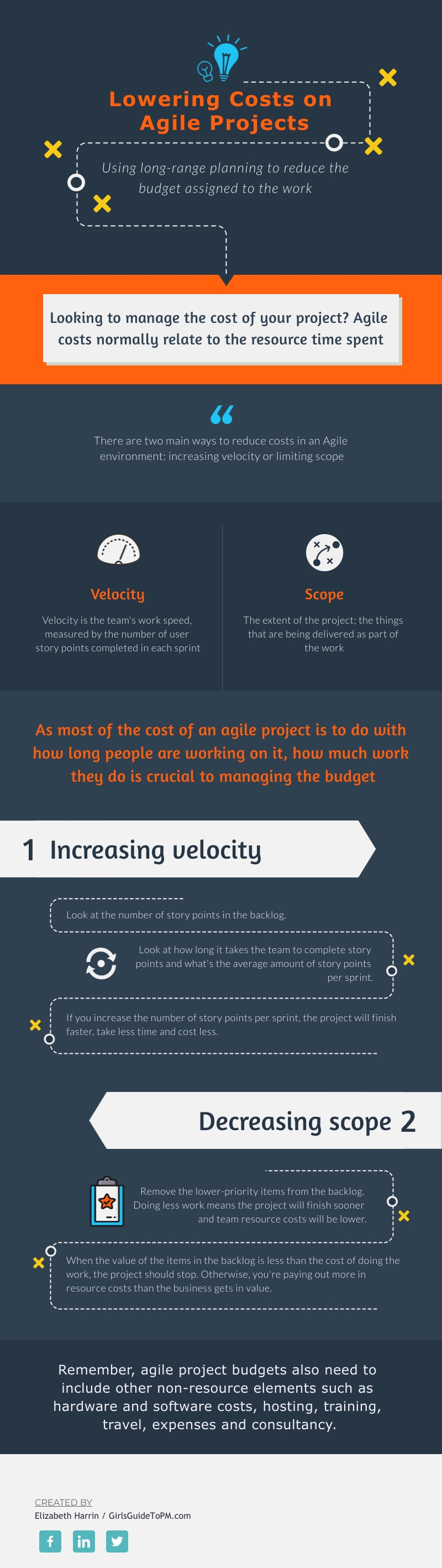
2 Ways to Lower the Cost of an Agile Project [Infographic]


| Given the type of work that normally happens in an agile project – yes, we’re talking IT development – it’s common that the largest overhead is normally the team. People cost money because we have to pay their salaries. All the while they are tied up on a project they aren’t doing other projects. Those other projects could be more valuable to the organization. So it does matter how people spend their time. If you are asked to cut the time of an agile deployment, how can you do it? If we’re focusing on staff costs, there are two main ways: increasing velocity (i.e. working more efficiently and doing more in less time) or decreasing scope (i.e. doing less so you finish earlier). The infographic below shares a bit more about these two options. What are your top tips for cutting costs in an agile project without cutting quality? Are there other techniques you use? Share them in the comments below!
|
3 Impacts of Risk Management [Video]
Categories:
risk
Categories: risk
|
Poor risk management can impact your project and massively affect your business more broadly as well. In this video, I discuss 3 impacts of less-than-optimal risk management which you might not have considered:
Interested in finding out why risk management can affect those areas of your project and what you can do about them? There’s more in the video! You can switch subtitles on if you are in a place where you can’t have the sound up or have other reasons to want to use closed captioning: Simply click the little icon at the bottom of the video that looks like a square with dots in, and the subtitles will automagically appear for you.
Pin for later reading
|

Establishing the Performance Measurement Baseline in Earned Value Management
Categories:
earned value
Categories: earned value
|
If you’ve been following along with my monthly dive into The Practice Standard for Earned Value, you’ll know that I’ve been picking up a lot of tips along the way. I’ll be honest – I don’t work on projects that use EV. However, that’s not to say that I can’t learn from the standard, and pick out things that apply to my non-EV projects. For example, last month I looked at the process around performance measurement methods, and it was good to refresh myself on different ways of tracking progress like discrete effort, apportioned effort and level of effort. Those are tools I can use to think about progress tracking on any project, because you should know how you are going to measure success before you start, regardless of whether EV is part of your toolkit or not. The Establish Performance Measurement Baseline is where we take all the scope, schedule and cost baseline info and blend it all together to create an integrated baseline from which to track performance. It’s the guide against which we’ll measure ourselves and our project to ensure we are on track. I said last time that performance measurement methods was the most important part of the whole EV journey – now I’m not so sure. This integrated baseline is the starting point for project control, and what can we do if we don’t have that? Perhaps I need to rethink my priorities and put this baseline at the top of the tree for EV components. (In reality, it’s all important, I guess.) InputsThere are four inputs to this process:
The first three are pretty obvious, but what is the risk register doing in there? Aha – it’s all part of a holistic, robust way of looking at the work. The project plan includes the tasks, but the risk register includes another set of tasks: your risk management activities that help you implement the risk responses (and the budget required for those). EV is a truly rounded way of looking at project scheduling, so it’s important to acknowledge that if the team are off doing risk mitigation work (or trying to optimise for opportunity risk), they aren’t delivering tasks from the ‘main’ project schedule. And you need to account for that time and effort. And budget. So it’s important that your risk activity is taken into consideration for the baseline. What to doThere is a lot of work to do to integrate everything. Let’s hope that in real life software can do a lot of the heavy lifting for you. However, the standard sets out the steps that need to happen, regardless of whether your IT tools can make short work of doing them. First, the team integrates all the different elements together. Take the scope, the schedule, the cost baselines and blend them all together with the risk response plans. You might not have all the detail for the full duration of the project, so do what you can with what you have – the rest can be progressively elaborated later as you get closer to the deliverables and know more about what is expected. Next, check you’ve got your project budget base and management reserve figures. Finally, create the performance measurement baseline. Blend the schedule and budget information together. It’s a time-phased view of what needs to be done and how much it costs. OutputsThe outputs from this process are:
There’s a lot that goes into this step, and a lot more covered by the standard than I can fit in here, with regards to this process. Take the time to get this right because it shapes everything else to come and how reliable your reporting is going to be. Remember, that’s why we are doing all of this, because the reports from EV are helpful and let us course correct as soon as possible to give us more chance of completing the project on time, on budget and to the desired scope. Next time, I’ll be looking at the next process in the earned value management standard, which is analysing project performance. Now we’ve created that baseline, the next step is to get the project going and track our work against it. Pin for later reading
|

How to Create a Project Budget Step-by-Step [Infographic]
Categories:
budget
Categories: budget
|
Project budgeting seems to be a topic that worries project managers more than any other. Perhaps it’s because people don’t feel comfortable doing it, as many project managers actually don’t have responsibility for the finances. It very much depends on your organisation and their processes, and the kinds of projects you are managing. For example, I frequently mentor people and hear them say that they don’t have responsibility for project finances. And when I teach project management, the Project Financial Management lesson is the one we always get through the fastest as people don’t seem to have much practical use for it. This is wrong. Project managers should have responsibility for the finances. How can you monitor and control the work and make the right decisions if you don’t see the numbers? Having said that, I know that I’ve worked on projects where the cost has been internal resource only, and we haven’t had a budget, let alone the need to track external spend. If you are in that situation, I would suggest that you volunteer to track hours spent (for ‘resource-only projects) or that you offer to take on the tracking of the budget even if you can’t wrestle away control of the actual purse from someone else. Then at least you’ll be starting to gain experience and show that people in your organization can be responsible for handing the money. Here’s how I would go about creating a project budget. First, make sure you have a grasp of how much the sponsor is prepared to pay. Have you already heard them say it’s important to keep costs down or do things cheaply to save cost? Then you know you’ll need to manage the budget and estimate accordingly. Then work through the steps in the infographic below. You guys always have such helpful feedback on my images. What do you think I’ve forgotten from this one? What else do you do when setting up a project budget for the first time? Let me know in the comments!
|

Books for Building Power Skills
|
This month on ProjectManagement.com we’re talking about ‘power skills’: all the things that help you lead effectively and make a difference in your work. The skills you need to advance your career and be the kind of project manager that everyone wants to work with. I’ve done a couple of training courses in my career that changed how I approached work and gave me additional skills that I could put to good use. Early on in my career, as a graduate trainee, my cohort did a course on management approaches and I remember learning about situational leadership. That was a game changer for me. Later on, I did an assertiveness course (another game changer) and then a day-long seminar on conflict management. To be honest, I use that one less in my day-to-day life but it was fascinating to learn about best ways to help people come to agreements. However, I’ve read a lot more books than I have attended courses, and I have learned just as much from those as I have from being in a classroom. Today, I wanted to share a few of my favourites with you: books that will truly give you those power skills to be an excellent project manager. Never Split the Difference by Chris Voss This book fundamentally changed the way I saw negotiation and gave me practical tips to use in high-stakes conversation. I mean, not that I’m in high-stakes negotiations very often (read: never) but the book also gave me some tools for ‘normal’ conversations and has also been very useful at home. If you have to negotiate with stakeholders, or even have the requirement to simply understand their perspective and what is important to them (and be honest, who doesn’t as a PM?), then this is a great read. The stories of his job as a hostage negotiator are pretty awesome too. This one is available as an audio book if you are having difficulty carving out time to read. Exactly What to Say by Phil M Jones Subtitled, The Magic Words for Influence and Impact, I read this book a while ago and still flick through it now when I’m trying to craft conversations or project communications that HAVE to be just right. It’s easy to read and full of handy tips that are simple to implement. Basically, changing a couple of words in what you say can make all the difference, so think about your communication intentionally and start to see improved results. It’s a small format book that is nicely laid out (i.e. with some pages just taken up with a giant quote) so it won’t take you long to read and it’s tiny enough to go in your bag. The Grit Factor by Shannon Huffman Polson A book about courage, resilience and leadership but one of the first US female attack helicopter pilots. There are some shocking stories of misogyny in here, but also a lot of takeaways about building an intentional career, being brave enough to go for what you want and taking calculated risks to get you where you want to be. This is an interesting and thought-provoking read, especially for women in (or wanting to be in) leadership positions. And finally… Getting It All Done by Harvard Business Review Press This is a collection of essays from HBR contributors, from their Working Parents series. It’s a relatively quick read, and project managers will be familiar with some of the tools and techniques suggested as things to help us balance work and home life – for example, a family Kanban board or regular ‘stand up’ meeting around the kitchen table. However, what I took away from it – and what makes me want to include it in a list of books about power skills – is that it’s hard to be an awesome leader and meet the requirements of your job and also be an awesome human, showing up for your family and community at the same time. And that doesn’t even include having the ability to take time out to look after your own health and mental wellbeing. The people in the book have a support network and systems that allow them to prioritize. From shared calendars, flexible working and understanding managers, they have built flexibility and balance into their lives by being intentional. I think that’s a real power skill: knowing what is important to you and showing up for that first, and then everything else second. I mean, isn’t that part of the agile principles, prioritizing requirements? And isn’t your family a higher priority than you work? Have you read any books that have changed your thought process on what it means to be a good project manager? I have some space on my shelves for some new reads, so let me know what I should be looking at next! Pin for later reading
|




