


Upcoming Presentation: Is This Thing On??? Communicating So People Will Hear You
Categories:
Virtual Experience Series
Categories: Virtual Experience Series


|
By: Nikki Evans Have you ever felt like you weren’t making any progress with your project team, even though you believe that you had communicated everything as clearly as possible? Do you get exhausted talking to some people? Getting people to understand us is critical to successful initiatives. While repetition of critical information can be important, if you are communicating in a style that your audience doesn’t connect with, that repetition may be falling on deaf ears. We each have unique communication style preferences, and if you aren’t aware of yours and those around you – you may be contributing to confusion, delay and misunderstanding. I’m on a mission to make work work better. I believe that we spend too much of our waking hours with co-workers to be plagued by constant misunderstandings. After 20+ years in technology leadership, I’m now dedicated to helping others understand their strengths and work with their differences. We all know how to talk – so why should we need to learn about communicating? Well, just because we know how to talk, doesn’t mean we are all good at communicating. You know how important clear communications are in leading a successful project. During the course of your work, you are keeping up with details, keeping various stakeholders informed, forecasting and estimating and re-negotiating with people to keep your projects on track. Mistakes and misunderstanding slow you down, cost more money and impact the quality of projects in every organization. While you may be amazing at the work that you do, if you aren’t communicating well with those on your teams, your work may be more difficult or even impossible. With the pandemic and more people working from home, we have all felt a strain on communications. We’ve had to rely more on electronic transmissions than in-person discussions, so it’s more important than ever to be sure you are doing all you can to clarify your message to avoid delay and confusion. Join my session in the PMI Virtual Experience Series: 9 June program to learn:
Imagine being able to adapt in real time to connect more effectively with anyone. How might your projects improve? I share an easy-to-read graphic to describe and help you remember the framework. You’ll be able to place yourself on the framework and estimate where others you work with might fall, resulting in you being able to connect with others better and build better relationships. In addition, you’ll get access to a printable guide with more details on how you can effectively adapt your communication style to better connect with others and includes actionable instructions to follow to adapt your communication. This guide will be yours to keep after the presentation. The framework and the communication styles are based on scientifically validated research conducted over many years. Attend my presentation and you’ll have the opportunity to take the discovery for yourself. Join me on Thursday, 9 June at 11:45 a.m. US EDT at the PMI Virtual Experience Series: 9 June program for this presentation and take part in the question and answers with me and the rest of the PM community. |

Upcoming Presentation - Session 314: Using Project Management Skills to Be the CEO of Your Career
Categories:
Virtual Experience Series
Categories: Virtual Experience Series
|
By Dr. Ahmed Zouhair Did you know the market is shrinking, changing, and constantly being disrupted by FAANG? Most organizations have their own unique project management terminology. They also have their own processes, methodologies, and tools that cannot typically be transferred from one organization to another. This can often result in chaos and confusion. The good news is that most of us have been doing project management all of our lives. Everything we do is a “project”: learning to read, making the team in Little League, playing a musical instrument, getting through college, finding our spouse, finding and keeping a job, and on and on. Most of us have been practicing project management without the awareness and knowledge that we are doing so. My session in the PMI Virtual Experience Series: 9 June program is a practical and pragmatic guide to real-world project management for your job search. I will talk about the roadmap of your job search that would lead to land your job of your dreams. I will also cover how to manage your job search as a project using the Double Diamond framework. I remember my first job in oil and gas was with the Mudlogging Company. I found the job listing in the Houston Chronicle. The only option we had was to mail our resume to the HR manager. Companies are looking for people who can do the job and not the tools and templates like resume, and cover letters. They are looking for people who can communicate, collaborate, and work smart to get the job done. Job fairs, newspaper ads, and cold calling are things of the past. Today 90% of jobs today are found through networking. As an example, my last six consulting gigs were found through word of mouth. Your job search cannot be done without the alignment of people, processes, and tools that will create a faster, better, and efficient roadmap. A roadmap is a gameplan showing where you are and what you want to do to land that dream job. Key takeaways from this session: Interested in learning more about becoming the CEO of your career? Join this session and register today for the PMI Virtual Experience Series: 9 June. |

Presentation Recap: PMBOK® Guide Seventh Edition – Tailoring Your Approach to Deliver Value
|
By Josh Parrott Along with panelist and subject matter experts Michael Frenette and Jonathan Lee, it was an honor to present at PMI's Virtual Experience Series: PMXPO on 24 March. We held a great round table discussion centered on the newly published PMBOK® Guide – Seventh Edition, with a focus on guidance for project managers on tailoring their approach to deliver value. As a follow up, we wanted to answer several key questions that came through the chat. 1. What is the correct way to pass the PMP exam and which PMBOK guide should be used? It is important to remember that the PMP® exam is not based on the PMBOK® Guide, but rather the exam content outline (ECO). Here is how it works:
Therefore, while the PMBOK® Guide – Seventh Edition is now included on the approved reference list, exam questions are NOT FROM the title itself. And the best way to prepare for the PMP exam is to review the current ECO document and either: 1) take an instructor-led exam prep workshop from our global network of our Authorized Training Partners or 2) take our self-paced, online PMI® Authorized On-demand PMP® Exam Prep, while using the PMBOK® Guide as one of your references. 2. Do you use an off-the-shelf dashboard tool, like Smartsheets, or home-grown? We use two tools for our dashboards. We are a Microsoft shop, so not surprisingly, they come from Microsoft. One dashboard is automatically created and maintained as a result of loading our project schedules to MS Project Server, yielding Project Center. This automatic dashboard shows all projects by category and stage. Our second dashboard shows the status of every project in each of the business portfolios. It displays standard identifying data for each project, along with dates, financials, a few KPIs and accounting information. This dashboard was custom developed using SharePoint. It is not as automatic as Project Center and is managed bi-weekly by the PM of each project, who maintains a fairly simple status report record that feeds the dashboard. We have what some might consider a third dashboard of sorts, also custom developed in SharePoint. It has a clickable diagram on the Home page, aligned to Process Groups and organizational methods that allows team members to drill down into PPM tools, processes, templates, samples and so on. Not really a dashboard, but rather a live entry point into our PPM methods, maintained dynamically over time. 3. Do you have an Agile Playbook for your teams to follow? Yes, we have a tailored Agile Playbook for customers depending on their context. It is good to have an Agile Playbook, especially for newer teams or organizations trying to adopt the agile way of thinking and working. It will be a good reference for them. There are a lot of sample Agile Playbooks available on the internet you can download. You can also create your version of the Agile Playbook and tailor it for your team based on the context of your team and the organization. 4. From a training standpoint, do you find that PMI-aligned PM trainers are having to do major re-vamping of their training materials? Since PMI now provides official "PMP Exam Prep" course training materials, PM trainers do not have to do a major re-vamping of their training materials. However, PM trainers will need to get familiarized with the PMI Authorized PMP Exam materials to deliver them. The same goes for Disciplined Agile (DA) training courses. PMI provides all DA training materials. Trainers interested in delivering PMP or DA certifications training will need to master the content supplied by PMI to deliver them. 5. Corporations use Agile to get work done by asking employees to collaborate, but what about the reward system? Is this still a traditional way to reward an individual? An Agile team reward system should be team focused. Rewarding by team further promotes the Agile team culture. If a reward system is individual focused, it will create local optimization and competition amongst team members rather than collaboration. Also, rewards can be financial but there are other tangible rewards such as growth opportunities like attending training/conference of their choice, time-off, recognition, etc. We had a great time presenting, and the entire presentation will be available on demand through the end of January 2023. Visit PMI Virtual Experience Series 2022 for more details. |
.png)
Presentation Recap: Redefine the “P” in PMO
|
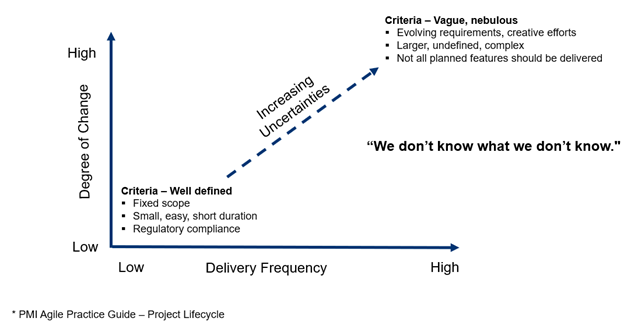
By Fiona Lin I had the honor of presenting at PMI's Virtual Experience Series: PMXPO on 24 March, a global event that attracted attendees from all over the world. My presentation, “Session 205: Redefine the ‘P’ in PMO,” focused on why portfolio, program, and project management as well as process improvement should be the four integral parts of a PMO. During the presentation, I shared proven methodologies and frameworks and provided real examples on how to elevate the value of PMO. Thanks all for the great questions posed. Here are my responses to a few. Question 1: What is your process to decide which methodology to use for a specific project? It really depends on the project. You can flex your approach based on the needs and nature of the project.
If the project has a well-defined scope and has low degrees of change and low delivery frequency, a waterfall approach to map out the deliverable timelines would not hurt. A well-graphed Gantt chart utilizing precedence diagraming (FS, SS, FF for example) to indicate when the deliverables and tasks need to be done can provide teams with clarity. However, when the scope is not well defined and we need to control time and cost, and when we must deal with increasing uncertainties, it will be helpful to introduce scrum to teams. More complex projects will benefit from shorter sprints to start. Building and continuing refining and prioritizing the backlog give the team a clear picture of what needs to be accomplished. Working with teams to set goals for each sprint provides them with clear direction and focus as well. This followed by standups, sprint review/demo and retrospectives help put teams’ minds at ease, allowing them to tackle deliverables chunk by chunk. One of the challenges with teams moving from sprint to sprint is that there is a likelihood of losing sight of the bigger picture – what are we really trying to accomplish as a project? There are many ways that can help overcome this challenge. For example: 1) clearly articulate goals and objectives as well as success metrics and periodically review with teams; 2) establish milestones and proactively identify risks and dependencies and the next bigger steps. Besides what we usually refer to, a predictive (waterfall/traditional) approach and an agile (Scrum, Kanban, etc.) approach, if we are trying to improve a business process, Lean Six Sigma’s DMAIC approach would be most beneficial to follow.
To digest these five phases easier, you can map them to the five process groups under PMI’s predictive approach.
Question 2: You mentioned multiple systems used among users at the beginning; do you have now one centralized system? Which one? When PMO was brought into the organization almost four years ago, we had 5+ tools being used by various functions - Trello, Asana, Smartsheet, Traction, Jira. As you can imagine, this created many challenges. One, there was no centralized platform to house all project information; thus, communication was scattered in different places, making it difficult for teams to collaborate. Second, company data could not be protected with free tools when an enterprise solution was not in place. The immediate need was to evaluate all teams’ needs and wants and consolidate these tools. After careful evaluation, we learned that 80% of the teams shared the same or similar needs. We selected Wrike to be the main tool for business groups and Jira/confluence for technology and product teams. When introducing Wrike to the organization, we developed a change management plan, assembled Deploy Champions composed by individuals representing all core functions, and designed and configured Wrike to meet internal needs before rolling it out. This was followed by a series of group and individual training sessions. The additional functionalities Wrike offer, the intake form, workflow customization and enhanced Board Views, helped elevate the organization of work. At that time, our executive team decided to move away from Traction. Their adoption of the new tool paved the path for our implementation success. Wrike and Jira are two coexisting tools. Being able to use Unito plug-in to perform one way (Wrike to Jira or Jira to Wrike) sync and two-way syncs helps reduce duplicate entries and allow teams to collaborate more smoothly. One example was the executive portfolio view built by pushing epics from Jira into Wrike with one click and a prefix indicating development efforts needed. By aligning the Kanban flow in Jira and Wrike we could have better visibility of both worlds without manual adjustment on the status of each epic. To make this successful, the first step is to understand teams’ needs and create a vision on how to bring the information together. Second, it is important to have someone with the knowledge and expertise on board as Jira does require significant configuration to make it work well. For Program Increment Planning, we installed the Ativo plug-in to Jira so teams can pull features from Jira to the Ativo Program Board for planning. This helps dissolve many spreadsheets and increase the efficiency of planning by having PI Objectives, team capacity allocation for each sprint, dependencies and risks all identified and shared in one central location. If you are still heavily relying on spreadsheets or word documents to keep track of information, there are probably tools out there worth exploring and implementing. Let the tools do the work for you and automate as much as you can so team can focus on more value-add activities. Question 3: What are your recommendations for PMO Managers/Director as to PMO certification? Focus on best practices of how to organize PMOs? Previously we have required project managers to obtain PMP certification within one year of hire. Recently we have made the change to require ACP (Agile Certified Practitioner) to meet our organizational needs better as most of our projects have development and tech elements. It’s very important for our enterprise PMs to not just have a deep understanding of the Agile principles and values but truly internalize them and embrace them in their daily interactions with teams. For process improvement, Lean Six Sigma is a proven methodology with very rich tools to learn and adopt. The process of being certified exposes you to many useful tools: Affinity Diagram, Value-Stream mapping, RCA – Root Cause Analysis (Current Reality Tree, Fishbone Diagram, FMEA, 5 Whys), Pareto. A green belt certification is a good start. It takes a lot of practice to become proficient and know when to apply what tool to solve real business problems. Having a continuous improvement mindset is the first step as it helps you quickly identify opportunities, and having this toolbox helps you structure your approach to solve the problems. For portfolio managers, SAFe’s Lean Portfolio Manager certification not only provides high-level guidance on establishing the portfolio strategy and vision, realizing portfolio vision through epics, but also shares useful tactics on how to set up and manage your portfolio flow. Having teams go through the certification process offers many benefits. It allows them to reflect on their own practice for improvement, gives us a common set of language to communicate, and standardizes our practice for execution consistency. Participating in PMXPO was a great experience, and the entire presentation will be available on demand through the end of January 2023. Visit PMI Virtual Experience Series 2022 for more details. |



Presentation Recap - Change Reaction: The Impact of Change Management on Stakeholders and Project Portfolios
|
By Jill Almaguer I enjoyed the experience of presenting at PMI's Virtual Experience Series: PMXPO on 24 March. My session, Session 210: Change Reaction: The Impact of Change Management on Stakeholders and Project Portfolios, generated many questions in the chat, and I have prepared responses to some of those questions in this blog. 1. Was Covid a RISK or ISSUE or discussed before it became a global pandemic? Within IT, Covid was not discussed very much until we saw cases starting to appear in the Houston, Texas area. Then suddenly, we were asked to work remotely. Of course, our projects had to continue with remote project meetings, training, etc. All of our vendors were also suddenly restricted from traveling or having in person planning or go-live support. Even after a vaccine became widely available, it is difficult to predict when the next surge of patients and subsequent restrictions on hospital visitors will come. Unlike hurricane season or flu season, Covid does not seem to have a season and variants behave differently. Thus, the probability and impact for a risk rating is only an estimate at best. If the risk is realized with another surge, then the same issues of remote work and training will again be felt on projects with our mitigation strategies and lessons learned applied from previous surges. 2. How do you mitigate resistance when you don't have "control" over groups of people? This is very true in the federal government space. The causes of resistance vary widely from individual to individual. First, it is important to find out what kind of “cheese” is most attractive to each stakeholder. Providing the right cheese (i.e., incentive) may help bring the resistant stakeholders along. Providing disincentives (i.e., penalties) is not as favorable to enticing people to adopt a change. When the early adopters have some success with the new change, publicize that success to the late adopters. Use lessons learned from the early adopters’ experience to update the training for the late adopters. The world is a bell-shaped curve and late adopters will always be late or may even leave after the change is implemented. People can only change themselves if they chose to; they cannot be forced or controlled. Provide the change as the best choice to overcome resistance. 3. Is there a scale by which you would measure the Estimated Change Magnitude both for the calculation of project change and environmental change? Unlike the Richter magnitude scale used to measure the strength of earthquakes, there is not a standard scale to measure projects because of the huge variation between numbers of users impacted by the change. Instead, the projects in a portfolio can be ranked by relative change magnitude to identify those projects that have the highest project and environmental change. 4. In terms of estimate change magnitude, what's the scale which number is considered a big change or small? After ranking the projects in a portfolio by the relative change magnitude, then a natural break point may show which projects have high, medium, or low change estimates. 5. What in your experience is the best way to engage resistant people at the beginning of a project? This population is likely to not participate in your workshop or answer your survey at all. Some low-tech techniques include offering lunch or other incentive such as T-shirts or coffee gift cards to attend the workshop. Another method is making participation in the workshop or response to the survey as a development goal for performance evaluation. It is important to ask everyone what risks they anticipate on the project up front and thank them for that input. Then continue to engage them as the project proceeds.
Participating in PMXPO was a great experience, and the entire presentation will be available on demand through the end of January 2023. Visit PMI Virtual Experience Series 2022 for more details. |



