


How to align Operation & Maintenance Teams and Project Teams


| When it comes to mixing O&M teams and capital project teams how can you promote goal alignment and performance focus? In industrial facilities, small capital projects (under $10M) are largely undertaken to address compliance requirements (health, safety or environmental), planned equipment replacement, or plant modifications that will achieve a process improvement or de-bottlenecking. This means Operations or Maintenance are often the project sponsors for small projects. The ChallengeOne of the biggest challenges facing small projects is facilitating productive communication around scope requirements as a project transitions from an ‘identified project’ by Operations & Maintenance (O&M), to an approved project, managed by a project manager or project delivery team. O&M teams are usually under tremendous pressure and time constraints. They appreciate that a project team needs clear scope requirements, but often find it difficult to know just how, or in what format to best communicate.
Align O&M and Project Management Small capital projects are quite different from routine maintenance activities so communication gaps can be a serious problem. Small capital projects:
So what can be done to align project teams and O&M so that everyone achieves their goals? PDRI for Small Industrial Projects
One of the best methods for aligning stakeholders is to take a systematic approach to defining scope. The Project Definition Rating Index (PDRI) is an excellent methodology for facilitating communication around project scope requirements and making sure all stakeholders have a voice. PDRI is a collaborative process that involves all major stakeholders working together to identify gaps in scope. Once these gaps are identified, project teams can take appropriate actions to reduce risk during front end planning. Traditionally PDRI has been viewed as a great process for large and mega projects, but not appropriate for our typical small projects in an industrial facility. PDRI was a lot like using a sledge hammer to drive a tack – overkill! The new PDRI templateLast year, the Construction Industry Institute (CII) published a PDRI template to address the specific scope definition needs of small industrial projects. (They also released a PDRI for Small Infrastructure Projects template in August 2016). We’ve had the pleasure of working with a number of clients to introduce this Small PDRI template and the sessions have shown tremendous results as a way to bridge the gap between the project sponsor (Operations & Maintenance) and the project manager. How does PDRI help bridge the communication gap?The ideal time to conduct a first PDRI session is when a project manager has been assigned, and the project is transitioning from O&M to the project team. Clear definition and communication of what is in and out of scope is critical. A PDRI session can be conducted as part of the project kickoff meeting, and requires no more than two-hours. Of the 41 elements in the PDRI for Small Projects template, we’ve seen the most productive discussions with O&M come from the review of the checklists for these scope elements: 1. Project Objectives Statement This element focuses on ensuring there is a clear understanding of why a project is being performed, and what its value is to the organization. This discussion helps project teams gain clarity on the primary business drivers, especially with reliability-driven projects. 2. Project Strategy & Scope of Work The focus is on development of a scope of work that supports the project objectives. When discussed at the project kickoff, it helps in early identification of all the interface points and coordination efforts that will be required with operations, owner staff, and other projects that are ongoing at the site. 3. Piping & Instrumentation Diagrams (P&IDs)
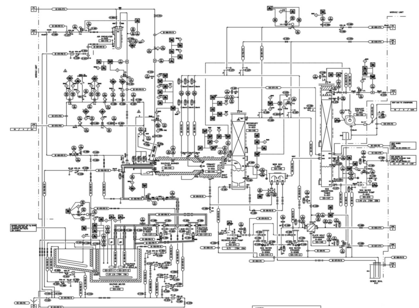
P&ID An open discussion with O&M on the their first-hand experience with the accuracy of existing P&IDs can be very informative for the project team. Accuracy of as-built diagrams is one of the biggest risk areas in industrial renovation and revamp projects. 4. Shutdown/Turnaround Requirements This is often the first discussion the stakeholders have had on the scope of work that can be completed prior to, during, and after any required shutdown/turnaround for the project. A better upfront understanding of the project’s potential impact on operating facilities, and hazardous working conditions for workers helps the project team better develop the project scope. 5. Project Site Assessment Even before site assessment activities have been initiated, operations and maintenance can provide tremendous insight on existing conditions that they know could be an issue. We’ve captured more comments from this element than any other element so far. This discussion goes a long way to eliminating late surprises in the planning process. SummaryIf you’re looking for ways to align communications between Operations & Maintenance and your project teams, PDRI for Small Projects is worth checking out. It offers an opportunity to adopt a mature process for assessing scope definition (20 years of history) using a fit-for-purpose PDRI template for small industrial projects. |

What you don't like about someone is what you like about them.
| Tips for managing a cross-functional team
This sounds very self-conflicted. But it’s not. I’ve found that with a project team of highly skilled people, there’s at least a few people that will *really* bug you. They’ll get under your skin and annoy you in team meetings. The project manager’s first instinct is to “deal around” them. In other words, don’t get them involved important aspects of the project. Leave them out, don’t ask them questions, don’t get their opinions. You’re hoping that maybe they’ll get the message and leave the rest of you alone. This is absolutely the wrong thing to do. You need the pests, you want the pests, the pests are your BEST friends! LOVE THE PESTS! Don’t get annoyed, simply smile and say “thank you!) When these people annoy you and the project team, they’re showing a unique quality that will, most likely, be very useful to everyone. The best way I can think to explain what I mean is by picking a few personalities that stick in my mind. These are my recollections of real people, and there’s a chance they’ll recognize my description of them. That’s OK. They know we’re all friends that worked long and hard together. Here are some of the best and most frustrating team mates I’ve ever worked with ANNOYING TEAM MEMBERS Always Wanting More Detail I must say this is typically considered an engineering oddity. I have it myself. Some of the best engineers are NEVER EVER satisfied with the information they have. This behavior isn’t just restricted to engineers though. But, when I’m typing this, I’m thinking of our reliability / maintainability person. He never had enough detail to calculate reliability numbers or to insure we met our maintainability goals.
Whiner / Complainer These folks will complain about every step in the project, every deviation, every change, everything that’s not what they think it should be. These folks are the first choice to work-around, do without or leave out of any project decision. That would be a big mistake. Here’s a few test cases:
Negotiator These folks want to negotiate every detail in the project. “Can’t we do it differently – everyone does it this way?” “Let’s get the two teams together and work out a solution.” This is *after* it’s all be decided.
THE LIST GOES ON AND ON… We all have a list like this of different personality types we’ve worked with on teams. The key is when the annoy you and everyone on the team -- remember this when you DON’T like them. But sooner or later, this person will help the project a great deal. Embrace the jerks on your projects – they may be your best friends! Please comment with a list of your favorite project jerks! And remember that's what you like them for. MEET ME IN SAN DIEGO NEAR THE PROJECTMANAGEMENT.COM BOOTH. MAKE AN ONLINE / EARLY RESERVATION TO TALK TO ONE OF OUR EXPERTS HERE! |

Healthcare Project Management: Patient Care Project Initiation
| Let's get started ...and get a patient's project initiated! Lacking a standardized approach to initiating a project can lend itself to confusion and a build of unrealistic expectations that is detrimental to the desired outcome of the project. A case of patient care is no different. A formal initiation is needed for a detailed planning, setting of control points and above all getting all the stakeholders on the same page. A patient’s project is initiated with the need and desire to get better or, in some instances, planned visits to a physician’s office for a wellness and preventive health check up. Let's see a few examples
Creating an initial expectation document that includes patient's details such as finings, assessment, plan of care, high-level milestones of lab/physical examination findings, funding sources and constraints, care continuum details, high-level risks and roles and responsibilities of those involved inc are key details that can help set this initiation on track. The nature of project initiation has a significant bearing on the subsequent activities that can follow. The eventual outcome of the patient’s disease management depends on a good understanding of the context in which the project of patient care is initiated. More to follow...so stay tuned! Look forward to meeting you all and talking to you ….will be glad to share my thoughts and clarify your questions on this confluence domain. Meet me at the Global Congress Solutions Center in San Diego (25th – 27th September 2016). Can make it? Find the information on the sessions as well as sign up to ask questions http://congresses.pmi.org/NorthAmerica2016/sponsors/hours-overview |
10 Commandments of Front End Planning
Categories:
Tools,
Best Practices,
Project Planning,
Stakeholder Management,
Teams,
Communications Management
Categories: Tools, Best Practices, Project Planning, Stakeholder Management, Teams, Communications Management
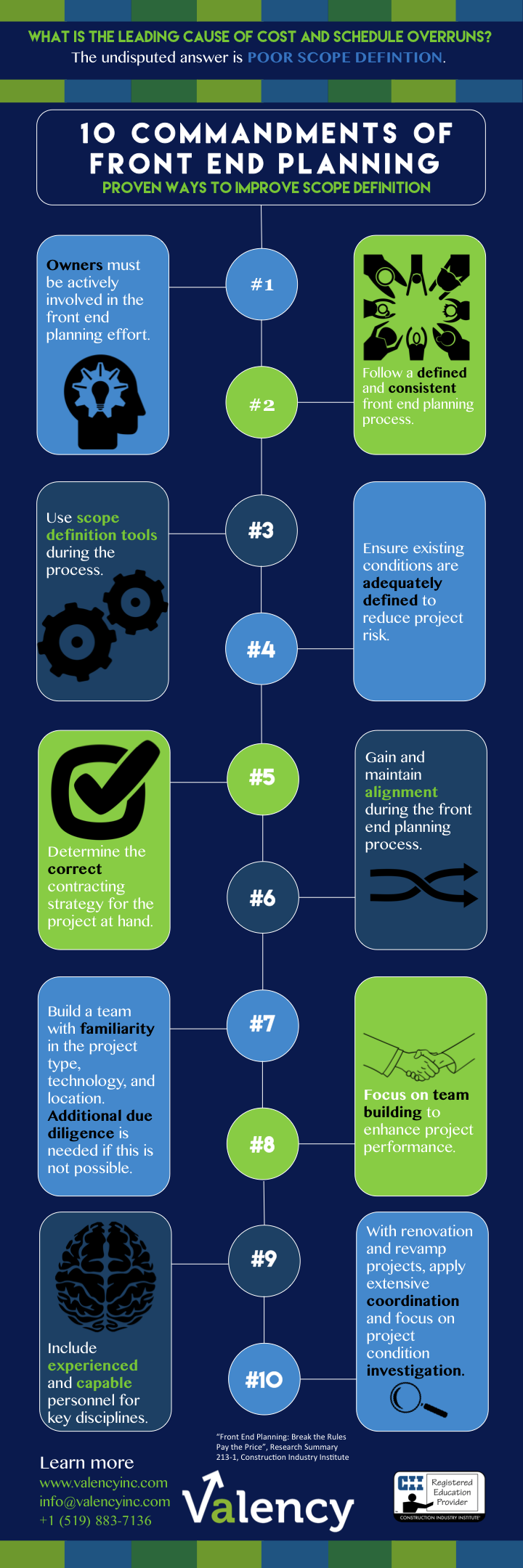
What is the leading cause of capital project cost & schedule overruns?The undisputed answer the world over is poor scope definition. Check out this infographic detailing the 10 commandments of front end planning based on CII’s implementation resource, “Front End Planning – Break the Rules, Pay the Price.” Each of these 10 practices are proven ways to improve scope definition during front end planning.
|
Creating a Vision
| It has been said by many, that if you commit a vision to paper, express it in detail, so that others can see this vision, and then communicate it broadly in some way, it shall become true. Do you believe in that? As most leaders know, the most critical thing about a vision, is that the people following you get it, that they buy into it, and that they feel motivated enough to support and take action on it. How often do companies fail to achieve the goals that they set out? Did they do a good enough job of describing the end point? Was it appealing enough to gain the support required? Were they willing to publicly state that future goal, to show their commitment? The ones who do seem to make greater strides, even if they don’t fully achieve them in the timeframes set out. They tend to work hard to make them happen - to maintain commitments, to save face. So I believe that there is truth to the statement. But I believe there is not only the element of drive for success that occurs - I think also that it tends to increase the belief in what is possible. For companies, it gives their employees an open, positive sense of direction, where fresh ideas might emerge, small steps are taken, and then a much larger leap is made over time. People put more effort into building that action plan, to removing barriers, and to making it happen when they are encouraged to help build it. For projects, the same is true. If your team cannot clearly understand the desired endpoint, see the final outcomes happening (not just by the client but also by influential stakeholders), then the project team will have difficulty aligning, and each person or disciplinary group will tend to work in different directions according to whatever is pictured in their own mind as success. So, in a team environment, you need to start the visioning process, but involve the major players to ensure they've helped establish and visualize that together. An exercise that has been suggested, to facilitate setting a clear vision, is to imagine your perfect day. To describe it in detail, where you might be, how you might feel, what you can see and smell, and more. This may be a bit more difficult with a team - but a healthy exercise to make sure people can come to the same frame of mind before moving forward. So, for today, to set an example, I put business visions, and work aside for just a minute - I’ve written about those before anyways. And I write about a perfect day. Perhaps it will come to be my every day - through efforts of my own, or by chance, or both! (We all know that achieving goals takes work - planning, removing risks and barriers to its realization, and progressive action until complete - but that is for another day…) My perfect day: I wake on my own accord, after a restful, fabulous sleep, snuggled in my cozy bed, with the sun lighting the room. I get up first, while everyone else sleeps in just a bit - a quiet shower, a few stretches, a hot coffee while my mind comes alive. I might read, or browse some news, email, or social posts of interest. My dog curls up beside me to snooze a bit more. It’s a beautiful sunny day out, the air fresh, a light breeze rustling the trees, and it is a good day for walking. When I’ve finished my coffee, I wake the kids, getting them up for their breakfast, their busy school day. They are sleepy, but content, and rise without issue. They eat peacefully, and get their bags ready to go, telling me about what they will be doing today. My husband comes downstairs after his shower - he is nearly ready for his day too. And then it is time for the kids to be off - goodbye! I make some breakfast for my hubby and I, and we chat easily while we eat. What will we do today? I tell him that I plan to work for a few hours, starting with some solid writing and content generation in the morning. Later this afternoon, I will prepare for a few interviews and coaching sessions I have with students and clients later this week. But in between, I will have a light lunch and then walk down by the beach with our dog, or perhaps drive out to the wooded trails - she loves either one. Always running and playing in the sand and surf, or exploring and darting through the trees, scurrying the chipmunks and birds. She’s fun to watch and brings a smile to my face every time. My husband decides to do some work this morning too - he’s not as much to do today, and he’ll come walking with me later. He has plans to make a gourmet meal for dinner, and will go shopping after our walk to get some fresh supplies - a surprise that we’ll all enjoy. I’m thrilled, of course, as I always am when he cooks like this - he enjoys it and it tastes so good! I can’t wait, and when the kids hear about it they’ll want to help out too. It’s great seeing them transform foods in the kitchen - they have such talent, my little smarty pants in school and master chefs at home! I sit back and relish in the progress that we’ve made - we have no hurries, no worries, no stresses to manage now. We’ve paid off the house, our vehicles, and we buy what we need, when we need it. We aren’t wasteful, but having money to spend at our leisure brings a level of comfort and security that was unexpected. We have had a few good years to put us ahead, and work has been consistent - not too heavy, as I prefer, and bringing in enough income that my husband was able to quit his corporate job and shift to helping out with the business. It’s nice that neither of us needs to put in more than a half day on average each day. We choose how we schedule our days and weeks. We choose the work we’d like to take on. It’s brought an ease to our life, and we don’t want for anything, really. Next year, we plan on traveling a bit more, working from afar, giving back a little more too - I’m investigating various volunteer projects overseas. The kids will enjoy seeing some new parts of the world, and it is great experience for them too. Everything’s online and functioning smoothly for work - and besides, I have access to great support staff who take care of the little things, as needed. I know it will be a fabulous way to run our business and live life - at least for a while. But for now, I need to get those few things done, as I mentioned, and I’m done my breakfast. And so my day has begun. Were you able to envision my day too? If you have never attempted to do this, I encourage you to try! It takes a bit of work, but each time you do it, you get better at filling in the gaps...and it really makes you realize the level of effort that should go into setting a vision with your team!
Will you be attending the PMI Global congress in San Diego? You can schedule a face-to-face chat with me in the “Ask An Expert” sessions and meet me in the Solutions Centre (exhibit hall). Book your session here. |


