Support to Develop
by Luis Branco

This blog addresses management-related topics and has three areas of focus: 1. Technical skills; 2. Competencies in the field of interpersonal relations and communication (including personal organization and delegation, leadership, teamwork, conflict resolution, conducting meetings, and negotiation); and 3. Strategy (including diagnosis, strategic guidelines, and implementation).4.Technology
Recent Posts
The Self-Reinforcing Organization
What Should Never Be Optimized Away?
What If Organizing Work Is No Longer Primarily a Human Capability?
Where Does Organizational Wisdom Live?
Organizational Wisdom
Categories
Agile,
Career Development,
Career Development,
Career Development,
Career Development,
Career Development,
Career Development,
Career Development,
Career Development,
Career Development,
Career Development,
Career Development,
Career Development,
Career Development,
Career Development,
Career Development,
Career Development,
Career Development,
Career Development,
Career Development,
Career Development,
Career Development,
Career Development,
Career Development,
Career Development,
Career Development,
Career Development,
Career Development,
Career Development,
Career Development,
Career Development,
Career Development,
Career Development,
Career Development,
Career Development,
Career Development,
Career Development,
Career Development,
Career Development,
Career Development,
Career Development,
Career Development,
Career Development,
Career Development,
Career Development,
Career Development,
Career Development,
Career Development,
Career Development,
Career Development,
Career Development,
Career Development,
Career Development,
Career Development,
Career Development,
Career Development,
Career Development,
Career Development,
Career Development,
Career Development,
Career Development,
Career Development,
Career Development,
Career Development,
Career Development,
Career Development,
Career Development,
Career Development,
Career Development,
Career Development,
Career Development,
Career Development,
Career Development,
Career Development,
Career Development,
Career Development,
Career Development,
Career Development,
Career Development,
Career Development,
Career Development,
Career Development,
Career Development,
Career Development,
Career Development,
Career Development,
Career Development,
Career Development,
Career Development,
Career Development,
Career Development,
Career Development,
Career Development,
Career Development,
Career Development,
Career Development,
Career Development,
Interpersonal Skills,
Interpersonal Skills,
Interpersonal Skills,
Interpersonal Skills,
Interpersonal Skills,
Interpersonal Skills,
Interpersonal Skills,
Interpersonal Skills,
Interpersonal Skills,
Interpersonal Skills,
Interpersonal Skills,
Interpersonal Skills,
Interpersonal Skills,
Interpersonal Skills,
Interpersonal Skills,
Interpersonal Skills,
Interpersonal Skills,
Interpersonal Skills,
Interpersonal Skills,
Interpersonal Skills,
Interpersonal Skills,
Interpersonal Skills,
Interpersonal Skills,
Interpersonal Skills,
Interpersonal Skills,
Interpersonal Skills,
Interpersonal Skills,
Interpersonal Skills,
Interpersonal Skills,
Interpersonal Skills,
Interpersonal Skills,
Interpersonal Skills,
Interpersonal Skills,
Interpersonal Skills,
Interpersonal Skills,
Interpersonal Skills,
Interpersonal Skills,
Interpersonal Skills,
Interpersonal Skills,
Interpersonal Skills,
Interpersonal Skills,
Interpersonal Skills,
Interpersonal Skills,
Interpersonal Skills,
Interpersonal Skills,
Interpersonal Skills,
Interpersonal Skills,
Interpersonal Skills,
Interpersonal Skills,
Interpersonal Skills,
Interpersonal Skills,
Interpersonal Skills,
Interpersonal Skills,
Interpersonal Skills,
Interpersonal Skills,
Interpersonal Skills,
Interpersonal Skills,
Interpersonal Skills,
Interpersonal Skills,
Interpersonal Skills,
Interpersonal Skills,
Interpersonal Skills,
Interpersonal Skills,
Interpersonal Skills,
Interpersonal Skills,
Interpersonal Skills,
Interpersonal Skills,
Interpersonal Skills,
Interpersonal Skills,
Interpersonal Skills,
Interpersonal Skills,
Interpersonal Skills,
Interpersonal Skills,
Interpersonal Skills,
Interpersonal Skills,
Interpersonal Skills,
Interpersonal Skills,
Interpersonal Skills,
Interpersonal Skills,
Interpersonal Skills,
Interpersonal Skills,
Interpersonal Skills,
Interpersonal Skills,
Interpersonal Skills,
Interpersonal Skills,
Interpersonal Skills,
Interpersonal Skills,
Interpersonal Skills,
Interpersonal Skills,
Interpersonal Skills,
Interpersonal Skills,
Interpersonal Skills,
Interpersonal Skills,
Interpersonal Skills,
Interpersonal Skills,
Interpersonal Skills,
Leadership,
Leadership,
Leadership,
Leadership,
Leadership,
Leadership,
Leadership,
Leadership,
Leadership,
Leadership,
Leadership,
Leadership,
Leadership,
Leadership,
Leadership,
Leadership,
Leadership,
Leadership,
Leadership,
Leadership,
Leadership,
Leadership,
Leadership,
Leadership,
Leadership,
Leadership,
Leadership,
Leadership,
Leadership,
Leadership,
Leadership,
Leadership,
Leadership,
Leadership,
Leadership,
Leadership,
Leadership,
Leadership,
Leadership,
Leadership,
Leadership,
Leadership,
Leadership,
Leadership,
Leadership,
Leadership,
Leadership,
Leadership,
Leadership,
Leadership,
Leadership,
Leadership,
Leadership,
Leadership,
Leadership,
Leadership,
Leadership,
Leadership,
Leadership,
Leadership,
Leadership,
Leadership,
Leadership,
Leadership,
Leadership,
Leadership,
Leadership,
Leadership,
Leadership,
Leadership,
Leadership,
Leadership,
Leadership,
Leadership,
Leadership,
Leadership,
Leadership,
Leadership,
Leadership,
Leadership,
Leadership,
Leadership,
Leadership,
Leadership,
Leadership,
Leadership,
Leadership,
Leadership,
Leadership,
Leadership,
Leadership,
Leadership,
Leadership,
Leadership,
Leadership,
Leadership,
Leadership,
Strategy,
Strategy,
Strategy,
Strategy,
Strategy,
Strategy,
Strategy,
Strategy,
Strategy,
Strategy,
Strategy,
Strategy,
Strategy,
Strategy,
Strategy,
Strategy,
Strategy,
Strategy,
Strategy,
Strategy,
Strategy,
Strategy,
Strategy,
Strategy,
Strategy,
Strategy,
Strategy,
Strategy,
Strategy,
Strategy,
Strategy,
Strategy,
Strategy,
Strategy,
Strategy,
Strategy,
Strategy,
Strategy,
Strategy,
Strategy,
Strategy,
Strategy,
Strategy,
Strategy,
Strategy,
Strategy,
Strategy,
Strategy,
Strategy,
Strategy,
Strategy,
Strategy,
Strategy,
Strategy,
Strategy,
Strategy,
Strategy,
Strategy,
Strategy,
Strategy,
Strategy,
Strategy,
Strategy,
Strategy,
Strategy,
Strategy,
Strategy,
Strategy,
Strategy,
Strategy,
Strategy,
Strategy,
Strategy,
Strategy,
Strategy,
Strategy,
Strategy,
Strategy,
Strategy,
Strategy,
Strategy,
Strategy,
Strategy,
Strategy,
Strategy,
Strategy,
Strategy,
Strategy,
Strategy,
Strategy,
Strategy,
Strategy,
Strategy,
Strategy,
Strategy,
Strategy,
Sustainability,
Talent Management,
Talent Management,
Talent Management,
Talent Management,
Talent Management,
Talent Management,
Talent Management,
Talent Management,
Talent Management,
Talent Management,
Talent Management,
Talent Management,
Talent Management,
Talent Management,
Talent Management,
Talent Management,
Talent Management,
Talent Management,
Talent Management,
Talent Management,
Talent Management,
Talent Management,
Talent Management,
Talent Management,
Talent Management,
Talent Management,
Talent Management,
Talent Management,
Talent Management,
Talent Management,
Talent Management,
Talent Management,
Talent Management,
Talent Management,
Talent Management,
Talent Management,
Talent Management,
Talent Management,
Talent Management,
Talent Management,
Talent Management,
Talent Management,
Talent Management,
Talent Management,
Talent Management,
Talent Management,
Talent Management,
Talent Management,
Talent Management,
Talent Management,
Talent Management,
Talent Management,
Talent Management,
Talent Management,
Talent Management,
Talent Management,
Talent Management,
Talent Management,
Talent Management,
Talent Management,
Talent Management,
Talent Management,
Talent Management,
Talent Management,
Talent Management,
Talent Management,
Talent Management,
Talent Management,
Talent Management,
Talent Management,
Talent Management,
Talent Management,
Talent Management,
Talent Management,
Talent Management,
Talent Management,
Talent Management,
Talent Management,
Talent Management,
Talent Management,
Talent Management,
Talent Management,
Talent Management,
Talent Management,
Talent Management,
Talent Management,
Talent Management,
Talent Management,
Talent Management,
Talent Management,
Talent Management,
Talent Management,
Talent Management,
Talent Management,
Talent Management,
Talent Management
Date
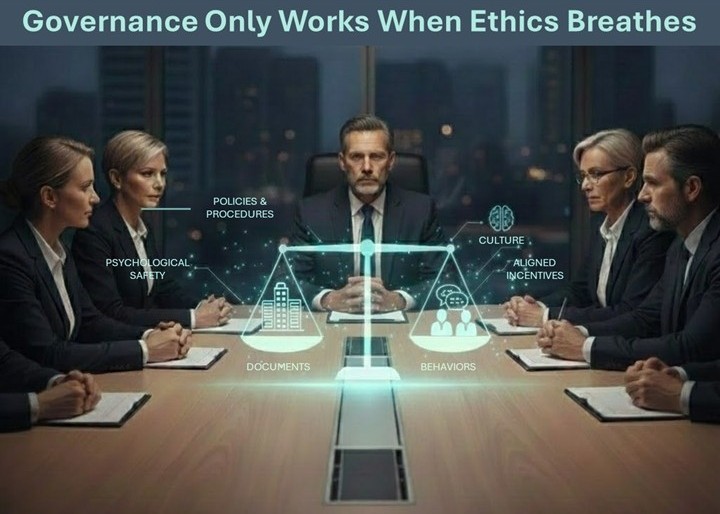
From Structure to a Living Ethical Culture in Modern Organizations
Introduction
Governance and ethics are two inseparable pillars of organizational maturity.
But even the most sophisticated structures - policies, processes, committees, org charts- do not guarantee ethical behavior.
When governance exists on paper but is not lived by people, the risks are predictable:
- Loss of trust,
- Inconsistent decisions,
- Internal conflict,
- Technical and operational failures,
- Reputational damage,
- And in extreme cases, systemic collapse.
In today’s fast-paced, high-pressure, technology-driven environment, effective governance requires more than structure.
It requires ethical behaviors that are internalized, practiced, and protected by culture.
1. Governance Today: Beyond Structure and Compliance
Classic governance references - Cadbury, King, OECD - remain essential foundations.
But modern organizations must go further.
Current global standards, such as:
- ISO 37000 – Governance of Organizations (2021)
- OECD Corporate Governance Principles (2023 revision)
- IFC Corporate Governance Methodology
Highlight that governance is not simply about control.
It is about creating sustainable value, enabling transparency, ensuring accountability, and making decisions grounded in information, ethics, and impact.
Formal Governance vs. Living Governance
- Formal governance defines roles, responsibilities, and the decision-making structure.
- Living governance reflects what truly happens under pressure — behaviors, incentives, motivation, and culture.
Organizational maturity is measured by the distance between the two.
The smaller the gap, the stronger the governance.
2. Ethics: The Energy System That Makes Governance Work
Governance does not function without an ethical foundation.
Ethics is not a document, it is a behavior.
Traditional ethical frameworks continue to be relevant:
- Deontology - doing what is right because it is right.
- Utilitarianism - analyzing impacts and consequences.
- Virtue ethics - character, integrity, prudence.
But the reality of modern organizations introduces additional dimensions:
- Kahneman- fast thinking under pressure leads to errors.
- Thaler & Sunstein - incentives and nudges shape behavior.
- Amy Edmondson - psychological safety is a prerequisite for ethical behavior.
- Jonathan Haidt - moral values differ across people and cultures.
When ethics is lived, not merely defined, it becomes the force that energizes governance.
3. Why Structure Fails: The Gap Between Policy and Practice
Organizations can have impeccable policies and still fail ethically.
The reasons are well known:
- Misaligned incentives,
- Inconsistent leadership,
- Fear, silence, or retaliation culture,
- “we’ve always done it this way” mentality,
- Lack of ethical decision-making models,
- Normalization of small deviations that grow over time.
This gap creates visible consequences:
- Toxic work climate,
- Erratic decisions,
- Favoritism or bias,
- Technical and operational risk,
- Erosion of trust,
- Ethical failures and sometimes fraud.
Governance does not fail in the document.
It fails in the behavior.
4. How to Build a Living Ethical Culture
A strong ethical culture is not accidental, it is intentional and systematic.
A. Create living, practical Codes of Conduct
Grounded in real cases, updated frequently, and easy to apply.
B. Provide continuous ethics training
Workshops, simulations, real-world dilemmas, scenario-based discussions.
C. Use structured decision-making models
These reduce ambiguity and impulsivity:
- PMI Ethical Decision-Making Framework (EDMF)
- RCPCV™ – Collect, Consult, Think, Communicate, Verify
- Regenerative Consciousness Cycle™
- Deontological, utilitarian, and virtue-based analysis
D. Build psychological safety
People must feel safe to raise concerns, challenge assumptions, and report risks.
E. Align incentives with values
Behavior follows incentives — positively or negatively.
F. Create regular spaces for ethical dialogue
Ethics is strengthened through reflection, not enforcement.
5. Learning from Real-World Cases
Wells Fargo - Toxic Incentives
From 2011 to 2016, unrealistic sales targets led employees to open millions of unauthorized accounts.
Incentives rewarded volume but punished integrity.
Leadership ignored early signals.
Lesson: Misaligned incentives can destroy culture and make governance ineffective.
Boeing 737-MAX - Silence Over Safety
Competitive pressure led to rushed decisions, fragmented communication, and concealment of technical risks.
Engineers feared challenging management decisions.
Lesson: Technical governance collapses when transparency and psychological safety are absent.
Volkswagen Dieselgate - Fear and Conformity
To meet impossible emission targets, teams installed fraudulent software.
A culture of fear silenced voices of integrity.
Lesson: When honesty is punished or discouraged, governance becomes a systemic risk factor.
Across all cases, one conclusion stands out:
Governance that ignores culture is doomed, because culture drives real behavior.
6. Measuring Ethical and Governance Maturity
Governance must be measurable, not aspirational.
Key indicators include:
- Compliance Rate
- Ethical Risk Heatmap
- Psychological Safety Index
- ISO 37000 Governance Maturity Model
- Ethics Pulse Surveys
- Stakeholder Trust Index
What is not measured cannot be improved — or protected.
7. Governance and Ethics in the Age of AI
Artificial intelligence introduces new ethical and governance challenges:
- Algorithmic bias,
- Opaque decision pathways,
- Autonomous decisions without human context,
- Misuse of data,
- Shared decision responsibility between humans and AI.
Modern organizations require:
- Ethical AI audits,
- Transparency in algorithms and data use,
- Responsible human–AI collaboration practices,
- Digital ethical literacy,
- Hybrid governance models including AI oversight.
Technology without ethics accelerates risk – not progress.
8. Conclusion - Governance Only Works When Ethics Breathes
True governance maturity arises when:
- Structure (formal governance)
- meets
- Behavior (lived ethics)
and the two reinforce each other daily.
The Unified VMCL™ model illustrates this:
- Vision → ethical purpose
- Mission → disciplined, value-driven action
- Capacity → culture, competence, safety
- Learning → reflection and continuous improvement
Governance is ultimately a commitment to coherence, a living practice, renewed in every decision, every interaction, every choice.
Call to Action for Project Leaders
Ask yourself and your team:
- Are governance structures really being lived?
- Do we have clear decision-making frameworks for ethical dilemmas?
- Does our culture encourage truth, transparency, and accountability?
- Are our incentives aligned with our values?
- Is our use of technology, especially AI, ethically governed?
- Can we measure the alignment between governance and ethics?
Because governance is not what is written — it is what happens when no one is watching. |
Posted on: December 26, 2025 09:03 AM
|
Permalink |
Comments (2)

As we come to the close of another year, I would like to extend my warmest wishes to all members of the ProjectManagement.com community.
This has been a year of significant change, reflection, and learning for our profession.
Across different regions, industries, and roles, project professionals have continued to navigate complexity, adapt to new realities, and deliver value in increasingly dynamic environments.
May the holiday season offer a moment to pause, reconnect, and reflect on the lessons learned throughout the year.
And may the year ahead bring clarity, resilience, and renewed purpose to the work we do together.
Thank you for being part of this global community and for contributing to the ongoing evolution of project management.
Wishing you happy holidays and a strong, meaningful year ahead.
Kind regards,
Luis Abreu Branco |
Posted on: December 23, 2025 04:20 AM
|
Permalink |
Comments (2)
| 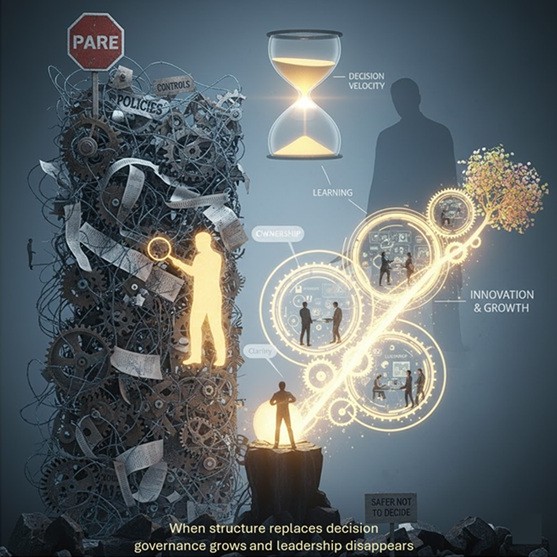
How Organizations Replaced Decision with Structure and What It Cost Them
Introduction: A Silent Organizational Trade-Off
Across modern organizations, a paradox has become impossible to ignore.
We have never had:
- So many governance frameworks,
- So many policies, committees, and controls,
- So many compliance mechanisms,
- So many reporting and oversight structures.
And yet, at the same time:
- Decisions take longer,
- Responsibility is harder to locate,
- Leaders hesitate,
- Execution fragments,
- And accountability dissolves into process.
This is not accidental.
Governance has grown precisely as leadership has retreated.
And in many organizations, structure has quietly replaced decision.
The Comfort of Structure, the Discomfort of Leadership
Leadership is uncomfortable by nature.
It requires:
- Choosing under uncertainty,
- Acting with incomplete information,
- Accepting personal responsibility,
- Risking error,
- And standing visibly behind a decision.
Governance, by contrast, offers safety:
- Shared responsibility,
- Distributed accountability,
- Documented alignment,
- Procedural legitimacy,
- Protection against blame.
Over time, organizations learned an unspoken lesson:
Structure feels safer than leadership.
So they invested heavily in governance, not to enable leadership, but to reduce exposure to it.
How Decision Was Replaced by Structure
The substitution did not happen overnight.
It happened through a series of subtle shifts:
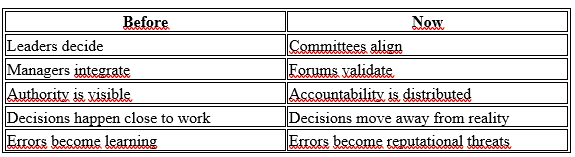
The language changed too:
- From deciding to aligning,
- From leading to facilitating,
- From owning outcomes to following process.
What was lost was not control.
What was lost was ownership.
Why Leadership Shrinks in Governed Systems
Leadership shrinks when systems send one clear signal:
“It is safer not to decide.”
This happens when:
- Mistakes are punished more than indecision,
- Incentives reward compliance over judgment,
- Escalation is safer than resolution,
- Consensus is valued over clarity,
- Leaders are blamed but not empowered.
In such environments, governance does not support leadership.
It crowds it out.
Governance as a Defense Mechanism
In theory, governance exists to:
- Define boundaries,
- Protect stakeholders,
- Ensure accountability,
- Enable sustainable value creation.
In practice, when leadership weakens, governance takes on a different role:
It becomes a defense mechanism.
- Against uncertainty
- Against risk
- Against visibility
- Against responsibility
More rules appear where judgment disappears.
More process appears where trust erodes.
The organization becomes safe, but also slow, reactive, and inward-looking.
The Hidden Costs of Replacing Leadership
The costs are rarely immediate, but they are systemic:
- Decision latency increases
- Innovation slows
- Execution fragments
- Talented leaders disengage or leave
- Risk moves outside the organization
- Learning collapses into reporting
What remains is activity without direction, movement without leadership.
Governance keeps expanding, trying to compensate for the very capability it helped suppress.
Governance Is Not the Enemy, Confusion Is
This is not an argument against governance.
Strong governance is necessary:
- To protect integrity,
- To ensure fairness,
- To prevent abuse,
- To align strategy and execution.
But governance was never meant to replace leadership.
Governance defines the frame.
Leadership exercises judgment within it.
When that distinction collapses, organizations confuse control with competence, and process with purpose.
Reclaiming Leadership Without Abandoning Governance
The way forward is not less governance.
It is clearer leadership.
That requires:
- Restoring decision ownership,
- Making authority explicit,
- Protecting leaders who decide in good faith,
- Treating error as learning, not failure,
- Reconnecting decision with reality.
Leadership is not domination.
It is responsibility for decisions that cannot be deferred.
Conclusion: What Is at Stake
Governance grows when leadership retreats.
But organizations do not thrive on structure alone.
They thrive when:
- Ethics guide behavior,
- Integration enables coherent action,
- And leadership accepts the burden of decision.
Without leadership, governance becomes administration of decline.
With leadership, governance becomes what it was always meant to be:
An enabler of responsible, human judgment in complex systems. |
Posted on: December 22, 2025 10:47 AM
|
Permalink |
Comments (2)
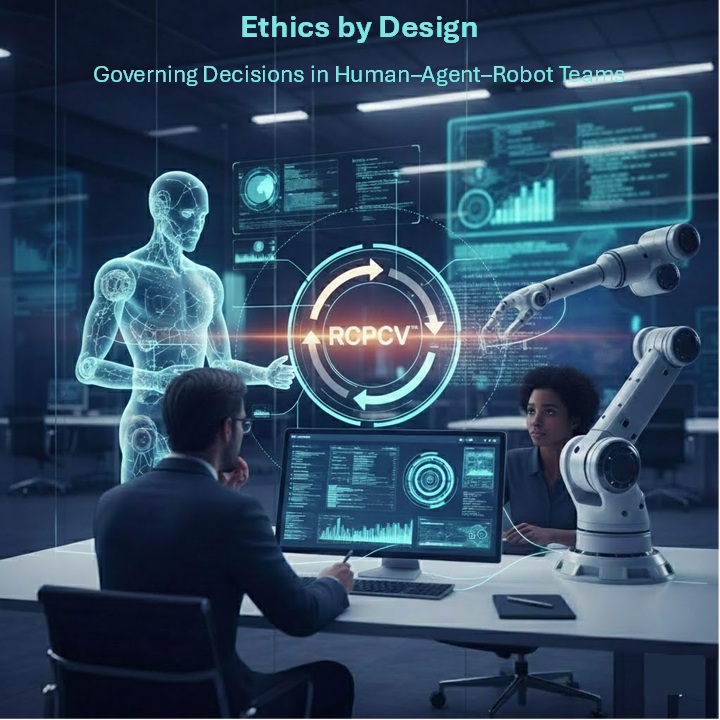
Work is no longer defined solely by human action.
Today, value is created inside hybrid systems where humans, cognitive agents (AI), and robots operate together, sensing, deciding, acting, and learning at different speeds and with different forms of autonomy.
This transformation is not theoretical.
It is already shaping how projects are planned, how decisions are made, and how responsibility is distributed.
And it raises a question most organizations are still avoiding:
If work is now designed as a hybrid system, why is ethics still treated as an afterthought?
1. New Forms of Work Create New Moral Surfaces
When AI and automation become active participants in workflows, ethics does not disappear, it multiplies.
Hybrid Human–Agent–Robot teams introduce:
- Distributed decision-making
- Algorithmic influence without explicit intent
- Actions executed faster than human reflection
- Responsibility spread across humans, agents, and systems
These conditions create what we can call new moral surfaces:
- Points where decisions affect people, trust, safety, fairness, or outcomes, even when no single human consciously chose the result.
The absence of ethical design does not create neutrality.
It creates unmanaged ethical risk.
2. Why Traditional Ethics Approaches Are No Longer Enough
Most professional ethics frameworks were built for a different reality:
- Human-led decisions
- Clear chains of authority
- Linear accountability
- Post-action evaluation
But hybrid work environments are:
- Continuous
- Non-linear
- Distributed
- Accelerated by AI
In this context, ethics cannot remain:
- A static document
- A compliance checklist
- A once-a-year training
- A personal virtue disconnected from system design
Ethics must evolve from guidance to architecture.
3. Ethics as Work Design, Not Compliance
In modern work environments:
- Autonomy without ethical boundaries becomes risk
- Speed without reflection amplifies errors
- Intelligence without accountability erodes trust
That is why ethics must be embedded by design:
- In workflows
- In decision loops
- In AI autonomy boundaries
- In escalation rules
- In feedback and learning cycles
Just as we design for performance, safety, or quality, we must now design for ethical coherence.
Ethics is no longer something we “apply” after decisions.
It is something we build into how decisions happen.
4. Agentic AI Makes Ethical Design Non-Optional
Agentic AI introduces contextual autonomy:
- Systems that interpret intent, anticipate risks, and act within predefined boundaries.
This makes three principles unavoidable:
- Transparency - decisions must be explainable
- Human accountability - responsibility cannot be delegated to algorithms
- Continuous verification - ethical impact must be reviewed, not assumed
Without these principles embedded into work design, organizations risk creating systems that are efficient, but ethically blind.
5. Ethical Operating Loops for Hybrid Teams
In hybrid environments, decisions occur at multiple speeds:
- Human
- Algorithmic
- Automated
This requires ethical operating loops, not ethical slogans.
One example is the RCPCV™ decision cycle:
- Recollect — data, signals, context
- Consult — affected people and AI insights
- Process (Think) — critical reasoning and bias awareness
- Communicate — clarity, intent, responsibility
- Verify — real-world impact and learning
Such loops align naturally with:
- PMI’s 2025 Code of Ethics
- Ethical Decision-Making Frameworks
- NIST AI Risk Management principles
- Emerging regulatory expectations (e.g., EU AI Act)
The key is not the label, it is the design intent:
- Ethics operating at the same speed as work.
6. From Ethics Awareness to Ethics Capability
As project professionals, we certify:
- Methodologies
- Tools
- Delivery competence
- Governance structures
Yet in environments where:
- AI influences decisions
- Automation executes actions
- Teams operate across human–machine boundaries
Ethical maturity becomes a core professional capability, not a personal preference.
Technique without ethics is risk.
Ethics without practice is fragile.
The evolution of work naturally leads to a new question:
- Should ethical capability be treated with the same rigor as technical capability?
This is not a critique.
It is a consequence of structural change.
7. Conclusion — Ethics Is the Missing Infrastructure of Hybrid Work
AI does not eliminate the need for ethics.
It amplifies the consequences of its absence.
The future of work will not be decided by tools alone, but by:
- How responsibility is designed
- How decisions are governed
- How trust is protected
- How learning is embedded
Ethics is no longer a boundary condition.
It is core infrastructure.
AI scales capability.
Ethics scales trust.
And without trust, there is no team, only coordinated risk.
Final Reflection
As work becomes more intelligent, autonomous, and hybrid, one question remains unavoidable:
- Is ethics in your organization a document, or is it designed into how work actually happens?
Note: This reflection is personal and independent, based on my study of PMI’s published materials, and does not represent an official PMI position.
References:
- Project Management Institute. (2025). PMI Code of Ethics and Professional Conduct
- National Institute of Standards and Technology. (2023). AI Risk Management Framework
- European Union. (2025). Artificial Intelligence Act
- Nonaka, I., & Takeuchi, H. (1995). The Knowledge-Creating Company
- Senge, P. (2006). The Fifth Discipline
- Edmondson, A. (1999). Psychological Safety and Learning Behavior
- Meadows, D. (2008). Thinking in Systems
- Laloux, F. (2014). Reinventing Organizations
|
Posted on: December 19, 2025 09:08 AM
|
Permalink |
Comments (1)

Work is changing faster than organizations can process, and often faster than leaders can adapt.
We are entering a new era:
Hybrid Human–Agent–Robot Teams™.
Technology is no longer a tool that sits outside the workflow.
It has become an active member of the team, with presence, agency, and autonomous influence in the flow of value.
So the core question is no longer:
“How do we use AI?”
The real question is:
“How do we work - and lead - when AI has voice, agency, and contextual autonomy inside the team?”
This is the new anatomy of work.
And it demands a new mindset, a new ethical foundation, and a new approach to Work Design.
1. Human–Agent–Robot: The New Anatomy of Work
Modern work blends three complementary forms of intelligence:
Humans -Consciousness, Ethics, Creativity
Intention • Purpose • Meaning • Context • Ethical judgment • Deep collaboration • Cultural sense-making • Relational learning
Cognitive Agents (AI) - Prediction, Analysis, Coordination
Language interpretation • Pattern recognition • Risk anticipation • Real-time decision support • Living documentation • Human–robot orchestration
Robots - Execution, Precision, Cadence
Physical/digital automation • High-frequency reliability • Safety • Repeatability • Elimination of dangerous or exhausting tasks
This is not science fiction.
It is the present becoming visible.
2. New Forms of Work = Intelligent Work Design
The integration of humans, agents, and robots is not a technology problem.
It is a Work Design problem.
New Forms of Work require:
• Flexible and reconfigurable teams
• Adaptive, living workflows
• Short learning cycles
• Dynamic roles (initiator, checker, explainer, arbiter, synthesizer)
• Clear autonomy boundaries for agents and robots
• Intentional alignment rituals
• Psychological safety
• Embedded ethical governance
• Transparency in algorithmic decisions
• Coherent organizational intent
New forms of work do not “happen.”
They are designed and redesigned continuously.
3. Agentic AI: The Nervous System of Modern Teams
AI no longer simply responds to commands.
It acts with contextual autonomy, across three levels:
Level 1 - Assistive
Zero autonomy. AI responds, summarizes, executes.
Level 2 - Collaborative
Partial autonomy. AI suggests, anticipates patterns, identifies tensions and risks.
Level 3 - Contextually Autonomous
AI interprets intent, reads variables, acts within ethical and operational boundaries — always with human fallback.
AI does not replace teams.
AI amplifies teams.
4. Copilots, Chatbots, and NLP - Language Is the New Operating System
With advanced NLP, language becomes the universal interface of collaboration:
• Copilots capture knowledge in real time
• Meetings turn into structured documentation
• Ideas become visual maps
• Misalignment becomes clarity
• Cognitive noise becomes shared understanding
• Humans, agents, and robots connect into one workflow
Language is now the operating system of intelligent collaboration.
5. SECI 2.0™ + AI - Knowledge That Breathes
The SECI 2.0™ model transforms knowledge into an organizational breathing cycle:
Socialization → AI captures signals, tensions, and context
Externalization → copilots turn conversations into structured knowledge
Combination → agents merge data, narratives, and scenarios
Internalization → real-time learning embedded into work itself
Knowledge stops being static documentation.
It becomes living, adaptive, continuous.
6. Cognitive Agility™ - The Essential Competence of Hybrid Work
Hybrid teams require a new mental fluency:
• Pattern recognition
• Clarity amid complexity
• Intentional action
• Rapid adaptation
• Integrating AI without losing humanity
• Balancing data with meaning
• Navigating paradoxes
Cognitive Agility™ is the core muscle of future-ready teams.
7. RCPCV™ — Ethical Decision-Making in Hybrid Environments
Decisions now occur at multiple speeds: human, robotic, and algorithmic.
RCPCV™ ensures moral coherence:
R — Recollect → data, weak signals, perceptions, context
C — Consult → affected people + AI-generated insights
P — Process (Think) → critical reasoning, foresight, bias awareness
C — Communicate → clarity, intent, responsibility
V — Verify → real-world impact, learning, regeneration
AI accelerates.
RCPCV™ protects.
Leadership integrates.
8. The Human Edge - The Competitive Advantage AI Cannot Replace
Even in an AI-augmented world, human capabilities define outcomes:
Purpose • Ethics • Trust • Deep Learning • Psychological Safety • Sensibility • Discernment • Culture • Intention • Impact •Technology amplifies.
Humans direct.
9. The Human–Agent–Robot Ethical Contract
Hybrid teams require a living ethical contract built on:
- Transparency
- Final Human Accountability
- Algorithmic Justification
- Data Protection & Intentional Use
- Continuous Verification
Without an ethical contract, there is no trust.
Without trust, there is no team.
10. Conclusion - Work Has Changed. Leadership Must Change Too.
AI does not replace teams.
It replaces outdated ways of working.
The future belongs to those who can:
Design intelligent work
Integrate humans, agents, and robots
Cultivate the human edge
Learn continuously
Make ethical decisions
Lead with consciousness
Create sustainable, regenerative value
So the central question becomes:
Is AI in your organization just a tool, or already a team member?
References:
Nonaka, I., & Takeuchi, H. (1995). The Knowledge-Creating Company. Oxford University Press.
Senge, P. (2006). The Fifth Discipline. Doubleday.
Siemens, G. (2005). Connectivism: A learning theory for the digital age. IJITDL.
Edmondson, A. (1999). Psychological safety and learning behavior. ASQ.
Jurafsky, D., & Martin, J. (2023). Speech and Language Processing (3rd ed.).
Vaswani, A., et al. (2017). Attention is all you need. NeurIPS.
Valentine, M., & Bernstein, M. (2025). Flash Teams 2.0. MIT Work Design Lab.
Appelo, J. (2025). Human–Robot–Agent.
Meadows, D. (2008). Thinking in Systems. Chelsea Green.
Laloux, F. (2014). Reinventing Organizations. Nelson Parker.
Covey, S. (2006). The Speed of Trust. Free Press.
Project Management Institute. (2025). PMI Code of Ethics.
National Institute of Standards and Technology. (2023). AI Risk Management Framework.
McKinsey & Company. (2024). Future of Work Report.
Boston Consulting Group. (2023). Adaptive Work Design.
European Union. (2025). Artificial Intelligence Act (Regulation (EU). |
Posted on: December 17, 2025 10:42 AM
|
Permalink |
Comments (0)
|
"The industrial revolution was neither industrial nor a revolution - discuss"
- Linda Richman
|




