


The Brain Economy: Why Decision Is the New Scarcity in the Age of AI


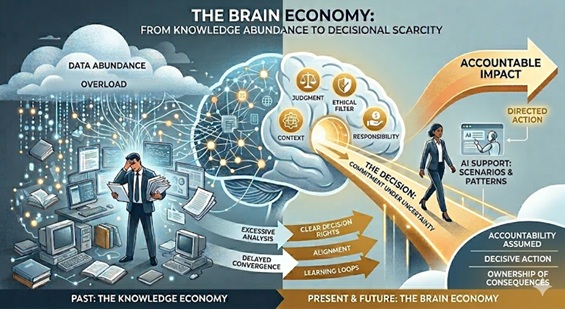 From Knowledge Abundance to Decisional Scarcity For decades, organizations operated under a simple assumption: Knowledge creates advantage. The more you knew, the better you performed. The faster you processed information, the stronger your position. That assumption no longer holds. 1. The Shift No One Can Ignore We are not witnessing a technological upgrade. We are witnessing a structural shift. Today: • Data is abundant • Information is instantly structured • Knowledge is synthesized in seconds • Insights are generated at scale The constraint has moved. Organizations are no longer limited by access to knowledge. They are limited by their ability to decide and act under uncertainty. 2. The End of Knowledge as a Scarce Resource In the Knowledge Economy: • Information was expensive • Expertise was rare • Experience accumulated slowly Competitive advantage was built on accumulation. In the emerging reality: • Knowledge is accessible • Intelligence is distributed • Analysis is accelerated The value of knowledge does not disappear. But its scarcity does. And when scarcity disappears, differentiation erodes. 3. The New Scarcity: Decision If knowledge is no longer scarce, what is? Decision. Not as a logical conclusion. But as: • Commitment • Exposure • Responsibility • Irreversible direction Organizations do not struggle to understand. They struggle to close possibilities and move forward. 4. The Illusion of More Information For years, organizations believed: More data leads to better decisions. In practice, the opposite is increasingly true. More information: • Expands possibilities • Increases complexity • Delays convergence • Diffuses ownership Without a decision architecture, more knowledge does not create clarity. It creates: Decisional entropy. 5. Intelligence Is Now Distributed AI systems, digital platforms, and connected teams have changed the structure of intelligence. It is no longer centralized. It is distributed across systems, tools, and people. This creates a structural tension: • Intelligence expands • Responsibility fragments Insights can be generated anywhere. But accountability cannot be everywhere. And when responsibility is not explicit, decisions weaken. 6. The Human Domain In this context, the human role becomes clearer. Not as processor. Not as analyzer. But as: The agent of decision and responsibility. Humans define: • What matters • What is acceptable • What risk is taken • What direction is chosen AI can suggest, simulate, and optimize. But it cannot: Assume consequences. This boundary is not technical. It is ethical and organizational. 7. From Knowledge Economy to Brain Economy We are entering the Brain Economy. In this economy: • Value is not created by what is known • Value is created by how decisions are made The differentiator shifts to: • Quality of judgment • Clarity of responsibility • Speed of commitment • Coherence of execution Organizations that succeed are not those that know more. They are those that: Decide better under real conditions. 8. The Cost of Not Deciding One of the most persistent illusions is that delaying a decision preserves flexibility. It does not. It produces: • Drift • Fragmentation • Hidden consequences • Loss of direction Not deciding is not neutral. It is a decision without ownership. And over time, unmade decisions accumulate into real, often negative, impact. 9. The Emerging Requirement To operate in the Brain Economy, organizations must evolve. Not only in tools. Not only in processes. But in decision capacity. This requires: • Explicit decision ownership • Clarity of trade-offs • Tolerance for uncertainty • Mechanisms for alignment • Learning loops based on outcomes It also requires a shift in how leaders are developed. Executive education can no longer focus primarily on transferring knowledge. It must evolve toward: • Training judgment • Strengthening accountability • Developing the capacity to decide under uncertainty • Building the courage to act and assume consequences Because in this context, knowing is no longer the constraint. Deciding is. 10. Final Insight The transition we are witnessing is not about technology. It is about responsibility. Knowledge explains the world. Decision shapes it. And in a context where knowledge is abundant, the real question is no longer: What do we know? It becomes: What are we willing to decide and to be accountable for? Closing Statement In the Knowledge Economy, advantage came from knowing more. In the Brain Economy, advantage comes from deciding better. Not faster. Not louder. But with clarity, commitment, and accountability. Because in the end: Value is not created by what is understood. It is created by what is decided and carried through. Call to Action In your most recent decisions: Did AI help you reduce uncertainty, or did it simply help you delay commitment? |
Posted on: April 20, 2026 03:06 AM
| Permalink |
Comments (3)
The Responsible Decision Cycle
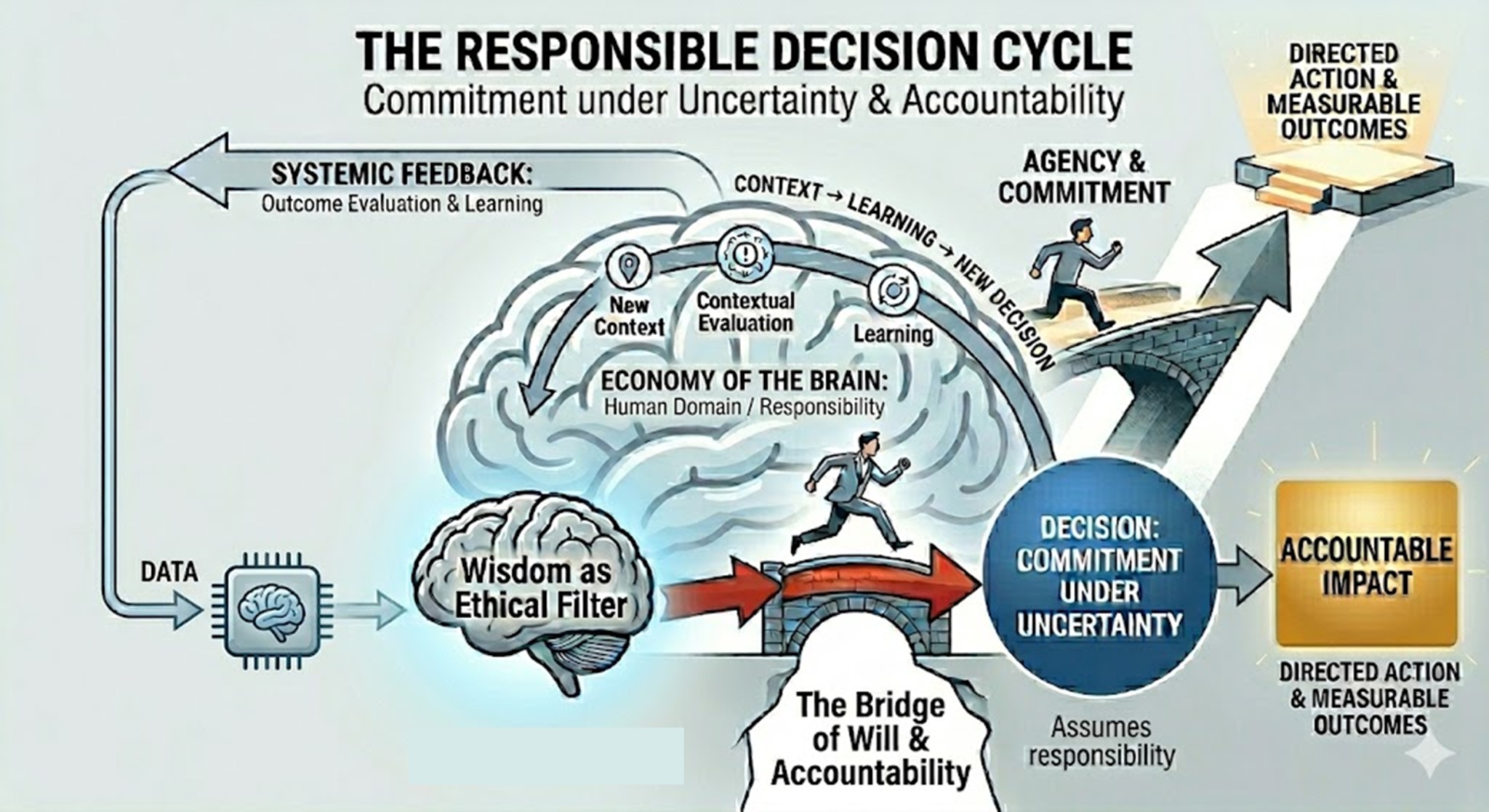 From Knowledge to Accountable Impact For decades, organizations optimized how they process information. Today, the real challenge is different:
The Responsible Decision Cycle is not an extension of DIKW. It is a structural shift:
The DIKW model explains how knowledge is structured. It does not explain how organizations act. Between wisdom and action, there is a critical space:
They fail because they delay or dilute decisions. Not deciding does not preserve neutrality. It produces consequences. In that sense, omission is not the absence of decision. It is a form of decision with delayed and often unaccounted impact. 2. Decision as Commitment, Not Computation In an AI-augmented environment:
Why? Because decision is not calculation. It is commitment under uncertainty. It requires:
That boundary defines the human domain. 3. The Architecture of the Responsible Decision Cycle The Responsible Decision Cycle operates as a closed loop: A. Knowledge (Interpreted) Information is processed, structured, and contextualized. This layer is increasingly augmented by AI. B. Wisdom (Ethical Filter) Knowledge is evaluated through experience, judgment, and values. This is where meaning is constructed. C. Decision (Commitment under Uncertainty) A choice is made. Alternatives are reduced. Risk is accepted. Direction is made explicit. This is the point of no neutrality. 4. Accountable Impact The decision produces measurable and coordinated outcomes. Value is created when action aligns across the system. Accountability is not theoretical. It is validated through impact. 5. Systemic Feedback (Learning)
It is a signal. It informs the recalibration of judgment, the refinement of the ethical filter, and the adjustment of future decisions. This feeds the next cycle. 4. From Linear Thinking to Living Systems Traditional models are linear:
5. The Role of AI in the Cycle AI plays a critical role but within clear boundaries. It enhances:
It increases the number of plausible options. Without a decision cycle, this does not lead to clarity. It leads to decisional entropy.
The risk is:
In modern organizations, scarcity has shifted. We no longer lack:
Over time, unmade decisions accumulate into systemic consequences. This is not inefficiency. It is decisional entropy. 7. Governance as Decision Architecture If decision is the critical layer, governance must evolve. Governance is no longer:
The goal is decisions that the system can commit to and execute coherently. 8. The Human Position in the Brain Economy We are entering the Brain Economy. In this context:
It is how we decide and what we are willing to stand behind. Human value concentrates in three dimensions:
The Responsible Decision Cycle resolves a limitation that has existed for decades. DIKW explains how we know. This model explains:
Closing StatementKnowledge without decision is potential. Decision without accountability is risk. Accountability without alignment is fragmentation. Alignment without learning is repetition. Not deciding is not neutral. It is a decision without ownership. Only when these elements operate together does an organization evolve. Progress does not happen when we know more. It happens when we decide, align, learn and are willing to be accountable for the impact. |
Posted on: April 17, 2026 11:17 AM
| Permalink |
Comments (0)
The Decisional Chasm
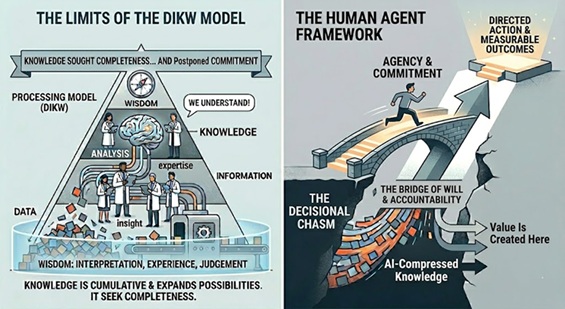 The Leap from Wisdom to DecisionIn the DIKW model, wisdom is often presented as the highest stage of understanding. It represents experience, judgment, and the ability to interpret complex situations. But there is a fundamental question that remains unanswered:
Movement does. The missing transitionIn theory, wisdom should naturally lead to action. In practice, it rarely does. Between knowing what should be done and actually doing it, there is a gap. This gap is not informational. It is decisional. Organizations frequently accumulate insight, analysis, and expertise, yet remain unable to move forward. Not because they lack knowledge, but because they lack commitment to a choice. Decision is not a continuation of knowledgeA common misconception is that decision is simply the next step after knowledge. It is not. Decision is a different category altogether. Knowledge is cumulative. Decision is selective. Knowledge expands possibilities. Decision reduces them. Knowledge seeks completeness. Decision accepts incompleteness. This is why more knowledge does not necessarily lead to better decisions. At some point, it increases hesitation. The role of agencyWhat separates wisdom from decision is not more analysis. It is agency. Decision requires the willingness to:
It is a human one. It is where intention becomes commitment. The weight of consequenceEvery decision creates direction. But it also creates exposure. Once a choice is made:
Not because it is complex, but because it is irreversible in its effects. Wisdom can remain abstract. Decision cannot. The illusion of better timingMany organizations delay decisions under the assumption that more information will reduce risk. Sometimes it does. Often, it does not. In fast-moving environments, the pursuit of perfect clarity becomes a defensive mechanism. A way to postpone commitment. A way to avoid exposure to consequence. Over time, this creates a subtle but damaging pattern:
It is not deciding at all. From analysis to commitmentThe transition from wisdom to decision is not a smooth progression. It is a shift. From: Understanding → Positioning Possibility → Choice Analysis → Commitment This is the point where leadership becomes visible. Not in the ability to interpret reality, but in the willingness to shape it. Why this matters nowIn an AI-enabled environment, knowledge is increasingly accessible. Analysis is faster. Alternatives are easier to generate. But this does not eliminate the need for decision. It amplifies it. Because more options create more complexity, and more complexity requires clearer commitment. The abundance of insight increases the demand for judgment. The real differentiatorWhat distinguishes high-performing organizations is not how much they know. It is how effectively they decide. Not just the quality of their analysis, but the clarity of their choices and the ownership of their consequences. What comes nextIf the limitation of DIKW is that it ends at wisdom, and if the critical gap lies in the transition to decision, then the next step is clear. We need a model that integrates: Knowledge, decision, accountable impact, and learning. A model that does not stop at understanding, but continues into action and consequence. A model that makes responsibility explicit. That model is what we will explore next. |
Posted on: April 15, 2026 07:41 AM
| Permalink |
Comments (0)
The Limits of the DIKW Model
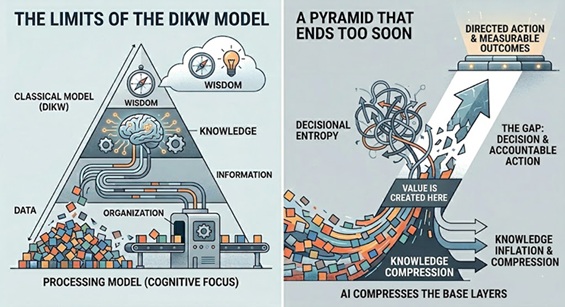 For decades, the DIKW model — Data, Information, Knowledge, Wisdom — has served as a compass for organizations and managers. Its logic is simple:
Competitive advantage lay in knowing more, interpreting better, and accumulating experience over time. But that context has changed.
The problem is no longer access to knowledge. A pyramid that ends too soon The DIKW model has a structural limitation. It ends at wisdom. But in organizational reality, wisdom is not the end of the process. It is merely the point before that which truly creates value. Between understanding and transformation, there is a critical step that the model does not explain: Decision. DIKW is a model of processing. Organizations require a model of commitment and action. Knowing is not deciding In the classical interpretation, wisdom is often understood as applied knowledge. But applying is not the same as deciding. Decision implies commitment. It implies:
It is an act of will and responsibility. Wisdom can explain the world. Decision defines what we do with it. The compression of knowledge Today, AI systems can:
The human differential shifts to where technology cannot fully act: The risk of consequence. The problem is not a lack of analysis For a long time, it was assumed that more data would lead to better decisions. In practice, what many organizations face today is not a shortage of information. It is a different phenomenon: The dilution of responsibility.
It is decisional entropy. The missing point DIKW describes well how the cognitive system organizes the world. But it does not explain how an organization commits to it. Between wisdom and action, there is a space inhabited by:
It is in this space that value is created. A silent shift We are witnessing a structural change. Scarcity is no longer informational. It has become decisional. There is no lack of data. There is no lack of knowledge. There is a lack of capacity to make decisions with clarity and accountability. What comes next If the DIKW model ends at wisdom, then something is incomplete. The question is no longer just: How do we know? The question becomes: How do we decide and how do we own the consequences? Wisdom without decision is erudition without impact. For knowledge to generate value, a new layer is required. One that transforms knowledge into direction and information into accountable action. It is from this gap that the need for a new model emerges. |
Posted on: April 13, 2026 07:43 AM
| Permalink |
Comments (2)
Cognitive Tension Orchestration™
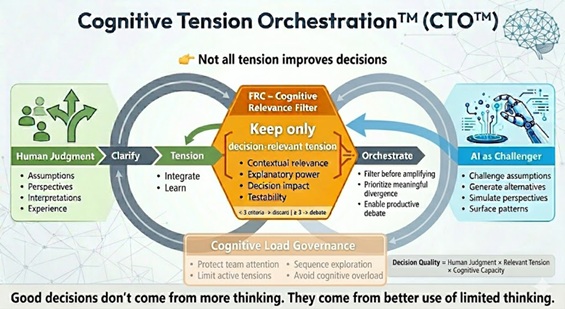 Why Better Decisions Don’t Come from More Thinking 1. The Illusion of Better ThinkingMost organizations believe that better decisions come from:
In practice, it often produces the opposite:
It is unstructured thinking under cognitive constraints. 2. The Hidden Problem: Decision Quality Is a Cognitive SystemEvery decision operates under three constraints:
As Daniel Kahneman demonstrated, we are systematically biased. And as Amy Edmondson observed, teams often suppress disagreement even when they claim to value it. The result: We don’t fail because we don’t think. We fail because we don’t govern how we think. 3. The Missing Layer: Structured Cognitive TensionHigh-quality decisions require something uncomfortable: Cognitive tension Not conflict. Not noise. But structured divergence between:
The problem is lack of orchestration. 4. Introducing Cognitive Tension Orchestration™ (CTO)Cognitive Tension Orchestration™ is a framework designed to: Generate, filter, and integrate cognitive tension Under real-world cognitive limits With ai as a structured challenger Its purpose is simple: Improve decision quality without delegating judgment 5. The Core MechanismAt its core, CTO™ operates through a structured loop: Clarify → Tension → Filter → Orchestrate → Integrate → Learn 5.1 ClarifyMake assumptions visible
5.2 Tension (AI-enabled)Introduce structured challenge
It expands the space of thinking. 5.3 Filter – The Critical StepNot all tension improves decisions. This is where most teams fail. The Cognitive Relevance Filter (FRC) ensures only meaningful tension is explored:
5.4 OrchestrateTurn tension into productive dialogue
5.5 IntegrateSynthesize before deciding
5.6 LearnClose the loop
6. The Often-Ignored Constraint: Cognitive CapacityEven relevant tension has a cost. Thinking consumes energy. Attention is finite. This introduces a second critical layer: Cognitive Load Governance
More thinking ≠ better thinking 7. The Decision FormulaAt a structural level: Decision Quality = Human Judgment × Relevant Tension × Cognitive Capacity If any of these collapse, decision quality collapses. 8. Real-World Example 1Strategic Investment Decision A leadership team evaluates entering a new market. Typical approach
Fast alignment Hidden risks ignored CTO™ approach Clarify “We assume demand will scale quickly.” Tension (AI)
Not a safer decision. A more conscious decision. 9. Real-World Example 2Project Risk Review A project team reviews risks in a complex delivery. Typical outcome
Tension (AI)
Risk management becomes decision-shaping, not documentation. 10. Integration with RCPCV™In the RCPCV™ decision cycle: Recolher → Consultar → Pensar/Decidir → Comunicar → Verificar CTO™ operates inside Pensar: Structuring how thinking happens before the decision This transforms:
11. What This ChangesThis is not a framework about AI. It is about: Decision quality under constraint It changes four things:
12. Final InsightGood decisions don’t come from more thinking. They come from: Better use of limited thinking Structured tension Conscious integration And ultimately: Human responsibility for the final choice Closing LineDo not automate judgment. Orchestrate thinking. Decide consciously. |
Posted on: April 10, 2026 09:30 AM
| Permalink |
Comments (1)


