


I have an electronic copy of the PMBOK® 7th edition, so from time to time I open it up to check on something. Recently, I’ve been looking at different ways to forecast as we’ve got some work on that needs to be planned out.
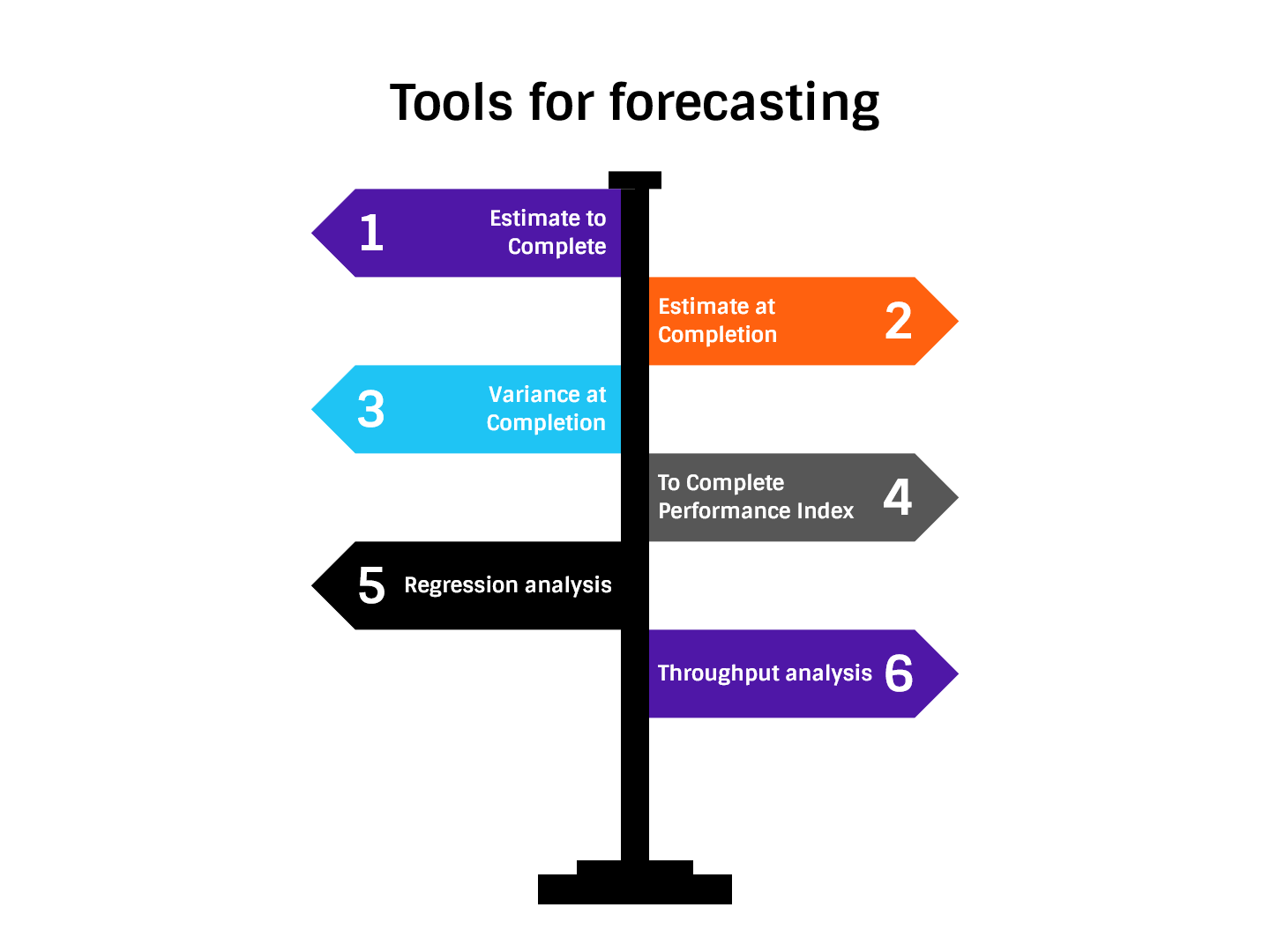
There are 6 quantitative forecasting options called out in the Guide. These are as follows.
Estimate to complete (ETC)
This is top of the list and the one I personally use the most often. It works even if you are not in a full, compliant, earned value management environment. The risk here is that we assume past performance is indicative of future performance, and honestly, why wouldn’t you? Unless you know something is definitely going to change measurable performance, you would assume that work is going to continue at broadly the same rate. Just jot that down as an assumption so it’s transparent to everyone.
Estimate at completion (EAC)
For me, this goes hand in hand with ETC. It’s calculated by taking the actuals and adding the ETC, so again, while it comes under the umbrella of earned value acronyms, it’s completely accessible to those who don’t work in EV setting.
Variance at completion (VAC)
As forecasting tools go, this gives interesting data. It’s the measure that shows the amount of forecasted budget over or under at the end of the project, and it’s one most project sponsors will be interested in: “Will we have any cash left to do anything else when we’re finished?”
To-complete performance index (TCPI)
I have never had the opportunity (or reason) to use this forecasting metric. Perfect for those of you working with earned value day in, day out, it’s the cost performance required to meet whatever management target you’ve set for the work. It’s a ratio, so I think it is less meaningful to execs who are used to see tangible numbers of days or money.
Regression analysis
Now more and more tools are introducing AI features, it is possible to access regression analysis more easily. Perhaps you’ve got access to an AI-powered tool that will crunch these numbers for your automatically, removing the need for statistical knowledge.
The output allows you to predict performance going forward based on what has happened in the past, so it’s arguably more grounded than other guesstimates!
Throughput analysis
The final forecasting technique mentioned is throughput analysis. This looks at the number of items completed in a fixed time, so it’s useful for teams measuring features completed, velocity and story points. You can compare the output to those of other teams, although I’d be wary about comparing teams unless they work on very similar products or services. It wouldn’t be fair to judge a team on their throughput when dealing with very complex features against the performance of a team that has higher throughput but lower complexity.
However, the team can compare its performance against itself: that would be a worthwhile exercise. Ideally, you’d want to see that the learnings from retros have been fully incorporated and, more importantly, that the changes have actually made a difference.
Which of these are most used for your project forecasting? Let us know in the comments below!


 Community Champion

