

Contingency isn’t spare money: How to use it properly
Categories:
contingency
Categories: contingency


 Contingency can cause tension in projects. After all, if you’ve got it, why not spend it? Although before you can spend it, you have to work out who can approve the contingency… Common mistakesContingency does exist to manage uncertainty. You can’t know what is going to happen on every project, so it’s worth having some money tucked away for a rainy day fund.Sometimes I see project managers treating contingency as a buffer for poor planning. If a project holds contingency but can’t explain what it is protecting against, the money quickly becomes vulnerable to being reallocated or misused – no sponsor wants money sitting around that could be used for other capex investments or projects, especially when the team can’t justify why they need to hang on to it. The second issue is that if you haven't done your planning correctly, it can sometimes feel easy to just eat into the contingency because it's there. And that’s not correct. If your estimates were off, it’s better to own that, and look at creative scheduling options before you dip into the emergency fund. Another thing that can sometimes be a problem is project managers or their teams spending contingency quietly, because then it avoids having to do an escalation. If you have to escalate a problem, you have to talk about it and share solutions, including what the costs might be. But that can lead to an awkward conversation that you might want to avoid! Using up a bit of contingency to get rid of a problem can seem like a good idea in the moment. However, longer term, it's not a good idea to get into the habit of spending under the radar to avoid conflict or a difficult conversation, not least because it makes it hard to understand the true cost of the project and how good the estimates were at the beginning. A better way to manage contingencyA good way to manage contingency. Is to think about how you can link it to risk events. Consider what activities might cause risks, raise a risk about those things, and then consider how you can create a mitigation plan that means you're identifying things that contingency can be spent on – the items that will help you manage through risk. You also need to track the drawdown transparently in a way that helps you evidence how it has been spent and why it was spent. Spending contingency needs authorization, and at the beginning of the project you should have worked out who can give you the permission to go ahead and use some of that money. Great news if it is you! If not though (and probably it won’t be) you should get clarity as soon as possible so you work out the process for when you need to use it. That forms the first part of your contingency tracker. Make sure that you have separate lines in your budget to account for how and when contingency is spent. So if you ever need to justify what decisions were made you can go back and show people what was done and why. Sponsors feel more secure knowing the money was used in a controlled way, rather than as a sticky plaster. Used well, contingency strengthens trust because it shows you anticipated there would be problems and managed thoughtfully around them in advance. Compare that to spending it in a less controlled way – it can make the project budget feel suspiciously fake and weaken the project’s financial credibility. |
Posted on: August 04, 2026 12:00 AM
| Permalink |
Comments (0)
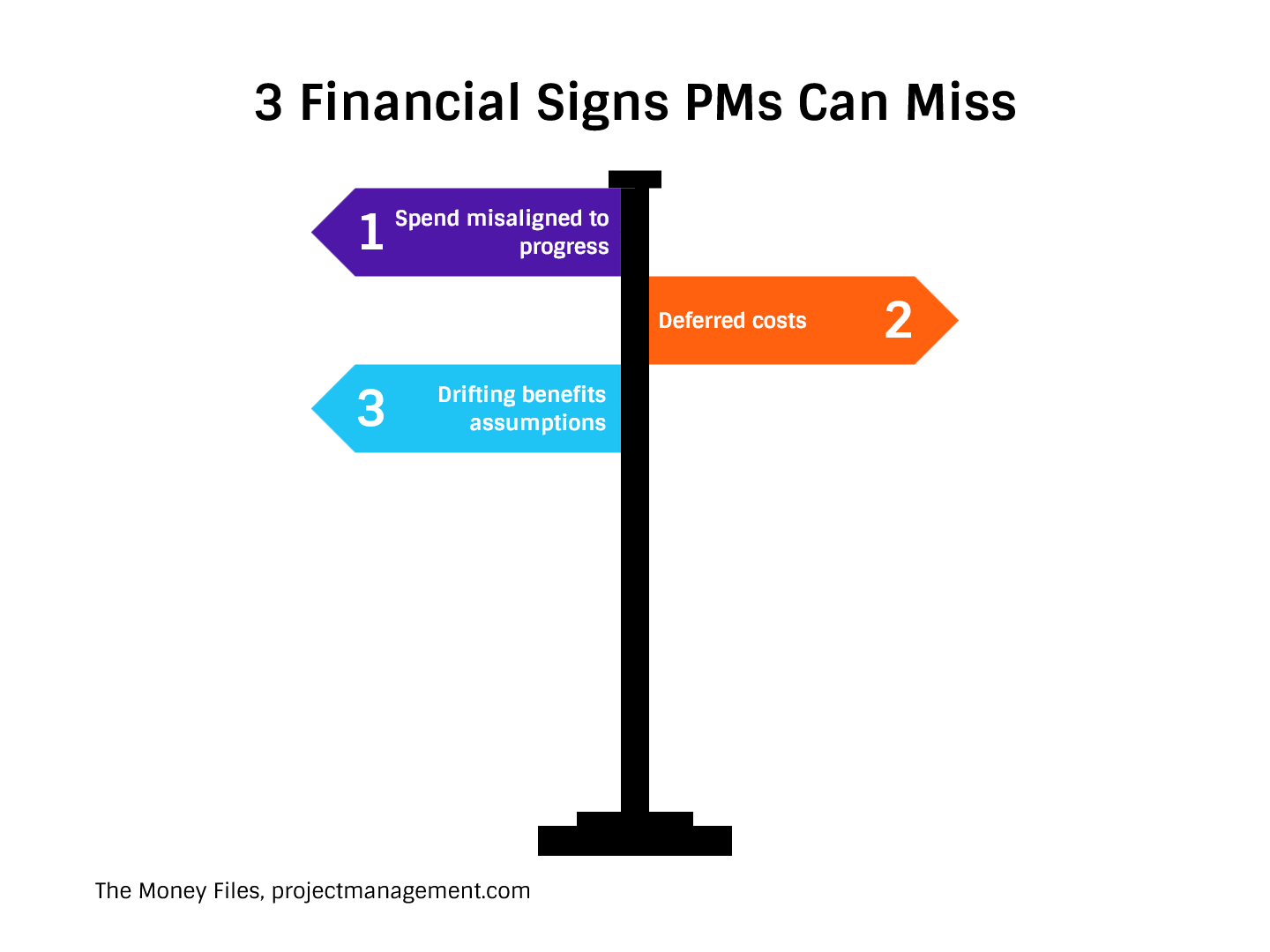
3 Financial signs PMs often miss
Green is good, right? But a project that is on budget can still be in trouble, even if all the signs are pointing to a Green RAG status. Let’s look at some early warning indicators beyond headline budget, which are sometimes financial signals that project managers miss.
|
 Hidden financial risks
Posted on: July 27, 2026 12:00 AM
| Permalink |
Comments (2)
What’s next for project managers? Emerging roles to watch
Categories:
Career Development
Categories: Career Development
| PM roles are diversifying, don’t you think? I’m friends with technical leads, delivery managers, implementation managers, and people with all kinds of job titles. You might know people with the title of delivery lead, or value manager. Transformation manager or portfolio integrator, systems integrator, things like that. And that’s a good thing, if you’re in the market for a new role but I can imagine that it also creates anxiety – what does it mean for us if we stick with ‘project manager’ as a job title?
|
 Why roles are fragmenting
Posted on: July 15, 2026 12:00 AM
| Permalink |
Comments (4)
Green isn’t just for infrastructure: Sustainability in digital and change projects
Categories:
Social Impact
Categories: Social Impact
When we talk about sustainability in projects, the conversation often jumps straight to physical outputs: buildings, infrastructure, manufacturing, or environmental mitigation plans. Which is great if you are working on that kind of project, because it makes sense. Those impacts are visible and measurable. But it also creates a blind spot, because the flip side of those conversations is that we don’t need to consider sustainability for the many other types of projects. Many digital, organisational change, and transformation projects are assumed to be ‘sustainability neutral’ simply because they don’t produce something tangible, and if you’ve ready anything about the power and water requirements needed for server farms, you’ll know that isn’t the case. The impact might be less obvious, but it’s still there. As project managers, we are well placed to influence those outcomes, and bring to people’s attention that there are perhaps hidden impacts that we can do something about. For example, digital projects often drive increased data storage, additional processing, new ways of working, or changes in travel, energy use, and consumption. Ignoring those effects doesn’t make them disappear. So we should be documenting and recording them, even if the end result is that you aren’t actively tracking the carbon impact. You can at least include them in the business case as non-tangible benefits (or costs) to highlight the fact that they should be considered as part of the decision-making process. One challenge is that while many organisations now have sustainability teams, ESG leads, or environmental experts, getting their time for smaller, less ‘construction’ projects can be difficult. In some organisations I know, the team is one person, and they can’t support every project. So it’s for the project manager to shape where they can, and we can! Where project managers can influence sustainabilityProject managers influence sustainability in several practical, low-key ways, often without realising it (see, you’re doing it already!). Procurement is one obvious lever. Choices about suppliers, contract lengths, hosting arrangements, and service models all have sustainability implications. I know we don’t have the power to choose suppliers directly most of the time, but you can write sustainability requirements into statements of work or ask the procurement team to include them in tenders. Ask the questions – you never know what impact that might have. The other easy area to get people talking is in data usage. Digital and change projects frequently increase data volumes, reporting demands, or system integrations, API calls and so on. Which uses power and often all this is done in the cloud these days, so we don’t even have the physical aspect of adding a server to the server room on site to see the impact. We can ask questions about what data is genuinely needed, how long it should be retained, and whether duplication can be avoided. Are we migrating data from the old system ‘just because’ or are we following retention policies? If there aren’t retention policies for this type of data, should there be? (Then we can delete some of it.) What PMOs can do differentlyPMOs have a valuable role in normalising sustainability thinking without turning it into bureaucracy, because that isn’t going to land well. One effective approach is to ask sustainability-related questions early. Put some prompts in the kick off template, or in the business case slide deck template. Asking the right questions helps teams think through what the choices might be at a point where they still have choices. It’s the thinking – and getting teams to do the thinking – that is the valuable bit. PMOs can share examples of good practice too. Highlighting how teams have made sensible, proportionate choices helps sustainability feel achievable rather than abstract, so ask teams, get some case studies and share what is working in your organisation. Sustainability as a cumulative effectSustainability isn’t going to hinge on one dramatic decision. Across the company, it’s going to be impacted by lots of small choices made across projects and programmes, and BAU work. We don’t need to be sustainability experts to make a difference, which is lucky! We’re seeing sustainability threads woven through the PMBOK® Guide and other project management literature now, and I’m sure the same thing is happening in other disciplines. By being curious, asking thoughtful questions, and considering the longer-term effects of change, we can become everyday influencers shaping more sustainable outcomes, often without adding any extra process at all. Have you got any examples of sustainability at work that you can share? Let us know in the comments below! |
Posted on: July 02, 2026 12:00 AM
| Permalink |
Comments (3)
Making social impact part of everyday delivery
Categories:
social impact
Categories: social impact
Social impact isn’t limited to special projects. As we’re seeing on this website, there’s more chatter around social impact and social returns. And this isn’t just for the projects where social impact is the main goal. Every project shapes people’s experiences, and people are social, right? We should be factoring in the impact on our environment and communities for every project. As project managers already influence outcomes through the work we do facilitating other people’s work, there is quite a lot of scope for us to help shape our projects.  Where social impact shows upSocial impact is about:
There are risk trade-offs too. Which risk management activity has the highest negative social impact? Do we want to do that, or is there an alternative trade-off that might give us better results. Finally, think about change design. What’s the impact of the change you are implementing, and how can that be structured for the best possible outcome? How to do itLet’s think about some practical ways you can embed ‘impact thinking’ in your normal project team meetings and conversations with stakeholders. I think it starts with asking different questions at initiation, being more pointed with discussions to bring social impact to top of mind for people. You can be the person who asks everyone to consider unintended consequences. You can make social impact visible in reporting, even if it’s just to say that you haven’t worked out what it will be for this project yet. The role of the PMOI do think there is a role for the PMO to play in helping project teams set themselves up to take social impact into account in a reasonable way. For example, if you’re in an PMO role, you could standardise some good questions so they are added into project initiation and kick off calls, or you could put a section in the PID template that talks about what’s important to consider. Proportionality matters here. Not every project needs a detailed social impact assessment, and trying to apply the same level of rigour to every piece of work will only create resistance – or teams filling in paperwork for bureaucracy’s sake. The PMO’s role is to help teams think and make it easy for them. Providing prompts, examples, and lightweight guidance gives teams permission to engage with social impact in a way that makes sense for the scale and risk of their work. If this is becoming a tick-box approach, then you’re doing it wrong! Social impact should be something the team can actively support and understand, not some documentation requirement to get through the next gate review. So what does it mean in practice? I think it’s about including purpose as part of professional judgement, and understanding that small decisions matter. You can be sensitive to the impact your project is having without having to do big assessments or lots of analysis. Just be aware of what’s changing for people and see what opportunities you have to make that experience of change as positive as possible in as many ways as possible. What do you do to encourage social impact on your projects? Let me know in the comments! |
Posted on: June 23, 2026 12:00 AM
| Permalink |
Comments (7)


