


Capital projects in London


|
When Livingstone was leader of the Greater London Council, it was at a time when there was no central government funding for capital investment projects. He also said that during the Thatcher years a law was passed making it a requirement for local councils to have their capital spending plans reviewed by the government before they took place, so even if there was the money, there was no chance that investment projects would happen. Implementing the congestion chargeLivingstone was elected Mayor of London in 2000 and one of his first challenges was to deal with the transport situation in the capital. He said he did not want to be remembered as the Mayor for failed projects, so when he decided to implement the congestion charge, he brought in a team of people with the experience of delivering this type of thing.
Livingtone bemoaned the situation in the UK that meant he had to look elsewhere for the skills required. His overseas team settled in London and took on the job of implementing the congestion charge. Every fortnight they had "an incredibly bruising meeting where all the assumptions were tested,” he said. “That level of real scrutiny, done that scale, meant that it worked perfectly from day one, with one small glitch." That small glitch was that there were not enough people available to answer the phone when drivers called in with questions. The congestion charge project was launched as expected and the introduction was remarkably smooth. Londoners now have come to accept paying to drive into the capital, and we even manage to keep up to date when the boundaries of the congestion zone change or the rates are amended. Working with the Olympics team
Livingstone was Mayor during the time that the UK was preparing a bid for London to host the Olympics. Despite having no interest in sport himself, Livingstone saw the Olympics as a great opportunity for the city, because the country would be forced to invest in a transport infrastructure in East London. He also knew that the government would want to run the construction if they were successful in winning the bid. "Every change you make magnifies the cost," Livingstone said. The Olympic site is virtually complete and £800 million under budget at the moment. He said that he had to bring in an American woman to plan it and an Australian man to build it. It’s unfortunately, he said, that we don’t have enough of those types of skills in the UK. It’s the legacy of not having investment projects during the 80’s, as we didn’t learn the lessons from capital initiatives. "What worries me so much at the moment,” he said, “in response to the economic downturn, is cancelling all the investment projects and losing another generation of competent project managers." |
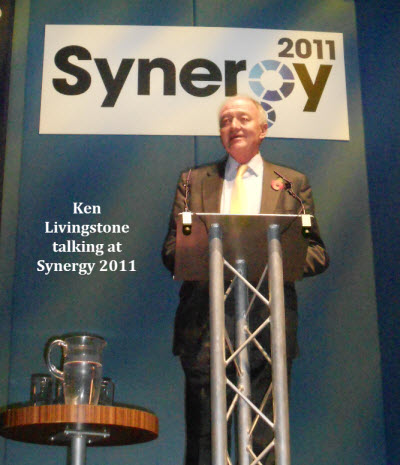 Ken Livingstone, former Mayor of London, spoke at Synergy 2011 last month in London for International Project Management Day.
What is Payback Period?
Carnival of Project Management #37
Categories:
carnival
Categories: carnival
|
New to the Carnival? It's a round up of interesting blog posts related to project management, to help you discover some new blogs and some new ideas. It runs every two months and is hosted by a number of project management blogs including A Girl's Guide to Project Management and PMTips.net. So, without further ado, here are this edition's great articles. Rodney Maley presents Effective To Do Lists posted at Life-fficient. This is an interesting take on to do lists. Ken Lange presents Grace Under Pressure posted at Kenneth Lange. CA presents On estimating project tasks posted at Project Management - The Kanban Way, saying, "The post talks about issues surrounding project task estimation process". CA also submitted two other articles: Speed up project delivery using Critical Chain and Making Kanban work in matrix organizations. Useful reading if you are working with Kanban. VyrtuNet presents Did I Do That? How to Stop “The Urkel Effect” posted at P3 Peak Performance, saying, "The Urkel Effect is a syndrome that often consumes certain key members of a project team, whereas they are often seen spinning seamlessly in multiple directions until they disappear altogether. One begins to observe this phenomenon when certain delusional symptoms appear, often followed by the words “Did I do that?” So where do project team members turn for relief? Enter the Project Manager equipped with just the right tool. Thokk the Project Troll has come up with a solution; a cure that may finally put an end to this awful spectacle." Bob Lieberman presents The Can-Do Attitude posted at Cultivating Creativity – Developing Leaders for the Creative Economy. Rich Maltzman, PMP presents The Elephant and the Swiss Army Knife posted at Earth PM. Rich is one of the authors of the book that won the Cleland prize for literature at PMI's awards last month, for his book, Green PM, so his views are certainly worth reading. Anna Farmery presents 6 Tips to Reinvent your Next Meeting posted at The Engaging Brand. I particularly like the tip to decide before the meeting, not during it. Stuart Arthur presents The Challenges of Project Management posted at Stuart Arthur. This is an interesting discussion of the differences between Scrum and PRINCE2, although I dispute the idea that a PRINCE2 approach can't be at least a bit Agile. There's also another link worth sharing, particularly if you are looking for the best value for an investment in your PMO. Find The Best is a human-curated website with a section for project management software tools, so if you are working out where to spend your 2012 budget, you could find that useful. The good thing about being human-curated is that it's more intelligent than a search tool that just crawls the internet automatically. |
 Welcome to the October/November 2011 edition of the Carnival of Project Management, hosted this time here at Gantthead.
You don’t need money to be successful
Categories:
events
Categories: events
|
Obviously someone has to come up with the new ideas, and the world is a better place because of it. “There are costs to having a culture arranged around innovation,” Gladwell said. For example, the very culture that makes some companies good at innovating makes it hard to do the things critical for implementation, like working collaboratively and being able to operationalise innovations for public use and commercial value. Followers and borrowers take ideas from others, put them together and put them into practice. This is a different kind of innovation. Don’t be first: follow “The first clear advantage of this way of innovation is that it gives an organisation the chance to properly understand a technology before it implements it,” he said. Gladwell talked (without notes or slides) about the early social networking site, Friendster. MySpace took those ideas and developed them, but Facebook was the one that really took off. Facebook had the chance to see how the technology was evolving. Friendster was too narrow: it was only used for dating. MySpace had a focus on music. Facebook could see that people wanted something wider than that.”Nobody could have known at the beginning that this was the way the technology was going to end up,” Gladwell added. Adapt the ideas of others Tweaking other people’s ideas is positive, he said. “It’s a reminder of the fact that innovation at its best is a mass phenomenon and not an elite phenomenon. Google tweaked online search. “There’s a real benefit to being the one who toys with the idea and gets to be the one who perfects it,” he said. Money constrains creativity Finally, he addressed the topic of cost. “Invention requires a great amount of resources but implementation – the kind of culture that thrives on something real – doesn’t need resources at all.” Gladwell said that creativity and daring are the key criteria for taking an idea and making it into a practical, implementable idea. Too much money, he said, compromises creativity and can be stifling. “We privilege resources far too much and we privilege being first far too much,” he said. So there you have it. Follow, borrow, tweak. And don’t let money be a barrier to creativity. |
 Malcolm Gladwell, author of Blink and Outliers, was the keynote speaker at the PMI Global Congress North America in Dallas last month. He spoke about the paradox of successful cultures. “They’re followers and borrowers, not leaders and inventors,” he said. In other words, our culture puts a premium on new things but actually in organisational cultures, new isn’t the best thing. There is value to be had in letting someone else try out the ideas first and then you adapting and blending them to produce something of real value. In short, you don’t need a lot of money and a huge research team to be a business success story.
Budgeting for the Olympics
|
The construction involved all the civil engineering works required to get that area of London ready for the Games. It required building:
The Games team had committed to developing the site in a sustainable way, which was a challenge in itself given the level of contamination in the soil and the risk of unexploded ordnance left over from the Blitz. Needless to say, that area of London wasn’t used for much before the Games bid was won, and a strong focus of the construction work has been on making sure the investment leaves a legacy for the surrounding area. Louise said that there were 3 things that kept them on track. 1. Rigorous change control Louise said that clear reporting at project level was one thing that helped keep the whole project on track. Changes were discussed at this level. When the project started, there were 60-80 people in the project reporting meetings, which took about 4 hours. A strong change control process, with everyone involved, meant that the cost of change could be properly analysed. 2. Rigorous management of cost Cost management involved a firm hand establishing and monitoring contingency spending. Contingency levels were based on quantitative risk analysis (QRA) with an 80% level of confidence. All contingency budgets were identified as part of a project or programme; there were no general buckets of money to be drawn from at a later date. Cost management was particularly important because “the media were fierce in the early days.” Louise said that there was wide belief that the UK in general was not capable of managing the civil engineering works required to put on an Olympic and Paralympic Games. The media were on the look out for examples of where projects were overspent or poorly managed. 3. Performance management The most important area for controlling cost seemed to be performance management. There were several techniques in use at the Olympic Park for performance management, including project reporting meetings. The reports did not just focus on historical information. While this was useful, it doesn’t help the stakeholders see what could happen in the future, so Louise and her team put some effort into preparing monthly trend reports. “It’s given us good visibility and enhanced reporting at government level,” she said. She also showed us an example of the monthly report, which was a graphic representation of the project’s performance that fitted on piece of A3 paper. Variance analysis, total cost and key milestones were also reported. Once stakeholders felt that the project was being well managed and the performance was on track, the number of people attending these meetings dropped significantly. In the end, the project reporting meetings were only attended by 6 people, and they took about an hour. The main message from Louise was that earned value analysis was a critical part of keeping the project on track. “It was absolutely essential to undertake earned value analysis on all areas of the programme,” she said. “There was a surprising amount of resistance.” She knew it was the only way to generate trust and belief in the schedule and the project’s achievements. In order to overcome the resistance, the project team undertook a training and education initiative to bring everyone on board with EVA. It all paid off. The construction work is already complete, and it finished a year before the Games begin. This gives the other Olympics teams plenty of time to make the final preparations before Olympics fever descends on London in 2012. |
 At
At 

