


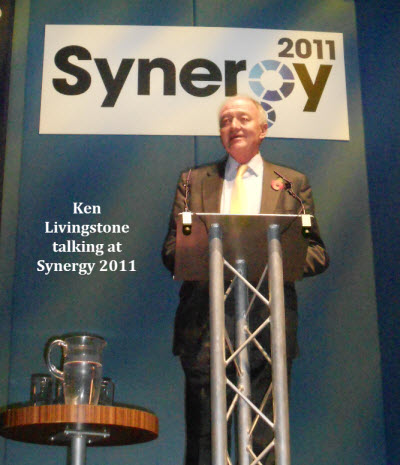
 Ken Livingstone, former Mayor of London, spoke at Synergy 2011 last month in London for International Project Management Day.
He talked about the U.K.'s reputation and ability to carry out large construction and civil engineering projects. He used the example of the Thames Barrier project which was instigated after a number of floods in the 1950s. The project was finally approved to go ahead in the 1970s. It was finally completed a few weeks before some more floods. He explained that there was no incentive or structure put in place for the project to be finished and no one built into the plans any proposals for on time delivery. In fact, it was in the project team’s interest that the project as long as possible. No wonder that the project went eight times over budget.
"What is so wrong about public services in Britain that we just can't complete these projects?" he said.
When Livingstone was leader of the Greater London Council, it was at a time when there was no central government funding for capital investment projects. He also said that during the Thatcher years a law was passed making it a requirement for local councils to have their capital spending plans reviewed by the government before they took place, so even if there was the money, there was no chance that investment projects would happen.
Implementing the congestion charge
Livingstone was elected Mayor of London in 2000 and one of his first challenges was to deal with the transport situation in the capital. He said he did not want to be remembered as the Mayor for failed projects, so when he decided to implement the congestion charge, he brought in a team of people with the experience of delivering this type of thing.
Livingtone bemoaned the situation in the UK that meant he had to look elsewhere for the skills required.
TFL is the largest transport organisation in the world. No one in the organisation from bus drivers to managers had a record of successful management at the time, he said. The Jubilee line extension was the only thing the city had managed to pull off and that had hardly been a roaring success. He told us that 27 of the top 30 executives were pensioned off in his first year as Mayor. "Far too many people simply accept what they are told by people who have a vested interest in the outcome."
His overseas team settled in London and took on the job of implementing the congestion charge. Every fortnight they had "an incredibly bruising meeting where all the assumptions were tested,” he said. “That level of real scrutiny, done that scale, meant that it worked perfectly from day one, with one small glitch." That small glitch was that there were not enough people available to answer the phone when drivers called in with questions. The congestion charge project was launched as expected and the introduction was remarkably smooth. Londoners now have come to accept paying to drive into the capital, and we even manage to keep up to date when the boundaries of the congestion zone change or the rates are amended.
Working with the Olympics team
Livingstone was Mayor during the time that the UK was preparing a bid for London to host the Olympics. Despite having no interest in sport himself, Livingstone saw the Olympics as a great opportunity for the city, because the country would be forced to invest in a transport infrastructure in East London. He also knew that the government would want to run the construction if they were successful in winning the bid.
Luckily (or unluckily, depending on which side you are on), no one in the senior civil services thought London had a credible chance of winning the bid for the Olympics. The way Livingstone tells the story, this meant that the Olympics team had the opportunity to structure the contract in a way that reduced central government involvement and allowed the office of the Mayor a significant say in how the investment projects were run. The projects could go ahead under that contract without needing to be substantially changed.
"Every change you make magnifies the cost," Livingstone said. The Olympic site is virtually complete and £800 million under budget at the moment. He said that he had to bring in an American woman to plan it and an Australian man to build it. It’s unfortunately, he said, that we don’t have enough of those types of skills in the UK. It’s the legacy of not having investment projects during the 80’s, as we didn’t learn the lessons from capital initiatives. "What worries me so much at the moment,” he said, “in response to the economic downturn, is cancelling all the investment projects and losing another generation of competent project managers."



