


Salaries, benefits and the training outlook for 2011


|
Training budgets cut
Salaries static
As well as looking at salary movements, the survey gathered data on salary amounts. The mode salary for project practitioners in the public sector is £30k to £40k: 36% of respondents fit in here. In the private sector the mode salary is the £40k to 350k band. BenefitsPart of a remuneration package is benefits: cycle hire scheme, childcare vouchers, season ticket loan, pension and so on. If you get these, consider yourself luck: 52% of employees reported that they receive no benefits. The full 36-page Arras People Project Management Benchmark Report 2011 is available on line here. |
 Arras People
Book review: Make Every Second Count
Categories:
books
Categories: books
|
What...do you do that's routine and could be turned into a standard operating procedure?... Don't engage in time-consuming problem-solving when there's a recipe that could be followed more easily and more productively. If you had to make a pie, for instance, why would you perform chemical analysis of other pies to determine the compounds in the crust when you could just look it up in a cookbook? Yet people do the equivalent every day. What a waste!
In my writing job, I have recently started to use checklists for software reviews. The list gives me a standard procedure for testing project management tools, and a framework for writing up the findings. It took a little while to develop, but I can't tell you the relief I felt when I wrote up the first review with my new checklist. It was so much easier, and I wasn't reinventing the wheel each time I tried out a new application. What standard operating procedures do you have for your projects? Is there a process for starting up new projects? A directory of document templates? Standard processes don't just make things easier, they also ensure that you don't miss out steps along the way. If you want to be super-productive, there are certain things you will have to give up. These things include the extravagant luxuries of sloth, inertia, laziness, and wasted idle time. If you are not willing to give these up, you must seriously question whether being more productive is truly a priority in your life. If it isn't, that's okay. However, don't complain that there's "never enough time," and then watch 25 hours of sports on TV each weekend. Well said. |
 "You can solve most of your time-related problems - not enough time, to much to do, deadlines too short, bosses too demanding, not getting to your own priorities - simply by increasing the one resource you can control: you," says Robert R. Bly. His book, Make Every Second Count: Time Management Tips and Techniques for More Success with Less Stress, is aimed at busy people. I wonder how many busy people have time to read books about time management.
 Bly also points out that most of us can't control when we feel most productive. For me, it is the post-lunch slot that is the worst. Don't expect much out of me if I am at my desk between 1pm and 3pm. Meetings are fine, but left to my own devices I know it takes an extra kick to move things along. Bly's own tip for getting that extra bit of usefulness out of yourself is to find something that can revitalise you during the day. For him, it is washing his hair (his office has a private bathroom). For you, it could be coffee with a colleague in the afternoon, making calls, or getting out of the building for a walk.
Big Hairy Projects: Managing project scope
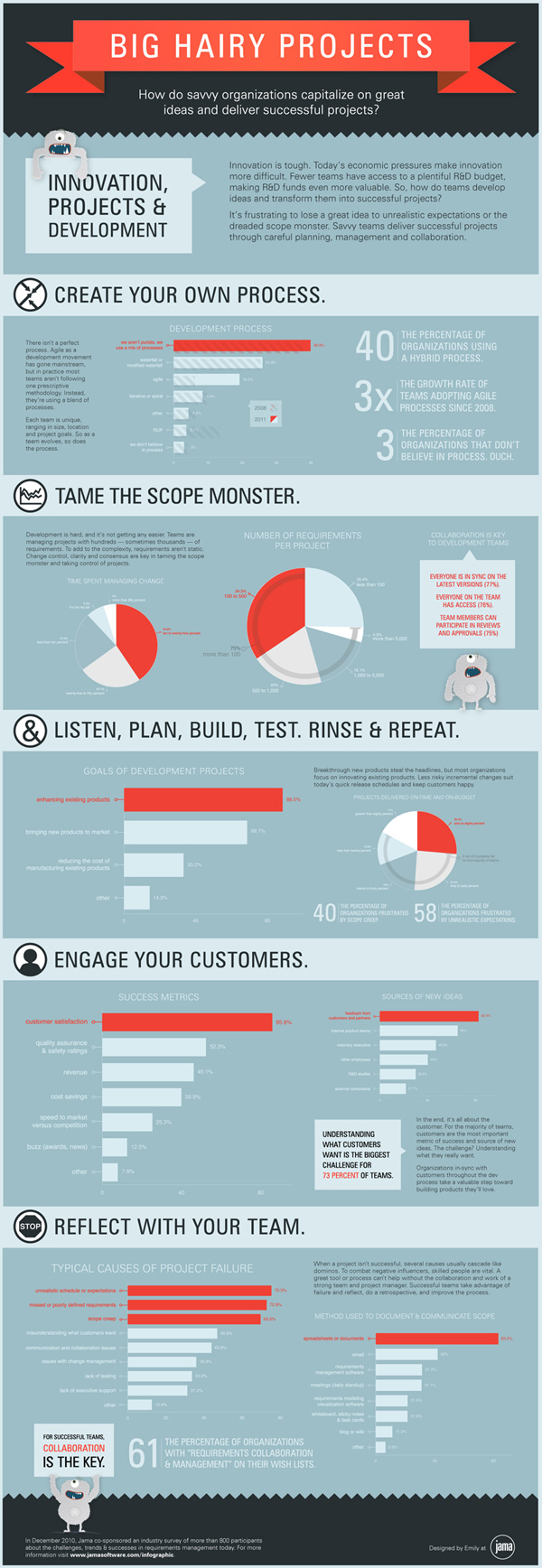
| Don't you just hate change control? According to a study by Jama Software, 75% of project managers are managing projects with at least 100 requirements. One in five are managing projects with over 1,000 requirements. That's a big project. Here's a summary of the rest of their findings:
Download the full report here. |
Ask the Experts: Change Management with Jeff Furman
|
Hello Jeff. You used to run a large change management system. Can you tell me a bit about that? Hi Elizabeth, yes, I worked for a brokerage firm in Manhattan with an IT department of more than 1,000 developers (including a wing in London!) Brokerage people will all tell you there is a “life and death” urgency when putting in any software change in their environment, because the traders often need to take advantage of the new code ASAP to process their trades accurately (especially when the changes involve new laws or regulations!) Our company chose a vendor change management solution which could handle the diverse programming needs of hundreds of projects simultaneously, 24x7, and I managed the team that supported and customized this system through several successful upgrades. That sounds like a complex system, but one that worked really well. Why was the system so good? A good IT change management system must be user-friendly, as well as customizable and flexible, meaning it can support many types of software changes. But of paramount importance in a financial environment, it also must be VERY SAFE! To that end, our system included a very powerful “automated back-out capability,” meaning that if a bug was discovered after a change went in, all components associated with the developer’s change package could be backed out in one shot, and automatically replaced by the previous versions. This meant that if a developer got a call at 3:00 am EST to pull a change package containing 50 components before trading opened in London the next morning (where it was already 8:00 am) he or she wouldn’t have to scramble to find the 50 prior versions -- the system did that for them.
Two things – 1. Earlier training– What really got people to embrace the system was a customized training program we put together, highlighting the benefits to the developers. If I had a time machine, I would go back and initiate this training even sooner, because as you say about social media tools in your book, “If they can see the benefits, they will use the tool.” There was ironically resistance to change to the change management system, and it didn’t catch on until the training. 2. Customizations with future vendor upgrades in mind -- We had a very large customer-base, and so there were a great many enhancement requests over the years. Beware that the more you customize your system, the more it will take to maintain it over future upgrades, which often need to be done fast. If I could take a second ride on the time-machine, I would push back harder against some of the customizations we agreed to. What are your tips for good change management? Stay strong about change approval rights: PMs often tell me they work with systems where people can bypass their process. This undercuts the system and in some cases the success of their projects. A tip for avoiding this problem is to get advance agreement from senior stakeholders that changes will go in ONLY if they are authorized by the designated approvers. This works because it puts them on record for agreeing this is for the greater good of the company, which also gives them buy-in to the rules being enforced. Customer-focused training: Bring in a good class early, customize it to your environment, and emphasize the biggest benefits to the people who will be using it. Don’t reinvent this particular wheel: There are many mature vendor products out there, with powerful and robust features, and I would advise that it’s probably a mistake for any company nowadays to try to build their own change control system from scratch. Thanks, Jeff! Jeff's book, The Project Management Answer Book, is published by Management Concepts (Vienna, Virginia) |
 Jeff Furman, PMP and author of
  Was there anything you would do differently if you worked on something like that again?
 3 Items to include in project reports
|
Here's the transcription of this video: Hello! My name is Elizabeth Harrin from the Gantthead blog, The Money Files. And today, I want to talk a bit about some items to include in your project reports, specifically three items to do with financial information. Firstly, you should include in your project reports a reminder to the stakeholders about the overall budget available to your project and that should be both in terms of what’s available to you this financial year, your budget for this financial period, and your budget overall for the duration of the project or program if it goes into multiple financial periods. Say for example, it’s a program that has a long duration. You should also include how much you’ve actually spent to date, so your running total. What is it that you’ve incurred cost-wise so far on this particular project? Finally, you should include a comment around whether or not you are actually on track and that means: Will you hit the budget within tolerance at the time the project closes? So you might think of this as estimate to complete. You can talk about whether or not you’re on track in your project report with a red, amber or green status or you could specifically mention estimate to complete or you could talk about a percentage of spend. Or you could just a commentary that says: “We feel that with the current progress of the project we will be on track to complete within the current budget.” Your finance department or your project stakeholder might want some more justification behind that. But if they do, they can always ask. So those are three things that I think you should include in your project reports with relation to financial topics. Thank you for listening. |


