Socialite!
Categories:
general
Categories: general


|

The Gantthead T-shirts are great - and here's the proof! Which one is your favourite? |
5 Considerations when choosing a project management course provider
Categories:
training
Categories: training
|
1. Tutor Can you find out who is the course tutor? Look them up on LinkedIn, on Gantthead or on their own website. Do they have credibility? Do they have experience in the industry? Have other people written nice things about them? 2. Other delegates You won’t be able to find out the names of the people attending the course with you, but you can find out the types of clients that the course provider serves. For example, and ISEB project management course is likely to attract IT project managers. A course run by the Impact Factory is likely to attract people in different industries, perhaps with a more creative outlook. The course provider may have a list of previous clients on their website, or testimonials from people who have attended courses with them in the past. The job titles and companies of these people can tell you a lot about the sort of delegates who will potentially be on the course with you. 3. Location You need to factor in travel costs. Attending a course far away from the office could be good as it minimises distractions. Staying in a hotel also means that you have time in the evenings to focus on your class homework. However, staying away is more expensive and this will either be factored in to the course costs or into your own expenses for attending. 4. Pre-course work What pre-course work is made available to delegates? What format is this in? A course provider who offers a range of materials is good. Do you get an e-course or e-book? Is there a CD-ROM of course materials you can browse before the course? During the course you will probably receive handouts and worksheets, so find out if the company provides a binder and a copy of all the class slides for you as well. 5. Cost Finally, consider what is included in the cost of attending. For certification courses like P3O or PRINCE2, is a copy of the manual included – and is it a paper one or an electronic copy? A physical copy is better, especially if you are taking an open book exam where you can take in your annotated manual. Materials aside, consider what extras are included to make your studying experience more bearable. Does the venue provide lunch? Will they offer you slices of cake mid-afternoon, like Maven? These extras may not be important to you, in which case you can opt for a vendor that provides fewer extras and charges less. It is always a gamble to use a new project management course provider for the first time, but you can reduce some of the risk by making sure that you have done your homework before handing over your cash. As for your homework during the course – I can’t help you with that... |
 I have done two training courses recently: the P3O certification course and
 Salaries, benefits and the training outlook for 2011
|
Training budgets cut
Salaries static
As well as looking at salary movements, the survey gathered data on salary amounts. The mode salary for project practitioners in the public sector is £30k to £40k: 36% of respondents fit in here. In the private sector the mode salary is the £40k to 350k band. BenefitsPart of a remuneration package is benefits: cycle hire scheme, childcare vouchers, season ticket loan, pension and so on. If you get these, consider yourself luck: 52% of employees reported that they receive no benefits. The full 36-page Arras People Project Management Benchmark Report 2011 is available on line here. |
 Arras People
Book review: Make Every Second Count
Categories:
books
Categories: books
|
What...do you do that's routine and could be turned into a standard operating procedure?... Don't engage in time-consuming problem-solving when there's a recipe that could be followed more easily and more productively. If you had to make a pie, for instance, why would you perform chemical analysis of other pies to determine the compounds in the crust when you could just look it up in a cookbook? Yet people do the equivalent every day. What a waste!
In my writing job, I have recently started to use checklists for software reviews. The list gives me a standard procedure for testing project management tools, and a framework for writing up the findings. It took a little while to develop, but I can't tell you the relief I felt when I wrote up the first review with my new checklist. It was so much easier, and I wasn't reinventing the wheel each time I tried out a new application. What standard operating procedures do you have for your projects? Is there a process for starting up new projects? A directory of document templates? Standard processes don't just make things easier, they also ensure that you don't miss out steps along the way. If you want to be super-productive, there are certain things you will have to give up. These things include the extravagant luxuries of sloth, inertia, laziness, and wasted idle time. If you are not willing to give these up, you must seriously question whether being more productive is truly a priority in your life. If it isn't, that's okay. However, don't complain that there's "never enough time," and then watch 25 hours of sports on TV each weekend. Well said. |
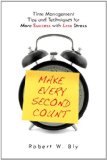 "You can solve most of your time-related problems - not enough time, to much to do, deadlines too short, bosses too demanding, not getting to your own priorities - simply by increasing the one resource you can control: you," says Robert R. Bly. His book, Make Every Second Count: Time Management Tips and Techniques for More Success with Less Stress, is aimed at busy people. I wonder how many busy people have time to read books about time management.
 Bly also points out that most of us can't control when we feel most productive. For me, it is the post-lunch slot that is the worst. Don't expect much out of me if I am at my desk between 1pm and 3pm. Meetings are fine, but left to my own devices I know it takes an extra kick to move things along. Bly's own tip for getting that extra bit of usefulness out of yourself is to find something that can revitalise you during the day. For him, it is washing his hair (his office has a private bathroom). For you, it could be coffee with a colleague in the afternoon, making calls, or getting out of the building for a walk.
Big Hairy Projects: Managing project scope
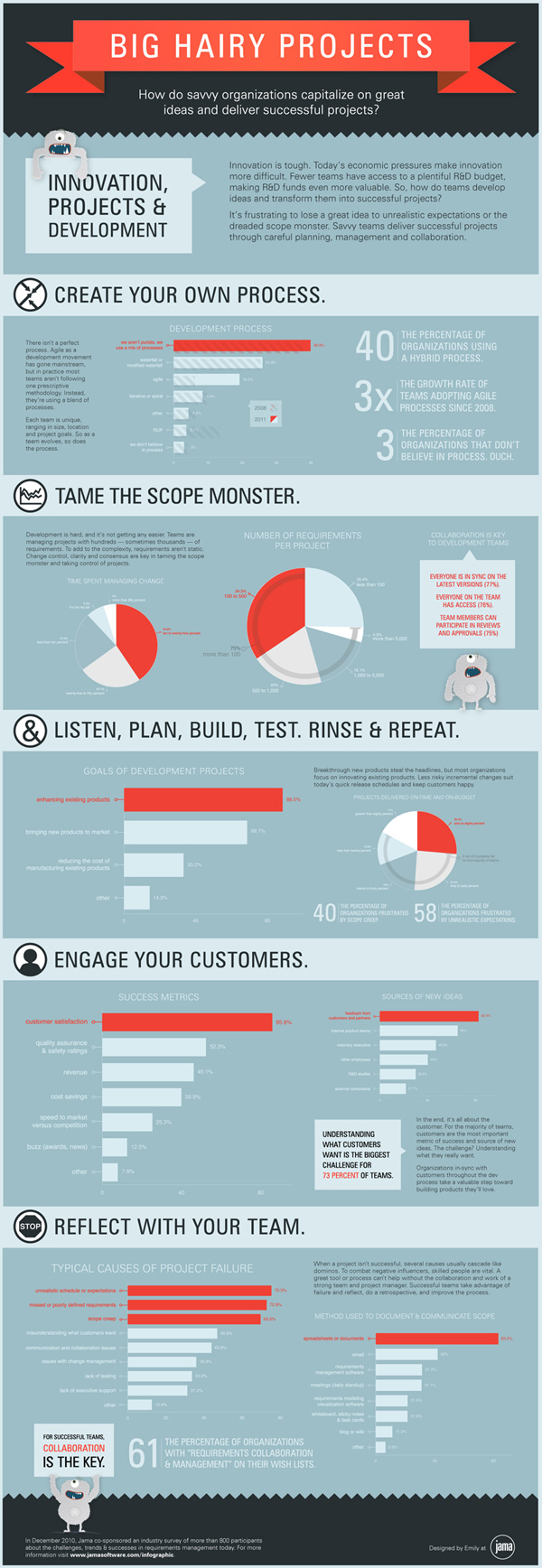
| Don't you just hate change control? According to a study by Jama Software, 75% of project managers are managing projects with at least 100 requirements. One in five are managing projects with over 1,000 requirements. That's a big project. Here's a summary of the rest of their findings:
Download the full report here. |