The Money Files
by Elizabeth Harrin

A blog that looks at all aspects of project and program finances from budgets, estimating and accounting to getting a pay rise and managing contracts.
Written by Elizabeth Harrin from RebelsGuideToPM.com.
Recent Posts
Who really owns the project budget? Clarifying financial accountability
How to learn AI the sensible way
Making sense of project cost reports
How real PM mentoring actually works
The Accidental Product Manager: What project managers need to know
Categories
accounting,
agile,
ai,
appraisals,
Artificial Intelligence,
audit,
Backlog,
Benchmarking,
benefits,
Benefits Management,
Benefits Realization,
Bias,
books,
budget,
Business Case,
business case,
business case,
Career Development,
Career Development,
carnival,
case study,
Change Management,
checklist,
collaboration tools,
communication,
Communications Management,
competition,
complex projects,
Conferences,
config management,
consultancy,
contingency,
contracts,
corporate finance,
corporate finance,
cost,
Cost Management,
cost management,
credit crunch,
CRM,
data,
data security,
debate,
Decision Making,
delegating,
digite,
earned value,
Education,
Energy and Utilities,
Estimating,
events,
FAQ,
financial management,
financial management,
forecasting,
future,
GDPR,
general,
Goals,
Governance,
green,
Information Technology,
Innovation,
insurance,
interviews,
it,
Knowledge Management,
Leadership,
Lessons Learned,
measuring performance,
Mentoring,
merger,
methods,
metrics,
multiple projects,
negotiating,
Networking,
news,
Olympics,
organization,
Organizational Culture,
outsourcing,
personal finance,
Planning,
pmi,
PMO,
PMO,
Portfolio Management,
portfolio management,
presentations,
privacy policy,
process,
procurement,
product management,
productivity,
Program Management,
project closure,
project data,
project delivery,
Project Success,
project testing,
prototyping,
qualifications,
Quality,
quality,
Quarterly Review,
records,
recruitment,
reports,
requirements,
research,
resilience,
Resource Management,
resources,
risk,
Risk Management,
ROI,
salaries,
Schedule Management,
Scheduling,
scope,
Scope Management,
security,
small projects,
Social Impact,
social impact,
social media,
software,
software,
software,
Stakeholder Management,
stakeholders,
Strategy,
success factors,
supplier management,
team,
Teams,
testing,
testing,
timesheets,
tips,
training,
transparency,
trends,
value management,
vendors,
video,
virtual teams,
workflow
Date
|
 It seems ages ago now that I gave a webinar on managing money on projects, but it is taking a long time to answer all the questions that I didn’t get round to doing during the live session. Thanks to all the fabulous participants, who asked such brilliant questions! I am still trawling through them hoping to answer them all, and here is today’s batch of managing money Q&A. It seems ages ago now that I gave a webinar on managing money on projects, but it is taking a long time to answer all the questions that I didn’t get round to doing during the live session. Thanks to all the fabulous participants, who asked such brilliant questions! I am still trawling through them hoping to answer them all, and here is today’s batch of managing money Q&A.
Is there an industrial standard for a ball-park of the Project Management cost during estimation for all IT projects? Does it vary for Application Development projects versus Application maintenance projects? Also, does platform matter?
There is no industry standard for ball-park project management costs for IT projects. It depends on the complexity of the project. A small project that requires very little oversight, with competent and experienced developers and engineers, may only need a small amount of project management time. A complex, never-been-done-before project might need project management effort at practically full time. I don’t think the type of project, or the platform, matters much. What matters is the skill of the project manager and the complexity of the project. Look back at the statistics that your PMO has about percentage of project management time per developer day. If you really, really, don’t have a clue, start with 20%, which is one day of project management time per developer week.
Should I track project costs if I have never been required to do this? And if so, where would I begin since this would be for my information only, for now, with the intent of presenting to upper management (sponsors) to show value?
If you want to do this as a learning exercise, then go ahead. You are not required to do it, so don’t let it take up too much of your time. Are any other project managers required to do it? If so, why? Maybe they work on projects of greater strategic significance or with higher external costs. Ask your PMO why you don’t have to track costs – you might be reassured by the answer.
If you’d still like to do so, you could start with tracking your time, and then talking to the Finance department about the daily rate for resources so you can put a financial value on that. If you are only managing a project with people resources, and not other expenditure, you can track how much effort it is taking to complete the project. If you are spending money on other things, like buying computers or hiring a contractor, you can add those in too.
Do you have publicly available SharePoint templates (e.g. budget tracker)? Or url?
No, sorry. Although this is an excellent suggestion. I’ll see if I can sort something out. On another note, why would you want to use a SharePoint template as a budget tracker? It’s not designed to be a spreadsheet so that is going to give you a lot more work to do. Use a spreadsheet programme, and get it to do all the maths for you.
Salary and contractor costs are sensitive information. How do you share the entire budget with the team without divulging this sensitive information?
You don’t. Sharing capital expenditure – buying things – is different from sharing operating expenditure. To be honest, not many project mangers have access to salary information for the people on their teams anyway. That’s normally data belonging to the line manager. You may have day rates set by the company for different types of resources, which are not the same as salary figures. These will be publicly available.
Read Part 1 here
Read Part 2 here
Read Part 3 here
Read Part 4 here
You can see the whole presentation online here, via a recording of the webinar. I’ll have some more Q&A for you soon! Got any questions? Leave me a comment and I’ll answer them in a future post.
|
Posted on: December 17, 2010 05:41 PM
|
Permalink |
Comments (2)
|
 Is project management a cost to be reduced or an enabler for cost reduction? This was the question asked at the Austerity Debate in London last month. Donnie MacNicol, Director, Team Animation, presented his view. Is project management a cost to be reduced or an enabler for cost reduction? This was the question asked at the Austerity Debate in London last month. Donnie MacNicol, Director, Team Animation, presented his view.
Project management is likely to be seen as a cost to be reduced, he said, in organisations which do not have mature project management structures. In this situation, project management is not linked to strategy and it is ineffective. Projects delivered are not the right projects, and they don’t deliver appropriate benefits.
Project management is likely to be seen as an enabler for cost reduction in an organisation where project management as a discipline is understood and well-implemented.
The role of organisational culture
Organisational culture is a key driver for how project management is perceived in the business. “Project management typically requires people to have a certain level of openness,” he said. How does this work across an organisation where other departments are not like that? It certainly makes it harder, he explained.
Culture has an impact on the PMO, which supports the organisation in achieving its strategy. It also has an impact on how well this strategy is articulated. Getting the strategy implemented isn’t something we can spend too much time on now, he explained. We’re now in a position where we have to make large scale changes using a directive style – because we have to change things quickly. In a time of austerity, organisations need to be responsive and flexible, and that means implementing and adopting change speedily.
He also explained that how we brand the project, programme and portfolio management internally has a big impact on its success. “Do you understand your organisational culture and the impact it has?” he asked.
The vote
Attendees at the austerity debate were asked to vote on whether project management is a cost to be reduced or an enable for cost reduction. Some people put their hands up to show they thought it was a cost to be reduced. However, many of them also put their hands up to show it was an enabler for cost reduction too. Overall, the ‘enabler’ opinion won out, with the majority of people thinking that project management facilitates cost saving in companies.
Project management is an enabler, but I think that those people who voted for it to be both an enabler and a cost to be reduced had it right. It is both those things. We need to be delivering projects in a cost-effective way. We should be looking at the cost of project management and working out how we can best make savings to make the PMO (or P3O) as efficient as possible. Only then can we really use project management as an enabler for cost reduction in the enterprise.
|
Posted on: December 10, 2010 05:08 PM
|
Permalink |
Comments (8)
|
 Andy Murray, Director of Outperform, and lead author of PRINCE2:2009, spoke at the Austerity Debate at Lloyd’s Register in London recently about the role project management plays in this difficult economy. Andy Murray, Director of Outperform, and lead author of PRINCE2:2009, spoke at the Austerity Debate at Lloyd’s Register in London recently about the role project management plays in this difficult economy.
When times are tough, senior management look to reduce costs and that sometimes means cutting projects and project management. So how much does project management cost? Murray explained that there several ways to look at this question.
The cost of managing a project
Each project has an overhead, including the cost of the project manager, the sponsor, a risk budget, the project board and any project support services.
The cost of failure
What does it cost if you don’t do projects well? There’s rework, the cost of overruns, poor outputs, under-delivery, consequential loss, and benefits that remain unrealised.
The cost of managing projects
This is the infrastructure related to managing projects and includes any Centre of Excellence overheads, the PMO, support, monitoring, tools, evaluation, assurance, the Portfolio Office and audits.
Reducing these costs is possible, Murray explained. He presented several options that senior managers could consider:
-
Reducing the number of projects
-
Reducing the cost of managing a project – giving each project manager more projects to run, for example
-
Reducing the cost of managing projects but minimising the central overheads
-
Reducing the cost of failure
-
Improving performance with better targets and delivering more benefits.
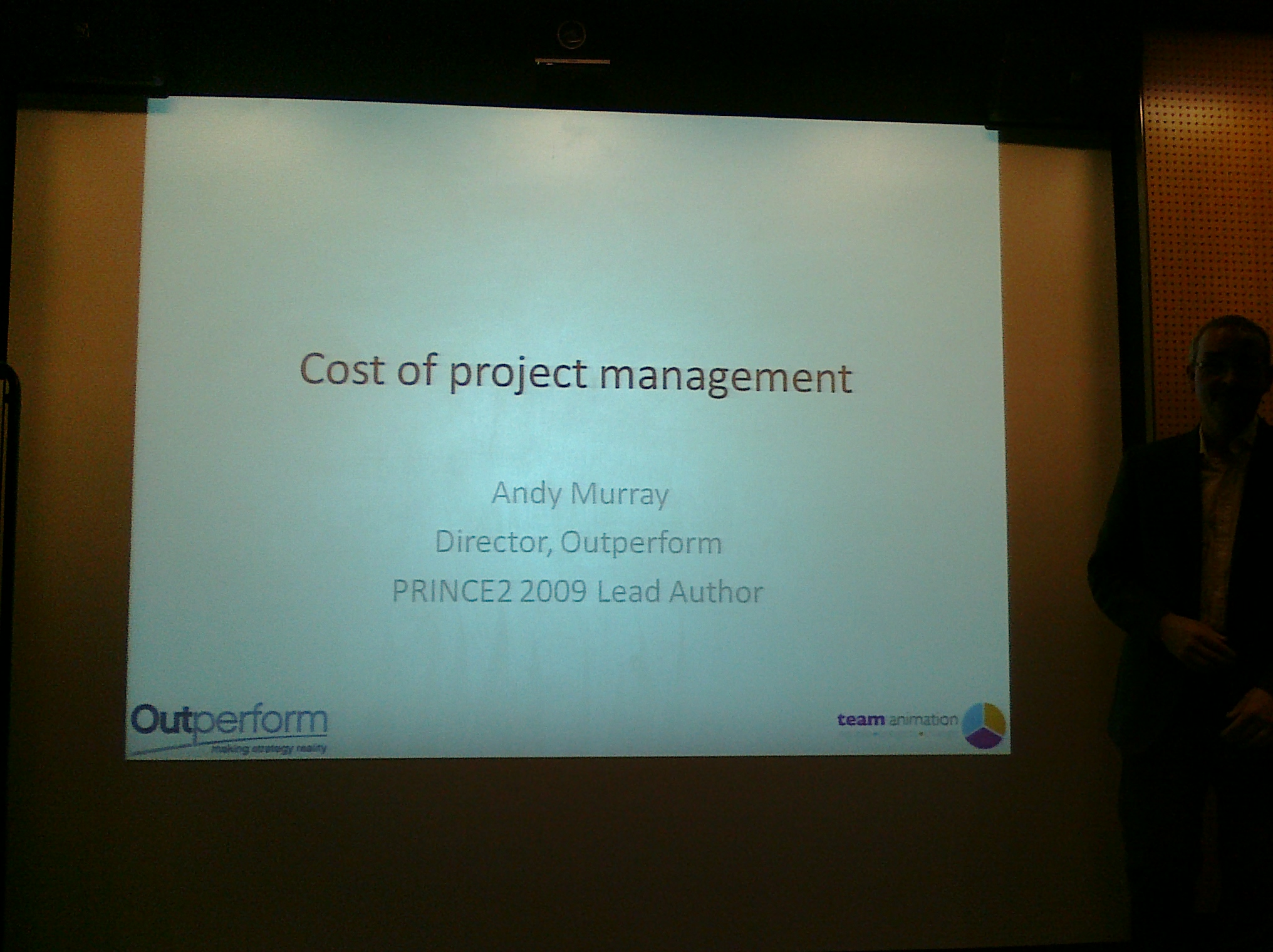 Murray said that the contribution project management offers is a mix of the value of increased performance, plus a reduced cost of failure and a lower cost projects, less the cost of project management itself. I’ve represented this as a sum in the picture here. Murray said that the contribution project management offers is a mix of the value of increased performance, plus a reduced cost of failure and a lower cost projects, less the cost of project management itself. I’ve represented this as a sum in the picture here.
In the last decade the focus has been on methods, training and techniques, Murray said. There’s been no focus on behaviour, although he admitted that things have been looking up over the past three years. There’s been a bit of development in the organisational space around P3O and strategic planning, but he believes we can do better.
What do you think?
|
Posted on: December 07, 2010 01:04 PM
|
Permalink |
Comments (2)
|
 “When you’re in content focus, you load a project into your brain and do everything related to that project,” says Stever Robbins, in his book Get-It-Done Guy’s 9 Steps to Work Less and Do More. “If you’re writing a report in content focus mode, you might spend the day writing, researching, calling people strictly about the report topic, brainstorming and editing. Even though you’re doing lots of different stuff, it’s all so deeply related that your brain can stay with that project for the whole day.” “When you’re in content focus, you load a project into your brain and do everything related to that project,” says Stever Robbins, in his book Get-It-Done Guy’s 9 Steps to Work Less and Do More. “If you’re writing a report in content focus mode, you might spend the day writing, researching, calling people strictly about the report topic, brainstorming and editing. Even though you’re doing lots of different stuff, it’s all so deeply related that your brain can stay with that project for the whole day.”
Do you do that? Pick a project and work on it with the focus it deserves? This is one of Robbins’ many tips for working smarter. He then talks about task focus, which is grouping together tasks that require the same skills, such as returning all your calls, shopping, emptying your inbox and so on.
This book is funny, and if you struggle with time management - and making the most of the hours in the day - you won’t find it difficult to dedicate the time required to read it. It’s a normal sized paperback, with over 200 pages, all filled with useful advice for people struggling to get things done in the normal working day. One of the most radical ideas in the book is from the CEO who charges her team $5 from their budget for each email she receives from them. “[T]he overload has gone down, the relevance of emails has gone up, and the senders are happy, too, because the added thought often results in their solving more problems on their own,” he writes.
One of the other useful tips about dealing with email is to delete everything, then go into your Deleted Items folder and rescue emails. There’s a different mental approach to rescuing things that have already been deleted. Your brain can be more picky about the things it really has to deal with. I think this is a great suggestion, although I keep my inbox at under 100 messages most of the time, so I’m happy with the way I handle emails. Still, if it ever gets too much, this is a great way to sift out what’s really important.
 Robbins also presents a very mature response to dealing with awkward people who never do what they say they will: Robbins also presents a very mature response to dealing with awkward people who never do what they say they will:
"If your job requires paper, Billy’s job is to reorder paper, and Billy never reorders. You can waste hours being upset, blaming Billy. It won’t help; blocking your paper order is Billy’s unconscious attempt to wrestle a tiny bit of power over an otherwise miserable life… You’re best choice is to take full responsibility and find other solutions… It would be easier if you could count on Billy, but you can’t. You can, however, take responsibility and do what it takes to help Billy succeed so you can get your job done faster."
This is the concept of radical responsibility that Nick McCormick covers in his book, Acting Up Brings Everyone Down.
Get-It-Done Guy’s 9 Steps to Work Less and Do More (aff) is more than just another book about time management. It’s an entertaining read, and it’s definitely going to show you some new ways to be more productive at work by focusing on the right things and doing them right.
|
Posted on: November 30, 2010 01:19 PM
|
Permalink |
Comments (2)
| Inspired by this blog post [link removed] about fun ways of doing day to day things, several bloggers have come together to run a competition to capture the best ideas for having more fun in project management.
They need your ideas to for having more fun in project management. There are prizes on offer including
- A copy of the Lazy Project Manager from Peter Taylor, @thelazypm
- A free project management distance learnng course from @paralleprojecttraining
- €10 from Jacques Dunselman, @pmflying
Submit your ideas here. [link removed] The best idea will be judged in the best traditions of TV dance competition, as they say, by:
- The Public Vote (50%)
- Jury of @paralleprojecttraining, @pmflying and @thelazypm
The closing date is the end of December 2010 and the prizes will be awarded early in the new year. Why is this relevant to The Money Files? Well, it's always nice to have the opportunity for free things!
Powered by Idea.informer.com
|
Posted on: November 29, 2010 12:25 PM
|
Permalink |
Comments (8)
|
You know what I love? How there's two nuts named after people: Hazel and Filbert.
- George Costanza
|




