


Books for Building Power Skills


|
This month on ProjectManagement.com we’re talking about ‘power skills’: all the things that help you lead effectively and make a difference in your work. The skills you need to advance your career and be the kind of project manager that everyone wants to work with. I’ve done a couple of training courses in my career that changed how I approached work and gave me additional skills that I could put to good use. Early on in my career, as a graduate trainee, my cohort did a course on management approaches and I remember learning about situational leadership. That was a game changer for me. Later on, I did an assertiveness course (another game changer) and then a day-long seminar on conflict management. To be honest, I use that one less in my day-to-day life but it was fascinating to learn about best ways to help people come to agreements. However, I’ve read a lot more books than I have attended courses, and I have learned just as much from those as I have from being in a classroom. Today, I wanted to share a few of my favourites with you: books that will truly give you those power skills to be an excellent project manager. Never Split the Difference by Chris Voss This book fundamentally changed the way I saw negotiation and gave me practical tips to use in high-stakes conversation. I mean, not that I’m in high-stakes negotiations very often (read: never) but the book also gave me some tools for ‘normal’ conversations and has also been very useful at home. If you have to negotiate with stakeholders, or even have the requirement to simply understand their perspective and what is important to them (and be honest, who doesn’t as a PM?), then this is a great read. The stories of his job as a hostage negotiator are pretty awesome too. This one is available as an audio book if you are having difficulty carving out time to read. Exactly What to Say by Phil M Jones Subtitled, The Magic Words for Influence and Impact, I read this book a while ago and still flick through it now when I’m trying to craft conversations or project communications that HAVE to be just right. It’s easy to read and full of handy tips that are simple to implement. Basically, changing a couple of words in what you say can make all the difference, so think about your communication intentionally and start to see improved results. It’s a small format book that is nicely laid out (i.e. with some pages just taken up with a giant quote) so it won’t take you long to read and it’s tiny enough to go in your bag. The Grit Factor by Shannon Huffman Polson A book about courage, resilience and leadership but one of the first US female attack helicopter pilots. There are some shocking stories of misogyny in here, but also a lot of takeaways about building an intentional career, being brave enough to go for what you want and taking calculated risks to get you where you want to be. This is an interesting and thought-provoking read, especially for women in (or wanting to be in) leadership positions. And finally… Getting It All Done by Harvard Business Review Press This is a collection of essays from HBR contributors, from their Working Parents series. It’s a relatively quick read, and project managers will be familiar with some of the tools and techniques suggested as things to help us balance work and home life – for example, a family Kanban board or regular ‘stand up’ meeting around the kitchen table. However, what I took away from it – and what makes me want to include it in a list of books about power skills – is that it’s hard to be an awesome leader and meet the requirements of your job and also be an awesome human, showing up for your family and community at the same time. And that doesn’t even include having the ability to take time out to look after your own health and mental wellbeing. The people in the book have a support network and systems that allow them to prioritize. From shared calendars, flexible working and understanding managers, they have built flexibility and balance into their lives by being intentional. I think that’s a real power skill: knowing what is important to you and showing up for that first, and then everything else second. I mean, isn’t that part of the agile principles, prioritizing requirements? And isn’t your family a higher priority than you work? Have you read any books that have changed your thought process on what it means to be a good project manager? I have some space on my shelves for some new reads, so let me know what I should be looking at next! Pin for later reading
|


3 Challenges That Risk Management Helps With [Video]
Categories:
risk
Categories: risk
|
Risk management: just a way to stop stuff from biting you in the backside later, right? Wrong. The risk management process has so much more to offer than that. It’s a way of thinking: a way of doing, that helps everything operate at a better level. In this video, I’m talking about 3 challenges for business that we deal with as project leaders and that risk management can help us address:
Yep, risk management can help with all of those (and a few more, that I’ll cover in another video). Want to know how? The video has all the info, and you can turn on subtitles if that helps you. What do you think, can you see a way for risk management to help you at work addressing these common pain points for project teams? Let me know in the comments!
Pin for later reading
|
Components of Earned Value [Infographic]
Categories:
earned value
Categories: earned value
|
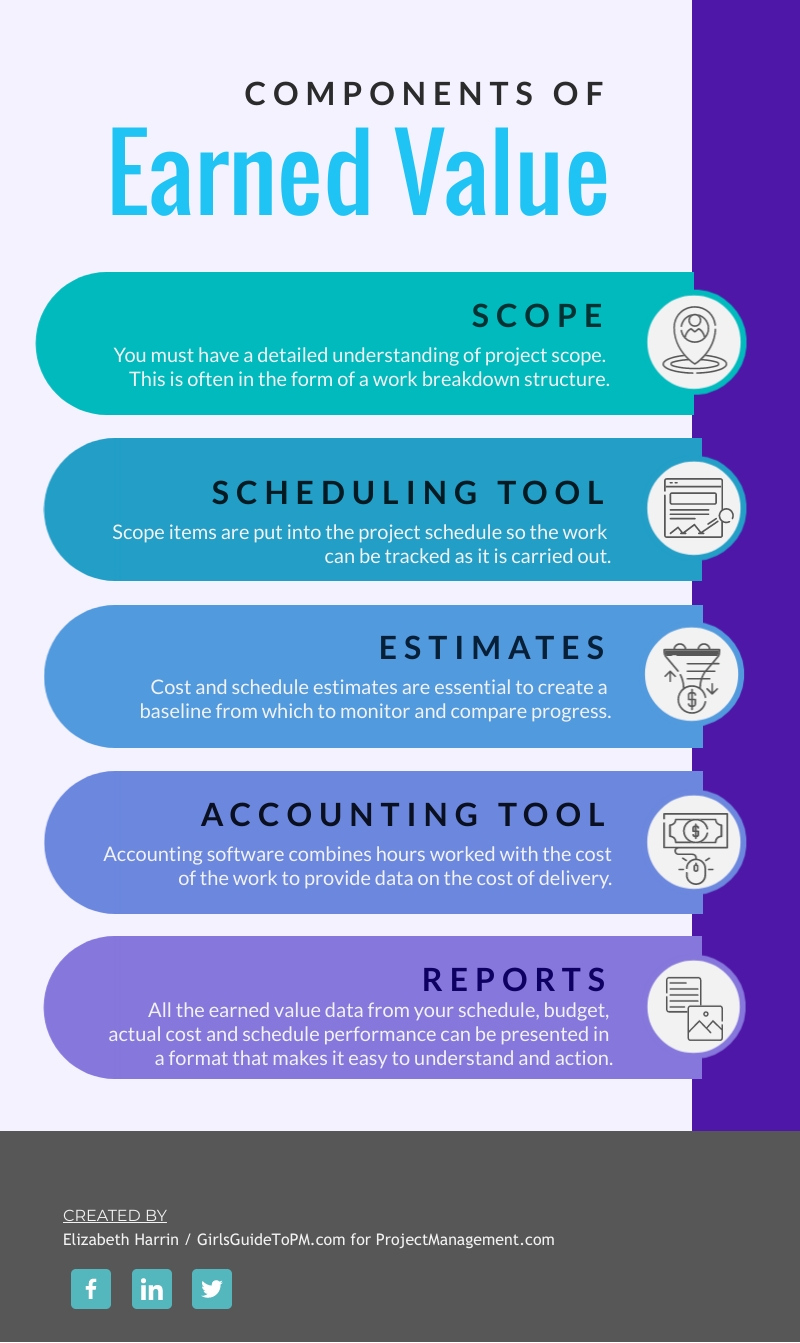
What goes into earned value? The five components needed to make it work are:
Earned value management is an effective way to manage project performance, but it all falls apart if you don’t have the right fundamentals in place. Without these five elements, you can’t effectively track and measure process, “the earned value way”. And the good news is that none of these components are individually difficult to create. You probably already have an accounting tool in your organisation, for example, and creating a defined project scope is part of what you’ll be doing anyway while managing a project. However, the thing that brings it all together and creates an earned value management system out of these components is a culture that believes EV is the way to track project performance, and that it’s worth spending time and effort measuring progress in this way. What do you think? Do you have these fundamentals in place and do you use EV to manage project performance?
|

Determining Measurement Methods in Earned Value Management
|
Reading The Practice Standard for Earned Value might not be everyone’s idea of a fun way to spend the afternoon, but I’ve been really trying to understand how EVM works in practice this year. Today, I’m diving into the Determine Measurement Methods process because it seems – to me, at least – that this is probably the most important part. How do we know what to measure and if we are doing it right? I think EV management software probably takes a lot of the measurement heavy lifting off the project team, but you still have to know enough about what’s going on under the hood to be able to make intelligent, informed decisions and explain what you’re seeing to other people. This process is where you choose the right method of performance measurement and progress evaluation for each of your work packages. Who does this? You, as the project manager, should take an active role in leading on facilitating the process, with input from the control account manager who has the detailed knowledge of what measurements would actually work in practice. In other words, you can’t be taking these decisions by yourself. As you aren’t the expert in doing the work or tracking the work, it’s someone else who has to tell you what’s reasonable for measurement. You can inform and support this, providing tips and ideas when they don’t know what to say, but ultimately I would prefer to be guided by the expert’s decision once we’ve discussed and agreed. InputsThere are five inputs to this process:
These last two are the most important, in my view. You use the IMS and the budget together to create a phased view of how the money relates to the tasks. That’s the backbone of EV. What to doWith those inputs on your desk, you’re good to go. The task to do is to determine how you are going to measure progress for each work package. There are a number of different ways to measure progress, and you can’t really rate them in order of priority or importance because they all have their pros and cons. It’s most important to choose one that relates closely to the work you are doing and will give you the most appropriate, most accurate way of understanding how the work is going. Typically, you’ll end up choosing one of these:
You can choose whatever measurement approach works for you, the control account manager and the project, but it needs to be something tangible and documented so everyone can see what ‘progress’ means and how it is tracked. You have to be pretty sure about your approach because changing it halfway through the project when you realised you picked the wrong one is going to mess up your EV reporting. So how do you decide? Think about what the work is and what the most appropriate way of measuring it would be. For example, how long is the work going on for? You may choose weekly measurement instead of daily measurement if you’ve got to be tracking over a longer period of time. How risky is the work? Do you need to be totally on top of it with detailed tracking hourly? For low risk tasks that wouldn’t be appropriate. If your organisation has guidelines, then use them so projects can be compared. OutputsThe outputs from this process are:
So what are you doing when you update the control account plans? The documents are created already, and now all you have to do is drop in the performance measurement method that you’ve decided on. You’ll also want to add in the period over which the progress is tracked, so is that weekly, monthly or some other time period. And what unit you are measuring in: hours, days, money, widgets created or anything else that makes sense for your project. The point of this project is to come up with ways of tracking progress that are objective, accurate and timely. It sounds hard, but if you think about it, you’ll come up with some ways of measuring that work for you. And if you can’t, perhaps you need to be a little bit more creative or get some expert help in working out how to track – or perhaps EV isn’t appropriate for this project, if there are a lot of tasks that can’t be tracked in an objective way. Because if you can’t track it, you won’t be getting a lot of value out of the EV reporting, which rather defeats the purpose of setting up tracking mechanisms in the first place. Remember, pick something sensible that works, that the control account manager can work with, and that is documented clearly so everyone knows how progress is being measured. That’s all this process is about. Hopefully, over time and with some experience, this part becomes standard and very easy, as you can lift parts of control account plans from other projects to use on this one. Next time, I’ll be looking at the next process in the earned value management standard, which is establishing the performance measurement baseline. Pin for later reading
|
3 Levels of Project Work Authorization [Infographic]
|
How do you go from someone high up in a position of authority saying it’s OK to begin the work through to the individual team member knowing that it is OK to start a task? That’s where different levels of authorization come in. This is important for projects using earned value management, because there are often formal approaches that require formal approval and sign off in order to accurately track performance. According to the Practice Standard for Earned Value (2nd edition, 2011) there are four steps that are typically used to authorize the work:
That seems like a lot of authorization, but it doesn’t need to become a bureaucratic of long-winded process. An efficient process wouldn’t take much time at all. You simply need to know who to inform and what to tell them, and the people responsible for doing the work need to have a clear brief of what to do so they can get on with it The infographic below sets out the flow of authorization, and you’ll see that I’ve streamlined two of the bullets above to make it easier to follow. How do you authorize work in your organization? Is it as structured as this? Let us know in the comments below!
|




