
A blog that looks at all aspects of project and program finances from budgets, estimating and accounting to getting a pay rise and managing contracts.
Written by Elizabeth Harrin from RebelsGuideToPM.com.
Recent Posts
When projects get serious: what changes after the “easy” phase
How to run a retrospective that isn’t awful
A practical guide to stakeholder influence mapping
Why Your Project Forecast Keeps Changing (and What to Do About It)
Invisible progress: how to show value when nothing big has launched yet
Categories
accounting,
agile,
ai,
appraisals,
Artificial Intelligence,
audit,
Backlog,
Benchmarking,
benefits,
Benefits Management,
Benefits Realization,
Bias,
books,
budget,
Business Case,
business case,
business case,
Career Development,
Career Development,
carnival,
case study,
Change Management,
checklist,
collaboration tools,
communication,
Communications Management,
competition,
complex projects,
Conferences,
config management,
consultancy,
contingency,
contracts,
corporate finance,
corporate finance,
cost,
Cost Management,
cost management,
credit crunch,
CRM,
data,
data security,
debate,
Decision Making,
delegating,
digite,
earned value,
Education,
Energy and Utilities,
Estimating,
events,
FAQ,
financial management,
financial management,
forecasting,
future,
GDPR,
general,
Goals,
Governance,
green,
Information Technology,
Innovation,
insurance,
interviews,
it,
Knowledge Management,
Leadership,
Lessons Learned,
measuring performance,
Mentoring,
merger,
methods,
metrics,
multiple projects,
negotiating,
Networking,
news,
Olympics,
organization,
Organizational Culture,
outsourcing,
personal finance,
Planning,
pmi,
PMO,
PMO,
Portfolio Management,
portfolio management,
presentations,
privacy policy,
process,
procurement,
product management,
productivity,
Program Management,
project closure,
project data,
project delivery,
Project Success,
project testing,
prototyping,
qualifications,
Quality,
quality,
Quarterly Review,
records,
recruitment,
reports,
requirements,
research,
resilience,
Resource Management,
resources,
risk,
Risk Management,
ROI,
salaries,
Schedule Management,
Scheduling,
scope,
Scope Management,
security,
small projects,
Social Impact,
social impact,
social media,
software,
software,
software,
Stakeholder Management,
stakeholders,
Strategy,
success factors,
supplier management,
team,
Teams,
testing,
testing,
timesheets,
tips,
training,
transparency,
trends,
value management,
vendors,
video,
virtual teams,
workflow
Date

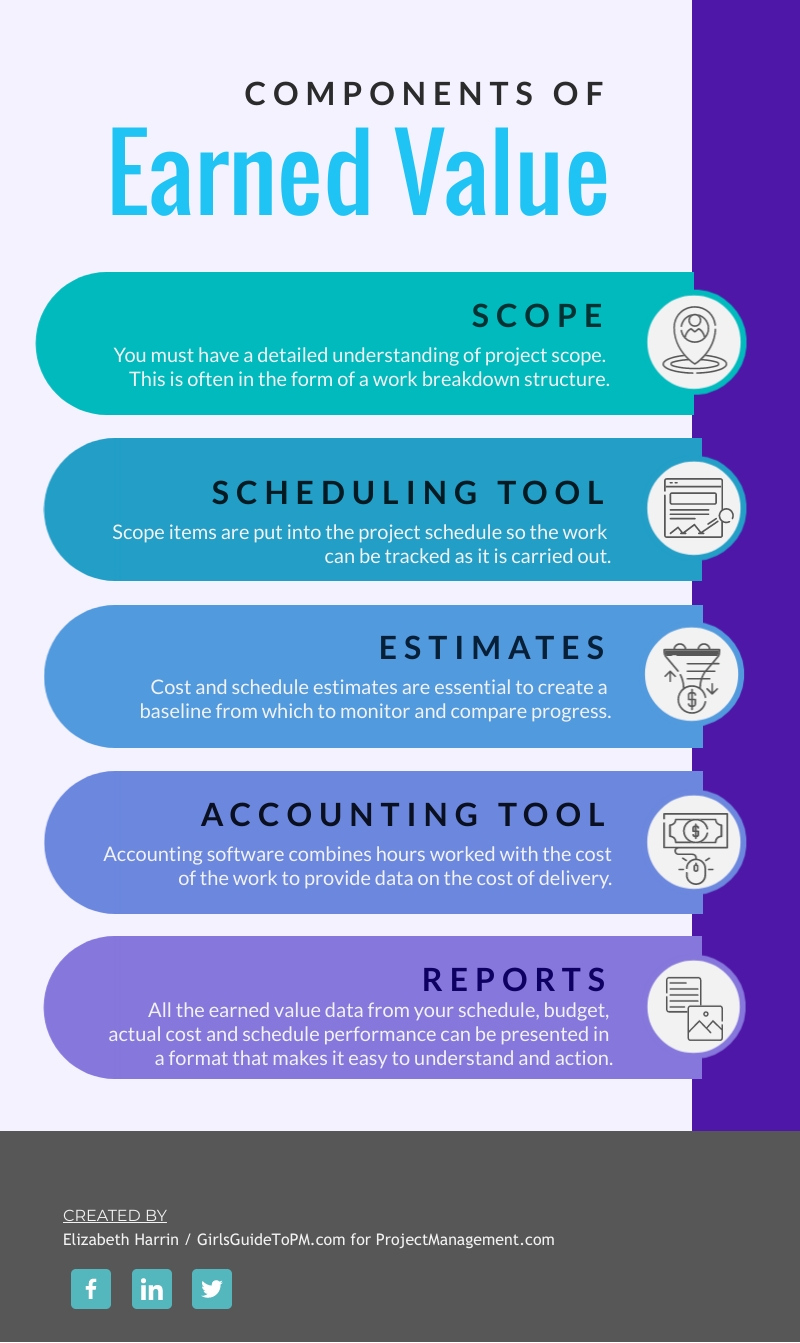
What goes into earned value? The five components needed to make it work are:
- A defined project scope
- A scheduling tool
- Estimates
- An accounting tool
- A way to generate appropriate reports
Earned value management is an effective way to manage project performance, but it all falls apart if you don’t have the right fundamentals in place. Without these five elements, you can’t effectively track and measure process, “the earned value way”.
And the good news is that none of these components are individually difficult to create. You probably already have an accounting tool in your organisation, for example, and creating a defined project scope is part of what you’ll be doing anyway while managing a project.
However, the thing that brings it all together and creates an earned value management system out of these components is a culture that believes EV is the way to track project performance, and that it’s worth spending time and effort measuring progress in this way.
What do you think? Do you have these fundamentals in place and do you use EV to manage project performance?
Posted on: July 01, 2021 10:50 AM |
Permalink




