3 Challenges That Risk Management Helps With [Video]
Categories:
risk
Categories: risk


|
Risk management: just a way to stop stuff from biting you in the backside later, right? Wrong. The risk management process has so much more to offer than that. It’s a way of thinking: a way of doing, that helps everything operate at a better level. In this video, I’m talking about 3 challenges for business that we deal with as project leaders and that risk management can help us address:
Yep, risk management can help with all of those (and a few more, that I’ll cover in another video). Want to know how? The video has all the info, and you can turn on subtitles if that helps you. What do you think, can you see a way for risk management to help you at work addressing these common pain points for project teams? Let me know in the comments!
Pin for later reading
|
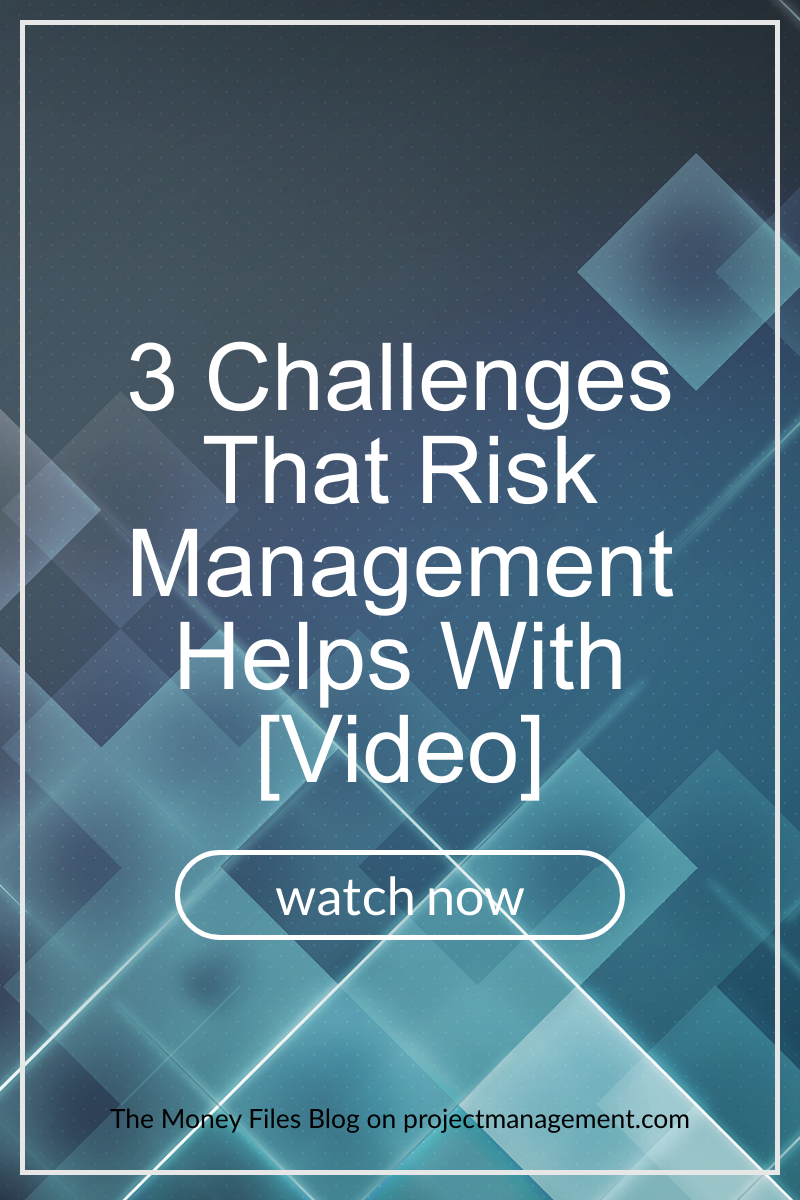
Components of Earned Value [Infographic]
Categories:
earned value
Categories: earned value
|
What goes into earned value? The five components needed to make it work are:
Earned value management is an effective way to manage project performance, but it all falls apart if you don’t have the right fundamentals in place. Without these five elements, you can’t effectively track and measure process, “the earned value way”. And the good news is that none of these components are individually difficult to create. You probably already have an accounting tool in your organisation, for example, and creating a defined project scope is part of what you’ll be doing anyway while managing a project. However, the thing that brings it all together and creates an earned value management system out of these components is a culture that believes EV is the way to track project performance, and that it’s worth spending time and effort measuring progress in this way. What do you think? Do you have these fundamentals in place and do you use EV to manage project performance?
|

Determining Measurement Methods in Earned Value Management
|
Reading The Practice Standard for Earned Value might not be everyone’s idea of a fun way to spend the afternoon, but I’ve been really trying to understand how EVM works in practice this year. Today, I’m diving into the Determine Measurement Methods process because it seems – to me, at least – that this is probably the most important part. How do we know what to measure and if we are doing it right? I think EV management software probably takes a lot of the measurement heavy lifting off the project team, but you still have to know enough about what’s going on under the hood to be able to make intelligent, informed decisions and explain what you’re seeing to other people. This process is where you choose the right method of performance measurement and progress evaluation for each of your work packages. Who does this? You, as the project manager, should take an active role in leading on facilitating the process, with input from the control account manager who has the detailed knowledge of what measurements would actually work in practice. In other words, you can’t be taking these decisions by yourself. As you aren’t the expert in doing the work or tracking the work, it’s someone else who has to tell you what’s reasonable for measurement. You can inform and support this, providing tips and ideas when they don’t know what to say, but ultimately I would prefer to be guided by the expert’s decision once we’ve discussed and agreed. InputsThere are five inputs to this process:
These last two are the most important, in my view. You use the IMS and the budget together to create a phased view of how the money relates to the tasks. That’s the backbone of EV. What to doWith those inputs on your desk, you’re good to go. The task to do is to determine how you are going to measure progress for each work package. There are a number of different ways to measure progress, and you can’t really rate them in order of priority or importance because they all have their pros and cons. It’s most important to choose one that relates closely to the work you are doing and will give you the most appropriate, most accurate way of understanding how the work is going. Typically, you’ll end up choosing one of these:
You can choose whatever measurement approach works for you, the control account manager and the project, but it needs to be something tangible and documented so everyone can see what ‘progress’ means and how it is tracked. You have to be pretty sure about your approach because changing it halfway through the project when you realised you picked the wrong one is going to mess up your EV reporting. So how do you decide? Think about what the work is and what the most appropriate way of measuring it would be. For example, how long is the work going on for? You may choose weekly measurement instead of daily measurement if you’ve got to be tracking over a longer period of time. How risky is the work? Do you need to be totally on top of it with detailed tracking hourly? For low risk tasks that wouldn’t be appropriate. If your organisation has guidelines, then use them so projects can be compared. OutputsThe outputs from this process are:
So what are you doing when you update the control account plans? The documents are created already, and now all you have to do is drop in the performance measurement method that you’ve decided on. You’ll also want to add in the period over which the progress is tracked, so is that weekly, monthly or some other time period. And what unit you are measuring in: hours, days, money, widgets created or anything else that makes sense for your project. The point of this project is to come up with ways of tracking progress that are objective, accurate and timely. It sounds hard, but if you think about it, you’ll come up with some ways of measuring that work for you. And if you can’t, perhaps you need to be a little bit more creative or get some expert help in working out how to track – or perhaps EV isn’t appropriate for this project, if there are a lot of tasks that can’t be tracked in an objective way. Because if you can’t track it, you won’t be getting a lot of value out of the EV reporting, which rather defeats the purpose of setting up tracking mechanisms in the first place. Remember, pick something sensible that works, that the control account manager can work with, and that is documented clearly so everyone knows how progress is being measured. That’s all this process is about. Hopefully, over time and with some experience, this part becomes standard and very easy, as you can lift parts of control account plans from other projects to use on this one. Next time, I’ll be looking at the next process in the earned value management standard, which is establishing the performance measurement baseline. Pin for later reading
|
3 Levels of Project Work Authorization [Infographic]
|
How do you go from someone high up in a position of authority saying it’s OK to begin the work through to the individual team member knowing that it is OK to start a task? That’s where different levels of authorization come in. This is important for projects using earned value management, because there are often formal approaches that require formal approval and sign off in order to accurately track performance. According to the Practice Standard for Earned Value (2nd edition, 2011) there are four steps that are typically used to authorize the work:
That seems like a lot of authorization, but it doesn’t need to become a bureaucratic of long-winded process. An efficient process wouldn’t take much time at all. You simply need to know who to inform and what to tell them, and the people responsible for doing the work need to have a clear brief of what to do so they can get on with it The infographic below sets out the flow of authorization, and you’ll see that I’ve streamlined two of the bullets above to make it easier to follow. How do you authorize work in your organization? Is it as structured as this? Let us know in the comments below!
|


What goes into a Control Account Plan?
Categories:
earned value
Categories: earned value
|
Control account plans (CAPs) are detailed plan for each control account. If the term control account isn’t familiar to you, you probably aren’t using earned value management. The CAP is part of EV and it describes the work that goes into each formally defined chunk of the project. The project is broken up into control accounts for the purpose of controlling the work and monitoring earned value. So if that’s the way you are managing project performance, what goes into a control account plan? Honestly, if you are working in a formal earned value environment on a project where EV is the prescribed way of managing performance, you probably have templates within the PMO that you can use to create a control account plan. However, if you are someone who has just started working in a formal EV environment – let’s say, you’re a functional manager who is now contributing to a project using EV – then it might help to know what you are looking at when your project manager hands you a CAP and either asks you to fill it in or expects you to be able to understand it. The PMI Practice Standard for Earned Value has a small section in about what goes into a control account plan, and if you are new to EV, I recommend reading the standard. It’s surprisingly easy to read and contains worked examples along with plenty of graphs and charts, so with a bit of perseverance you’ll have a decent theoretical knowledge in no time. Six things for your CAPSo let’s say you’re looking at a control account plan for the first time. What would you expect to see in there? 1. The name of the control account manager Someone is responsible for the control account. It is normally one person who takes ownership of a control account and ‘runs’ it. They should be named in the document. 2. What work is required There should also be a section that describe the work to be done. How you do this is up to you, but it needs to be detailed enough to help people understand what’s required. You probably have some other kinds of requirements documentation as well, and I don’t think it’s necessary to reinvent the wheel in the CAP. If it was me, I’d link out to any existing documentation and just include a summary, but best be guided by whatever templates exist in your organization. Pop your statement of work in the documentation. 3. The dates Drop your key milestones into the CAP. 4. Work packages Work packages are derived from the WBS. They should include the scope of the work, the schedule, and the budget for the tasks covered by the control account. Again, if you’ve got full WBS and work package documentation elsewhere, it seems silly to copy/paste it all in your CAP and you don’t need to. The CAP often looks like a spreadsheet, with work packages down the side, the key EV measures like PV and AC) in columns next to them, and dates across the top. Drop the numbers into the relevant cells and update the CAP as the work progresses. It’s a way of keeping track of performance over time. 5. Planning packages Planning packages are covered by the CAP as well. The same approach for the work package applies: include the scope, dates and costs for the tasks within the planning packages covered by the control account. 6. ETC The CAP should also include the estimate to complete. Time-phase it. This can be included as another row in the spreadsheet, per work package. As I understand it, the CAP needs to be a living document, updated regularly with the EV metrics like planned value, earned value, actual cost and estimate to complete, so that you can track performance at control account level. The Practice Standard includes a snapshot of what one might look like, filled in with some of the data to represent a project in-flight. I’ve made my own template in Excel, drawing from that.
However, it strikes me as something that an EV management system could do perfectly well. As long as the structure was set up correctly and the tasks within the control account were adequately identified, there’s no reason why software tools couldn’t pull out the figures and crunch the data on behalf of the control account manager. If you do need to set it up manually, hopefully you now have an idea of what it should include, but talk to your EVM experts or your PMO and see whether you can create the plan as a standard report from within your EV tools to save yourself a fair bit of time each month. Pin for later reading
|