

What’s next for project managers? Emerging roles to watch
Categories:
Career Development
Categories: Career Development


| PM roles are diversifying, don’t you think? I’m friends with technical leads, delivery managers, implementation managers, and people with all kinds of job titles. You might know people with the title of delivery lead, or value manager. Transformation manager or portfolio integrator, systems integrator, things like that. And that’s a good thing, if you’re in the market for a new role but I can imagine that it also creates anxiety – what does it mean for us if we stick with ‘project manager’ as a job title?
|
 Why roles are fragmenting
Is it time to rethink your PM career path?
Categories:
Career Development
Categories: Career Development
| There’s something about spring that makes me want to rethink everything – maybe it’s the fact that everything seems to be renewed, I know this is not an original thought! What it means for us at work is that I am hearing a lot of people talking about taking a moment to think about their career. Especially for those of us who are slightly older, we don’t want to end up with career drift instead of career choice. We want career moves to be meaningful and part of a rounded picture for the direction we want to take, instead of simply floating into the next role because it’s offered. Staying busy is good, but not at the expense of ending up somewhere you never expected to go. But it’s difficult to ‘plan’ your careerThe trouble with career reassessment exercises, or even a simple reflection on a Friday night with your favourite drink, is that the project management culture values resilience and ‘pushing through’. We are the doers, the people who drive change and get things done. Yes, there is of course space for lessons learned and reflection in the role, but there is a worry about appearing uncommitted if you are actively talking about career reflection and whether or not you are in the right place. It’s the conversation we need to have outside of our immediate line management team or colleagues because you never know, it might not come to anything. Also, I think in project management there is a lack of clear alternative paths. Unless you are up for taking larger and more strategically important (and therefore stressful projects), where do you go? What’s right for you?Think about these questions: What work energises me now? What work drains me? Where am I adding the most value? And then think about your skills: What skills am I underusing? What do I want less of? The GROW Model is a good starting point as well. It stands for:
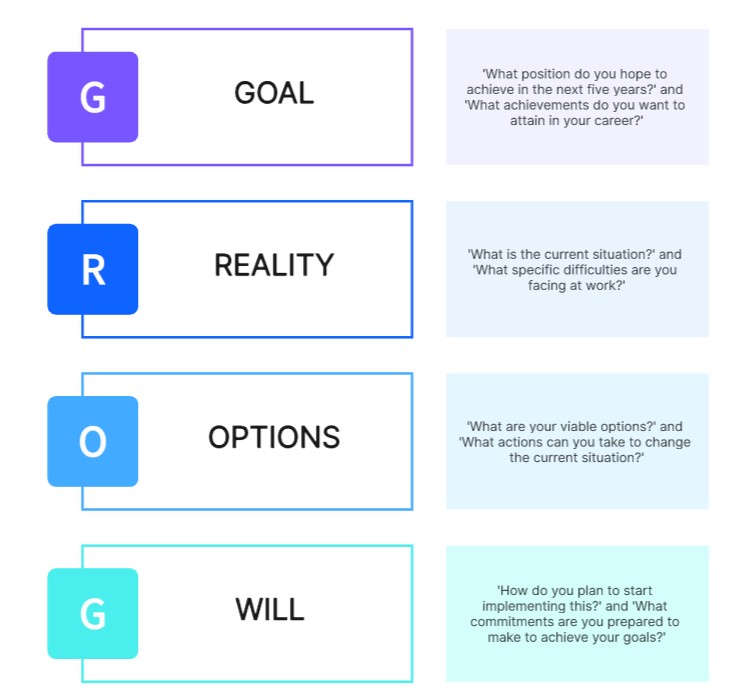 I know a lot of people are low-level job hunting for a portion of their time and if the perfect job came up, they’d jump ship. So you need to know what you are looking for in case it falls in your lap. I know a lot of people are low-level job hunting for a portion of their time and if the perfect job came up, they’d jump ship. So you need to know what you are looking for in case it falls in your lap. Where could you go?There are lots of job titles now that are PM-adjacent including:
Chat to your mentorIf you have a mentor, this is exactly the kind of thing your mentoring relationship is for. You should be able to talk to them informally, in confidence, about what you are thinking with regards to your current role. And any future role you might have in mind. They are not decision-makers in your life, but they will have an interesting perspective and can probably share some of their own thoughts from their career choices. If you don’t have a mentor, there are probably colleagues you trust, or friends or family members you could discuss with, or even type your thoughts into ChatGPT or Copilot (but take the output with a pinch of salt!). Career reflection is something we should all be doing because time passes quickly, and you want to steer your ship in the right direction for you. Don’t get me wrong, that direction is likely to change over time, but it’s better to have a loose plan than no plan at all. And project managers are great at planning, right? |
7 Project habits worth re-starting this year
Categories:
Career Development
Categories: Career Development
| January is here, and with it the pressure to plan the year and Do All The Things. In my view, January work doesn’t need a radical reinvention. Sometimes it’s about returning to what already works, and I’m sure there are some habits you know you should be doing but have stopped being so proactive about. This is your reminder that maybe this time of year it’s all about doing what works instead of trying to do something big. Here are 7 things you probably used to do and maybe don’t focus on so much anymore because the pressure of Q4 got in the way.
|
 Writing things down properly (not just holding them in your head)
Tools and techniques for continuous improvement
Categories:
Project Success,
communication,
collaboration tools,
Career Development,
Lessons Learned,
Teams
Categories: Project Success, communication, collaboration tools, Career Development, Lessons Learned, Teams
| I’ve been looking at continuous improvement in project management this month, covering why it matters and ideas for building a culture where continuous improvement is the norm. Now I’m going to turn to look at what you have available to help, in terms of tools and techniques. Luckily for us in project management, we have a range of tools available already that you are using across the rest of your project delivery work, and we can put those to use.
Tools for collecting feedbackFirst off, you have to make sure that you can collect the improvement ideas. We talked a bit about that in my last article (suggestion boxes) and there’s a lot more you can do – with techniques you will already be familiar with. Surveys and questionnairesWe use Microsoft Forms for sending out lessons learned surveys and you could set up a form (on any platform) to gather feedback at various points in the project or simply have one on your team intranet page for people to suggest improvements when they think of them. The trouble with ‘fill it in when you want’ forms is that you have to keep constantly reminding people it is there, so when they do have an idea they go to the form instinctively. RetrosYou’re probably (hopefully) already using retrospectives and lessons learned. Add in questions, if you don’t already have them, for the group to reflect on how project management processes could be changed to deliver better results. Team meetingsAdd an agenda point to your regular team meetings where you talk about what’s been improved, what improvements are being worked on and ask for suggestions. It doesn’t have to be every week, but once a quarter or something like that would work well as a reminder for the team. Techniques for learningOnce you’ve got some ideas, you’ll want to dig into them and see if they stand up to scrutiny – and whether they are worth the effort to change. Luckily, again as project professionals, we have a range of techniques already in our toolboxes that help us do exactly that. Root cause analysisUse root cause analysis techniques (like the ‘5 Whys’) to identify the underlying causes of issues. Then you can focus in on what is genuinely going to address the problem. Lessons learned databasesYou’ve got a repository of lessons learned from each project, right? Take a look through that at the types of projects that have struggled in this area and what has already been done to resolve the problem. That should help prevent you from wasting time on solutions that have already been shown not to work. Peer reviews and feedbackYou’ve got experienced people on the team. They’ve come from different corporate backgrounds and industries, so make use of their knowledge and find out what has worked in their previous roles. Project management toolsDon’t forget that we also have access to project management tools. Collaboration tools can help people communicate and work together to sort out issues. Planning and scheduling can be done for your improvements, using the tools you already have. Use your knowledge management systems to capture, store and share the ideas, improvements and lessons, so that everyone can benefit from any information created. With all the resources available to us, it should be easy to make improvements to ways of working. So let’s say you’ve made the improvements, and you want to track how things are going and whether your improvements are having the impact you expected. That’s what I’ll be talking about next time. |

Building a Culture of Continuous Improvement in Project Teams
Categories:
communication,
success factors,
Career Development,
Innovation,
Leadership,
Teams,
Organizational Culture
Categories: communication, success factors, Career Development, Innovation, Leadership, Teams, Organizational Culture
| It’s very easy to talk about continuous improvement, but if you’re anything like me, it’s a lot harder to build the actions into the workflows and processes you use to ensure that the improvement actually happens. OK, perhaps that is an exaggeration. There are some simple activities that, once you realise, are easy to change and within your sphere of influence. Those are the improvements we can make simply and with minimal effort, and that everyone appreciates.
Continuous improvement in project teamsWhat do we actually mean by continuous improvement? In my experience, when people talk about it in a project management environment, they mean the ongoing effort to enhance processes, increase efficiency, and drive better results. Whatever that takes. Like I said, it could be small tweaks or organisation-wide transformation of how projects are run in the business. And frankly, that makes it kind of hard for the average project team to effect any major change. Still, it doesn’t mean we shouldn’t try. So, if you want to create an environment where people have the opportunity to raise their voices when they see things that can be improved, here are some suggestions. Set the right exampleIf we want to foster the right culture, people have to believe they are already in a culture where their suggestions will be listened to. So we want to demonstrate: Leadership commitment: That’s leading by example, speaking up and suggesting improvements, pointing out where things could be better and encouraging others to do the same whenever we hear them mention a good idea. Communication: Unsurprisingly, communication needs to be taken seriously and you need to create the time for it. If everything is rushed, they won’t feel that they can share feedback and lessons learned (outside of structured conversations or retros). Create feedback loops or ask about improvement ideas in regular check ins. Recognise the wins: Celebrate improvements and suggestions, even if they don’t turn out to be implementable – you’re recognising the fact that an idea was brought to the group. Hopefully this will encourage others to do the same and to feel that their ideas are valued. Make it easy to suggest improvementsPeople need to feel empowered to suggest improvements and to act on them. Granted, most organisations don’t have dedicated ‘innovation’ time or slack in the calendar where people can work on their own projects. But you can remove the barriers to making suggestions. Let people work their own way: Encourage ownership on the project and let people run their area of the project the way they feel best. If they find ways to improve or change the process, let them. Suggestion schemes: In the olden days we used to have a box at work for suggestions. These days there are forms online where we can submit ideas. If you think people would be more open to suggesting ideas anonymously, make sure these systems are in place. Incentivise innovation: In my very first corporate job we had a scheme where we sent in suggestions and got cards back. If you matched the cards to make a picture, you got a prize. Or something like that. It was a long time ago, but there was an incentive scheme for pointing things out. What could you do that’s similar? Build in creativity trainingBuilding problem-solving and creativity skills is a… skill. And we can train people on skills. Find some time for training on problem solving techniques, process improvement methods, creative thinking and so on. The Six Sigma training I did in my early career was so influential in how I approach problems today. But let’s just say I’m not naturally someone who would whip out a control chart. Something else that’s easy to do and within your control is cross-skilling team members. Cross-functional learning and an appreciation of what other people do in their job helps people see the project from different perspectives and find improvement opportunities that way. This is an interesting topic for me and I think there’s more we can cover, so next time I’ll look at tools and techniques for continuous improvement. Watch this space! |



