


Agility - Let me count the types


|
(First published on LinkedIn and in the The Agility Series Blog) When we use the word agility these days it is usually prefaced by the words organizational or business. But are organizational or business agility the only two types of agility? Before I answer that question I need to fill in a bit of the back story about why I asked myself that in the first place. Last year I was the lead author on a book called Agile Value Delivery: Beyond the Numbers which we were lucky enough to have endorsed by a co-author of The Manifesto for Agile Software Development. At the same time as I was leading the writing that one I was also acting as the mentor for the PRINCE2 Agile and I was working on creating an Agile for Executives and Leaders course - it was a bust six months! As I was laying out the course I felt the need to take a different approach than simply writing yet another executive overview of Scrum or basic agile the way most have done (while there is value in those as well I wanted something a little different). Our book had talked about Value agility and we also had a section on the implications of agility thinking on the rest of an organization with a particular emphasis on HR and Finance. So as I started writing the course I began to think about the 'rest of the organization' part we had mentioned in our book. So that's where 8 of the 9 types came from, which I introduced in the course. The 9th type of agility came about while working with my friends at www.GreatWork.io and with our first wisdom council for our recent book on Organizational Agility where polled a group senior leaders on 4 continents on what they thought Organizational Agility really was. One of our council members, Claude Emond identified Learning Agility as a missing type so it was added to the list. So, here are the 9 types of agility with a (still forming) definition for each type:
As The Agility Series is still being written (both literally and figuratively) it remains to be seen whether we will stop at the 9 types or not as we don't know what will emerge from the work ahead. It also remains to be seen what the exact definitions will be for each type - the above is just our starting point. So what do you think? Are they other types of agility ? MEET ME IN SAN DIEGO NEAR THE PROJECTMANAGEMENT.COM BOOTH. |

Things That Have Worked Leading Informationally Diverse Teams
|
This is the fourth in a series of blogs on the challenges and fun related to managing a diverse team with widely different backgrounds, experiences, education, and understandings. (Or herding Cats, Cows, Sheep, Goats, Dogs and Llamas) This type of team has a high degree of “informational diversity.” The first three blogs:
Those set up the problem that makes it sound impossible to manage. But it’s clearly not impossible. THINGS I’VE TRIED THAT HAVE WORKED First off, I didn’t get this anywhere *near* correct for the first ‘zillion’ times. That’s right, I failed as a Project Manager (in varying degrees) for years. The project may not have failed, and the product of the project never failed, but I clearly didn’t do as good a job managing a cross-functional team as I should have. I did improve my skills and after continually trying and learning, I developed a cookbook of techniques that worked for me with a team of experts and a difficult technical project. I’ll write about all 7 of my recipes for leading a cross-functional team or project. The first one is the most important. Number 1: Establish a sense of mission There’s a popular story that exemplifies what I mean by “Project Mission.” During a visit to the NASA space center in 1961, President John F. Kennedy noticed a janitor mopping the floor. The President stopped, shook his hand, and asked what he did at NASA. The janitor replied: “Sir, I’m helping to put a man on the moon!” This is awe-inspiring to me. The sense of mission is the undeniable knowledge that everyone is working towards the end goal and that the goal will be useful. There’s a PURPOSE to what the project team is doing. My advice is to identify the mission of your project, in as few words as possible. Believe it, say it, and do it. Project Mission questions – everyone on the team must be able to answer these, and the answer to the last two is “YES.”
Remember the President Kennedy story? The janitor had a strong sense of the project’s mission. EVERYONE should have the same mission concept. In 1973, Peter Drucker said: “That business purpose and business mission are so rarely given adequate thought is perhaps the most important cause of business frustration and failure.” So, say the project mission, believe in the project mission, live the project mission – all the time. MEET ME IN SAN DIEGO NEAR THE PROJECTMANAGEMENT.COM BOOTH. |

Can you Coddiwomple?
|
(originally posted on LinkedIn and on The Agility Series Blog) On a recent Sunday morning, and as I am apt to do on weekends while drinking my morning coffee, I spent the first hour or so wandering through Facebook, LinkedIn and Twitter seeing what my connections have been up to over the past few days. That morning I saw a post on Facebook by a old friend of mine on the definition of coddiwomple. Ever had that moment where you see a description of something or you a come across a word that succinctly summarizes something for you? Coddiwomple is one of those words for me. For those who have read my recent book on Organizational Agility or my Adaptive Strategy Framework Guide or my first book Agile Value Delivery: Beyond the Numbers, attended any of our webinars, read any of my previous posts, or is an member of my LinkedIn group know that I write a lot about uncertainty and the fact we live in a VUCA world. Living in a VUCA world means that we cannot use the past to predict the future which is a basic assumption behind most strategic planning exercises that try to lay out a vision for the next 3-5 years. Couple this with the fact that our window of opportunity is now often measured in months and not years, and that our windows of stability are now measured in weeks instead of months, leaders of every organizational size and in every sector are challenged more that ever to learn how to be adaptive. They need to learn to base their decision-making on what they and their people do next based on what know today they did not know last month or even last week. Does that mean that strategy execution is now a crap-shoot? No. What it does mean is that we can no longer assume that we can simply make a plan and work the plan. It means leaders and their teams need to do strategic iteration as opposed to strategic planning as I describe in my Adaptive Strategy Framework Guide. Being able to prioritize what you and your teams do next means you need to have some sort of destination in mind, a vision of the future. This enables you to move towards that destination, however vague it may be, in a purposeful manner. By taking an adaptive approach to how you realize strategic goals and objectives also means that you may in fact end up at a slightly different destination that what you originally envisioned. And that's OK as it will be where you need to be, which is not necessarily where you intended to be. Being where you intended to be as opposed to where you need to be is failure - it means you executed to a strategic goal where all the signs along the way meant you were going in the wrong direction, yet you and your teams chose to ignore the signs anyway. So, as a leader, can you coddiwomple? |

Better Projects through Team Alignment
What is Team Alignment?Managing projects is challenging. My first hand experience has been that the most challenging aspects of project management are more behavioral than quantitative.
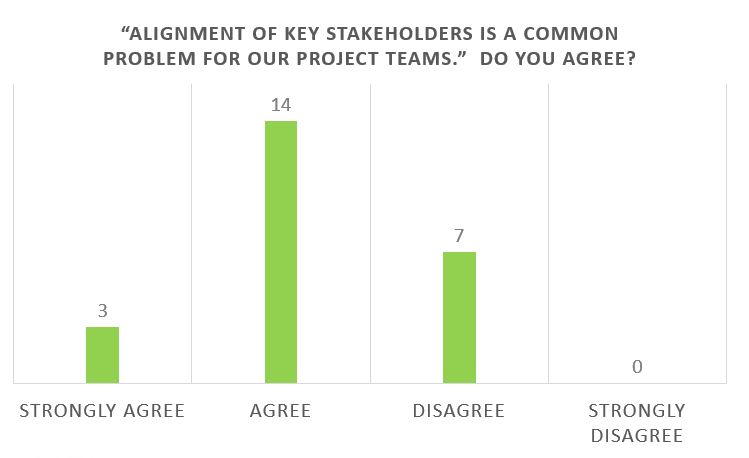
Alignment in Front End Planning Proper team alignment, starting in front end planning, is proven to positively affect behaviors and help you lead a team focused on a common project objective. The Construction Industry Institute (CII) defines alignment as the condition when project participants are working within acceptable tolerances to develop and meet a defined set of project objectives. People, not only need to work together, you have to ensure the team has exactly the same vision of what the objective is and how you, as a team, are going to successfully achieve that objective. Though the sample size is small, a recent survey we ran showed that team alignment of key stakeholders is a common problem.
Barriers to Project Team Alignment This not uncommon. The idea of alignment is simple enough, but the complexity of the conflicts and barriers project teams face can make achieving alignment very difficult. Some of the most common barriers experienced during front end planning include:
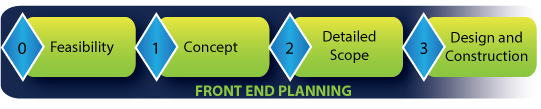
Have you experienced any of these challenges?The Alignment ThermometerOften project alignment issues start in front end planning, as we try to bring a diverse group of stakeholders together. The Alignment Thermometer was developed by CII to address this challenge. There are 3 phases and 3 logical application points to apply the Alignment Thermometer tool in Front End Planning.
The Thermometer can be used by projects teams by taking the first 5 minutes of a team meeting to have team members answer a short 10-question survey. This will provide a quantifiable measure of team alignment and identify the specific areas of disagreement that need to be addressed. Each of the 10 questions in the survey correlate to CII research findings on the top 10 issues that have the greatest effect on team alignment during front end planning. As an example:
The results are tallied and give a current “temperature” on team alignment. It will help you quickly measure if your team is:
As you move through the Front End Planning phases from Feasibility to Concept, your team size normally grows. With new team members coming to the table, we must ensure we maintain alignment around project objectives. It’s a similar scenario as you move from Concept into the Detailed Scope phase. The team size will grow again, and clear roles and responsibilities become even more important. Again, using the Alignment Thermometer is a great tool to ensure the team is working together in a way that will increase the likelihood of success. Several additional alignment tools can be introduced at this step including:
Are you facing uncertainty aligning your project team members and stakeholders? For more information on achieving alignment in Front End Planning here’s a link to a recent whitepaper: Team alignment: the key to addressing conflict in front end planning |

Four crucial questions for identifying Strategic Change
| (previously published as part of The Agility Series blog and on LinkedIn) In my recent post on Strategic Planning versus Strategic Iteration I discussed three ways in which we need to adjust how we view strategy. In this short post I'll look at how we can identify the kinds of strategic changes we will need to undertake by asking four crucial questions. In our recent book Agile Value Delivery: Beyond the Numbers we offered up that: "The primary reason for undertaking Portfolios, Programs and Projects is to enable the delivery of realizable Value into Business Operations". This is the recognition that the primary origin of change in organizations is because something in business operations is not working or that the organization is wanting to go in a different strategic direction; but it starts and ends in business operations. We also discussed the fact that organizations now face holistic messes rather than discrete problems coupled with increasing rates of change. Leaders need to learn how to lead at the pace of change rather than trying to control change. Strategic Iteration helps us take an adaptive approach to how we approach the resolution of these holistic messes based on an Observe-Orient-Decide-Act mindset. But how do we specifically identify what we need to change and how do we make needed refinements based on what emerges? Many organizations and portfolio teams have figured out that you need to take a holistic view of your organization in order to identify required strategic changes. But how do they do that? It starts with asking four crucial questions:
The real fun, as they say, happens once you get started. Strategic Goals and Objectives are statements of intent not statements of a defined scope and plan that cannot be changed. An Adaptive Strategy based in Strategic Iteration is an approach that allows us to continually refine both our strategic goals and strategic objectives as well as the strategic changes we are targeting based on what emerges once we start to execute our strategies. In my recent webinar on The Adaptive Strategy Framework I discussed a framework that organizations can use to answer these and many other questions using strategic iteration, rather than strategic planning to solve the holistic messes they now face, by continually refining their approach during execution based on feedback loops of what is working and what isn't. What questions do you ask to identify the strategic changes you need to make to meet your organizations strategic goals? I'd love to hear about them. |


