


18Mar2020 cropped small.jpg)




Guessing is not a strategy: How to build decision velocity with AI and real-time data
June 10, 2026 | Live Webinar

Disciplined Agile 5.5 Released
Choose Your WoW! Second Edition Is Now Available
Requisite Agility applied in Project Management
Disciplined Agile and PMBoK Guide 7th Edition
#ChoiceIsGood, #ChooseYourWoW, #ConsumableSolution, #ContinuousImprovement, #CoreAgilePractices, #experiment, #Experimentation, #GuidedContinuousImprovement, #Kaizen, #LifeCycles, #ProcessImprovement, #TealOrganizations, Adoption, agile, agile adoption, Agile Alliance, Agile Business Analyst, Agile certification, agile data, agile governance, agile lifecycle, agile metrics, agile principles, agile transformation, Agile2018, Agile2019, Agile20Reflect, AgileData, Analogy, announcement, Architecture, architecture, architecture owner, Articles and publications, Asset Management, Atari, Backlog, Barclays, being agile, benefits, bi, blades, book, Branching strategies, Browser, Business Agility, business intelligence, business operations, capex, Case Study, Certification, certification, charity, Choose your WoW, CMMI, cmmi, Coaching, Collaboration, Communications Management, Compliance, Compliancy, Conference, Construction, Construction phase, Context, Continuous Improvement, coordination, COVID-19, Culture, culture, Cutter, DA, DAD, DAD Book, DAD discussions, DAD press, DAD roles, DAD supporters, DAD webcast, DADay2019, Data Management, database, dependencies, Deployment, Development Strategies, DevOps, disaster, Discipline, discipline, Disciplined Agile, disciplined agile delivery, disciplined agile delivery blog, Disciplined Agile Enterprise, disciplined devops, Documentation, Domain complexity, dw, DW/BI, Energy Healing, Enterprise Agile, Enterprise Architecture, Enterprise Awareness, enterprise awareness, Essence, estimation, Evolving DA, Executive, Experiment, facilitation, FailureBow, feedback-cycle, finance, Financial, FLEX, Flow, foundation layer, Funding, GCI, GDD, Geographic Distribution, gladwell, global development, Goal-Driven, goal-driven, goals, Governance, GQM, Guideline, Hybrid, Improvement, inception, Inception phase, India, information technology, infosec, Introduction, iterations, Kanban, large teams, layer, lean, Lean Startup, learning, Legal Project Management, LeSS, Lifecycle, lifecycle, Manifesto, mark lines, marketing, MBI, Metaphor, Metrics, metrics, mindset, Miscellaneous, MVP, News, News and events, Non-Functional Requirements, non-functional requirements, Non-solo development, offshoring, Operations, opex, Organization, Outsourcing, outsourcing, paired programming, pairing, paper, People, People Management, phases, Philosophies, Planning, PMBoK, PMI, PMI and DA, PMI Chapter, Portfolio Management, post-format-quote, Practices, practices, Principle, Process, process improvement, process tailoring, Product Management, product owner, Product Owners, productivity, Program Management, Project Management, project-initiation, Promise, Quality, quality, rational unified process, Refactoring, Reiki, Release Management, release management, Remote Training, Remote Work, repeatability, requirements, Requirements Management, research&development, responsibilities, retrospectives, Reuse, Reuse Engineering, ride for heart, rights, Risk Management, Risk Management, Risk management, Roles, RUP, SAFe, sales, Scaling, scaling, scaling agile, Scheduled Workshops, SCM, scorecard, Scrum, ScrumMaster, SDLC, Security, security, self-organization, SEMAT, serial, skill, solutions software consumable shippable, Stakeholder Management, strategy, Support, Surveys, Teal organizations, team development, Team Lead, team lead, Teams, Technical Debt, Teleconferencing, Terminology, terraforming, test strategy, testing, time tracking, Tool kit, Toolkit, tools, traditional, Transformation, Transition iteration, transition phase, Uncategorized, Upmentors, Using PMI Standards, value stream, velocity, vendor management, Virtual Training, Workflow, workflow, workspaces


| An important part of agile culture is to be honest and forthcoming about your mistakes, so I'd like to share one that I've made in a key diagram that exists in both our courseware and in the book Choose Your WoW! This blog posting is my "failure bow" regarding mistakes that I made in the flowchart for how to choose between DA life cycles. Figure 1 presents the original flowchart as it currently appears in the book and courseware. Don't worry, we're in the process of updating both. I'm writing this blog now because I want to make this update publicly available as quickly as possible to support people's learning journeys. There are two problems in Figure 1:
Figure 1. Choosing a DA lifecycle (original diagram).
The update to the diagram is presented in Figure 2. You can see that we've changed one of the Yes options to be No. More importantly, we've reworded the decision point so that it's clearer. We had several people point out that they didn't understand the original wording of the question about potential disruption. I had written that question from the point of view of a team composed of people with a traditional background. But, many teams now have an agile background, having gotten started with a framework like Scrum only to find it insufficient for their needs. Such teams wouldn't be disrupted, at least not very much, by adopting the Agile lifecycle. Thus we've reworked the question to instead ask about the team's agile background. Figure 2. How to choose a DA life cycle (updated).
An important point that I would like to make about the flowchart of Figure 2 is that this is the logic that we suggest you follow, but you may still decide to make other decisions. For example, consider the decision point in the bottom-right corner. You may be working with a team that is new to agile but still decide to adopt the agile lifecycle over the lean lifecycle because you're willing to invest in the time and expense of training and coaching them in agile ways of working (WoW). Fair enough, that's your call. I hope that this update has cleared up any confusion you may have had around this diagram. |
|
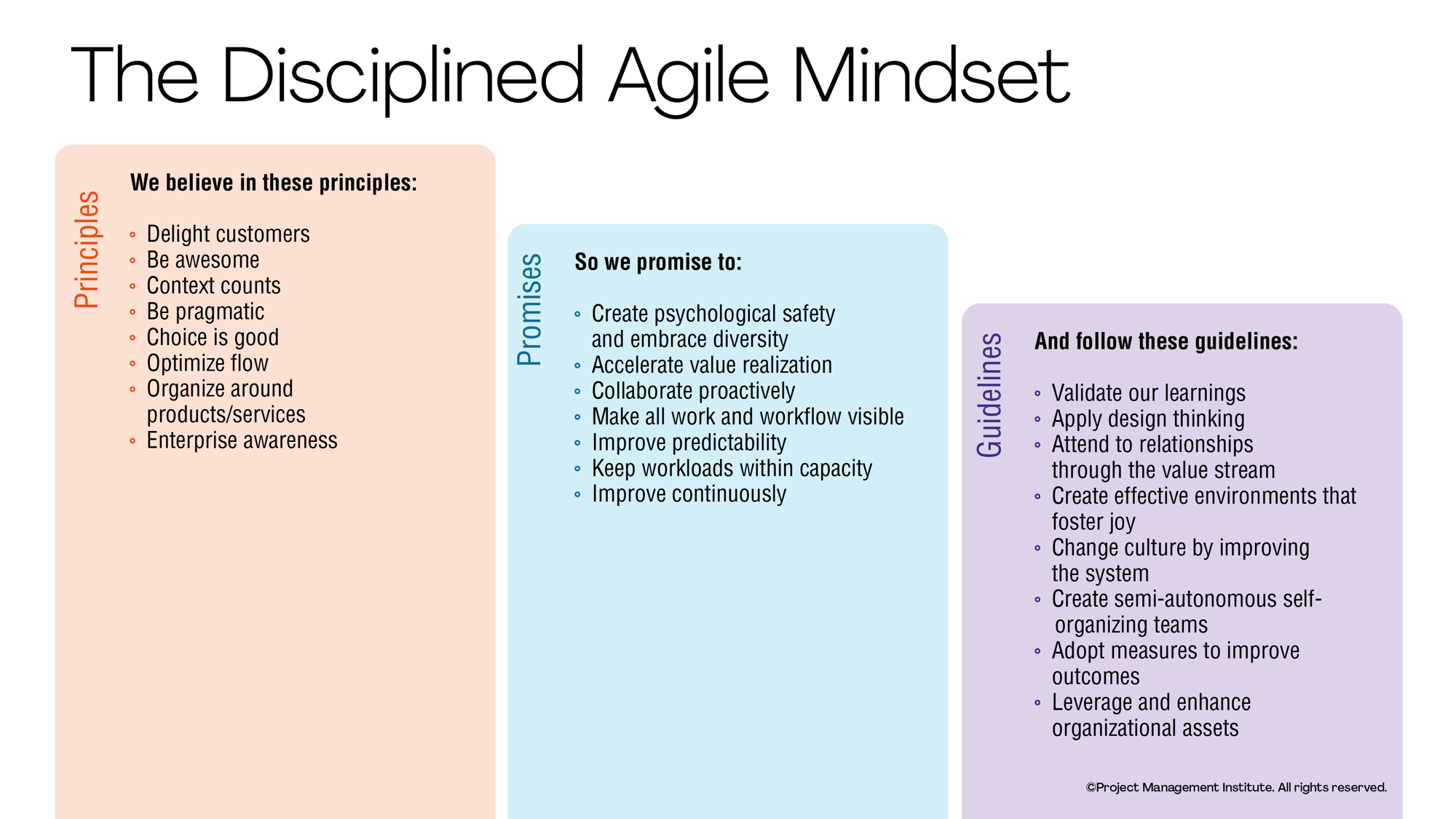
In the recent release of Choose Your WoW! we have evolved some aspects of the Disciplined Agile (DA) tool kit. One of the things we evolved is how we communicate the DA mindset (pictured above). The principles provide a philosophical foundation for business agility. They are based on both lean and flow concepts. In this blog posting we explore the eight principles.
These principles are described in greater detail in chapter 2 of Choose Your WoW!. In the next blog in this series we will explore the promises of the DA mindset. Stay tuned!
Free DownloadsWe have made several Disciplined Agile (DA) posters available to you for free download, including a Disciplined Agile Mindset poster. |
|
As I posted recently, the new version of our book Choose Your WoW! is now available. With this new release we have evolved the Disciplined Agile (DA) tool kit, and one of the things that we have updated is our approach to describing the DA Mindset. In this blog posting I overview our previous approach to describing the DA mindset and then describe our new strategy, which is summarized in the diagram above. Our Previous Approach to Describing the DA MindsetUntil recently, we described the DA mindset as the combination of the DA Principles and the DA Manifesto. The DA Manifesto in turn was described in terms of five values and 17 principles behind the manifesto. The DA Manifesto was based on the Manifesto for Agile Software Development, or more colloquially known as the Agile Manifesto. Three issues motivated us to move away from this approach:
Our New Approach to Describing the DA MindsetOur new approach to describing the DA Mindset is straightforward: We believe in these principles, so we promise to adopt these behaviours and follow these guidelines when doing so. There is a purpose for each aspect of the mindset:
We will soon be updating DA pages on PMI.org and the Disciplined Agile courseware to reflect the changes being described in this blog series. Our strategy is to let the books lead, in other words we update the relevant book and then shortly afterwards we release updates to related material. Future postings in this series explore the principles, promises, and guidelines behind the DA Mindset in greater detail.
Free DownloadsWe have made several Disciplined Agile (DA) posters available to you for free download, including a Disciplined Agile Mindset poster. |
|
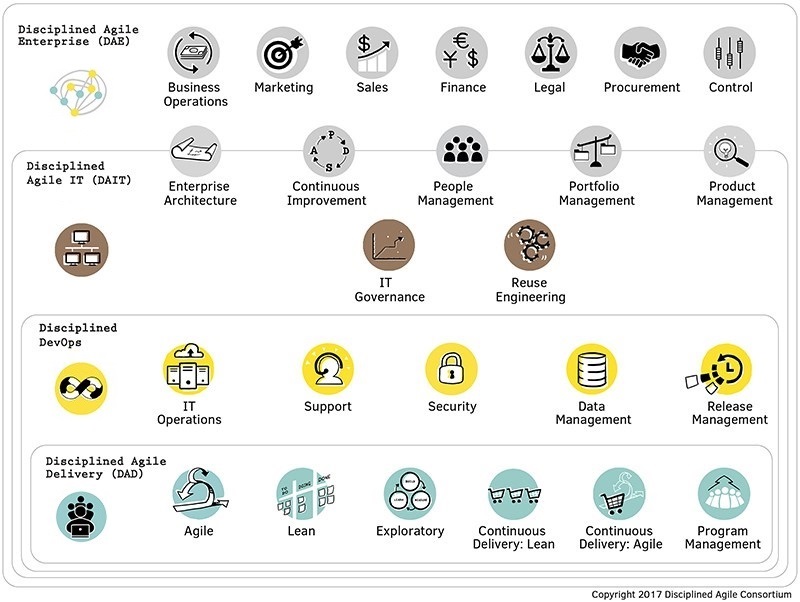
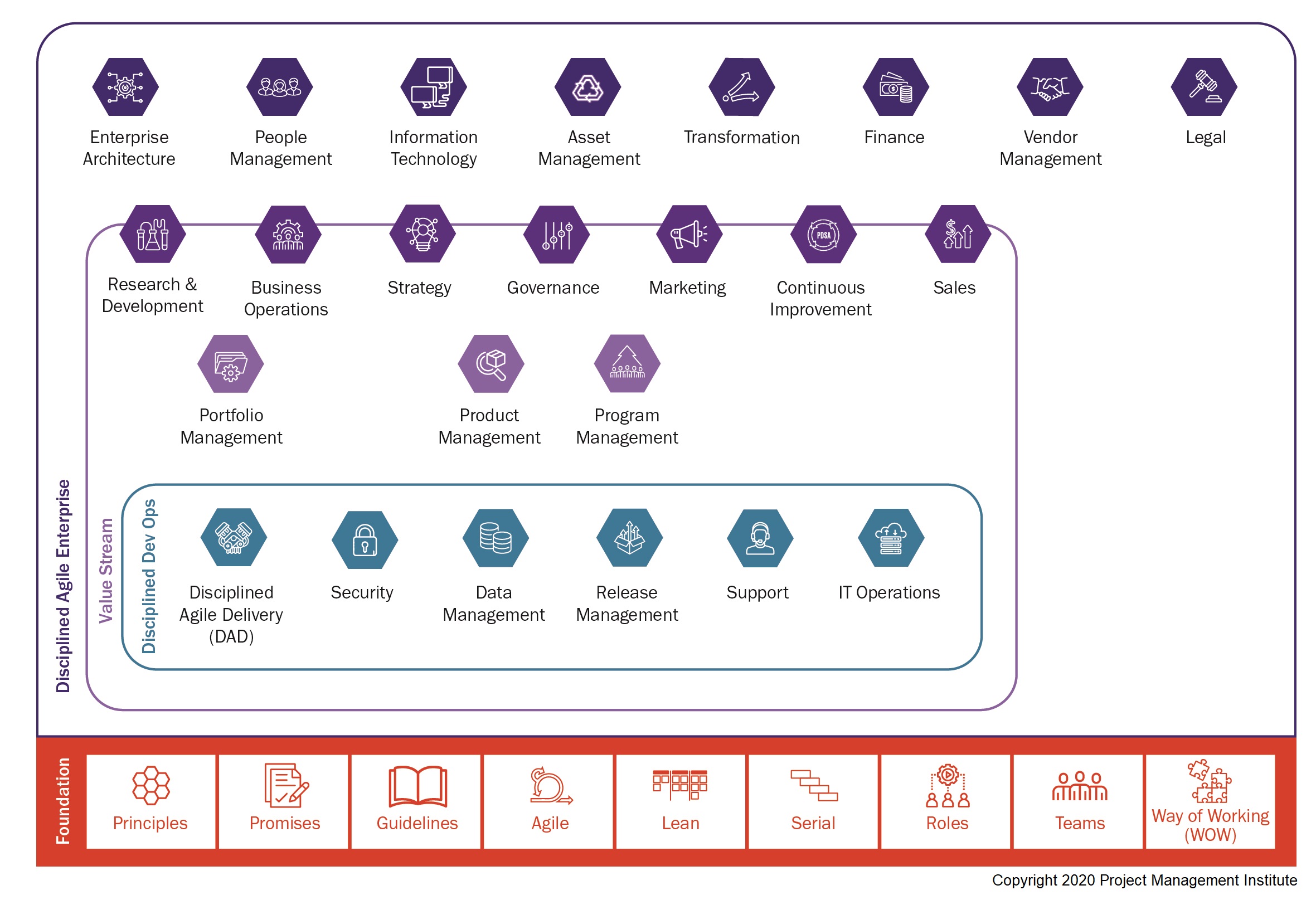
In this blog I will focus on the changes that we've made to the DA Overview diagram. Figure 1 shows the previous version of the diagram and Figure 2 our updated version. When PMI purchased Disciplined Agile in August 2019 we had several streams of evolution underway at the time, all of which are reflected in Figure 2. PMI also purchased Net Objectives so that we could merge their FLEX framework into DA, forming what has now become the Value Streams layer of DA. Al Shalloway and I will go into more detail on this in future blog postings.
Figure 1. The previous Disciplined Agile overview diagram.
Figure 2. The new Disciplined Agile (DA) overview diagram.
In addition to modernizing the look of the diagram, you'll notice several important changes:
As you can see, there is a long list of potential blog topics to describe how DA has evolved, and continues to evolve. Next up will be an overview of our updated approach to describing the DA mindset. Please stay tuned!
Free DownloadsWe have made several Disciplined Agile (DA) posters available to you for free download, including a Disciplined Agile Overview poster. |
|
Photo credit: Umanix ---- Disciplined Agile (DA) has always recognized that some teams work remotely and now, given the need to respond to the challenges presented by COVID-19, we are applying our own advice with our DA training offerings. Starting in early March we reworked our instructor-led training (ILT) offerings so that they can be delivered remotely by qualified instructors. In the picture above we see two Certified Disciplined Agile Instructors (CDAIs) from Umanix delivering the a Disciplined Agile workshop virtually. As you might expect, the instructors are using video conferencing software to work through the courseware with the students, but there's much more to it. The DA workshops have many hands-on exercises, both games and case study work, in which students collaborate to learn critical concepts and techniques. In the bottom left-hand corner you see an exercise in which a group of students are in a breakout room and are working together. In the face-to-face (F2F) version of this exercise students move cards around on a table and discuss their decisions as they go. In the virtual version they move images around on the screen. In both cases the instructor is observing and helping the students where necessary. Once the group work is over the students then do a "wall walk" by going into each of the breakout rooms to see and discuss how other groups approached the problem. We've been very lucky in that one of our DA Training Partners has been delivering DA training to globally dispersed teams for years. They agreed to take the lead and share their experiences and techniques with our other training partners so that we can successfully bring DA training to you remotely. In short, we've been in a position to apply proven remote training strategies so that your learning experience is the best that it can be. Don't worry, DA Training Partners will still be offering face-to-face training once it becomes safe to do so again. And we'll also continue with virtual workshops as well, because my gut tells me that we're going to have a lot more distributed Disciplined Agile teams in the future. ----- Please visit Disciplined Agile Training to discover our current workshop offerings. |
|
"A doctor can bury his mistakes but an architect can only advise his client to plant vines." - Frank Lloyd Wright |