Do you send project spam?
From the The Money Files Blog
by Elizabeth Harrin

A blog that looks at all aspects of project and program finances from budgets, estimating and accounting to getting a pay rise and managing contracts.
Written by Elizabeth Harrin from RebelsGuideToPM.com.
Recent Posts
Budget confidence vs budget optimism
When projects get serious: what changes after the “easy” phase
How to run a retrospective that isn’t awful
A practical guide to stakeholder influence mapping
Why Your Project Forecast Keeps Changing (and What to Do About It)
Categories
accounting,
agile,
ai,
appraisals,
Artificial Intelligence,
audit,
Backlog,
Benchmarking,
benefits,
Benefits Management,
Benefits Realization,
Bias,
books,
budget,
Business Case,
business case,
business case,
Career Development,
Career Development,
carnival,
case study,
Change Management,
checklist,
collaboration tools,
communication,
Communications Management,
competition,
complex projects,
Conferences,
config management,
consultancy,
contingency,
contracts,
corporate finance,
corporate finance,
cost,
Cost Management,
cost management,
credit crunch,
CRM,
data,
data security,
debate,
Decision Making,
delegating,
digite,
earned value,
Education,
Energy and Utilities,
Estimating,
events,
FAQ,
financial management,
financial management,
forecasting,
future,
GDPR,
general,
Goals,
Governance,
green,
Information Technology,
Innovation,
insurance,
interviews,
it,
Knowledge Management,
Leadership,
Lessons Learned,
measuring performance,
Mentoring,
merger,
methods,
metrics,
multiple projects,
negotiating,
Networking,
news,
Olympics,
organization,
Organizational Culture,
outsourcing,
personal finance,
Planning,
pmi,
PMO,
PMO,
Portfolio Management,
portfolio management,
presentations,
privacy policy,
process,
procurement,
product management,
productivity,
Program Management,
project closure,
project data,
project delivery,
Project Success,
project testing,
prototyping,
qualifications,
Quality,
quality,
Quarterly Review,
records,
recruitment,
reports,
requirements,
research,
resilience,
Resource Management,
resources,
risk,
Risk Management,
ROI,
salaries,
Schedule Management,
Scheduling,
scope,
Scope Management,
security,
small projects,
Social Impact,
social impact,
social media,
software,
software,
software,
Stakeholder Management,
stakeholders,
Strategy,
success factors,
supplier management,
team,
Teams,
testing,
testing,
timesheets,
tips,
training,
transparency,
trends,
value management,
vendors,
video,
virtual teams,
workflow
Date
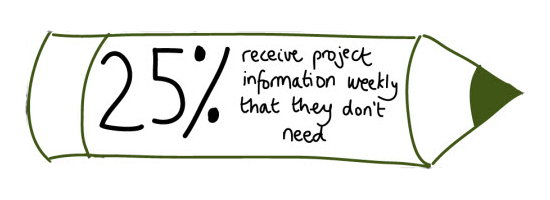
1 in 4 people receive project information weekly that they just throw in the bin. They don’t need it. This was one of the findings in research presented by Tim Lyons at the recent BCS Project Management Specialist Group Spring School in London.
Conversely, 1 in 5 people need information weekly about the project that they don’t get.
And 60% reported receiving ‘project spam’.
Whether it is project financial reporting or progress reporting, you need to be sure that you are providing the right information to the right people.
How do you know it’s the right information? Ask them. People find communication difficult.
When asked ‘how easy is it to communicate on your project?’ only 38% said it was easy. 6% said it was too difficult so they don’t bother. Over a third reported that it was labour-intensive to communicate.
All this means that people won’t always speak up if they aren’t getting what they need. Sometimes they won’t tell you when they are receiving things that they don’t need. It’s your job to get this balance right and consider what you are sending them.
Sending them? Did I assume you were passing on information by email?
87% of people in the APM People SIG research that Tim presented said that they regularly used face to face communication on projects. 67% said that this was the best way to get information.
Consider the mechanisms you use to pass information on, and the preferences of the audiences receiving the communication. What can you do to avoid project spam?
Posted on: April 17, 2011 05:09 AM |
Permalink
Comments (7)
Please login or join to subscribe to this item

Wai Mun Koo
PMO Director| Intergraph PP&M
Singapore, Singapore
Prepare a communication plan with different groups of stakeholders each receiving project information in different interval (frequency), volume (length), detail (granularity), and method (e.g. meeting, newsletter or email). State the objective of the communication clearly and always give people an option to opt out if they do not wish to get any more information regarding the project.
Wai Mun, this is the 'traditional' way to do communication planning. I think the piece that is missing is asking people what they want to receive before you start sending it.
Wai Mun Koo
PMO Director| Intergraph PP&M
Singapore, Singapore
Agree and it makes sense. But there is still one question - how do people know what they want to receive (assuming people don't know what they need and what they want most of the time)? Is there a good way to bridge this gap?
Ah, now that's a good question! I think it is worth talking to them about their role in the project or organisation and what decision-support information they need to do it. A lot of project information is used to make decisions, so if we better understand what they need the information for, we can advise on what they need. You are certainly right though that people need an option to opt out at any point. This should prompt a discussion with you about why they don't need it any longer (has their role changed, has the quality of the report dropped, or is there some other reason?) so that you can establish whether they need something different or whether someone else needs to get it instead of them.
Many organisations have mandatory documents that must be communicated to interested parties of the project, many of these documents are overkill but Project instigators dictate, collect and monitor whether PM's produce the documents. In simple terms, many would want to see the Progress Report and should be comprehensive so it spells out the financial position of the project e.g. is it still within budget, has the project slipped or on target, is the project in trouble etc - An updated project plan must also be communicated.
Stakeholders in particular want to receive no more than a couple of pages max of the Weekly progress report or it tends to remain unread - they simply dont have enough time to go through mountains of documents. The PM must recognise what is crucial, what is important and what they dont need to know [day to day tasks\activities]. The PM establishes best communication methods and ensures that what they communicate is consistent, valid and up to date information. As for the stakeholders they could be briefed at stakeholders meeting chances are they did not read the project reports so be prepared - give them a powerpoint presentation - Less is more!

Wayne Mack
Retired| Retired
South Riding, Va, United States
The challenge with communications is that the project manager needs to present information to people before they have a need to know. This allows people to prepare for a situation and act rather than just react to the news. Of the two statistics presented, I am more concerned about the "1 in 5 people [who] need information weekly about the project that they don’t get," than the"1 in 4 people [who] receive project information weekly that they just throw in the bin." I am never going to get the right mix, so I would rather err on the side of providing too much information rather than not providing enough.
Wayne, I think that's a very pragmatic approach. Given that it's incredibly difficult to know what people want, and that some people won't know what they want, more communication is the better approach. I would concur that erring on the side of providing too much is better than not communicating enough. It's getting the balance right that's so difficult.
Please Login/Register to leave a comment.
|
"Too bad all the people who know how to run the country are busy driving taxis and cutting hair."
- George Burns
|




