3 Principles for Project Metrics
From the The Money Files Blog
by Elizabeth Harrin

A blog that looks at all aspects of project and program finances from budgets, estimating and accounting to getting a pay rise and managing contracts.
Written by Elizabeth Harrin from RebelsGuideToPM.com.
Recent Posts
Budget confidence vs budget optimism
When projects get serious: what changes after the “easy” phase
How to run a retrospective that isn’t awful
A practical guide to stakeholder influence mapping
Why Your Project Forecast Keeps Changing (and What to Do About It)
Categories
accounting,
agile,
ai,
appraisals,
Artificial Intelligence,
audit,
Backlog,
Benchmarking,
benefits,
Benefits Management,
Benefits Realization,
Bias,
books,
budget,
Business Case,
business case,
business case,
Career Development,
Career Development,
carnival,
case study,
Change Management,
checklist,
collaboration tools,
communication,
Communications Management,
competition,
complex projects,
Conferences,
config management,
consultancy,
contingency,
contracts,
corporate finance,
corporate finance,
cost,
Cost Management,
cost management,
credit crunch,
CRM,
data,
data security,
debate,
Decision Making,
delegating,
digite,
earned value,
Education,
Energy and Utilities,
Estimating,
events,
FAQ,
financial management,
financial management,
forecasting,
future,
GDPR,
general,
Goals,
Governance,
green,
Information Technology,
Innovation,
insurance,
interviews,
it,
Knowledge Management,
Leadership,
Lessons Learned,
measuring performance,
Mentoring,
merger,
methods,
metrics,
multiple projects,
negotiating,
Networking,
news,
Olympics,
organization,
Organizational Culture,
outsourcing,
personal finance,
Planning,
pmi,
PMO,
PMO,
Portfolio Management,
portfolio management,
presentations,
privacy policy,
process,
procurement,
product management,
productivity,
Program Management,
project closure,
project data,
project delivery,
Project Success,
project testing,
prototyping,
qualifications,
Quality,
quality,
Quarterly Review,
records,
recruitment,
reports,
requirements,
research,
resilience,
Resource Management,
resources,
risk,
Risk Management,
ROI,
salaries,
Schedule Management,
Scheduling,
scope,
Scope Management,
security,
small projects,
Social Impact,
social impact,
social media,
software,
software,
software,
Stakeholder Management,
stakeholders,
Strategy,
success factors,
supplier management,
team,
Teams,
testing,
testing,
timesheets,
tips,
training,
transparency,
trends,
value management,
vendors,
video,
virtual teams,
workflow
Date
How often have you looked at a set of data points and wondered what the… point was of capturing them at all? I’ve seen PMOs with measures for how many projects were closed in a month but not measures for whether those closed projects were done on time and on budget, for example. Sometimes I think our desire to catalogue and record everything goes a little bit too far. There isn’t any point in capturing data that no one cares about.
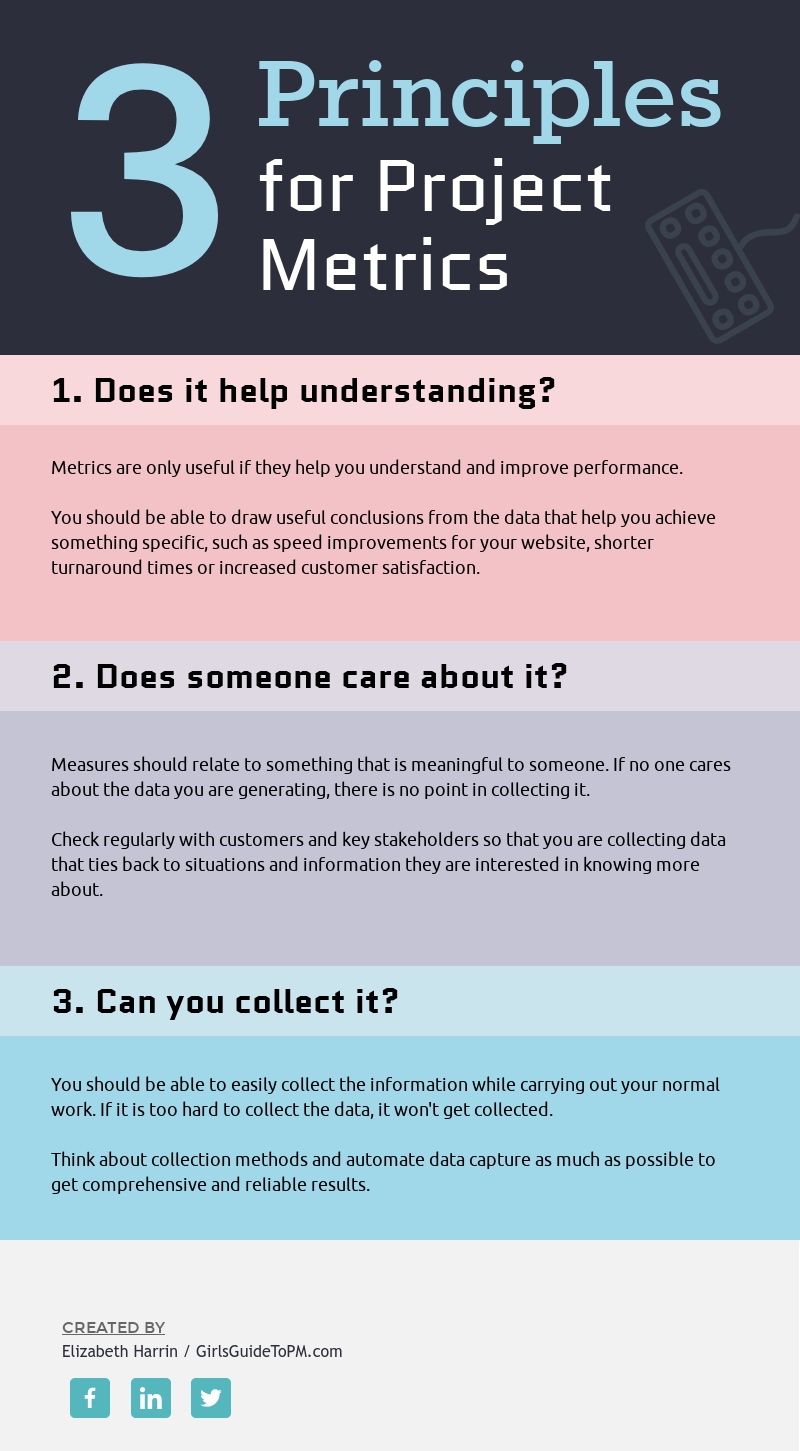
This graphic shows three core principles for creating and using metrics. They are universally applicable but good for project managers because we have to think up (and then find ways to track) KPIs and success criteria measures for our projects. And if you’re in a PMO role, you must have a bunch of data points you are collecting too – I wonder how many of them make it into the reports you produce for stakeholders? And then how many stakeholders actually read and care about them?
For more on the topic of what makes a good measure for your project, take a look at this article, which digs into some examples and how to make sure that you are creating measures that are useful, in more detail.
Posted on: February 07, 2019 01:25 PM |
Permalink
Comments (15)
Please login or join to subscribe to this item
Thank you very much, I succeed in 2019

Rami Kaibni
 Community Champion
Senior Projects Manager | Field & Marten Associates
New Westminster, British Columbia, Canada
Very good points Elizabeth!

Angélica Leiva
Project Manager Senior| Servipag
Santiago, Región Metropolitana, Chile
Thank you Elizabeth! very useful tips

Alok Priyadarshi
Project Manager| Tata Consulting Engineers Limited
Jamshedpur, Jharkhand, India
Thanks Elizabeth for your advice.

Tamer Zeyad Sadiq
Assistant Cost Manager| Turner & Townsend
Riyadh, Ar Riyad, Saudi Arabia
Nice topic it is created before scope definition

Tim Podesta
Director of PM/PMO| Former BP- now Independent
Penn, Bucks, United Kingdom
Spot on, the power of three. The challenge is to find the three key metrics for the sponsors that meet the requirements you have set out. My experience of getting Value from Front Eng Planning is that having well developed, understood and supported measures for Front End Planning, Team Alignment and Benchmarks for Estimates is a good example.

Drew Craig
Sr. Agile & Product Coach| Vanguard
Philadelphia, Pa, United States
Great, Elizabeth, thank you.

Sergio Luis Conte
Helping to create solutions for everyone| Worldwide based Organizations
Buenos Aires, Argentina
Thank you for sharing. The only thing I respectfully disagree is about your three point. You collect data not information. Metric is about to convert the data into information. Metric is information.

Amar S
DGM - Global Product Management| ELGi Equipments Ltd.
Bangalore, Karnataka, India
Thanks for sharing your thoughts.

RAJESH K L
Project Manager, PMP| Bharat Electronics, Bengaluru, India
Bengaluru, Karnataka, India
Interesting points. Thanks for sharing

Mark Steward
Director| Arrow Zee Australia
Sydney, Nsw, Australia
Thanks for sharing Elizabeth.
Great key points.In answer to your opening question, too many times!
Two other things people should consider is calculation and source.
If you have calculated measure, especially if it is new or unique, then explaining how it is calculated ensures people don't form the wrong conclusions.
Secondly, the source is important. I have seen people report on the same thing with dramatically different results. The reasons are many and can be because snapshots are taken at different times (e.g, before and after a supplier was paid); or that the data was taken from different source systems (e.g. finances from MS Project or GL systems); or it was taken from the same source but different filters were applied when it was extracted; or the data was cleaned and tidied up manually as it passed between people (common if people are emailing Excel reports, without controls). Timestamping reports, referencing any filter criteria and data sources, and controls are ways around this.

Frank Leslie Pinto
Senior Project Manager| Manipal Technologies Limited
Mangalore, Karnataka, India
Experience speaks. Thank you Elizabeth.
3 good principles
Thanks for sharing

Binu Samuel
Project Manager | Rosa Carolina
Pathanamthitta, Kerala, India
Please Login/Register to leave a comment.
|
"It is better to deserve honors and not have them than to have them and not to deserve them."
- Mark Twain
|




