


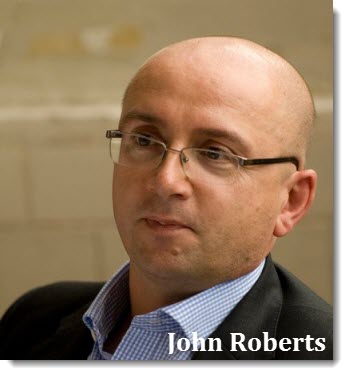
 I was on a course recently and all my pre-course reading came on a Kindle. When I asked the instructors about it, they said it was because people travelling to courses were fed up with coming and going with huge heavy folders of paper. New technologies have changed how we choose to do many things, and training courses are no exception. I caught up with John Roberts, Director at change consultancy myProteus, about how training providers are adapting.
John, how do you think models of training are changing and why?
A key finding from the CIPD 2012 Learning and Talent Development surveyrevealed that traditional learning methods are considered amongst the least effective ways to up-skill employees but, in the absence of anything else, they tend to dominate most learning and development programmes.
With the acceleration in economic uncertainty, organisations are keen to invest in the professional development of their people but can ill afford to provide costly face-to-face training for all. Increasingly organisations are looking for a more flexible solution that embeds learning and delivers an ongoing sustainable improvement in performance.
To satisfy this need, it is imperative that models of training change to appropriately reflect different learning styles, embrace technology, be practical, enable self-help on an ongoing basis, embed best practice and facilitate real skills transfer.
I see that companies are moving towards online learning. A product from your company, myProteus, provides online support – tell me more about that.
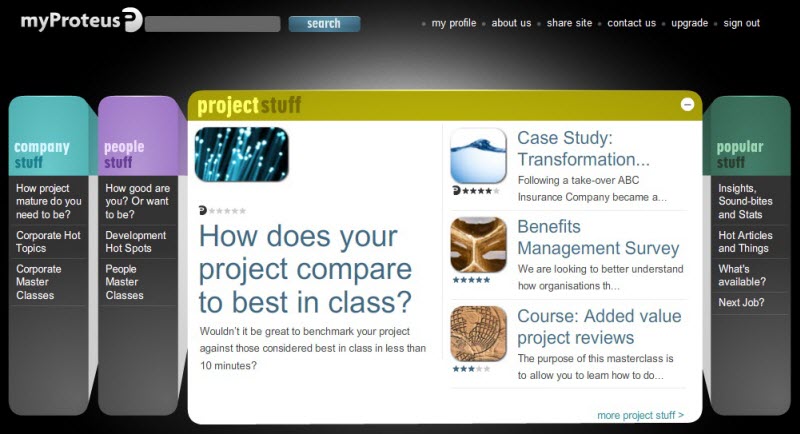
Technology has clearly caused a sea change in the delivery of both learning models and project management tools and techniques, and has been instrumental in developing the myProteus offering. myProteus is a modular online self-help portal which is replete with project and programme management best practice, cutting-edge know how, and diagnostic self-help tools. It is designed for anyone involved with change, not just the project management professionals.
Built upon the power of self-learning and customisation, it is more focused on the ‘how do I…’ of projects rather than the ‘what is…’
Not only does it provide the basics you would expect but it also makes available practical items and insights that can make a real difference to an organisation, its projects and its people.
Self-help ‘training’ is an interesting option. I image that helps project managers be more productive and spend less time (and money) on finding the answer?
Projects are, without a doubt, getting harder. In fact, a recent survey we conducted revealed that 55% of projects are demonstrating more complex characteristics than those traditionally delivered in the past.
This acceleration in complexity often means that organisations are embarking on projects of unprecedented size and scale, but using traditional training approaches which are unlikely to result in success.
Self-help products, like ours, help project managers be more effective by:
- helping them to know and ask the ‘right’ questions of their Sponsor or Project manager
- enabling them to regularly self-assess the health of their projects to identify and address any hot spots
- sharing insights and case studies to help organisations learn the lessons and issues to watch out for from similar projects to increase their chances of success
- equipping people with more appropriate approaches and know-how relevant for today’s projects
- providing an ability for corporates to compare themselves with ‘best-in-class’ (including from other sectors) to highlight areas for improvement.
Anything that helps project managers be more effective saves money. How else can the model of self-training benefit a company’s bottom line?
It allows corporates to achieve a level of project maturity and performance faster and cheaper than would be the norm. Typical corporate benefits include:
- Improved project delivery performance – significant improvement in the speed and predictability of the projects being run within organisations, releasing new capabilities and benefits into the business more quickly.
- Reduced costs – significant reduction in staff, capability investment, project mobilisation and consultancy costs, with typical savings between £2m - £17m.
- Better management information – significantly improved and useable intelligence around the ‘state of the nation’.
- Greater internal capability – multi-development offering including best practice know-how articles, self-help tools, e-learning, face-to-face masterclasses, mobile apps, and coaching, among others.
- Ability to benchmark – corporates can readily benchmark their projects and their project community against role model benchmarks to identify key areas to address and to demonstrate changes in capability and project performance over time. They can also be benchmarked with organisations in their sector or other sectors.
We believe such bold approaches – demystifying project management and empowering employees throughout an organisation with the knowledge and skills required to manage projects effectively – hold the keys to making sustainable change truly achievable.
Thanks, John!
About The Expert:
John Roberts is a director at myProteus, a change consultancy that has recently launched a mobile app for project managers and an app for project sponsors which contain market-leading insights built around the top ten themes identified by both project managers and sponsors in a survey.


