3 Options for Dealing with Team Conflict
From the The Money Files Blog
by Elizabeth Harrin

A blog that looks at all aspects of project and program finances from budgets, estimating and accounting to getting a pay rise and managing contracts.
Written by Elizabeth Harrin from RebelsGuideToPM.com.
Recent Posts
When projects get serious: what changes after the “easy” phase
How to run a retrospective that isn’t awful
A practical guide to stakeholder influence mapping
Why Your Project Forecast Keeps Changing (and What to Do About It)
Invisible progress: how to show value when nothing big has launched yet
Categories
accounting,
agile,
ai,
appraisals,
Artificial Intelligence,
audit,
Backlog,
Benchmarking,
benefits,
Benefits Management,
Benefits Realization,
Bias,
books,
budget,
Business Case,
business case,
business case,
Career Development,
Career Development,
carnival,
case study,
Change Management,
checklist,
collaboration tools,
communication,
Communications Management,
competition,
complex projects,
Conferences,
config management,
consultancy,
contingency,
contracts,
corporate finance,
corporate finance,
cost,
Cost Management,
cost management,
credit crunch,
CRM,
data,
data security,
debate,
Decision Making,
delegating,
digite,
earned value,
Education,
Energy and Utilities,
Estimating,
events,
FAQ,
financial management,
financial management,
forecasting,
future,
GDPR,
general,
Goals,
Governance,
green,
Information Technology,
Innovation,
insurance,
interviews,
it,
Knowledge Management,
Leadership,
Lessons Learned,
measuring performance,
Mentoring,
merger,
methods,
metrics,
multiple projects,
negotiating,
Networking,
news,
Olympics,
organization,
Organizational Culture,
outsourcing,
personal finance,
Planning,
pmi,
PMO,
PMO,
Portfolio Management,
portfolio management,
presentations,
privacy policy,
process,
procurement,
product management,
productivity,
Program Management,
project closure,
project data,
project delivery,
Project Success,
project testing,
prototyping,
qualifications,
Quality,
quality,
Quarterly Review,
records,
recruitment,
reports,
requirements,
research,
resilience,
Resource Management,
resources,
risk,
Risk Management,
ROI,
salaries,
Schedule Management,
Scheduling,
scope,
Scope Management,
security,
small projects,
Social Impact,
social impact,
social media,
software,
software,
software,
Stakeholder Management,
stakeholders,
Strategy,
success factors,
supplier management,
team,
Teams,
testing,
testing,
timesheets,
tips,
training,
transparency,
trends,
value management,
vendors,
video,
virtual teams,
workflow
Date
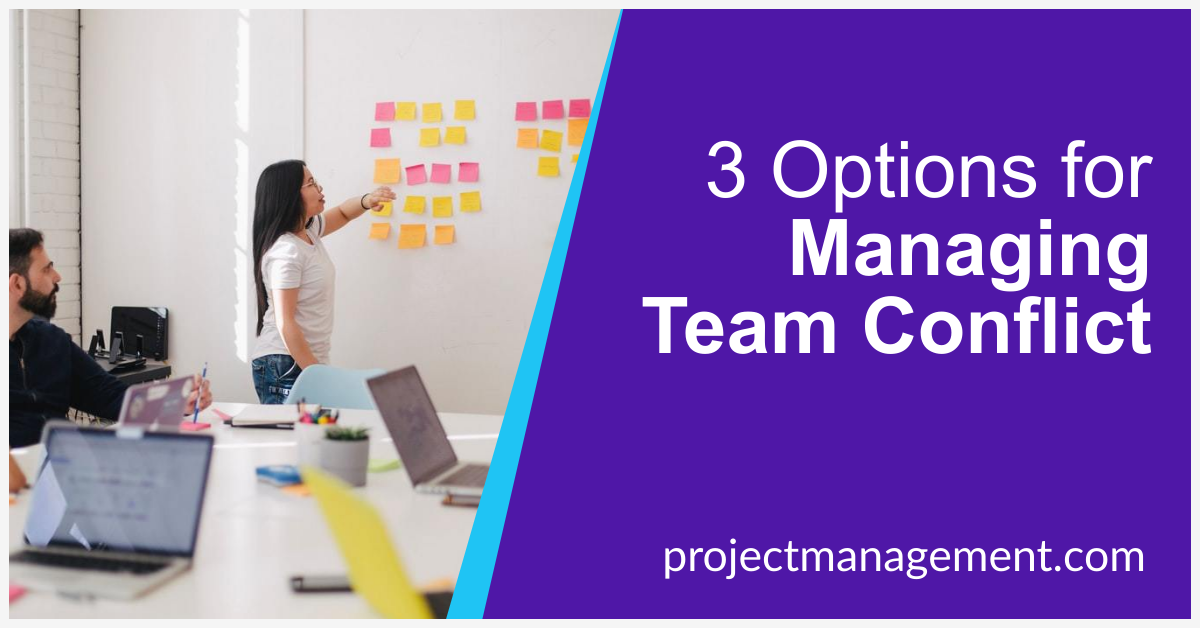
Whether it’s raised eyebrows and eyerolling or a full-on shouting match, projects are a conflict-inflicted environment!
You could be on the receiving end of the conflict because team members or stakeholders have fallen out over something. Or you could be contributing to it, having to address an issue such as not having enough money to complete the work.
As a self-confessed conflict avoider, I have always wanted to get conflict dealt with and out the way as soon as possible, so we can all get back to work. Here are 3 options for diffusing conflict situations on a project.
1. Take the heat out of the situation
One option – one of my favourites because it’s not confrontational – is to help everyone calm down a bit.
Oftentimes, a problem doesn’t look so bad with a bit of distance, and the heat disappears from the conflict.
The simplest thing to do here is to draw a line under the conversation, take a pause, and say you’ll come back to the conflict-causing topic at another time.
Remember to actually address the topic at that time, though, otherwise you just cause seething resentment in the team members who want to air their views and haven’t had the opportunity to.
If you are one of those people who can diffuse tension in a room with a joke, go for it. I’m not, so I wouldn’t risk saying something not very funny and making the situation worse, so I opt for calm voices, and a short pause in proceedings.
2. Agree
It’s so difficult to be rude or argumentative to someone who agrees with you. I don’t remember who I learned this from as a retail assistant in a busy shop while I was at college, but it certainly works with angry customers.
If you aren’t defensive, they stop fighting. It’s no fun arguing with someone who isn’t arguing back and who appears to actually be on your side.
Obviously, this isn’t going to work in every scenario. You can’t agree with a construction worker who is choosing not to wear protective gear on a building site and causing a fuss about it.
But in some situations, this is a good technique to try. You can always move the discussion along and use other techniques if necessary.
3. Say you are sorry
Again, this isn’t a solution appropriate for every project conflict situation. However, you shouldn’t be above saying sorry. If the mistake is yours, own it. Sometimes that’s all people want – for someone else to accept the issue happened and to own up to it.
I’ve been in meetings where I’ve taken the blame for something the project team did (collectively) as I’m the one who is responsible for the successful delivery. And we didn’t deliver. That’s on me. The body language of the person with the complaint changed significantly after I said sorry. The discussion moved on.
These 3 techniques aren’t going to win you any peace treaty awards, but for day-to-day small gripes and grumbles on a team, they are easy things to try. What’s your best tip for keeping the peace on a project?
Pin for later reading:

Posted on: March 17, 2020 09:00 AM |
Permalink
Comments (5)
Please login or join to subscribe to this item

Mahadevan Sannasy
Manager Aircraft Projects Engineering| Qantas Airways
Sydney, Australia
Great post, thanks. I have used your option #1 during many lengthy heated discussions with success to calm things down by saying something along the lines of, "your point is very well noted, thanks for highlighting it, let's move on we have a lot to cover today.."
Really memorable act to calm ownself .
I agree with 1, but not sure about 2 and 3; really depends on the situation. Thanks Elizabeth.

Jeremy Dacuycuy
Senior Project Manager| UC Davis Health
Sacramento, Ca, United States
Love it when you say, "you shouldn’t be above saying sorry. If the mistake is yours, own it." We all need to be humble.
I have been in countless meetings where I had to escalate the situation and then when we meet with their manager, their manager is looking at me wondering why he/she was brought into the conversation. At that point, its their word vs. mine. Thus, I've moved over to recording meetings to keep everyone honest.
Great post as usual. Congratulations! Agree with the first 2 , not always sure about #3. You are right, each situation is different and it can be applicable in some scenarios. I would add 2 more techniques to PMs who are genuinely interested in conflict resolutions
1. take learnings from each disagreement and see what can be improved the next time. use it as a learning experience
2. Have periodic retrospectives (once every 2 weeks) so team members can openly discuss issues that concern them. Make it about the team. You shuld see a reduction in conflicts over time if you are intentional about the retrospectives.
Thanks again for a very good post. It is definitely a reminder for all PMs/ Leaders.
Please Login/Register to leave a comment.





