Project Management

5 Ways to Improve your Budget Situation

From the The Money Files Blog
by
A blog that looks at all aspects of project and program finances from budgets, estimating and accounting to getting a pay rise and managing contracts. Written by Elizabeth Harrin from RebelsGuideToPM.com.

About this Blog

RSS

Recent Posts

Who really owns the project budget? Clarifying financial accountability

How to learn AI the sensible way

Making sense of project cost reports

How real PM mentoring actually works

The Accidental Product Manager: What project managers need to know

Categories

accounting, agile, ai, appraisals, Artificial Intelligence, audit, Backlog, Benchmarking, benefits, Benefits Management, Benefits Realization, Bias, books, budget, Business Case, business case, business case, Career Development, Career Development, carnival, case study, Change Management, checklist, collaboration tools, communication, Communications Management, competition, complex projects, Conferences, config management, consultancy, contingency, contracts, corporate finance, corporate finance, cost, Cost Management, cost management, credit crunch, CRM, data, data security, debate, Decision Making, delegating, digite, earned value, Education, Energy and Utilities, Estimating, events, FAQ, financial management, financial management, forecasting, future, GDPR, general, Goals, Governance, green, Information Technology, Innovation, insurance, interviews, it, Knowledge Management, Leadership, Lessons Learned, measuring performance, Mentoring, merger, methods, metrics, multiple projects, negotiating, Networking, news, Olympics, organization, Organizational Culture, outsourcing, personal finance, Planning, pmi, PMO, PMO, Portfolio Management, portfolio management, presentations, privacy policy, process, procurement, product management, productivity, Program Management, project closure, project data, project delivery, Project Success, project testing, prototyping, qualifications, Quality, quality, Quarterly Review, records, recruitment, reports, requirements, research, resilience, Resource Management, resources, risk, Risk Management, ROI, salaries, Schedule Management, Scheduling, scope, Scope Management, security, small projects, Social Impact, social impact, social media, software, software, software, Stakeholder Management, stakeholders, Strategy, success factors, supplier management, team, Teams, testing, testing, timesheets, tips, training, transparency, trends, value management, vendors, video, virtual teams, workflow

Date

linkedin twitter facebook Request to reuse this  


I’m lucky in that the projects I am working on at the moment have a requirement for resource time, but we can manage the work in-house so we don’t need to invest in anything else. However, in the past I have managed projects with substantial budgets – and also those with small budgets.

Personally, I think that managing smaller budgets is harder because there is less wiggle room to lose a small amount in the rounding, but we have to work with what we have.

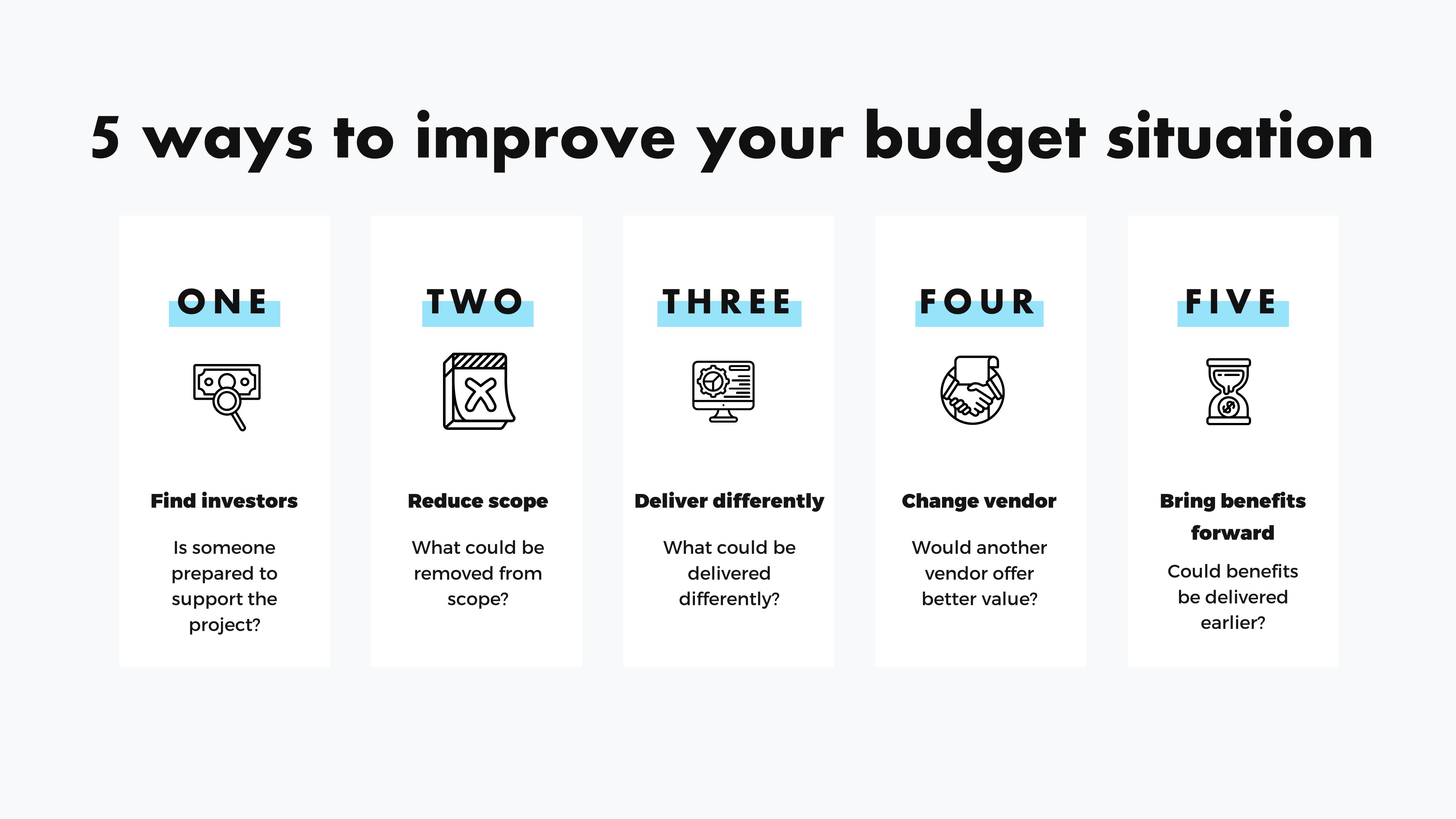
When something on your project changes and your budget is reduced, you might have to look at creative ways to make the money go further. Here are some suggestions.
budget

Find angel investors/donors

OK, let’s get this one out the way first! I got this example for the Project Management For Musicians book by Jonathan Feist, and it’s clear that it won’t work for all kinds of projects. I couldn’t run an SAP deployment by finding a lovely benefactor who just happened to want to sponsor an ERP implementation from the goodness of their heart.

But if your project is to run an event, stage a show, or something similar, perhaps this is an option for you. For example, if a benefactor donated a certain amount, they could get a free ticket to the gig.

I’m sure much of the world of PR and event management taps into this option all the time. If you do go down this route, just be sure to make sure whatever you do falls within the ethics guidelines of your organisation as you don’t want to be seen as taking or giving bribes or hospitality gifts that could get you and your company into trouble.

I’m including this one really as a prompt to ask you to think creatively about the situation you are in and what might address it.

Do less: reduce the scope

The classic way to save money on a project is to do less. Look for chunks of the project that could be pushed into a Phase 2 or subsequent initiative.

Typically, if you remove scope, you are also removing cost because the work takes less resource to get done. Analyse what could be removed to save money but would have minimal impact on the end result. There probably isn’t much that falls into this category, but there might be something.

Do different: change the scope

Another common way to reduce spend on a project is to look at changing the scope to deliver the goals in a different way. What about these switches:

  • Skip an expensive live in-person launch for a virtual tour
  • Replace classroom training with video walkthroughs and online help
  • Use a train-the-trainer model instead of asking the software vendor to train all employees.

What else could you switch? Let me know in the comments.

Change vendors

If your project involves buying in goods or services, you could also consider changing those providers. Perhaps another vendor would be cheaper, especially if you looked further afield.

Depending on the work, changing vendors could be more expensive, especially in the short-term. Pulling experienced contractors who know your business off a project and replacing them with remote contractors will have a learning curve, even if the skillsets of the two consulting firms are identical. Factor that in before you make any proposals.

Alternatively, consider the cost of bringing the work in-house. Would it be cheaper to hire someone on a fixed term contract than it would to get a supplier to do the work?

Bring benefits forward

Another option would be to look at how the project could be reordered to bring in some benefits earlier. For example, with a product launch, could you get a beta version out early to start bringing in some income that could be offset against future improvements.

If the deliverables can start bringing in some cash, that could change the financing of the work and improve the budget situation on paper, which might free up resources or investment for the next wave of development.

These are just ideas, and I hope you don’t have to use them!


Posted on: May 10, 2023 08:00 AM | Permalink

Comments (7)

Please login or join to subscribe to this item
avatar
Oala Rarua Manager Geology and Exploration| Ok Tedi Mining Ltd Papua New Guinea
Great article, short and concise and resonated well, especially on deferring some scope that will have minimal impact on end result. Train-the-trainer model is something worth exploring in lieu of software trainer training all employees, which should save some cost.

avatar
Ramkrishna Kashyap PM PMP,PMI-ACP,PMI-PBA,PMI-RMP,IFMA-CFM,LEED AP BD+C,LEEDAP O+M,NFPA-CFPS| Prime project international Dubai Thane., Maharashtra., India
so good

avatar
Zaeem Haider Project Manager| Emirates NBD Bank Dubai, Not In Us, United Arab Emirates
All ideas are practical. Thanks

avatar
Michael Hunsberger Fredericksburg, Va, United States
Thanks for the great article. I hope I don’t have to use them either!

avatar
Varney Alieu Kamara Project Supervisor | Ministry of Education Liberia
Good ideas sharing.

avatar
Najma Small Project Coordinator/Scrum Master| VM Group, Jamaica Kingston, Jamaica
All are practical. I particulary like the onr about which benefit to bring forward that could bring in income to help ofset furture investment in the project. I never thought of this. Great points.

avatar
Vidal Montoya Freelance - owner M, United States
I have done some of them in my projects, specially for that ones selecting a different vendor, do it in house Make or Buy (MoB)

Please Login/Register to leave a comment.

ADVERTISEMENTS

I lie every second of the day. My whole life has been a sham.

- George Costanza

ADVERTISEMENT

Sponsors


