What is BCF analysis?
From the The Money Files Blog
by Elizabeth Harrin

A blog that looks at all aspects of project and program finances from budgets, estimating and accounting to getting a pay rise and managing contracts.
Written by Elizabeth Harrin from RebelsGuideToPM.com.
Recent Posts
When projects get serious: what changes after the “easy” phase
How to run a retrospective that isn’t awful
A practical guide to stakeholder influence mapping
Why Your Project Forecast Keeps Changing (and What to Do About It)
Invisible progress: how to show value when nothing big has launched yet
Categories
accounting,
agile,
ai,
appraisals,
Artificial Intelligence,
audit,
Backlog,
Benchmarking,
benefits,
Benefits Management,
Benefits Realization,
Bias,
books,
budget,
Business Case,
business case,
business case,
Career Development,
Career Development,
carnival,
case study,
Change Management,
checklist,
collaboration tools,
communication,
Communications Management,
competition,
complex projects,
Conferences,
config management,
consultancy,
contingency,
contracts,
corporate finance,
corporate finance,
cost,
Cost Management,
cost management,
credit crunch,
CRM,
data,
data security,
debate,
Decision Making,
delegating,
digite,
earned value,
Education,
Energy and Utilities,
Estimating,
events,
FAQ,
financial management,
financial management,
forecasting,
future,
GDPR,
general,
Goals,
Governance,
green,
Information Technology,
Innovation,
insurance,
interviews,
it,
Knowledge Management,
Leadership,
Lessons Learned,
measuring performance,
Mentoring,
merger,
methods,
metrics,
multiple projects,
negotiating,
Networking,
news,
Olympics,
organization,
Organizational Culture,
outsourcing,
personal finance,
Planning,
pmi,
PMO,
PMO,
Portfolio Management,
portfolio management,
presentations,
privacy policy,
process,
procurement,
product management,
productivity,
Program Management,
project closure,
project data,
project delivery,
Project Success,
project testing,
prototyping,
qualifications,
Quality,
quality,
Quarterly Review,
records,
recruitment,
reports,
requirements,
research,
resilience,
Resource Management,
resources,
risk,
Risk Management,
ROI,
salaries,
Schedule Management,
Scheduling,
scope,
Scope Management,
security,
small projects,
Social Impact,
social impact,
social media,
software,
software,
software,
Stakeholder Management,
stakeholders,
Strategy,
success factors,
supplier management,
team,
Teams,
testing,
testing,
timesheets,
tips,
training,
transparency,
trends,
value management,
vendors,
video,
virtual teams,
workflow
Date
You know all those baselines you save in Microsoft Project? All the snapshots of your plan you keep just in case? Well, they are hugely useful for looking at to compare actual performance against forecast, so dust them off and let’s start using them.
BCF stands for Baseline-Current-Future and it’s a way of looking at comparative schedules. As a schedule control tool, it’s easy to use, easy to understand, and it’s a useful way of discussing project progress and performance with the team without having to go full earned value.
Plus, it’s not much work for you as the project manager, as you probably already have the details available.
Here’s how to do it.
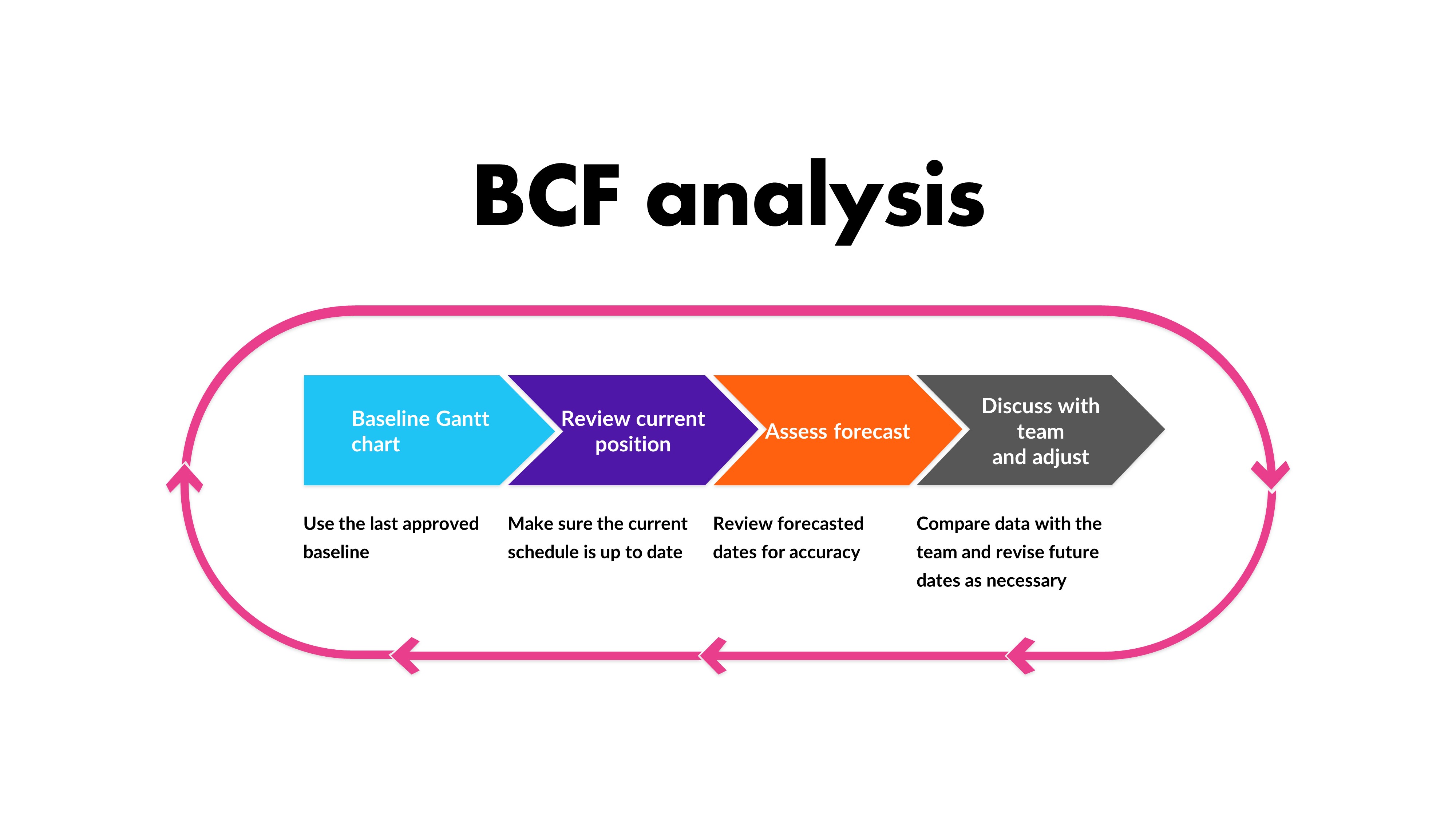
The process
First, take the baseline Gantt chart. This will be the latest saved version of your Gantt chart that is an approved baseline. I know software tools can keep baselines saved in the software, but I do tend to keep a separate version of the whole file saved with the date in the filename, just so I have a back up of exactly how the plan looked at the point of the last official review.
You’ll also need an up-to-date position for what is happening right now, so if you don’t have team members entering data in real-time, you might have to give them some notice to get their data into the tool.
Then, you’ll need the future scheduled dates; what you anticipate the rest of the schedule will look like. This is your forecast, and will be the information in your schedule for the dates that haven’t yet happened. Just give them a quick review to make sure they are still accurate and reasonable before you take them as finalised for this exercise.
Compare the baseline against the current and future positions. You can do this with a table that shows the milestones, or a Gantt chart that shows the various different bars on the same chart so people can see slippages and changes.
Talk to the team
When you have prepared your analysis of the baseline and current/future position, circulate the comparison for discussion.
Ask:
- Does the future schedule look OK?
- Do we understand why the dates have changed since we baselined the project?
- What assumptions have we made and do these need to change now?
- What future changes do we anticipate based on what we see about past performance?
- Who else needs to be involved in this discussion?
- What steps should we take next?
And anything else you think is helpful to ensure that the discussion is productive and you get what you want out of it – which should be increased confidence in your future scheduled dates.
You’ll probably find that there have been some changes that have not yet been reflected in the schedule. There might also be some interesting takeaways about why things changed. Feed these into the lessons learned documents – in fact, it might be valuable to have this discussion on scheduling as part of your pattern of retrospectives.
Schedule analysis is a useful tool to understand what happened and take from that some actions or learning that would help you do things differently in the future. In addition, it helps with being able to set expectations for stakeholders so they have the confidence that the schedule is deliverable and the team are onboard with what they need to do when.
What other tips do you have for using project baselines? Let us know in the comments!
Posted on: May 16, 2023 08:00 AM |
Permalink
Comments (6)
Please login or join to subscribe to this item

Sukru EREN
Planning Manager| TERSAN SHIPYARD
Yalova, Türkiye
Dear Harrin, thanks for sharing this useful article with us.
This blog provided valuable information that I will definitely put into practice
This blog provided valuable information that I will definitely put into practice

Naman Belwal
Project Manager. PMP, FIE, MIMA| Reliance Industries Ltd.
Jamnagar, Gujarat, India
Thank you.
BCF analysis is very important Focus is mainly on the baseline and current data.
The forecast is the most important to understand where the project is actually heading (future).

Ming Yeung
Professor (adjunct part time)| George Brown Polytechnic/Fanshawe College/Humber Polytechnic
Toronto, Ontario, Canada
Thank you for sharing the BCF analysis, a wonderful tool for me (and fellow PMs) in the project management realm.

Diego Alecyr
Executive Manager| Inter&Co
Belo Horizonte/MG, Brazil
Amazing and useful article that covers an important topic about monitoring and controlling the schedule's project.
Thank you for sharing, Elizabeth Harrin.
Please Login/Register to leave a comment.
|
"Maybe this world is another planet's hell."
- Aldous Huxley
|




