6 Types of Projects: Which one are you working on?
From the The Money Files Blog
by Elizabeth Harrin

A blog that looks at all aspects of project and program finances from budgets, estimating and accounting to getting a pay rise and managing contracts.
Written by Elizabeth Harrin from RebelsGuideToPM.com.
Recent Posts
When projects get serious: what changes after the “easy” phase
How to run a retrospective that isn’t awful
A practical guide to stakeholder influence mapping
Why Your Project Forecast Keeps Changing (and What to Do About It)
Invisible progress: how to show value when nothing big has launched yet
Categories
accounting,
agile,
ai,
appraisals,
Artificial Intelligence,
audit,
Backlog,
Benchmarking,
benefits,
Benefits Management,
Benefits Realization,
Bias,
books,
budget,
Business Case,
business case,
business case,
Career Development,
Career Development,
carnival,
case study,
Change Management,
checklist,
collaboration tools,
communication,
Communications Management,
competition,
complex projects,
Conferences,
config management,
consultancy,
contingency,
contracts,
corporate finance,
corporate finance,
cost,
Cost Management,
cost management,
credit crunch,
CRM,
data,
data security,
debate,
Decision Making,
delegating,
digite,
earned value,
Education,
Energy and Utilities,
Estimating,
events,
FAQ,
financial management,
financial management,
forecasting,
future,
GDPR,
general,
Goals,
Governance,
green,
Information Technology,
Innovation,
insurance,
interviews,
it,
Knowledge Management,
Leadership,
Lessons Learned,
measuring performance,
Mentoring,
merger,
methods,
metrics,
multiple projects,
negotiating,
Networking,
news,
Olympics,
organization,
Organizational Culture,
outsourcing,
personal finance,
Planning,
pmi,
PMO,
PMO,
Portfolio Management,
portfolio management,
presentations,
privacy policy,
process,
procurement,
product management,
productivity,
Program Management,
project closure,
project data,
project delivery,
Project Success,
project testing,
prototyping,
qualifications,
Quality,
quality,
Quarterly Review,
records,
recruitment,
reports,
requirements,
research,
resilience,
Resource Management,
resources,
risk,
Risk Management,
ROI,
salaries,
Schedule Management,
Scheduling,
scope,
Scope Management,
security,
small projects,
Social Impact,
social impact,
social media,
software,
software,
software,
Stakeholder Management,
stakeholders,
Strategy,
success factors,
supplier management,
team,
Teams,
testing,
testing,
timesheets,
tips,
training,
transparency,
trends,
value management,
vendors,
video,
virtual teams,
workflow
Date
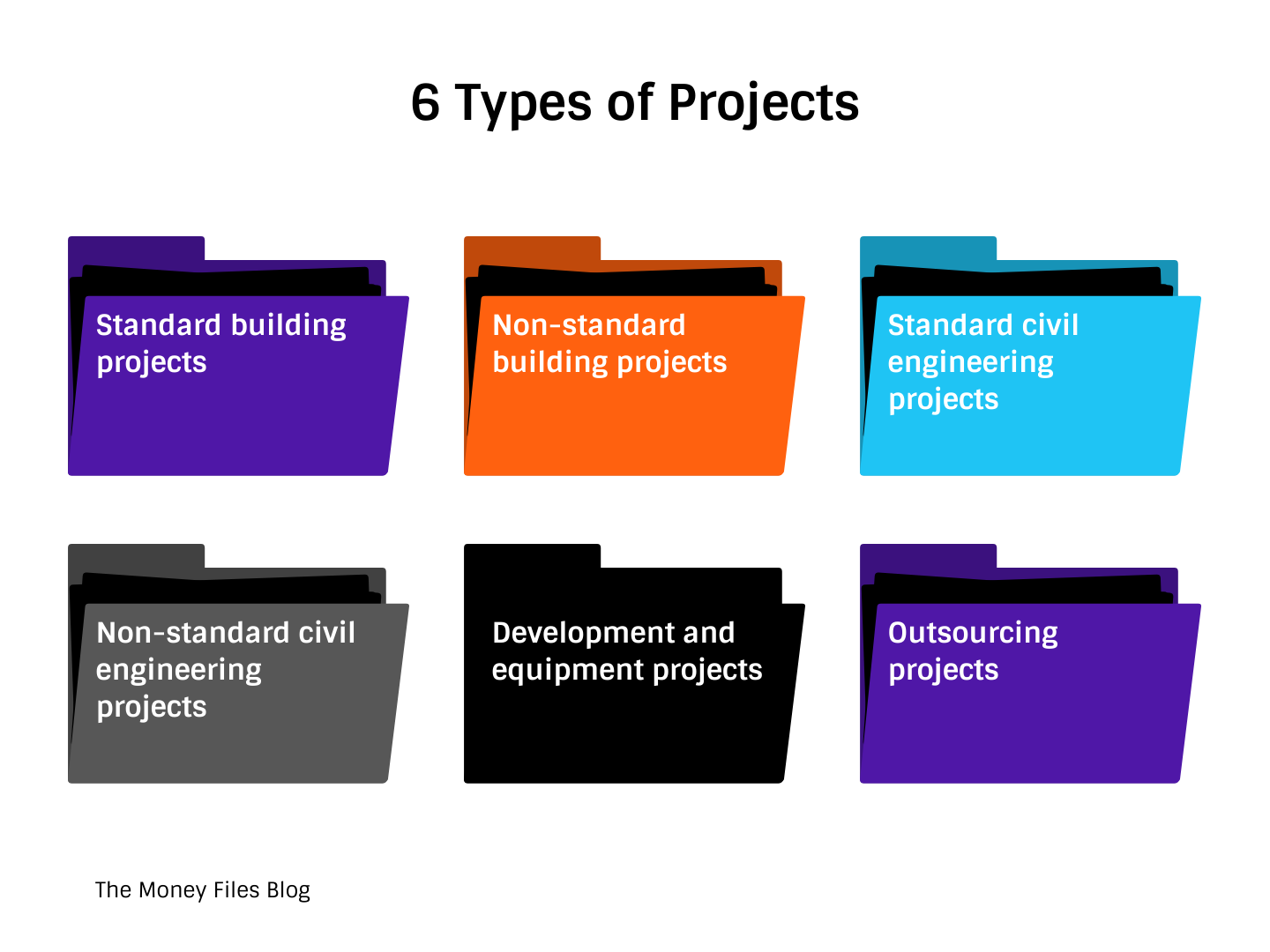
There are loads of different ways of categorising projects, but I came across a way that was new to me recently. There are 6 categories of project outlined at high level in a UK government publication about creating a project business case.
I’ve summarised them briefly below.
1. Standard building projects
Let’s start with the building projects. A ‘standard’ building project is one that pretty much uses a building blueprint that’s already available. There are no special design considerations, no fancy extras or design features to incorporate.
Examples:
- Office buildings
- Residential buildings (not self-build or fancy architect-led projects)
- Airport terminals
- Hospitals
- Schools
2. Non-standard building projects
Anything that is not a standard building construction project is a non-standard project. These are constructions that have special requirements or must meet certain conditions, perhaps dictated by use or space or the requirement to incorporate some high-tech feature.
The environment around the construction might also make the project non-standard. For example, if the site has some special archelogical, scientific or envrionmental significance. Or it could be that the building is going on the side of a mountain or in a cave, or something like that.
Examples:
- High-tech facilities such as labs or research facilities (think: a polar exploration hub)
- ‘Destination’ buildings: when we visited the Arctic Circle, we stayed in a hotel that had rooms with huge windows in the ceiling for watching the Northern Lights.
While I was in a previous role, the company acquired an old building and changed its use, but had to keep the existing façade. I’d put that project in this category as the complications around what we could and couldn’t do within the footprint of the building made everything quite a challenge.
3. Standard civil engineering projects
Straightforward civil works would use tried-and-tested techniques. There’s not much else to say about these.
Examples:
- Roads
- Utilities like electricity plants or water treatment facilities.
- Railways.
4. Non-standard civil engineering projects
Do you see the pattern? Unsurprisingly, non-standard public sector and civil works include things that don’t fit the mould of the standard work. They are non-routine constructions.
Examples:
- Upgrades and extensions like the Jubilee line extension on London’s underground system
- Utility projects where the environment is non-standard or constrained in some way
- Build projects like railways that require additional features or technology.
5. Development and equipment projects
If you’re not building something physical, you might be building software or doing some other kind of development. These projects move an organisation forward and help get things done. They are often the work that underpins strategy delivery and can be big or small.
All the projects I’ve ever worked on fall into this category, as I don’t work in construction or outsourcing (which we’re coming to).
Examples:
- Software development
- Process change
- Provision and installation of equipment into facilities.
These could be cutting-edge tech deliveries or simply upgrading your old phone system or something equally routine.
6. Outsourcing projects
Finally, projects that have the end result that something is outsourced. That could be providing a client with cloud computing solutions or running a building for them, and typically it’s all about ‘something as-a-service’.
Examples:
- Equipment maintenance
- Setting up a new helpdesk for IT queries
- Providing whatever it is you provide as a package to the client where they have outsourced provision of that service or product to you.
Do you think this is a good way to split up projects? I’m not sure that I do – there isn’t enough granularity of the ‘development’ projects for me. Maybe they are all unique and we don’t need to split them between standard and non-standard. Most of the things I’ve worked on have felt non-standard at the time.
What category of project do you work on? Let us know in the comments below!
Posted on: July 18, 2023 08:00 AM |
Permalink
Comments (7)
Please login or join to subscribe to this item

Binay Samanta
Director| Project & Environment Consultants
Dhanbad, India
Nice analysis of type of projects
Nice Article, I really enjoyed it.

samir mohi
PM Consultant| ietc
Giza, Giza, Cairo,Egypt, Egypt
Great categories on various type of projects.
I primarily have worked on Development projects with a keen focus on efficiencies and process improvements.
Regardless of project types, project success needs to be holistically defined and measured using an appropriate project success framework. Several project success frameworks are available such as the Multilevel project success framework by Bannerman (2008) for IT/IS projects, the Results framework by UNDP (2012) for development projects, the Multidimensional project success criteria by Elbaz & Spang (2018) for facility projects and the PESTOL framework by Zidane et al (2018) for infrastructure projects.
Projects can be categorized into various types based on their nature, objectives, and characteristics. Here are six common types of projects, along with brief explanations of each:
Construction Projects:
Description: Construction projects involve building or renovating physical structures, such as buildings, bridges, roads, and infrastructure. These projects often require careful planning, design, procurement of materials, and skilled labor.
Characteristics: High resource utilization, specific design and engineering requirements, complex project scheduling, and often subject to regulatory approvals.
Information Technology (IT) Projects:
Description: IT projects focus on developing, implementing, or upgrading software systems, hardware, or IT infrastructure. They are common in industries ranging from finance to healthcare.
Characteristics: Rapid technological advancements, iterative development methodologies (e.g., Agile), cybersecurity considerations, and often involve cross-functional teams.
Research and Development (R&D) Projects:
Description: R&D projects are aimed at advancing knowledge, creating new products, or improving existing ones. They are often exploratory and may not have well-defined outcomes at the outset.
Characteristics: High uncertainty, experimentation, interdisciplinary collaboration, and a focus on innovation and discovery.
Marketing and Advertising Campaigns:
Description: These projects involve creating and executing marketing strategies to promote products, services, or brands. They may include advertising, digital marketing, social media campaigns, and market research.
Characteristics: Creativity-driven, target audience analysis, tight deadlines, and a need for measuring campaign effectiveness.
Event Management Projects:
Description: Event management projects encompass planning, organizing, and executing various events, such as conferences, festivals, weddings, and corporate meetings. They aim to create memorable experiences.
Characteristics: Detailed event planning, logistics coordination, budget management, and customer satisfaction focus.
Organizational Change Projects:
Description: These projects aim to implement significant changes within an organization, such as restructuring, process improvement, or cultural transformation. They often involve change management efforts.
Characteristics: Resistance to change, stakeholder engagement, employee training, and a focus on achieving desired organizational outcomes.
Please Login/Register to leave a comment.
|
"A doctor can bury his mistakes but an architect can only advise his client to plant vines."
- Frank Lloyd Wright
|




