7 Alternative Metrics for Assessing Success
From the The Money Files Blog
by Elizabeth Harrin

A blog that looks at all aspects of project and program finances from budgets, estimating and accounting to getting a pay rise and managing contracts.
Written by Elizabeth Harrin from RebelsGuideToPM.com.
Recent Posts
How to run a retrospective that isn’t awful
A practical guide to stakeholder influence mapping
Why Your Project Forecast Keeps Changing (and What to Do About It)
Invisible progress: how to show value when nothing big has launched yet
Back ups – are you ready for disaster?
Categories
accounting,
agile,
ai,
appraisals,
Artificial Intelligence,
audit,
Backlog,
Benchmarking,
benefits,
Benefits Management,
Benefits Realization,
Bias,
books,
budget,
Business Case,
business case,
business case,
Career Development,
Career Development,
carnival,
case study,
Change Management,
checklist,
collaboration tools,
communication,
Communications Management,
competition,
complex projects,
Conferences,
config management,
consultancy,
contingency,
contracts,
corporate finance,
corporate finance,
cost,
Cost Management,
cost management,
credit crunch,
CRM,
data,
data security,
debate,
Decision Making,
delegating,
digite,
earned value,
Education,
Energy and Utilities,
Estimating,
events,
FAQ,
financial management,
financial management,
forecasting,
future,
GDPR,
general,
Goals,
Governance,
green,
Information Technology,
Innovation,
insurance,
interviews,
it,
Knowledge Management,
Leadership,
Lessons Learned,
measuring performance,
Mentoring,
merger,
methods,
metrics,
multiple projects,
negotiating,
Networking,
news,
Olympics,
organization,
Organizational Culture,
outsourcing,
personal finance,
Planning,
pmi,
PMO,
PMO,
Portfolio Management,
portfolio management,
presentations,
privacy policy,
process,
procurement,
product management,
productivity,
Program Management,
project closure,
project data,
project delivery,
Project Success,
project testing,
prototyping,
qualifications,
Quality,
quality,
Quarterly Review,
records,
recruitment,
reports,
requirements,
research,
resilience,
Resource Management,
resources,
risk,
Risk Management,
ROI,
salaries,
Schedule Management,
Scheduling,
scope,
Scope Management,
security,
small projects,
Social Impact,
social impact,
social media,
software,
software,
software,
Stakeholder Management,
stakeholders,
Strategy,
success factors,
supplier management,
team,
Teams,
testing,
testing,
timesheets,
tips,
training,
transparency,
trends,
value management,
vendors,
video,
virtual teams,
workflow
Date
We’ve all got metrics we use to assess project success: cycle time, earned value and so on.
As the year ends, maybe it’s time to look at some other measures we could use that might be a bit more… dare I say… interesting? Below, I’ve suggested 7 alternative metrics you could put in place (some easily, some would take more thought and set up) to look at what project performance really means in the round.
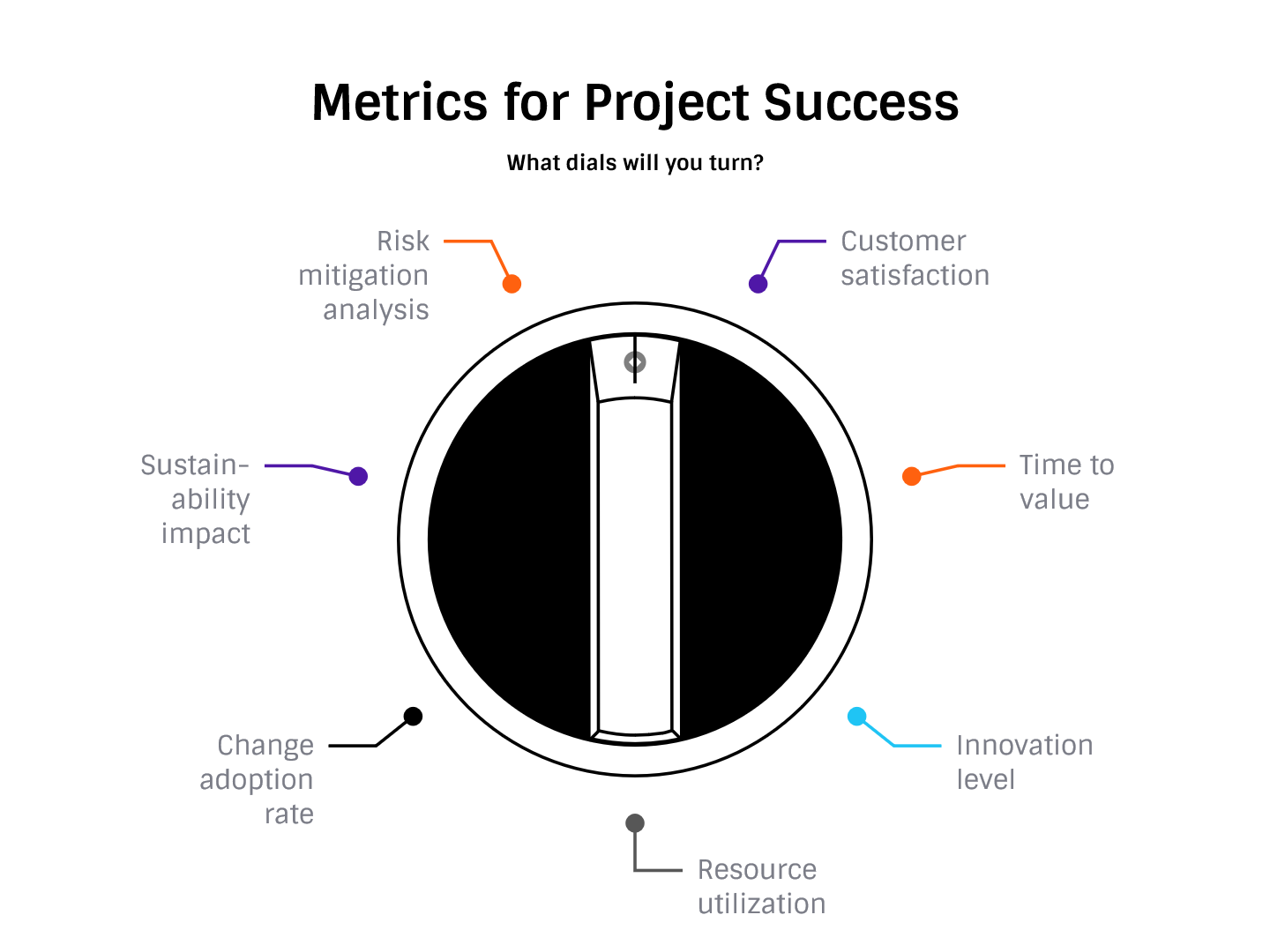
- Customer satisfaction (CSAT)
You might find CSAT in use across other teams. Why not implement it for project management customers too? Even if you work in-house, you will have internal customers. Trust me, they have an opinion on the project management service you provide. Why not check in with them directly and ask for it?
You don’t need a formal CSAT tool. Set some survey questions and set up a form to ask stakeholders their views, and then collate the results.
- Time to Value (TTV)
Cycle time is worth knowing, but does the end of your cycle always end in value delivered? A different way of thinking about it would be time to value: how quickly the project delivers tangible value per feature, or perhaps overall.
This metric comes with the added challenge of having to define value: but that could be a very useful exercise for stakeholders!
- Innovation level
Could you create your own innovation index? There are already indices in use like the Global Innovation Index, but that’s probably overkill for our projects. Consider how innovative the product/deliverables are and the method used to implement them.
- Resource utilization
Here’s one you can probably get from your project management software but I don’t see it on reports very often. What could you take from a utilization report? Metrics are only helpful if there is something you can use them for, like decision support. In this case, it would be making sure the team is adequately resourced, so you really want to be looking forward not backward. Although historical data is useful too to see if there is a trend towards over or under staffing.
- Change adoption rate
Could you create a metric that looks at how quickly the organization is adopting new changes? If you work with a change manager, they might have some ideas about how to implement this. Any new process changes or anything that requires training could be included, even if your measure was only based on smiley faces!
- Sustainability impact
Your procurement team might already have a sustainability index based on their work with vendors and a sustainable supply chain. If you have an energy team, they might have measures you can pull into your projects too. For example, how much carbon saving your project is creating, or how much waste is recycled from different locations.
- Risk mitigation effectiveness
We mitigate risks, but are those actions really useful? We could draw on AI-powered insights by plugging in risk mitigation activities across a selection of risks and the outcomes. (Or you could work through this manually). I’m not sure how you’d assess the usefulness of the mitigation strategy: maybe on a scale of 1-5? Then you could see which actions had the biggest impact in reducing the risk.
There are lots of ways to measure project performance, and no one wants to be creating reports and tracking metrics for the sake of it. However, it might be worth looking at whether your current suite of metrics truly give you the complete, holistic picture of performance, because we all know it goes beyond time, cost and quality.
Posted on: December 08, 2023 01:04 PM |
Permalink
Comments (11)
Please login or join to subscribe to this item

Kwiyuh Michael Wepngong
 Community Champion
Financial Management Specialist | US Peace Corps
Yaounde, Centre, Cameroon
Thanks Elizabeth.. The point on change adopting rate is so well explained

Luis Branco
CEO| Business Insight, Consultores de Gestão, Ldª
Carcavelos, Lisboa, Portugal
Dear Elizabeth
The topic you brought to our reflection and debate is very interesting.
Thank you for sharing and your opinions
Good contribution to evaluating success
Some of these metrics apply to different development approaches
Interesting insights, Elizabeth. Thank you for providing this knowledge share and supporting it with practical information.

Markus Kopko
AI Enabler for Project & Program Mgmt | Founder PMotion.ai / The PM
AI Coach| PMotion.ai
Hamburg, Hamburg, Germany
Dear Elizabeth,
Your exploration of alternative metrics for assessing project success provides a refreshing perspective that goes beyond traditional measures like cycle time and earned value. These metrics offer a more comprehensive view of project performance, considering aspects like customer satisfaction, innovation, and sustainability. Let’s delve into your suggestions:
Customer Satisfaction (CSAT): Measuring customer satisfaction is a direct way to gauge how well the project meets the needs and expectations of its stakeholders. Implementing a simple survey can provide valuable feedback and insights into areas for improvement.
Time to Value (TTV): Focusing on how quickly a project delivers tangible value is an excellent way to assess its effectiveness. This metric requires a clear definition of what constitutes value for the project, which can be an enlightening exercise for all stakeholders.
Innovation Level: Creating an innovation index specific to your projects can help assess how innovative the deliverables and implementation methods are. This can encourage creative thinking and help differentiate your projects in terms of their contribution to the field.
Resource Utilization: Understanding how resources are utilized throughout the project provides insights into efficiency and team workload. This can be instrumental in future planning and ensuring the team is adequately resourced.
Change Adoption Rate: Measuring the rate at which new changes are adopted within the organization can give a sense of the project's impact and the effectiveness of change management strategies.
Sustainability Impact: Assessing the sustainability impact of your projects aligns with growing global concerns about environmental responsibility. This can be quantified in terms of carbon savings, waste recycling, and other sustainability metrics.
Risk Mitigation Effectiveness: Evaluating the effectiveness of risk mitigation strategies can improve future risk management efforts. This could involve assessing the impact of these strategies on reducing or managing risks.
Your approach to project performance metrics reflects a more holistic understanding of project success, going beyond the conventional triad of time, cost, and quality. These alternative metrics can provide a fuller picture of how a project contributes to broader organizational goals and values.
In implementing these metrics, it’s crucial to balance the effort of tracking them against their practical utility. The key is to select metrics that are most relevant to your project's objectives and stakeholders.
Reflecting on your experience, how have you seen these or other alternative metrics implemented effectively? What challenges might arise in integrating these new metrics into existing project management frameworks, and how can they be addressed? Your insights in these areas would be incredibly valuable for project managers looking to adopt a more nuanced approach to measuring project success.
BR,
Markus

Lynda Roades
President| Roades Advisory
Arlington, Va, United States
Markus hit all the points I was going to make. The two alternatives that really resonated with me were 'time to value' and 'change adoption rate.' My work focuses on public sector projects and those two metrics are particularly applicable to public sector objectives. Thanks.
Great work, Elizabeth!
No matter which metric comes to mind while reading your piece, I categorized them under one of the buckets/main-categories you mentioned.

Robert Merrill
Senior Business Analyst| University of Wisconsin-Madison
Wi, United States
I can see how Time To Value and Change Adoption Rate can help span silos. Change Made and Value Realized are the whole point of doing projects, but the deliverables people and the value-realization people are often separated by a thick organizational wall. The Lowest Common Supervisor between the IT organization responsible for the "deliverables" and the business unit realizing the value and benefits is often pretty high up, often in the C-Suite. Everybody at all levels would have to come to an agreement on what Value looks like, and that feels like a good series of conversations to have.

Ming Yeung
Professor (adjunct part time)| George Brown Polytechnic/Fanshawe College/Humber Polytechnic
Toronto, Ontario, Canada
Wonderful insight and hindsight on these metrics. Thank you
Nice insights, thank you.
Great sharing! That's very useful information.

Phil Guerin
Consultant/Director| Hague Consulting Limited
Wellington, New Zealand
Interesting range of measures Elizabeth. Ideally you have a baseline and measures in place before a project and record performance before and after the project. The best measures are the ongoing ones that are produced as part of day to day business. They should also be the most useful ones for you. It is the impact on those measures that is most important.
Please Login/Register to leave a comment.
|
"There are only two ways to live your life. One is as though nothing is a miracle. The other is as though everything is a miracle."
- Albert Einstein
|






