






Guessing is not a strategy: How to build decision velocity with AI and real-time data
June 10, 2026 | Live Webinar

Who really owns the project budget? Clarifying financial accountability
How to learn AI the sensible way
Making sense of project cost reports
How real PM mentoring actually works
The Accidental Product Manager: What project managers need to know
accounting, agile, ai, appraisals, Artificial Intelligence, audit, Backlog, Benchmarking, benefits, Benefits Management, Benefits Realization, Bias, books, budget, Business Case, business case, business case, Career Development, Career Development, carnival, case study, Change Management, checklist, collaboration tools, communication, Communications Management, competition, complex projects, Conferences, config management, consultancy, contingency, contracts, corporate finance, corporate finance, cost, Cost Management, cost management, credit crunch, CRM, data, data security, debate, Decision Making, delegating, digite, earned value, Education, Energy and Utilities, Estimating, events, FAQ, financial management, financial management, forecasting, future, GDPR, general, Goals, Governance, green, Information Technology, Innovation, insurance, interviews, it, Knowledge Management, Leadership, Lessons Learned, measuring performance, Mentoring, merger, methods, metrics, multiple projects, negotiating, Networking, news, Olympics, organization, Organizational Culture, outsourcing, personal finance, Planning, pmi, PMO, PMO, Portfolio Management, portfolio management, presentations, privacy policy, process, procurement, product management, productivity, Program Management, project closure, project data, project delivery, Project Success, project testing, prototyping, qualifications, Quality, quality, Quarterly Review, records, recruitment, reports, requirements, research, resilience, Resource Management, resources, risk, Risk Management, ROI, salaries, Schedule Management, Scheduling, scope, Scope Management, security, small projects, Social Impact, social impact, social media, software, software, software, Stakeholder Management, stakeholders, Strategy, success factors, supplier management, team, Teams, testing, testing, timesheets, tips, training, transparency, trends, value management, vendors, video, virtual teams, workflow


|
The sustainability agenda is something all aspects of business are thinking about, and project management is no exception. We all need to be working towards creating a more sustainable future, and making the right choices on our projects is definitely one way to do that. The first step is to make sure sustainability criteria are included in your documentation templates. You can add sustainable and carbon footprint criteria to your business case templates. Here are some suggestions for how you can consider reducing the carbon footprint on your projects. Create a benchmarkMany companies these days have teams dedicated to energy management and sustainability, so your first point of call should be to check in to see what initiatives are already underway. If your carbon efforts are going to be officially recognised, you need to use official methods of calculating the reduction, with full transparency and a robust, proven measurement process in place. Who in the team will be responsible for tracking and measuring carbon savings, and do you need any additional processes in place to make it happen? A full approach like that might be overkill – if there is no expectation of having to save carbon, you might not want to go down the route of proving that you are in a measurable, transparent way. However, you can still follow the rest of the steps to brainstorm carbon-saving ideas with the team and build in carbon-friendly ways of working. Review project tasksTake a look at the work you are going to be doing on this project. Which tasks are going to generate a carbon calculation that can be measured? What tasks are going to generate carbon and what can you do differently? Identify carbon reduction activitiesFrom the work you are doing and the tasks identified, take a look at what extra actions you could to reduce the carbon impact. For example, are you planning to print a lot of leaflets or documentation? What could be delivered via a QR code or provided in digital format? What would still need to be created in paper format for a selection of users who would not be able to access digital content? What journeys are going to be undertaken on the project? Perhaps there are some workshops that can be held virtually and training delivered online instead of in a classroom. There are many advantages to getting together in person, but you might be able to identify some elements of the project that would work remotely. You can also look at the supply chain. Can you ask whether suppliers can deliver in a more sustainable way, such as with electric vehicles, or in recyclable packaging. What would that do to the budget, if anything? Add tasks to the planAdd your carbon reduction actions to your project plan. You might need to take specific actions, you might need to be more mindful of the way in which existing tasks are delivered. Make sure each action has an identified owner. Track and monitor progress towards your goalInclude carbon data in your reporting. If you are tracking according to your organisation’s metrics, then you might have some help from specialist teams who will know how best to report the data. Otherwise, add some narrative to your reporting to allow you to share your success with others. A lot of being smart with carbon on your project is just asking yourself the question: what can we do and are we doing things in the best possible way? Being aware of the challenges and helping others see that sustainability is a focus for you is key to keeping it on the agenda and making it part of the accepted ways of working. |
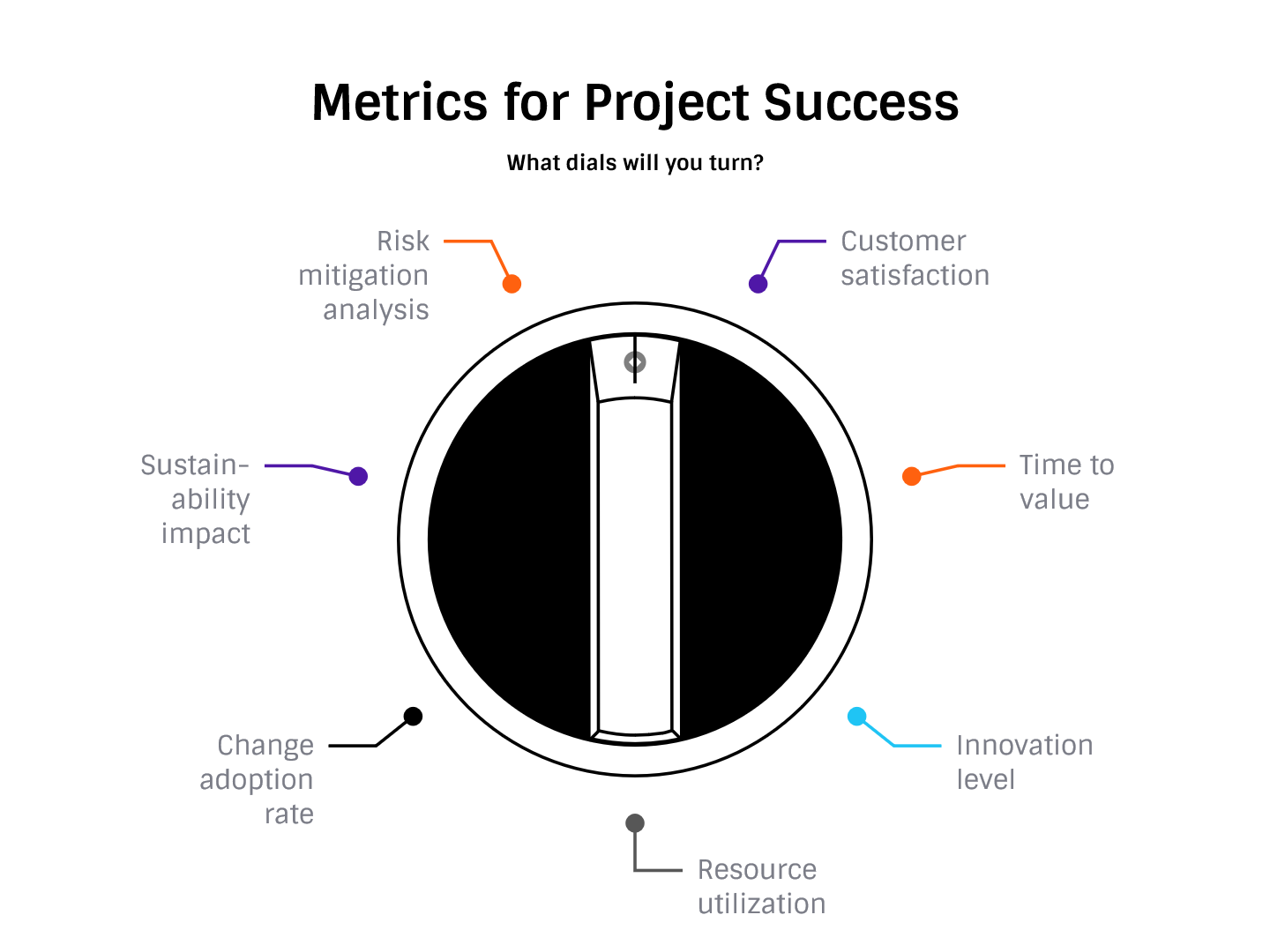
| We’ve all got metrics we use to assess project success: cycle time, earned value and so on. As the year ends, maybe it’s time to look at some other measures we could use that might be a bit more… dare I say… interesting? Below, I’ve suggested 7 alternative metrics you could put in place (some easily, some would take more thought and set up) to look at what project performance really means in the round.
You might find CSAT in use across other teams. Why not implement it for project management customers too? Even if you work in-house, you will have internal customers. Trust me, they have an opinion on the project management service you provide. Why not check in with them directly and ask for it? You don’t need a formal CSAT tool. Set some survey questions and set up a form to ask stakeholders their views, and then collate the results.
Cycle time is worth knowing, but does the end of your cycle always end in value delivered? A different way of thinking about it would be time to value: how quickly the project delivers tangible value per feature, or perhaps overall. This metric comes with the added challenge of having to define value: but that could be a very useful exercise for stakeholders!
Could you create your own innovation index? There are already indices in use like the Global Innovation Index, but that’s probably overkill for our projects. Consider how innovative the product/deliverables are and the method used to implement them.
Here’s one you can probably get from your project management software but I don’t see it on reports very often. What could you take from a utilization report? Metrics are only helpful if there is something you can use them for, like decision support. In this case, it would be making sure the team is adequately resourced, so you really want to be looking forward not backward. Although historical data is useful too to see if there is a trend towards over or under staffing.
Could you create a metric that looks at how quickly the organization is adopting new changes? If you work with a change manager, they might have some ideas about how to implement this. Any new process changes or anything that requires training could be included, even if your measure was only based on smiley faces!
Your procurement team might already have a sustainability index based on their work with vendors and a sustainable supply chain. If you have an energy team, they might have measures you can pull into your projects too. For example, how much carbon saving your project is creating, or how much waste is recycled from different locations.
We mitigate risks, but are those actions really useful? We could draw on AI-powered insights by plugging in risk mitigation activities across a selection of risks and the outcomes. (Or you could work through this manually). I’m not sure how you’d assess the usefulness of the mitigation strategy: maybe on a scale of 1-5? Then you could see which actions had the biggest impact in reducing the risk. There are lots of ways to measure project performance, and no one wants to be creating reports and tracking metrics for the sake of it. However, it might be worth looking at whether your current suite of metrics truly give you the complete, holistic picture of performance, because we all know it goes beyond time, cost and quality. |
| I was inspired to do the Generative AI for Project Managers course (which is currently free, and definitely worth looking at on the PMI website) and from there, to sign up for a ChatGPT account. In parallel to that, I was asked to deliver a webinar on AI-proofing your career (spoiler alert: AI takes away the parts of the job that I didn’t like so much anyway, and frees up more time for you to shine in human relationships), so I seem to have embedded myself in the world of AI recently! I thought I would put ChatGPT to the test by asking it a question I get asked frequently: What are the top 5 challenges affecting project managers in the world today? This is an edited version of what it said. It gave me 246 words, and I’ve added my own thoughts after each point to add a human-in-loop spin on the feedback. The GenAI course explains human-in-loop if you have not come across this term before. (Sidenote: I feel weird calling it ‘it’ when you can have a conversation with it. I think I would like to give my ChatGPT bot a name, I just don’t know what!)
As of my last knowledge update in September 2021, the following were some of the top challenges affecting project managers worldwide:
Elizabeth says: So far so good. This seems to be a perennial problem across the ages. It’s not particularly new, but I’m sure it is true. Every project manager I speak to seems to have issues with resourcing and capacity planning.
Elizabeth says: Again, this is not new news. It’s not the modern, fresh take I was hoping for. Perhaps there isn’t one: we’re stuck with the challenge we’ve always had, which is reassuring and disappointing at the same time!
Elizabeth says: I’m sensing a theme here. These are all true, but as project managers, we’ve been overcoming the challenge of remote and distributed teams for years, even before the pandemic.
Elizabeth says: I agree that risk management and working in uncertainty is a challenge, but we have whole project approaches designed to minimise the impact of that and maximise user engagement through short deliverable sprints. Yes, the world is an uncertain place, but again, project managers have been looking out for the things that will bite us in the backside for years. That’s the job!
Elizabeth says: I would not have put stakeholder management as one of the challenges for project managers. In fact, it’s one of the fun parts! I do understand that it is challenging to manage competing priorities, but again, our processes are set up to identify those and work through them. Then ChatGPT goes on to add: Please note that the landscape of project management may have evolved since my last knowledge update. Factors like emerging technologies, evolving business models, and global events (such as the ongoing COVID-19 pandemic) can introduce new challenges or shift the emphasis on existing ones. It's recommended to stay updated with current industry reports, trends, and insights to understand the most pressing challenges faced by project managers in 2023. Elizabeth says: I agree that it is important to stay up to date with the pressing challenges, and the best way to do that is to stay connected to the industry. Conferences like the PMI Summit and publications like project management magazines provide timely insights into what is important. For example, sustainability isn’t on the ChatGPT list and I would have thought that would have been a concern back in 2021. I haven’t yet paid for an upgraded account, so perhaps a paid account would have better outcomes and give me a different take on what the current challenges are, so there’s that to consider. Meanwhile, I’m curious! Do you agree with these challenges? Do you think there are others more pressing for us as project managers? And what do you think of the output of ChatGPT if you’ve used it? Let me know in the comments below! |
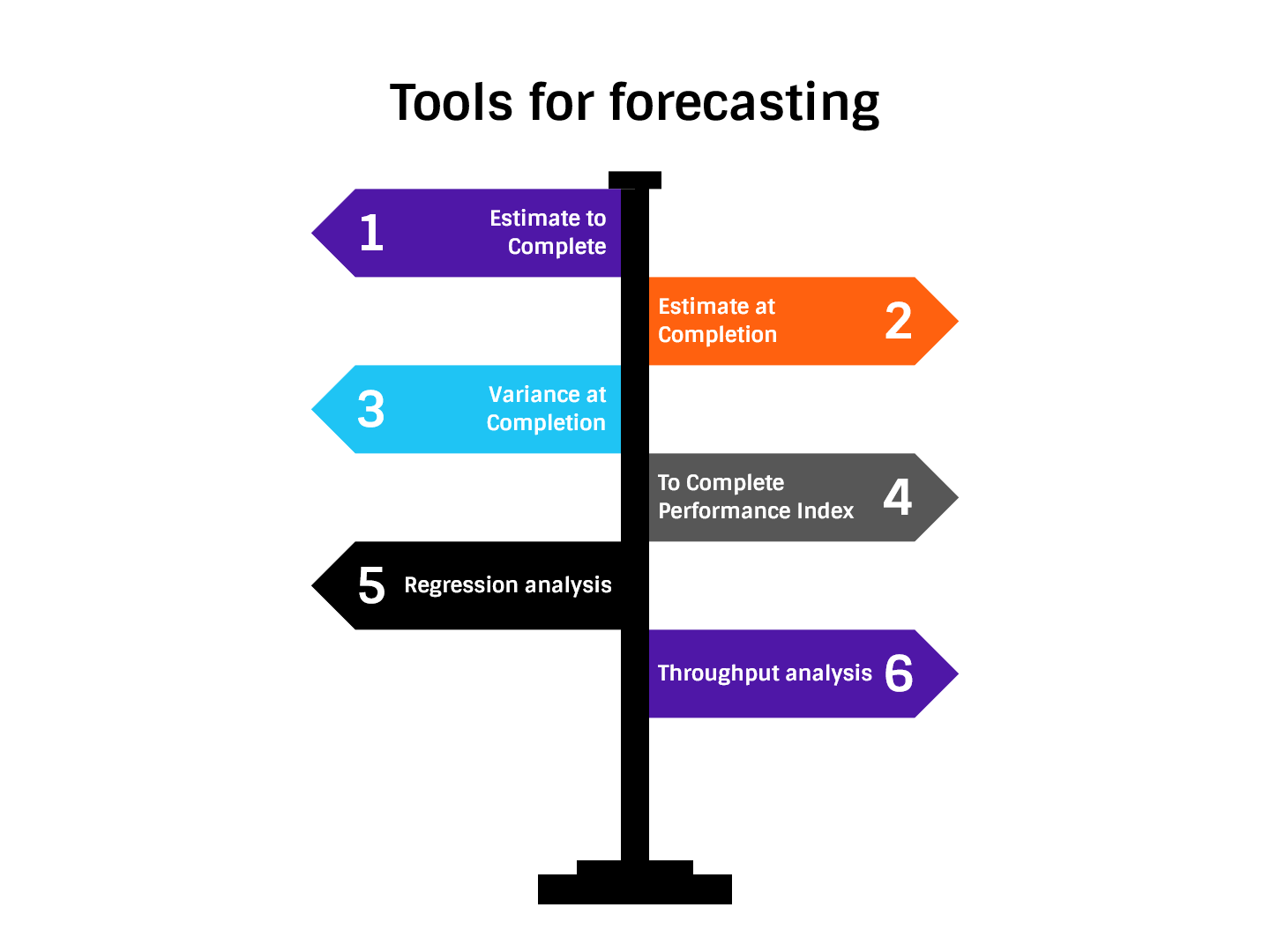
| I have an electronic copy of the PMBOK® 7th edition, so from time to time I open it up to check on something. Recently, I’ve been looking at different ways to forecast as we’ve got some work on that needs to be planned out. There are 6 quantitative forecasting options called out in the Guide. These are as follows.
Estimate to complete (ETC)This is top of the list and the one I personally use the most often. It works even if you are not in a full, compliant, earned value management environment. The risk here is that we assume past performance is indicative of future performance, and honestly, why wouldn’t you? Unless you know something is definitely going to change measurable performance, you would assume that work is going to continue at broadly the same rate. Just jot that down as an assumption so it’s transparent to everyone. Estimate at completion (EAC)For me, this goes hand in hand with ETC. It’s calculated by taking the actuals and adding the ETC, so again, while it comes under the umbrella of earned value acronyms, it’s completely accessible to those who don’t work in EV setting. Variance at completion (VAC)As forecasting tools go, this gives interesting data. It’s the measure that shows the amount of forecasted budget over or under at the end of the project, and it’s one most project sponsors will be interested in: “Will we have any cash left to do anything else when we’re finished?” To-complete performance index (TCPI)I have never had the opportunity (or reason) to use this forecasting metric. Perfect for those of you working with earned value day in, day out, it’s the cost performance required to meet whatever management target you’ve set for the work. It’s a ratio, so I think it is less meaningful to execs who are used to see tangible numbers of days or money. Regression analysisNow more and more tools are introducing AI features, it is possible to access regression analysis more easily. Perhaps you’ve got access to an AI-powered tool that will crunch these numbers for your automatically, removing the need for statistical knowledge. The output allows you to predict performance going forward based on what has happened in the past, so it’s arguably more grounded than other guesstimates! Throughput analysisThe final forecasting technique mentioned is throughput analysis. This looks at the number of items completed in a fixed time, so it’s useful for teams measuring features completed, velocity and story points. You can compare the output to those of other teams, although I’d be wary about comparing teams unless they work on very similar products or services. It wouldn’t be fair to judge a team on their throughput when dealing with very complex features against the performance of a team that has higher throughput but lower complexity. However, the team can compare its performance against itself: that would be a worthwhile exercise. Ideally, you’d want to see that the learnings from retros have been fully incorporated and, more importantly, that the changes have actually made a difference. Which of these are most used for your project forecasting? Let us know in the comments below! |
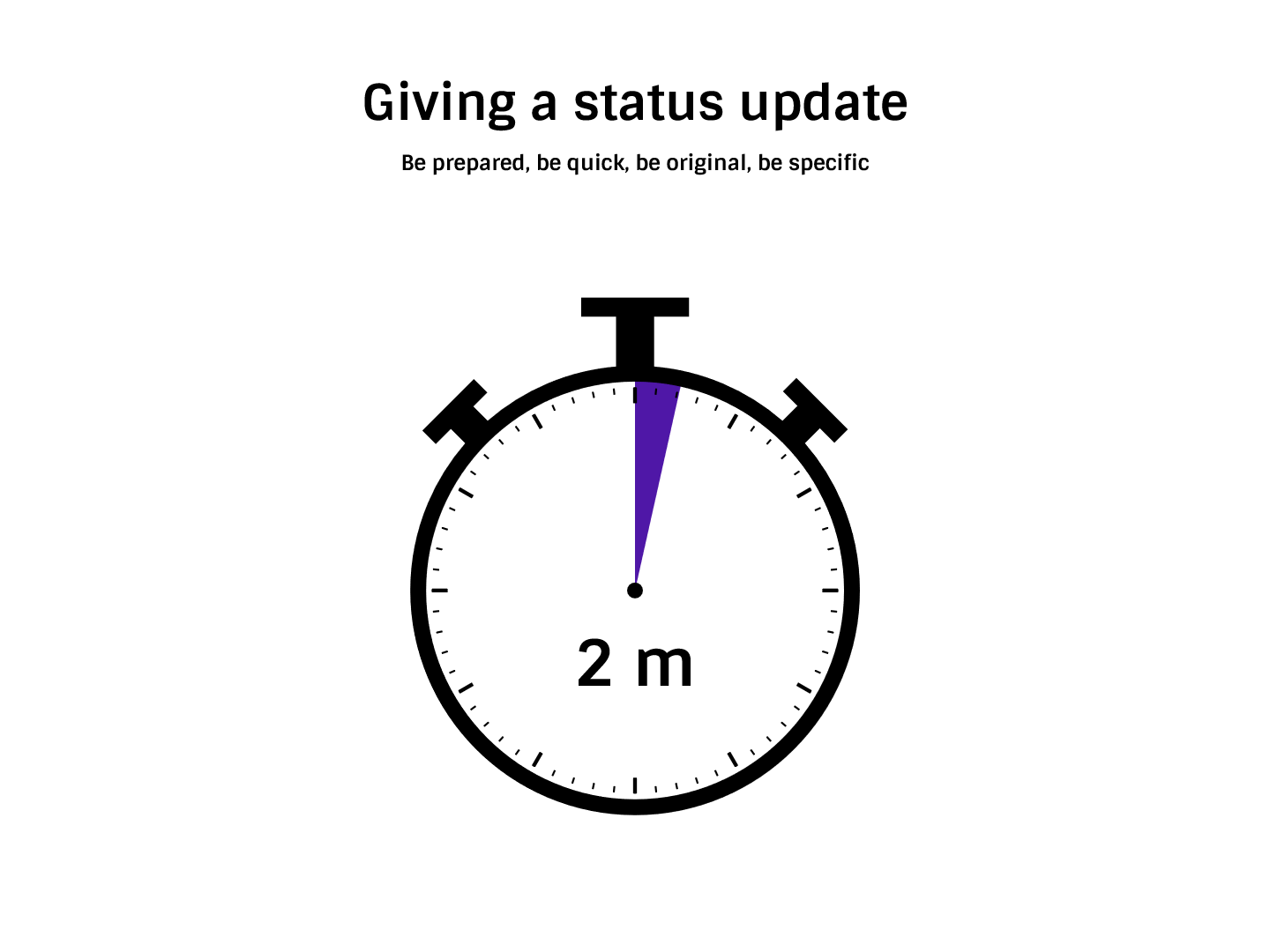
| I’m sure you’ve sat in meetings where you go round the table and give updates on progress. You could argue that it’s not the most interesting or effective use of everyone’s time, but it is used in many settings. For example, if you have a team of project managers meeting and it is useful to share a couple of points about the work that is going on, as the rest of the team wouldn’t necessarily be aware of it while they are busy on other projects. However, I also know that many people hate the ‘creeping death’ of going around the room for updates. Below are a few tips from my experience that will help you in your next ‘round table update’ meeting.
Be preparedIf your team meetings or PMO meetings have a section where you go round the table giving updates about progress and what you’ve achieved and so on, then you should know it’s coming. It might be specifically called out on the agenda or just part of your normal meeting practice. Spend some time before the meeting – just a few minutes – writing down a couple of bullet points so you have something to say when called on. These can be about your projects, successes, blockers or dependencies on other projects that would be worth highlighting to the group. Be quickIf you aren’t given a time limit, assume you have hardly any time! Three minutes feels like a very long time to the other people having to listen to you, so I would suggest less than that if you can, especially if you have nothing much to report. If you are the first to go, you set the unofficial time limit for the group, so it’s even more important to be speedy. Be originalDon’t repeat what another colleague has already said or things that the team already knows or has heard about. For example, if you said a milestone was completed when you all met up last week, you don’t need to say it again. It’s worth keeping track of what you did say for this exact purpose – I often find people repeat status updates that we covered last week and I have to assume they don’t remember telling us about it previously. It's also common that several people with the project office will be working on the large projects, and the person who goes first may well share the big successes or challenges for that project. You don’t need to say them again; just say, “To build on what X has already said about the Y project,” and share something different. Make a note of a couple of different updates you could give and cross them off your list if anyone else says them first! Be specificFocus on specific things. Talk about what issues you are having or successes the team achieved. Share where you need help or what you know they are most interested in. Focus on things that overlap with other projects, for example, where you share resources, as these are the information points that will help others in the team manage their own work more successfully. What other tips do you have for round table updates, or don’t you use that format any longer? Let us know your experiences in the chat! |
|
"The scientific theory I like best is that the rings of Saturn are composed entirely of lost airline luggage." - Mark Russell |