


Nice to (virtually) meet you


|
Meeting virtually means conference calls, webinars, video calls, and any type of discussion where you are not in the same room as the person or people you are talking to. Travelling to meet someone face-to-face normally incurs a cost. In several of my previous companies we have had multiple buildings in the same town and the ability to walk between them – but even that takes time. And time is money. A few years ago, there perhaps wasn’t the driver to cut down on travel, but now there are many reasons why project teams would choose to meet virtually. Penny listed some drivers for virtual meetings from her research:
She summarised that more people are working virtually for a number of different reasons. So why do we all still fall asleep on conference calls? Penny went on to describe the frustrations that project teams had raised with her when asked to attend a virtual meeting. They said:
With all those issues plaguing project conference calls and virtual meetings, it is a wonder that we get anything done on the phone or via video conference at all. Penny had some suggestions for how to improve virtual project meetings, and I’ll talk about them next time. In the meantime, what other reasons for conference calls or frustrations with virtual meetings do you have to add to these lists? |
 I was at the
 What's the difference between capital and operating cost?
|
For those of you who prefer reading or can't see the video, here is the transcript: Today, I want to talk about capital expenditure which you might know as capex and operating expenditure which you might know as opex. And I want to explain the differences between these two different types of money, the way that the money is categorized which will hopefully give you an idea of what you need to be looking for when you’re preparing project budgets. So, capital expenditure or capex is money that is allocated for buying things, physical things. So in an IT environment, that could be PCs. It could be servers. It could be the engineering time required to bring an asset into service. So really, capital is about assets, things that company can actually tangibly own and will keep. Operating expenditure on the other hand is more about labor costs. It’s transient expense that is used to keep the operation running. Hence, its name. So operating expenditure on a project might be things like travel expenses or a training budget or hiring a room for a meeting, or providing sandwiches and a working lunch for your team. So the way that finance departments categorize money tends to be either as capital or as opex. And you may find that as a project, you end up with two different budgets. So while at the end of the day, it’s all money that leaves our bank accounts or our company’s bank accounts, the way that finance departments need to account for it is different because if you’re buying an asset, assets depreciate in value. So if you’re buying a car for example at home, you might buy a car today for a particular cost and if you sell it again in 3 years, it will actually be worth less. It’s still worth something but it’s worth less than what you paid for it today. And that’s depreciation. So the cost of the asset devalues over time. And accounting departments need to take that into account when they’re looking at what assets a project has purchased. With operating expenditure though, it’s gone. You hire a room. You eat some sandwiches. You pay for a training course. And at the end of the day, you may have something left in terms of knowledge transfer or a successful outcome but you actually don’t have a tangible asset that adds value to the organization. So at the end of the day as I say, it’s the same cash that leaves the company but you need to talk to your finance department about how they determine the categorization. Because some companies may decide that certain costs can be capitalized and others may decide that actually that isn’t within their regulations and they want to count that particular expense as an opex charge. So talk to your finance department when you start working out your budget for your project and see how they determine within finite detail the difference between opex and capex. You’ll then be able to look at your two budgets and you may just find that you end up with two capital budgets and opex is handled somewhere else, perhaps in the running of the department or perhaps in the running of the department that you are delivering a project to. Once you understand the differences, once you understand what money has been allocated to you as a project manager to manage, you’ll be better placed to start asking intelligent questions around whether a particular piece of equipment you want to buy or a particular thing that you want to do is counted as capital and opex and you’ll know who to ask in order to be able to process those charges effectively. |
Do you send project spam?
|
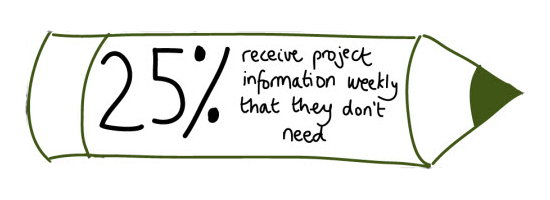
1 in 4 people receive project information weekly that they just throw in the bin. They don’t need it. This was one of the findings in research presented by Tim Lyons at the recent BCS Project Management Specialist Group Spring School in London. Conversely, 1 in 5 people need information weekly about the project that they don’t get. And 60% reported receiving ‘project spam’. Whether it is project financial reporting or progress reporting, you need to be sure that you are providing the right information to the right people. How do you know it’s the right information? Ask them. People find communication difficult. When asked ‘how easy is it to communicate on your project?’ only 38% said it was easy. 6% said it was too difficult so they don’t bother. Over a third reported that it was labour-intensive to communicate. All this means that people won’t always speak up if they aren’t getting what they need. Sometimes they won’t tell you when they are receiving things that they don’t need. It’s your job to get this balance right and consider what you are sending them. Sending them? Did I assume you were passing on information by email? 87% of people in the APM People SIG research that Tim presented said that they regularly used face to face communication on projects. 67% said that this was the best way to get information. Consider the mechanisms you use to pass information on, and the preferences of the audiences receiving the communication. What can you do to avoid project spam? |
Ask the Experts: Budget Management with Claudine Peet
|
I spoke to Claudine Peet, lead trainer at Silicon Beach Training, about what project managers need to know about balancing the books.
Claudine, in your opinion what's the one thing that project managers need to know about project budgeting?
Is the budgeting process the same regardless of how big the project is?
OK, that's helpful, thanks. I know that you run training courses specifically about handling financial information. On those training courses, what is the question you get asked the most? If you had one final tip for people putting together the team for a project, what would it be? It is strongly advised that one person with good financial knowledge manages the budget - although this is something many project managers are expected to do, it does not mean that they all have the financial know how to do it. Thanks, Claudine! Claudine Peet is Lead Trainer for PRINCE2 for Silicon Beach Training, providers of project management training and PRINCE2 Training courses in Brighton, Sussex. For more information about public or on-site project management training, please contact Training Manager Colin Welch. |
 Not all project managers have the opportunity to handle budgets, but when the moment comes, and the project finances are handed to you, it's good to have a plan about what to do.
Using Earned Value in MS Project
Categories:
earned value
Categories: earned value
| I came across this tutorial on the P3 Peak Performance blog that I thought was worth sharing. It discusses how to use Microsoft Project's features to do Earned Value calculations and walks you through the process step by step. It's aptly called You Can Get Blood From A Stone. |


