


Is it time to rethink your PM career path?
Categories:
Career Development
Categories: Career Development


| There’s something about spring that makes me want to rethink everything – maybe it’s the fact that everything seems to be renewed, I know this is not an original thought! What it means for us at work is that I am hearing a lot of people talking about taking a moment to think about their career. Especially for those of us who are slightly older, we don’t want to end up with career drift instead of career choice. We want career moves to be meaningful and part of a rounded picture for the direction we want to take, instead of simply floating into the next role because it’s offered. Staying busy is good, but not at the expense of ending up somewhere you never expected to go. But it’s difficult to ‘plan’ your careerThe trouble with career reassessment exercises, or even a simple reflection on a Friday night with your favourite drink, is that the project management culture values resilience and ‘pushing through’. We are the doers, the people who drive change and get things done. Yes, there is of course space for lessons learned and reflection in the role, but there is a worry about appearing uncommitted if you are actively talking about career reflection and whether or not you are in the right place. It’s the conversation we need to have outside of our immediate line management team or colleagues because you never know, it might not come to anything. Also, I think in project management there is a lack of clear alternative paths. Unless you are up for taking larger and more strategically important (and therefore stressful projects), where do you go? What’s right for you?Think about these questions: What work energises me now? What work drains me? Where am I adding the most value? And then think about your skills: What skills am I underusing? What do I want less of? The GROW Model is a good starting point as well. It stands for:
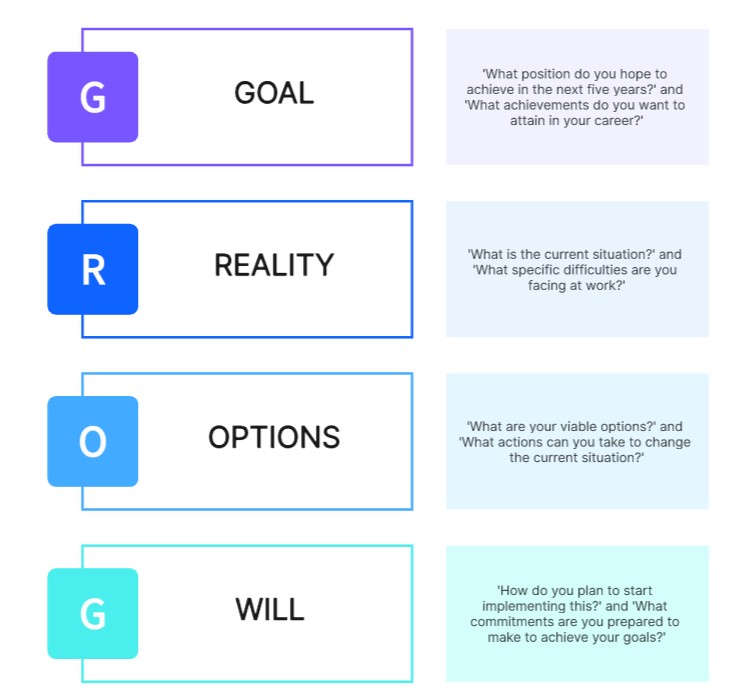 I know a lot of people are low-level job hunting for a portion of their time and if the perfect job came up, they’d jump ship. So you need to know what you are looking for in case it falls in your lap. I know a lot of people are low-level job hunting for a portion of their time and if the perfect job came up, they’d jump ship. So you need to know what you are looking for in case it falls in your lap. Where could you go?There are lots of job titles now that are PM-adjacent including:
Chat to your mentorIf you have a mentor, this is exactly the kind of thing your mentoring relationship is for. You should be able to talk to them informally, in confidence, about what you are thinking with regards to your current role. And any future role you might have in mind. They are not decision-makers in your life, but they will have an interesting perspective and can probably share some of their own thoughts from their career choices. If you don’t have a mentor, there are probably colleagues you trust, or friends or family members you could discuss with, or even type your thoughts into ChatGPT or Copilot (but take the output with a pinch of salt!). Career reflection is something we should all be doing because time passes quickly, and you want to steer your ship in the right direction for you. Don’t get me wrong, that direction is likely to change over time, but it’s better to have a loose plan than no plan at all. And project managers are great at planning, right? |
Posted on: April 13, 2026 08:00 AM
| Permalink |
Comments (4)
A Change Manager’s guide to spring resets
Categories:
Teams
Categories: Teams
| We’ve had the delivery pressure of Q1 and now April is here! Where I am in the northern hemisphere that means we are starting to see warmer weather and everything feels lighter and nicer, and that includes work. Somehow, it’s not so hard to get through the back to back meetings when the sun is shining outside the office window. April is a bit a breather after the struggle to get through Q1, but it also comes with the pressure of knowing that a big chunk of the year has already gone. So here’s what to do – don’t panic! Many teams push on instead of pausing to recalibrate, that doesn’t have to be you. You can pause here, regroup after the first three months of the year and think about what intentional change you want to manage for your team. Let’s start with the signs to look out for.  Warning signsLook out for change fatigue showing up as disengagement or cynicism – people who roll their eyes when you talk about the plans for the year. Another thing to put on your worry list is multiple initiatives competing for the same attention. There’s only so much change an organisation can deal with at any one time, and if you failed to land some biggies in Q1, that has just squeezed the change window into the remaining nine months. Talk to the PMO or project leaders and get a sense of how they are feeling, are they OK to pause if they need to, or are we into the “Everything is priority one” syndrome? How to resetAs a change manager, you have the power to help teams reset. It doesn’t mean stopping all the work or rebranding problems as “opportunities”. It’s about clarifying priorities for the rest of the year, the pace and the purpose. It’s about explaining what teams can manage to take onboard and resetting expectations with stakeholders. Practical reset opportunitiesI know I’ve used the word ‘opportunity’ there, but I don’t mean it negatively, I promise! Here are 5 things you could do if you know your teams are struggling and we’ve still got a lot of the year left to go. Pause low-value change activity. Can it wait? Does it have to be done at all? There might be some things you can take off people’s plates that everyone will benefit from. Reconfirm what success looks like now. Success might look different now to what it did when you first set these targets. Maybe you need a bit more benchmarking, or maybe other projects have shifted the art of the possible so you can set more challenging targets. Simplify governance temporarily. I am not going to make any friends for saying that, but it will make a difference! Ditch what you can. Talk to stakeholders. Remind them why you do what you do. Talk to them about expectations and how they sit within the wider programme of change across the organisation. Just because they have expectations doesn’t mean you can meet them, and it’s better to get that out in the open now rather than closer to the delivery date. Give teams psychological permission to say “this isn’t working”. We had a long talk in my team about psychological safety at the start of the year, and it’s something we’re actively working on. Assess how your teams are feeling and what you can do to make it safer and easier for them to express concerns in a way that is listened to (and feels listened to). As a change manager, you have the option to lead in a calm, considered way, it’s a leadership choice. We don’t need panic, and project managers are the same. We should be the stabilising influence on the team, even when everything is changing around us. We don’t just drive the change, we help people through it, and that’s a real skill. |
Posted on: April 06, 2026 05:00 AM
| Permalink |
Comments (3)
Tools and strategies for validating and auditing project data
| Oh my – projects create a lot of data. If you’ve been around projects for any amount of time (or read my previous articles on data management) then you’ll know that it’s really important what you do with that data. By project data in this sense, we’re talking about the data about managing the project – the performance management data you collect and use to course correct. Your project might also create data as a deliverable, for example customer records or staff records, or financial data. But what we are talking about here is the performance management of the project – the kind of data that the PMO wants to audit from time to time to ensure you are sticking to the process. |

Posted on: March 17, 2026 12:00 AM
| Permalink |
Comments (1)
Project management lessons unwrapped: 10 Things I learned in 2025
Categories:
Lessons Learned
Categories: Lessons Learned
| OK, I know we’re nearly a quarter of the way through the year, but it takes time to do the work to reflect. And if you’ve read my previous posts from earlier this year, you might have picked up that there’s been a lot going on. Before we move into the second quarter of the year (which here in the UK is the first quarter of the financial year – so there’s that), I wanted to share my takeaways from 2025 to see if there’s any that resonate with you. And if you haven’t had time to properly digest the end of last year (or the beginning of this one), take this as a sign that it’s worth putting the effort in. Here are 10 gifts I got to unwrap last year – the lessons we can all share with our teams.
I know in the workplace we don’t get to say no to work, but in my personal life I was able to say no to low-value work. We outsourced cleaning and now have a lovely cleaning team, for example. I said no to several speaking engagements that required overseas travel. And at work, I did have conversations with my management team about the projects I enjoyed and what I felt I could take on, which helped me focus on the projects that made best use of my skills. |
 The gift of focus
Posted on: March 10, 2026 12:00 AM
| Permalink |
Comments (1)
10 Things you should stop doing on projects (right now)
Categories:
productivity
Categories: productivity
| No one has time for avoidable chaos. If you’re anything like me, you’re preparing the draft steering deck for the next meeting as soon as this month’s meeting is over, to make life easier for Future You. When projects are busy (and your personal life is probably pretty full as well), you need to really focus on what is making a difference. So you can drop what is not. Some habits seem small but they drain time, energy, and your morale. So I’m giving you a permission slip to drop them, right now. If I were you, this is what I’d be giving up as soon as I could.
Even if your standing agenda is ‘action review, plan review, risk review, AOB.’ You still need something to work through to make it a meaningful interaction. |
 Scheduling meetings without an agenda
Posted on: March 03, 2026 12:00 AM
| Permalink |
Comments (10)


