What is the Practice Standard for Earned Value?
Categories:
earned value
Categories: earned value


|
Have you used the Practice Standard for Earned Value Management? It’s another one of the documents and standards available to project managers who are members of PMI. Go to your members area and log in, then navigate to the standards section and you’ll be able to download a copy. It’s a detailed guide to how to do earned value, but more than that, it also talks about scheduling elements that are so important to getting your project plans set up correctly from the beginning. Look at me, mixing up ‘schedule’ and ‘plan’ already. How many times have you heard ‘plan’ and known the person talking really means ‘schedule’ today? Earned Value requires that you are all on the same page with terminology and it’s a good way to standardise your approach to managing project performance. What’s in the standard?The standard is a document that sits alongside the PMBOK® Guide and doesn’t replace it. You can use them both together. Think of the standard as a deep dive into how to make earned value work. Like all standards, it is not prescriptive in that it doesn’t tell you that you need to use certain software tools to do the processes. It’s up to you to work out the best ways to implement the guidance. The standard covers the following areas:
And then it goes through the process for running an earned value management, in exactly the same way as the PMBOK® Guide is laid out:
If you are used to using the PMBOK® Guide as a reference, then the format of the EVM standard will be familiar to you. Each section talks about the process as a whole, then covers the inputs, outputs and considerations, enabling you to map it to your current work. There are some appendices that cover additional topics like how the standard was put together and how the subject of EV fits with risk management. There’s also a short system on deploying a full EVM system which is helpful if you are about to start software selection. It’s much shorter than the PMBOK® Guide (thankfully!) so if you are wondering whether it’s worth diving into, I say go for it. What I liked about it is that it’s readable – in as far as any standard and set of processes is – and I felt like I could implement it if I wanted to. It’s not the same as the standard required if you are bidding for US federal contracts, but if you want a place to start with EV, then this is a comprehensive guide. Plus, it’s free to PMI members, so what have you got to lose? I know that many PMP® students do worry about the earned value formulas and EV in general, especially if they don’t use the concepts day-to-day – and in my experience most of the people and companies I work with do not choose to use EV as a performance management method. So if you are going for the exam and want to build your confidence about EV, then this is a helpful read. It’s still basically a textbook though (maybe I find these things more interesting than the average person – certainly I’m the only one in my household who would pull out an EV book by choice). The thing about EV is that you need to know a little about it to know that it is not relevant to your projects. It’s a topic worth learning about as a project manager if only so you can have the confidence that you and your PMO are making the right choice by not adopting this way of tracking performance. Do you use EV on your projects? Let me know in the comments! Pin for later reading:
|
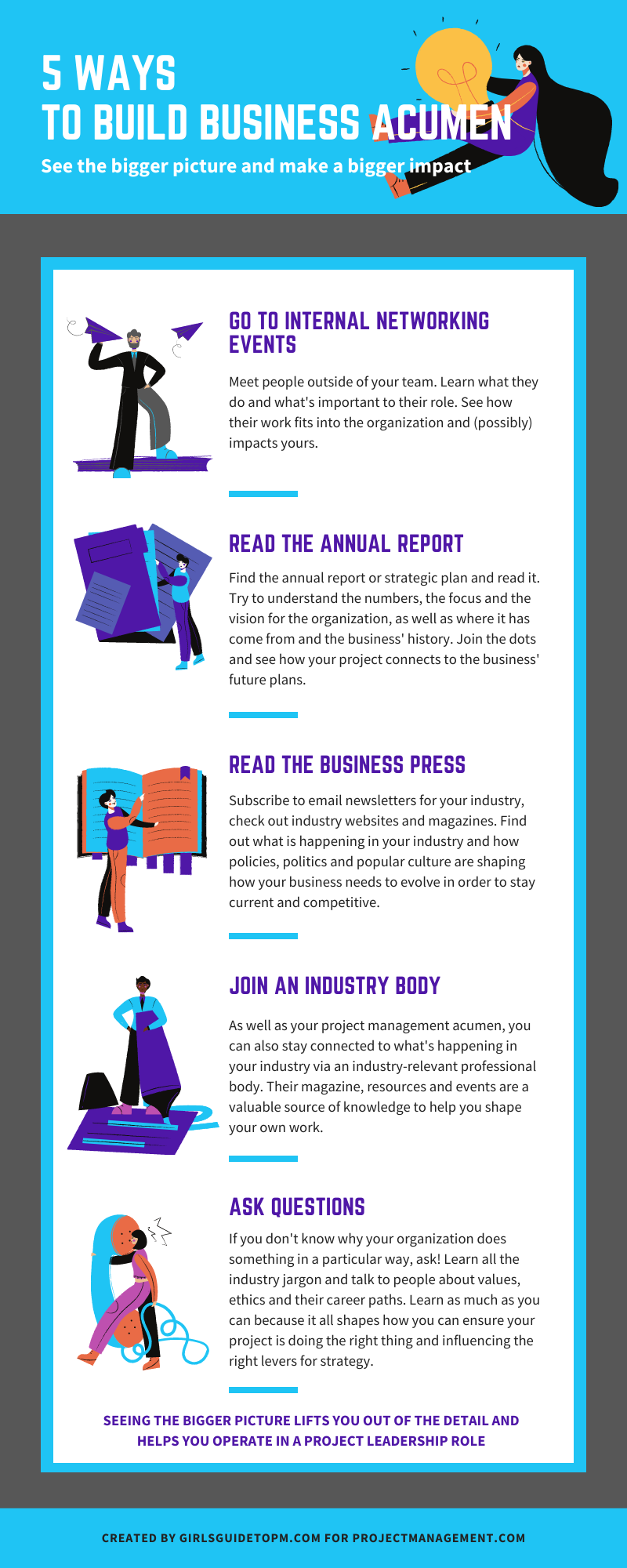
5 Ways to Build Business Acumen [Infographic]
| Here are 5 ways to see the bigger picture in your work in order to make a bigger impact with what you do.
There is more about each of these in the infographic below.
|
Plan Risk Responses: Process Overview
|
This article is the tenth part of my look into project risk management, and today the topic is how to plan risk responses. Who knew there would be so much to say about risk? What does it mean to plan risk responses?When you plan risk responses, what it means is that you are working out what to do about the risks you have identified. As you are doing the analysis, you’re probably talking to the team about the different options for addressing the risk, making judgements and plans as you go. The thing with all the risk management processes is that they can all happen in quite a short period of time, and often within the same conversation – especially for smaller risks and smaller projects. However, for the purposes of our discussion today, we’re looking at making sure the risk responses are considered, selected and agreed by the people who matter. You’ll also allocate people to do the work of implementing the risk responses so that you actually manage the risk and don’t simply talk about managing it. InputsThe inputs to this process are:
What documents should you review?The risk register and risk report are the most important documents because they give you information on what the risks actually are and how exposed the project (and/or business) is. That will inform your choices about how you respond to risk. First, check the Lessons learned log – check to see if any past risk responses were particularly helpful or pointless so you can repeat/avoid the same things in the future. The rest of the documents you may need to refer to are to do with the logistics of making sure the risks can be managed adequately. The project schedule is helpful so you can fit in the risk response plans and make sure there is time to do the work. The team assignments and resource calendars will also help. The stakeholder register will give you clues about ownership if you don’t have volunteers to lead on risk response actions. In practice, many experienced project managers won’t turn to those documents to find the answers – they’ll simply talk to the team and then update the schedule with any tasks that need to be added once the responses are agreed. Tools and TechniquesResponding to risk is a lot to do with expert judgement, so in my experience, this is the technique you’ll use the most. Rely on your subject matter experts and talk to them about how best to respond to threats, opportunities and how to manage contingent risk with the associated strategies and triggers in place. Basically, you need information from the experts and you gain that through interviews and facilitation (data gathering and interpersonal and team skills). Talk, talk, talk, and seek out the people with the answers. You can also employ some data analysis techniques to back up what your experts are saying or to help you choose the best response if there are several options. For example, alternatives analysis can help you compare the different options and select a course of action that will lead to an appropriate result. Cost-benefit analysis is another tool. Some risks will cost more to mitigate than they would if they happened, so this type of calculation can help you decide how much budget to spend on risk responses and whether the benefit of that investment is going to be worth it. Finally, you need to make a decision about what risk response plan to accept, so decision-making techniques for groups can be helpful. Consider the criteria for making the decision before you get to the actual decision-making part of the debate, as that will help give the team some structure. Typical criteria for making a decision on risk response include:
And so on. If your team doesn’t have much formal experience of making this kind of decision, I find it helpful to have the criteria available for us to review as we are discussing the risks. OutputsThe outputs from this process are:
In other words, there are lots of admin jobs to do once you’ve made your risk response plan because you’ve got a lot of paperwork to update – admittedly all of it is now electronic so it’s not so difficult to do. Review all the plans: update the schedule to reflect what you’ve just agreed to do, update the cost management plan to include any money now being spent on risk response, and review resource plans to ensure they are still accurate. Update your baselines if necessary. If your risks affected suppliers, make sure any changes to the procurement plan are incorporated. As part of your discussions and approved response plans you might have uncovered new assumptions, new lessons and even new risks. Make sure team assignments accurately reflect the work you are expecting people to do and make sure the risk register and risk report are updated with your plans. Next month I’ll be talking about 5 strategies for dealing with threats. In case you missed them, and to save you a job digging through the archives, here are the quick links back to the previous instalments: Read part 1 here: An introduction to risk management Read part 2 here: Trends and Emerging Practices in Project Risk Management (Part A) Read part 3 here: Trends and Emerging Practices in Project Risk Management (Part B) Read part 4 here: Tailoring Risk Management Read part 5 here: Planning Risk Management Read part 6 here: The Risk Management Plan Read part 7 here: Identify Risks Process Read part 8 here: Qualitative Risk Analysis Read part 9 here: Quantitative Risk Analysis Pin for later reading:
|


Risk management: A common cause of overspend [Video]
Categories:
risk
Categories: risk
|
A common project budget problem here is when you didn’t budget anything for project risk management. Then a risk pops up and you’d like to do something about it and can’t because there’s no money allocated for risk mitigation or to exploit a positive risk. It’s too late to go back and ask for a risk budget now… or is it? You might find your sponsor open to that kind of conversation, and it certainly doesn’t hurt to ask. If you don’t have additional money available then you have to adjust your activities accordingly. Perhaps your project board could accept a higher level of risk for that element, or they would be prepared to compromise on something else. Put together a proposal that explains the risks, the costs and the benefits along with some options so that they have choices. Pin for later reading:
|

Predictive Software: The Next Step for Collaboration Tools
Categories:
collaboration tools
Categories: collaboration tools
|
How much time do you spend doing routine tasks? Just think about how long it takes you to type things like your company name or location details when they get mentioned in an email. For a long time, Outlook (and I expect other tools) have had autocorrect functions that allow you to type something and have it ‘autocorrect’ to something else. It’s a text expander feature – and you get tools that lay on top of your normal suite of applications that just do text expanding. I even have that function built into my iPad, which is handy when it comes to typing out my email address every time. Now I just type a shortcode and the whole email address populates. Predictive text takes this one step further by working out what you are going to type before you type it. Predictive apps use passive data, for example, emails, to suggest tasks and updates. Think predictive text when you are trying to type a message on your phone, and scale it up so that the app sends suggestions to your To Do list about what activities you should be working on that day or flags which deliverables are likely to be late because of software defects logged in your testing system. Many tools are already embedding AI into them to help users have less to do. I was looking at one retrospective meetings management tool the other day and it used AI to automatically name the groupings of sticky notes we created in the meeting, based on the common content of those notes. Clever. It wasn’t always grammatically correct, but it saved us the job of typing a name for each group (although we could edit them if we wanted). Predictive software sounds like it’s taking the thinking and professional judgement out of being a project manager, but it’s just crunching data for you. For example, you can’t hold information in your head about how accurate each individual team member has been in estimating their workload on this project and the last five projects they have worked on. Predictive software could sift through estimates and actuals, and then flag the three team members with the worst record for getting their estimates right so that you can appropriately challenge them. This kind of system requires a particular leap of faith as it scours other systems for data. As a community, we’re going to have to go a long way before we are all comfortable with the idea of an app reading our emails and digging through personal files, even if it does predict who isn’t going to hit their deadlines that week. Whatever collaboration tools you adopt at work, and however you use them, keep in mind that they should be compatible with and reflect what is going on outside the walls of your company. Technology and workplace cultures will continue to evolve and the key is going to be keeping up and staying relevant while making sure your teams have the tools they need to do their jobs productively. That might mean embracing AI and predictive functionalities of tools, even if it feels a teeny bit uncomfortable to do so.
This article includes a few points that were made in my PMI book: Collaboration Tools for Project Managers. Given what we’ve been going through and seeing so far this year, it felt appropriate to try to pick out some comments on tech for teams and where that might be taking us – because it seems to me that virtual working is here to stay. Pin for later reading
|

 The future is in flatter, more informal working cultures supported by unified organizational collaborative technologies. We might not refer to the tools that way (or even be using the term social and collaborative media) in ten years’ time, but the principles that underpin this revolution in working practices are here to stay.