How to Use Alternative Metrics
From the The Money Files Blog
by Elizabeth Harrin

A blog that looks at all aspects of project and program finances from budgets, estimating and accounting to getting a pay rise and managing contracts.
Written by Elizabeth Harrin from RebelsGuideToPM.com.
Recent Posts
Budget confidence vs budget optimism
When projects get serious: what changes after the “easy” phase
How to run a retrospective that isn’t awful
A practical guide to stakeholder influence mapping
Why Your Project Forecast Keeps Changing (and What to Do About It)
Categories
accounting,
agile,
ai,
appraisals,
Artificial Intelligence,
audit,
Backlog,
Benchmarking,
benefits,
Benefits Management,
Benefits Realization,
Bias,
books,
budget,
Business Case,
business case,
business case,
Career Development,
Career Development,
carnival,
case study,
Change Management,
checklist,
collaboration tools,
communication,
Communications Management,
competition,
complex projects,
Conferences,
config management,
consultancy,
contingency,
contracts,
corporate finance,
corporate finance,
cost,
Cost Management,
cost management,
credit crunch,
CRM,
data,
data security,
debate,
Decision Making,
delegating,
digite,
earned value,
Education,
Energy and Utilities,
Estimating,
events,
FAQ,
financial management,
financial management,
forecasting,
future,
GDPR,
general,
Goals,
Governance,
green,
Information Technology,
Innovation,
insurance,
interviews,
it,
Knowledge Management,
Leadership,
Lessons Learned,
measuring performance,
Mentoring,
merger,
methods,
metrics,
multiple projects,
negotiating,
Networking,
news,
Olympics,
organization,
Organizational Culture,
outsourcing,
personal finance,
Planning,
pmi,
PMO,
PMO,
Portfolio Management,
portfolio management,
presentations,
privacy policy,
process,
procurement,
product management,
productivity,
Program Management,
project closure,
project data,
project delivery,
Project Success,
project testing,
prototyping,
qualifications,
Quality,
quality,
Quarterly Review,
records,
recruitment,
reports,
requirements,
research,
resilience,
Resource Management,
resources,
risk,
Risk Management,
ROI,
salaries,
Schedule Management,
Scheduling,
scope,
Scope Management,
security,
small projects,
Social Impact,
social impact,
social media,
software,
software,
software,
Stakeholder Management,
stakeholders,
Strategy,
success factors,
supplier management,
team,
Teams,
testing,
testing,
timesheets,
tips,
training,
transparency,
trends,
value management,
vendors,
video,
virtual teams,
workflow
Date
Last month I looked at a range of alternative metrics for assessing success. One of the comments on that article asked how, on reflection, had I seen these or other alternative metrics implemented effectively. It also asked whether there were challenges that might arise integrating alternative metrics into existing project management frameworks (which I’ll look at in a different article).
So, if you want to implement a more nuanced approach to measuring project success, how do you put this into practice? Below are some ideas. This topic is one that we could probably speak (or write) about at length, but hopefully the examples and ideas I share will give you some starting points for incorporating a range of measures into your project management practice.
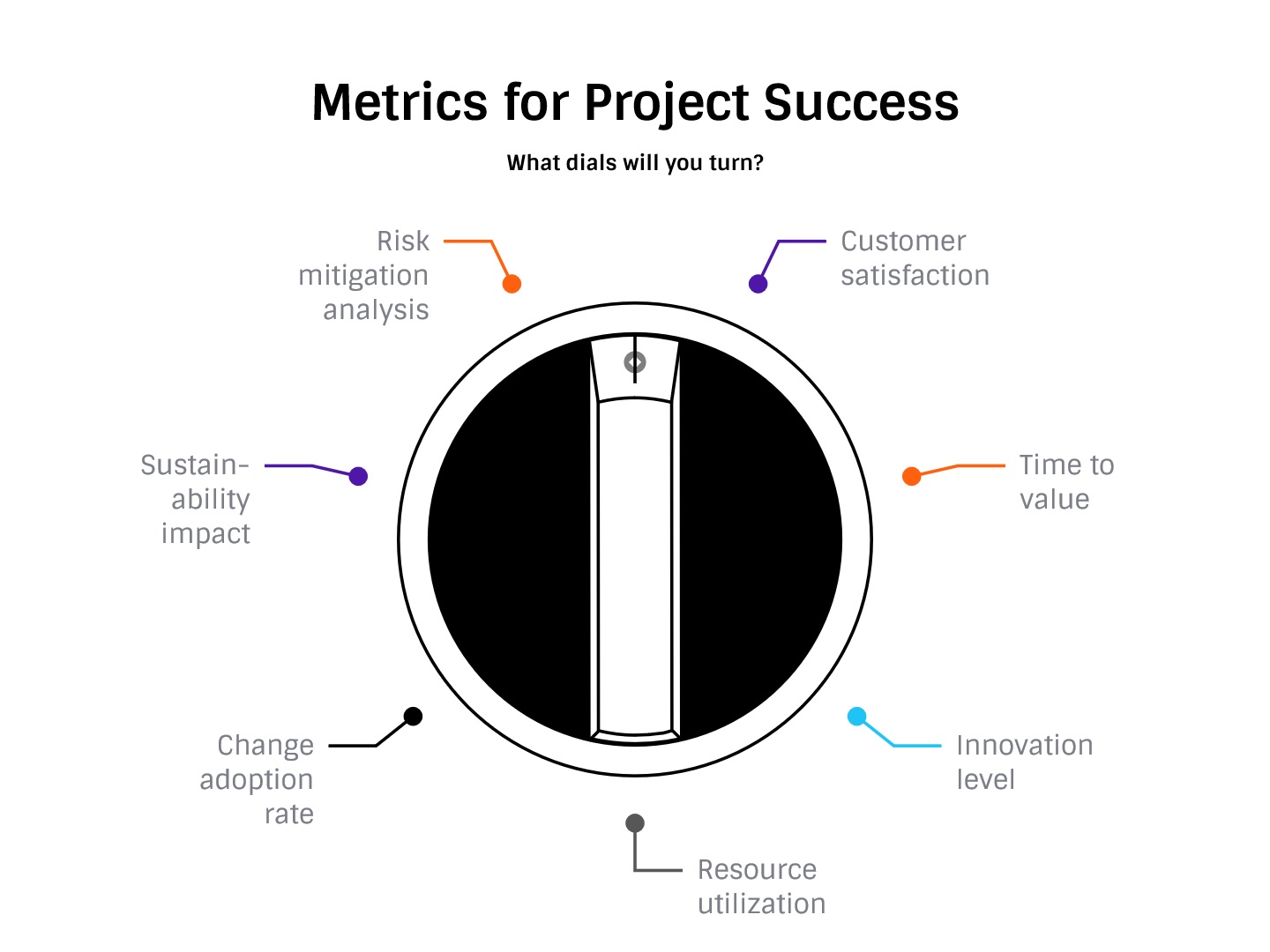
- Customer satisfaction
This is an area where I have quite a lot of examples to share. In my book, Customer-Centric Project Management, my co-author and I describe an extensive exercise to set up customer satisfaction tracking on projects, with internal customers.
I’ve written about customer satisfaction measurement on this blog before (start with this article: Lessons about project metrics). Basically, find out what is important to people, then track that regularly and plot your scores as part of regular reviews.
You don’t have to use an ‘official’ CSAT mechanism, or pay for electronic survey tools. Just ask people as a minimum.
- Innovation level
I haven’t used an innovation score regularly throughout a project, but it has been included in the way we rate projects and prioritize which ones should be done as the requests come into the pipeline.
Implement an innovation score yourself on a simple Likert scale (1-5 or similar). Ideally, you don’t want the measure to be subjective, so set some criteria e.g.:
- Number of tools used where the business has less than 1 year of experience using them
- Years of experience of team implementing (as someone could have gained a lot of relevant experience in a different role)
- Contractor level of experience rated on a scale of how many implementations they have done.
Or similar – you really only need a couple of measures to make up your innovation score. Use the innovation score as part of the decision criteria for whether a project should be taken forward or not.
- Resource utilization
Resource utilization reports are something I’ve only actively used on a couple of projects, because mostly we either haven’t had the tools to extract the data (because we aren’t doing timesheets or detailed estimates), or because staff have been 100% assigned to the project so we don’t have to worry about them splitting their time across projects. We would still have to worry about them being scheduled to do too many tasks in a week and being over booked, or under utilized, but when the team is full time somehow that’s easier to manage as you can see what they are doing and we speak every day.
Use the reports to check exactly that: is the team going to struggle to meet its commitments? And if it is, because staff are over-scheduled, what are you going to do about it?
Even the basic reports from Microsoft Project will give you utilization data, so take a look at what you already have within your tool suite and if you find it useful, use it.
- Risk mitigation effectiveness
The final one I’m going to talk about today is tracking risk mitigation effectiveness. I mentioned in the article that you could use AI-powered insights to establish the effectiveness of the risk management activities undertaken, but in reality I imagine that takes quite a lot of effort to set up.
Another way to do this would be at project closure, or during lessons learned conversations, whenever these take place in your project lifecycle.
Look at what the risk was and what was done to mitigate it. Score the risk based on the effectiveness of the action:
- 1: Risk management activity was 100% successful and risk was closed
- 2: Risk management activity was successful but residual risk was worth £x
- 3: and so on.
Using residual risk (and specifically, a financial value of residual risk) is a way to establish how effective your management action was – or at least, it’s one way to create data that allows you to assess that.
Hopefully that gives you some pointers for measuring project success through different routes, with some more concrete examples of how to get started.
Posted on: January 22, 2024 03:46 PM |
Permalink
Comments (5)
Please login or join to subscribe to this item

Kwiyuh Michael Wepngong
 Community Champion
Financial Management Specialist | US Peace Corps
Yaounde, Centre, Cameroon
Quite educative here.... could be a challenge to bring this onboard a project/organisation that have already established metrics for measuring project success.

Steven Gels
Buch Construction
Montgomery, Al, United States
I agree that utilization is difficult to accurately measure... even if the team is using timesheets, there is often misallocation or "fudging" that occurs. Also, if time is tracked too accurately it begins to be constraining and can spook employees who think you are looking for inefficiencies (wasted time).

Andreas Madjari
Senior Consultant| consigma Management Beratung GmbH
Vienna, Austria
Thank you for sharing Elizabeth! When it comes to surveys or getting feedback, the big collaboration tools present in most of the organizations have something to offer without extra cost. Always worth a look at it, especially if the target audience is beyond the core team and/or geographically dispersed.
It came to my mind (after the fact) that at least 2 construction projects I’ve being involve with, could (after years have passed by) receive positive evaluation in the innovation level metric (even though that was not the intention).
In 2001 China, and 2012 Mexico, I was involved in specific construction projects that now could be considered iconic. Regardless of the fact if quality, cost and time metrics were achieved, now is palpable that stakeholders involved in those projects, believe that there was a before and after of their participation on each project. In all projects there are lessons learned, but in some (even if you don’t notice it at the time), will mark you because of the level of innovation achieved. In my case, innovation came in the form of new safety and quality control standards and means and methods, new apps for better control metrics and communication (believe it or not, in 2001, email was kind of a new thing), etc.

Reshma Rizvi
Scientific Project Manager| University Of Saskatchewn
Saskatoon, Saskatchewan, Canada
Very elaborative description- great article, thanks!
Please Login/Register to leave a comment.
|
"I don't like work - no man does - but I like what is in the work - the chance to find yourself."
- Joseph Conrad
|




