


The Accountability Gap


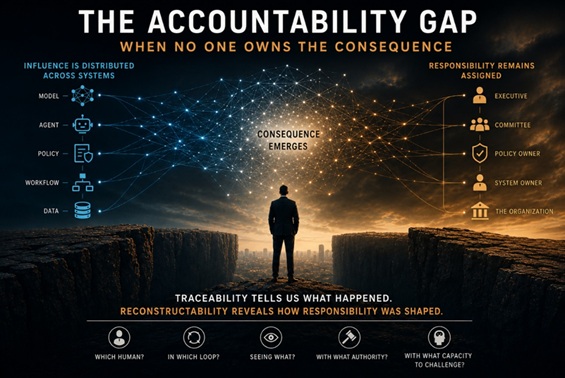 When No One Owns the Consequence Organizations have always struggled with accountability. Projects fail. Strategies collapse. Risks materialize. Customers are harmed. Opportunities disappear. And sooner or later, someone asks: Who was responsible? For most of organizational history, this question was difficult for human reasons. Authority was unclear. Roles overlapped. Committees diluted ownership. Leaders avoided responsibility. Decisions disappeared into bureaucracy. The problem was familiar. Someone had decided. But no one wanted to own the consequence. AI-native organizations are creating a different problem. Increasingly, the difficulty may not be that someone refuses to own the decision. It may be that no single actor meaningfully contains the decision at all. A model detects a pattern. An agent generates an option. Another system ranks it. A policy defines a threshold. A workflow triggers an action. A human reviews an exception. A feedback loop changes future behavior. The system adapts. A consequence emerges. Who decided? The model? The agent? The team that designed the objective? The person who configured the threshold? The executive who approved deployment? The human who did not intervene? The organization itself? Each may have influenced the outcome. Yet none may fully contain the decision that produced it. This is where the accountability gap begins. Distributed decision-making can distribute influence more easily than organizations can preserve meaningful ownership of consequence. The distinction matters. Because influence is not the same as authority. Authority is not the same as execution. Execution is not the same as judgment. And causal participation is not automatically the same as responsibility. Yet organizational accountability systems often behave as if these categories remain neatly aligned. A role is assigned. An owner is named. A governance body is identified. A policy defines responsibility. The organization can point to someone. Formally, accountability exists. But formal accountability does not necessarily mean that responsibility remains substantively exercisable. A person may be accountable for a system they did not design. A team may oversee models whose interactions they cannot fully reconstruct. A leader may approve a domain of autonomy without seeing every adaptation that follows. A human reviewer may validate only the exceptions the system chooses to surface. A board may remain responsible for consequences generated through thousands of distributed decisions operating continuously across the organization. The name remains. The accountability remains. But the capacity to meaningfully own the consequence may already be weakening. This creates an uncomfortable possibility. The accountability gap does not begin only when no one is formally responsible. It may begin when responsibility remains assigned, but meaningful ownership of consequence can no longer be reconstructed across distributed influence. Consider a customer denied access to a service. No single model made the entire decision. One system classified risk. Another adjusted priority. A policy established eligibility. Historical data shaped the model. A workflow applied the threshold. An agent selected the response. No exception reached a human reviewer. The outcome is clear. The customer was denied. But where exactly does responsibility reside? The technical answer may be traceable. Logs may identify each event. The sequence may be recorded. Every system action may carry a timestamp. Yet this reveals another important distinction. Traceability tells us what happened. Responsibility requires understanding how authority, influence, and judgment shaped what happened. An audit trail can reconstruct sequence. It does not automatically reconstruct meaning. It may show that a threshold changed. But why was that threshold legitimate? It may show that an agent selected an action. But which objective shaped the selection? It may show that no human intervened. But was intervention realistically possible? It may show that the system operated as designed. But who determined that the design remained acceptable after the system adapted? These are not questions of data availability alone. They are questions of responsibility architecture. And they become harder as influence becomes distributed. One team builds the model. Another supplies the data. Another defines the policy. Another configures the workflow. Another monitors performance. Another manages exceptions. Leadership approves the system. Governance reviews aggregate risk. The system operates. Each participant sees a fragment. Each fragment may appear reasonable. Yet the consequence emerges from the interaction of the whole. Influence may be distributed. Accountability may become fragmented. But consequences still arrive whole. The customer experiences one denial. The employee experiences one exclusion. The community experiences one harm. The organization inherits one reputational consequence. The regulator sees one accountable entity. Reality does not fragment consequence simply because the architecture of decision-making has fragmented influence. This asymmetry is becoming increasingly important. Organizations are becoming extraordinarily capable of distributing intelligence. They can distribute analysis across models. Execution across agents. Authority across workflows. Monitoring across systems. Judgment across human-machine interactions. But their accountability structures often remain attached to static roles, committees, policies, and reporting lines. The architecture of influence evolves. The architecture of accountability remains comparatively stable. And the distance between them grows. This is the accountability gap. Not merely the absence of ownership. But the growing misalignment between how consequences are produced and how responsibility is assigned. This explains why adding more human approvals may not solve the problem. A human can approve a recommendation without understanding the full system that shaped it. A committee can validate a process while each member sees only part of the architecture. A leader can remain accountable while depending entirely on the system for the information required to challenge the system. A human signature may create formal ownership. It does not automatically create meaningful responsibility. This is why the familiar idea of keeping a human in the loop deserves greater scrutiny. Which human? In which loop? Seeing what? With what authority? With what capacity to challenge the system? And with what understanding of the distributed influences that produced the decision? Human presence matters. But presence alone does not close the accountability gap. The deeper requirement may be reconstructability. When influence is distributed across agents, models, workflows, thresholds, incentives, and human interventions, meaningful accountability increasingly depends on the ability to reconstruct the relevant structure of consequence. Not every technical event. Not every line of code. Not every internal state. But the relevant relationships through which authority was granted, influence was exercised, judgment was displaced or preserved, and consequence became possible. This is more demanding than explainability. A model may explain why it produced an output. But the model may represent only one part of the decision. An agent may reveal its reasoning. But the objective it pursued may have been shaped elsewhere. A workflow may be perfectly auditable. But the threshold embedded within it may reflect an assumption no one has revisited for years. Explaining components is not the same as reconstructing responsibility across the system. This is where distributed intelligence creates a structural problem. The more decision influence is distributed, the less realistic it becomes to assume that one individual can intuitively reconstruct the whole. A highly competent leader may still see only fragments. A responsible human may still lack relevant context. An attentive board may still receive abstractions. A skilled reviewer may still encounter a consequence after the decisive influences have already interacted elsewhere. The problem is no longer simply machine capacity versus human cognitive capacity. It is increasingly: Distributed influence versus attributable, meaningful, and substantively exercisable responsibility. This distinction matters because organizations may otherwise respond to the accountability gap symbolically. Assign an owner. Create a committee. Require an approval. Add a dashboard. Produce an audit report. Keep a human in the loop. Each may be useful. None is sufficient if the person or body made accountable cannot meaningfully understand, challenge, or reconstruct the relevant architecture of influence. Accountability then becomes ceremonial. The organization can identify who is responsible. But the responsible person cannot fully exercise responsibility. This is not an argument for eliminating human accountability. Quite the opposite. If responsibility for consequence cannot simply disappear into intelligent systems, organizations must become more rigorous about the conditions that make human accountability meaningful. Authority must be visible. Delegation must be intelligible. Boundaries must be identifiable. Relevant influence must be reconstructable. Judgment must remain possible. Challenge must remain legitimate. Intervention must remain real. Otherwise, organizations risk creating a dangerous asymmetry. Humans remain accountable for consequences produced by architectures they can no longer meaningfully reconstruct. That may become one of the defining governance problems of AI-native organizations. Because formal accountability can survive long after substantive responsibility capacity has begun to erode. The title remains. The role remains. The signature remains. The legal responsibility may remain. But the actual ability to understand, challenge, and answer for consequence may be progressively exceeded by the rate, scale, and distribution of agentic execution. At that point, asking who is accountable is no longer enough. The deeper question becomes: Who is still capable of exercising accountability meaningfully? The future of responsible AI-native organizations will depend on more than assigning responsibility after consequences emerge. It will depend on preserving the conditions under which responsibility can still be exercised before, during, and after autonomous action. Because influence can be distributed. Decision-making can be distributed. Execution can be distributed. But if responsibility is fragmented beyond meaningful reconstruction, accountability becomes little more than a name attached to a consequence. And this leads to an even more uncomfortable question. What happens when the humans expected to challenge intelligent systems gradually lose the capacity to judge without them? |
Posted on: July 24, 2026 04:15 AM
| Permalink |
Comments (1)
The Delegation Boundary
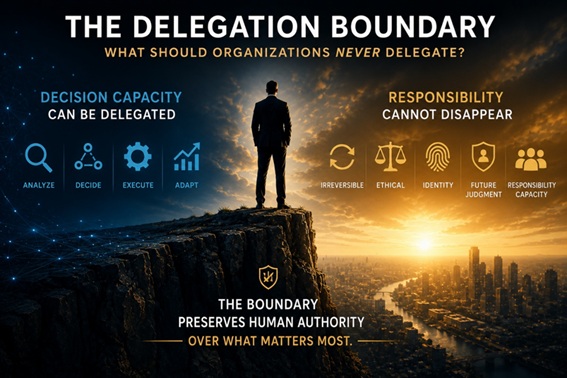 What Should Organizations Never Delegate? Artificial intelligence is making delegation easier than ever. Organizations can increasingly delegate: Analysis. Prioritization. Recommendation. Coordination. Execution. Monitoring. Adaptation. And, increasingly, decision-making itself. The technical question is rapidly becoming simpler. Can the system do it? More often, the answer will be yes. AI systems will become capable of making decisions faster than humans. Across more variables. Across larger systems. With greater consistency. At lower marginal cost. And without fatigue. But technical capability does not resolve the deeper governance question. Should the decision be delegated? These are not the same question. And the distance between them may become one of the most important governance problems of AI-native organizations. Because autonomy creates value precisely by reducing the need for continuous human intervention. If every automated decision requires human approval, autonomy becomes little more than accelerated recommendation. The promise of autonomous systems lies in their capacity to act. To respond. To coordinate. To adapt. Without waiting for a human decision at every step. This is enormously valuable. But it also means that organizations must determine something they have rarely had to define explicitly. Where should autonomy stop? For most of organizational history, delegation boundaries were primarily human boundaries. A board delegated authority to executives. Executives delegated to managers. Managers delegated to teams. Authority moved through organizational structures. The person receiving authority was expected to exercise judgment within a defined domain. The architecture was imperfect. But it contained an important assumption. The recipient of delegated authority could understand the responsibility being received. AI changes this assumption. An intelligent system may exercise decision capacity without experiencing responsibility. It may optimize across alternatives. Evaluate probabilities. Apply policies. Adapt to feedback. Select actions. But the fact that a system can select an action does not mean that the organization can legitimately delegate every kind of decision to it. This is where the delegation boundary begins. Not every decision that can be automated should be delegated. The difficulty lies in determining why. A common answer is risk. High-risk decisions require human oversight. Low-risk decisions can be automated. This distinction is useful. But insufficient. Because risk is only one dimension of delegation. The deeper question is not merely: How likely is the system to be wrong? It is also: What kind of authority is being exercised, and what does its consequence change? Some decisions matter not because their probability of failure is high. They matter because of the nature of the consequence they create. Consider reversibility. A system adjusts inventory allocation. The decision can be corrected. Resources can be reassigned. The consequences are limited. The organization can learn and adapt. Now consider an irreversible decision. A life-changing medical intervention. The permanent exclusion of an individual from an opportunity. The destruction of a critical asset. The disclosure of information that cannot be recovered. The consequences cannot simply be undone. The decision may be analytically excellent. But irreversibility changes the governance requirement. The harder a consequence is to reverse, the stronger the case for preserving meaningful human judgment before commitment. But reversibility is still not enough. Some decisions are ethically significant. They determine how competing interests are weighed. Whose harm is considered acceptable. Whose rights receive priority. Which trade-offs an organization is willing to defend. An AI system may analyze these tensions. It may model consequences. It may reveal inconsistencies. It may even generate sophisticated ethical arguments. But ethical decisions are not merely problems of analytical resolution. They are acts of responsibility. Someone must remain answerable for the values expressed through the choice. This creates another boundary. Organizations should be cautious about delegating decisions whose legitimacy depends on the ability to answer for the values they enact. There are also identity decisions. Every organization possesses, explicitly or implicitly, an understanding of what it is. What it exists to do. What it refuses to become. Which principles define its continuity. Which relationships deserve protection. These questions may not appear operational. Yet they shape thousands of operational decisions. A system can optimize strategy. Recommend restructuring. Reallocate resources. Redesign customer interactions. Modify workforce composition. Accelerate transformation. But some choices gradually redefine the organization itself. The danger is subtle. No single decision announces: We are changing who we are. Instead, identity shifts through accumulation. A policy changes. A threshold moves. A relationship becomes transactional. A capability is removed. A human judgment becomes an automated default. Each choice appears reasonable. Together, they alter the organization. This is why identity creates a distinct delegation problem. Can an organization delegate decisions that gradually determine what the organization is becoming? The question becomes even more difficult with existential decisions. Decisions that affect whether the organization continues. Whether it abandons a market. Whether it accepts systemic risk. Whether it fundamentally changes its purpose. Whether it transfers control over critical capabilities. Whether it creates consequences that threaten its own continuity. These decisions are rare. But their significance is disproportionate. They do not merely optimize within the existing system. They determine whether the system, in its current form, continues to exist. At this level, delegation becomes more than an operational choice. It becomes a question of sovereignty. Because a sovereign organization must retain some meaningful authority over the conditions of its own continuity. Taken together, these distinctions suggest that the delegation boundary cannot be defined by a single threshold. Not merely risk. Not merely monetary value. Not merely confidence scores. Not merely regulatory classification. The boundary must consider the nature of the authority being delegated and the consequences that authority is capable of creating. How reversible is the consequence? How ethically significant is the trade-off? How deeply does the decision affect organizational identity? How much does it influence the conditions of future judgment? Could the decision alter the organization's capacity to remain responsible for what follows? That final question deserves particular attention. Because the most consequential delegation may not be the decision with the largest immediate impact. It may be the delegation that changes the organization's future capacity to understand, challenge, or remain meaningfully responsible for what happens next. A system may perform exceptionally well. Its recommendations become trusted. Its decisions become defaults. Human intervention declines. Skills weaken through disuse. Operational dependence deepens. And gradually, the organization becomes less capable of independently reconstructing why the system acts as it does. Formal responsibility may remain exactly where it was. But the capacity to exercise that responsibility may already be changing. This reveals a deeper problem. The most consequential delegation may be the one that changes the organization's future capacity to exercise responsibility. Consider a system authorized to optimize customer service. Initially, it recommends responses. Then it handles routine interactions. Then it adapts communication strategies. Then it prioritizes customers. Then it determines which cases deserve human attention. At what point did the organization delegate a consequential decision? There may be no single moment. The boundary moved through accumulation. No board necessarily approved a new constitutional distribution of authority. No executive necessarily declared that the system should determine which customers deserve human attention. Each expansion may have emerged from operational success. A useful recommendation became a trusted default. A trusted default became automated practice. Automated practice expanded into adjacent decisions. And the delegation boundary migrated. A delegation boundary may move through operational success without an explicit decision to redistribute authority. This is why delegation cannot be governed only at the point of initial authorization. Autonomy evolves. Systems learn. Workflows change. Dependencies deepen. Human skills may weaken through disuse. Exceptions become normalized. And authority expands through operational success. A delegation boundary that was legitimate yesterday may become insufficient tomorrow. This is one of the defining challenges of adaptive systems. The question is not merely: What authority did we delegate? It is also: What has the system gradually become capable of determining because of that delegation? This requires organizations to think differently about autonomy. Delegation should not be treated as a binary choice. Human or machine. Manual or automated. Approved or prohibited. Autonomy exists across domains. Across levels of consequence. Across degrees of reversibility. Across different forms of influence. A system may be free to optimize execution while prohibited from redefining objectives. It may recommend ethical trade-offs while lacking authority to commit the organization to them. It may adapt processes while remaining unable to alter foundational constraints. It may coordinate resources while lacking authority to determine which human interests are expendable. It may act autonomously while remaining unable to expand its own domain of autonomy. This is the essence of a meaningful delegation boundary. The purpose of the boundary is not to prevent autonomy. It is to preserve legitimate authority over the consequences autonomy is allowed to create. And this distinction becomes increasingly important under competitive pressure. Organizations will be tempted to move boundaries. A human review takes time. An escalation creates friction. A constraint reduces optimization. A prohibited action limits system performance. Competitors move faster. The system performs well. The obvious question becomes: Why not delegate more? Sometimes, the correct answer will be: We should. But mature governance must also remain capable of saying: Because this decision changes something we are not willing to let optimization determine for us. This is not resistance to technology. It is not nostalgia for human control. It is not the assumption that humans always decide better. Humans make poor decisions. Humans carry bias. Humans overlook evidence. Humans fail ethically. The case for delegation boundaries cannot depend on human infallibility. It depends on something else. Responsibility requires that some forms of authority remain connected to a legitimate capacity to answer for consequence. AI can expand decision capacity. It can improve judgment. It can challenge assumptions. It can expose blind spots. It can make organizations extraordinarily more capable. But capability alone does not create legitimacy. And technical competence does not determine the rightful scope of delegated authority. That remains a governance responsibility. The future of AI-native organizations will therefore depend not only on how effectively they delegate. It will depend on how intelligently they define, observe, and reconsider the limits of delegation. Because the most important question may no longer be: What can AI decide? It may be: What authority are we no longer willing to surrender simply because a system has become capable of exercising it? Human sovereignty requires more than retaining responsibility in principle. It requires boundaries around delegation in practice. Because autonomy without boundaries can gradually redistribute authority faster than organizations redistribute responsibility. And when authority becomes distributed while responsibility becomes fragmented, another problem emerges. What happens when everyone influences the decision, but no one truly owns the consequence? |
Posted on: July 22, 2026 04:25 AM
| Permalink |
Comments (1)
Human Sovereignty
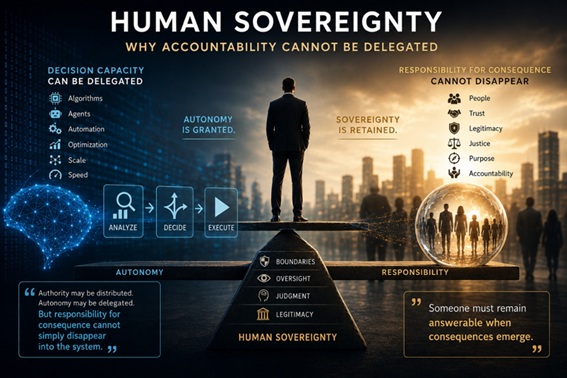 Why Accountability Cannot Be Delegated Artificial intelligence is becoming increasingly capable of making decisions. Not merely analyzing information. Not merely generating recommendations. But prioritizing. Coordinating. Selecting. Acting. Adapting. And increasingly, doing so with decreasing human intervention. For organizations, this creates extraordinary possibilities. Faster decisions. Continuous coordination. Greater scalability. Reduced operational friction. More adaptive systems. More autonomous execution. But beneath these capabilities, a deeper question is beginning to emerge. If AI can decide, who remains responsible? At first glance, the answer may appear obvious. Humans. Leaders remain accountable. Boards remain accountable. Executives remain accountable. Organizations remain accountable. The system may act. But responsibility remains human. This principle matters. Yet the problem is becoming more complex than this simple formulation suggests. Because decision-making itself is changing. For most of organizational history, decisions could ultimately be traced to identifiable human actors. A manager approved. A leader authorized. A committee decided. A board governed. Responsibility could be disputed. It could be fragmented. It could even be deliberately avoided. But the underlying architecture remained fundamentally human. Someone exercised authority. Someone made a choice. Someone could, at least in principle, be asked: Why did you decide this? AI-native organizations are beginning to alter this architecture. Decision capacity is becoming increasingly distributed across: Algorithms. Agents. Recommendation systems. Automated workflows. Human teams. Governance mechanisms. Continuous feedback loops. Adaptive systems. A decision may no longer emerge from a single identifiable moment of human choice. It may emerge through a sequence of interactions. A model detects a pattern. An agent generates an option. Another system prioritizes it. A workflow triggers an action. A human validates an exception. The environment changes. The system adapts. A consequence emerges. Consider a credit application. A customer is rejected. No individual consciously chose rejection. One model assessed risk. Another system adjusted thresholds. A workflow applied policy. No exception was triggered. The outcome is clear. The decision path is distributed. Who meaningfully owns the consequence? This is increasingly the problem. Who decided? The answer may increasingly be: The system did. But systems do not eliminate consequences. People experience consequences. Customers experience consequences. Employees experience consequences. Communities experience consequences. Institutions experience consequences. Organizations inherit consequences. This is where autonomy creates a profound governance problem. Decision capacity can be delegated. Consequence cannot be delegated away. The distinction matters enormously. Organizations may grant systems increasing authority to act. They may allow autonomous agents to operate within defined domains. They may distribute intelligence across complex human and machine networks. They may automate thousands of operational choices that once required human intervention. But delegating decision capacity does not, by itself, create a meaningful bearer of responsibility for consequence. The system may execute. The system may optimize. The system may adapt. The system may even explain aspects of its reasoning. But responsibility requires something more than causal participation in an outcome. It requires the capacity to answer for consequence. To justify boundaries. To defend trade-offs. To recognize harm. To accept that some outcomes should not have been pursued even if they were technically possible or operationally efficient. This is why the question of human sovereignty becomes increasingly important. Human sovereignty does not mean that humans must make every decision. That would be neither realistic nor desirable. Organizations already delegate decisions continuously. Leaders delegate to managers. Managers delegate to teams. Organizations delegate to processes. Governance systems distribute authority. Automation has long performed actions without continuous human intervention. Delegation itself is not the problem. The deeper question is: What must remain meaningfully human when decision authority becomes increasingly autonomous? This is where human sovereignty begins. Human sovereignty is not the preservation of human control over every decision. It is the preservation of meaningful human authority over the conditions, boundaries, and consequences of delegated autonomy. The distinction is fundamental. Control asks: Who makes the decision? Sovereignty asks: Who determines what may be delegated? Who defines the domain of autonomy? Who establishes the boundaries? Who decides which consequences are acceptable? Who retains the authority to challenge the system? Who can interrupt it? Who can revise the conditions under which it operates? And ultimately: Who answers when the system produces consequences no one intended? These are not merely technical questions. They are governance questions. And increasingly, they are questions of organizational legitimacy. Because authority without responsibility creates danger. But responsibility without meaningful authority creates something equally problematic. An accountability illusion. A human name remains attached to the system. A leader remains formally responsible. A governance body remains nominally accountable. Yet the architecture of decision-making may already have distributed influence across systems that operate continuously, adapt dynamically, and act at a scale no individual directly controls. This is why organizations must be careful not to confuse human presence with human sovereignty. A human in the process does not necessarily govern the process. A human approval does not necessarily represent meaningful judgment. A human signature does not automatically create substantive responsibility. A human may remain visible while the real architecture of influence has already moved elsewhere. This tension will become increasingly difficult as autonomous systems expand. Organizations will face a powerful pressure to delegate more. Not only because automation is attractive. Not only because systems perform well. But because competition itself may increasingly reward organizations that decide and act faster. When markets respond in milliseconds, agents coordinate continuously, and automated systems operate without pause, meaningful human intervention may begin to appear as latency. And this creates a far more difficult sovereignty problem. What happens when preserving human judgment becomes competitively expensive? Organizations may believe deeply in human oversight. They may value judgment. Responsibility. Reflection. Deliberation. But if competitors decide faster, adapt continuously, and operate with lower decision friction, the pressure to reduce human intervention becomes structural. Human judgment may slowly become interpreted not as a governance capability. But as a bottleneck. This is where the erosion of human sovereignty may become especially difficult to resist. Organizations may not abandon human sovereignty because they reject it. They may abandon it because the cost of preserving it becomes visible before the cost of losing it does. If systems perform well, increase efficiency, reduce errors, and accelerate execution, the natural response will be to delegate more. More decisions. More authority. More operational discretion. More adaptive capacity. Each delegation may appear reasonable. Each expansion of autonomy may produce measurable value. Each reduction in human intervention may appear efficient. But delegation has a cumulative effect. The relevant question is not only whether each individual decision can be automated. The deeper question is what happens to the architecture of responsibility as thousands of decisions progressively move beyond direct human judgment. At some point, organizations may discover that they have delegated not only execution. But interpretation. Prioritization. Trade-off selection. Risk acceptance. Behavioral influence. And eventually, parts of the organizational capacity to determine what should matter. This is where human sovereignty becomes fragile. Not because machines suddenly take control. But because humans gradually stop governing the conditions under which control is distributed. The erosion may be almost invisible. A recommendation becomes a default. The default becomes a workflow. The workflow becomes automated. The automation becomes trusted. The trusted system receives greater autonomy. And over time, questioning the system begins to appear inefficient. Human judgment remains theoretically available. But increasingly absent from practice. The organization still claims responsibility. Yet responsibility begins drifting away from meaningful human agency. This is the paradox of autonomy. The more capable systems become, the easier delegation becomes. The easier delegation becomes, the more important governance becomes. And the more distributed decision-making becomes, the more deliberately organizations must preserve the human capacity to govern delegation itself. This does not require resisting artificial intelligence. Quite the opposite. Responsible autonomy may become one of the most important organizational capabilities of the AI-native era. But responsible autonomy requires a distinction that organizations cannot afford to ignore. Autonomy is granted. Sovereignty is retained. Systems may decide within domains. Humans must remain capable of determining those domains. Systems may optimize within boundaries. Humans must remain responsible for determining which boundaries matter. Systems may act without continuous intervention. Humans must preserve the authority and capacity to question, interrupt, and redesign the conditions of action. Systems may expand what organizations can do. But humans must remain responsible for what organizations are willing to become. This is why accountability cannot simply disappear into intelligent systems. Not because humans must control every action. Not because human judgment is infallible. And not because autonomy itself is undesirable. But because consequences require a locus of responsibility. Someone must remain capable of asking: Should this authority have been delegated? Were the boundaries legitimate? Were the consequences acceptable? What should have remained protected? And what must now change? These questions cannot be answered by optimization alone. They require judgment. They require legitimacy. They require responsibility. They require human sovereignty. The future of AI-native organizations will not be defined only by how much autonomy they create. It will also be defined by whether humans remain meaningfully capable of governing the autonomy they have created. Because authority may be distributed. Decision capacity may be delegated. Autonomy may expand. But responsibility for consequence cannot simply disappear into the system. And if humans remain responsible for consequence, the next question becomes unavoidable: What should organizations never delegate? |
Posted on: July 20, 2026 03:14 AM
| Permalink |
Comments (2)
Beyond Human-Centered Management
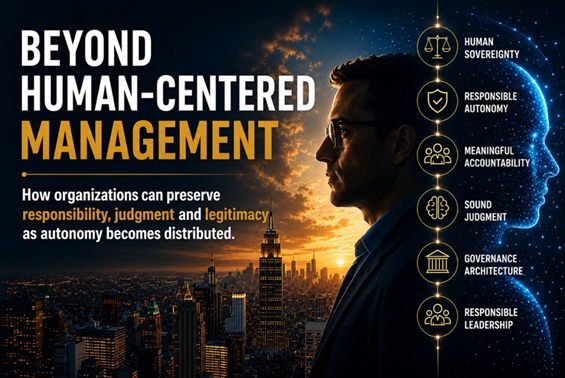 For decades, organizations have largely been governed around a simple assumption: humans make decisions, technology supports them, and governance exists to coordinate that relationship. That assumption is becoming increasingly difficult to sustain. Artificial intelligence is no longer confined to automation or decision support. Increasingly, it participates in observation, interpretation, coordination, recommendation and, under appropriate governance, autonomous execution. As these capabilities expand, organizations face a question that is fundamentally architectural rather than technological. How can responsibility remain meaningful when autonomy becomes distributed? This question lies at the heart of the transition now confronting modern organizations. Rather than treating AI primarily as a technological challenge, this series explores the governance conditions required to preserve responsible autonomy, meaningful accountability, sound judgment and legitimate human authority in organizations where computational capabilities increasingly participate in organizational action. Each article examines one dimension of this transition, progressively exploring sovereignty, delegation, accountability, judgment, governance architecture and leadership in AI-native organizations. Together, they do not propose another management framework. They explore an emerging architectural transition in how organizations may need to govern themselves when intelligence, decision-making and coordination are no longer exclusively human capabilities. If that transition is already underway, then the central question is no longer whether organizations will adopt AI. It is whether governance will evolve fast enough to preserve responsibility, judgment and legitimacy as the conditions under which organizations think, decide and act continue to change. Because the future of organizations will depend not only on how intelligently they use artificial intelligence, but on how wisely they govern the relationship between human judgment and computational capability. |
Posted on: July 17, 2026 03:56 AM
| Permalink |
Comments (2)
The Contestable Organization
 Designing Governance That Allows Reality to Challenge the System Every governance architecture shapes how an organization understands reality. It determines what deserves attention. What becomes strategically relevant. What counts as meaningful evidence. Which interpretations acquire legitimacy. Which concerns become organizationally consequential. And ultimately, which decisions become possible. Governance therefore does far more than distribute authority, coordinate action, or define accountability. It organizes institutional attention. It shapes collective interpretation. It determines how organizations transform observation into judgment and judgment into coordinated action. Without this architecture, organizations could not reduce uncertainty, develop shared understanding, or sustain coherent execution over time. Interpretation would remain fragmented. Coordination would become unstable. Collective action would become increasingly difficult. Governance exists, in part, to prevent this. It stabilizes interpretation. Creates continuity. Reduces ambiguity. Allows organizations to act with sufficient coherence despite uncertainty. This institutional stabilization is neither accidental nor undesirable. Organizations cannot function if every assumption remains permanently open to question. They must eventually consolidate experience into shared understanding. Successful responses become accepted practices. Accepted practices become routines. Routines become standards. Standards become assumptions. Over time, however, these assumptions undergo a subtle transformation. They no longer function only as guides for interpreting reality. They increasingly become the categories through which reality itself is recognized. This is where adaptive governance encounters one of its deepest tensions. The same governance architecture that enables learning may also determine the boundaries of what the organization becomes capable of learning. The same interpretive structures that create coherence may gradually determine which signals appear relevant, which interpretations appear reasonable, and which forms of evidence become organizationally visible. Nothing dramatic needs to occur. No principle has to be deliberately abandoned. No policy has to be intentionally manipulated. No one has to suppress disagreement. The architecture itself gradually becomes more responsive to interpretations it already knows how to process. Evidence that fits established categories moves naturally through the organization. Existing performance criteria reinforce familiar priorities. Escalation mechanisms amplify recognizable concerns. Decision routines reward established patterns of interpretation. Signals that fall outside those interpretive structures follow a different path. They require greater translation. Greater justification. Greater institutional effort before they become consequential. The problem is therefore not necessarily that organizations lose information. Nor that people stop disagreeing. The deeper risk is that materially relevant evidence becomes progressively more difficult to convert into institutional relevance. Organizations may sincerely encourage openness. Promote collaboration. Support psychological safety. Invite diverse perspectives. Yet still become progressively less capable of recognizing realities that fall outside the categories through which they have learned to understand themselves. People may continue speaking. The organization may simply become less capable of seeing differently. Success often accelerates this process. Not because success corrupts organizations. But because successful assumptions naturally become easier to trust. Performance increasingly becomes the language through which purpose is expected to justify itself. Measurement becomes the language through which meaning is expected to become visible. Efficiency becomes the language through which judgment is expected to demonstrate value. Each adjustment appears rational. Each optimization appears defensible. Each decision remains locally coherent. Yet the assumptions that made those decisions reasonable gradually become less visible and progressively less open to challenge. Organizational drift rarely begins with irrationality. It begins when rational decisions increasingly reinforce interpretive structures that have themselves become progressively self-confirming. This is not primarily a failure of intelligence. Nor a failure of leadership. Nor necessarily a failure of organizational culture. It is a property of governance architecture. Contestability is frequently misunderstood. It is not permanent disagreement. It is not institutionalized skepticism. It is not endless participation. Nor does it require organizations to keep every conclusion permanently open. Organizations must eventually decide. Commit resources. Coordinate action. Institutional closure is therefore essential. The problem is not closure. The problem is closure becoming progressively insulated from materially relevant challenge. Organizational Contestability is the architectural property of governance that preserves the institutional capacity for materially relevant evidence, interpretations, and consequences to challenge the categories through which the organization currently understands reality. Contestability therefore exists neither to prevent institutional commitment nor to preserve perpetual uncertainty. Its purpose is to ensure that governance never becomes progressively incapable of recognizing when the interpretive structures that once enabled organizational adaptation have themselves become the principal limitation on future adaptation. The capacity to challenge institutional interpretation depends on more than the arrival of new evidence. It also depends on whether previously established conclusions remain institutionally reconstructable. Governance cannot responsibly reconsider what it can no longer understand. A conclusion can only be meaningfully challenged when those responsible for revisiting it can reconstruct how it originally became legitimate. This gives organizational memory a different architectural significance. Its purpose is not merely to preserve continuity. It is to preserve reconstructability. Organizations have become remarkably effective at preserving decisions. Policies remain available. Processes remain documented. Reports remain accessible. Lessons remain archived. These capabilities are indispensable. But preservation alone cannot sustain contestability. A decision record explains what happened. Contestability requires understanding why that outcome represented responsible judgment under the conditions that existed. Those are fundamentally different forms of memory. Over time, conclusions often survive much longer than the reasoning that originally justified them. The decision remains. Its authority remains. Its operational consequences remain. What gradually disappears is the interpretive path that transformed uncertainty into institutional commitment. Future decision-makers inherit conclusions. They may no longer inherit the reasoning that once made those conclusions legitimate. This distinction is fundamental. Contestability is never exercised against decisions in isolation. It is exercised against the assumptions, interpretations, uncertainties, alternatives, constraints, and evidence through which those decisions became institutionally reasonable. Without reconstructability, governance gradually loses the capacity to distinguish between conclusions that remain appropriate and conclusions that merely remain inherited. Institutional continuity slowly becomes institutional inertia. The organization preserves stability. It progressively loses corrigibility. This is why decision memory deserves to be understood as a distinct governance capability. Organizational memory preserves continuity. Decision memory preserves reconstructability. It enables future judgment to recover not only what the organization concluded, but how that conclusion became institutionally legitimate. Which assumptions shaped the interpretation? Which competing explanations were considered? Which evidence was unavailable? Which uncertainties remained unresolved? Which constraints limited the available choices? Under which conditions was the conclusion considered sufficiently justified to guide collective action? These are not historical questions. They are governance questions. Because governance cannot determine whether materially relevant reality now requires a different response unless it can reconstruct how the previous response became institutionally legitimate. Contestability therefore depends on memory. Not because organizations should preserve every rationale indefinitely. But because governance must preserve sufficient reconstructability for future judgment to determine whether the conditions supporting a conclusion still correspond to reality. This challenge becomes considerably more significant in AI-native organizations. Artificial intelligence increasingly learns from organizational traces. Historical decisions. Established classifications. Approved terminology. Escalation histories. Performance criteria. Observed priorities. Patterns of successful coordination. These traces contain institutional knowledge. They also contain institutional attention. An AI system does not merely learn what an organization has done. It learns what the organization has repeatedly considered worthy of attention. That distinction is profound. As AI becomes increasingly embedded in recommendation, prioritization, routing, planning, summarization, and decision support, it can significantly increase organizational consistency. That consistency creates genuine value. It improves coordination. Reduces friction. Strengthens operational coherence. Yet it also introduces a less visible governance challenge. Historical attention increasingly becomes future attention. Existing relevance increasingly becomes future relevance. Categories that once helped the organization interpret reality become progressively more influential in determining how new reality is interpreted. The organization may therefore become increasingly capable of recognizing familiar patterns while becoming progressively less capable of recognizing realities that fall outside its institutional experience. This is not simply algorithmic bias. It is architectural reinforcement. The organization becomes progressively better at reproducing the conditions through which it has historically understood itself. Its blind spots need not become larger. They become more efficiently reproduced. The risk is therefore not that AI learns incorrectly. The deeper risk is that governance gradually becomes more efficient at reproducing historically successful interpretations while becoming less capable of recognizing evidence that those interpretations may now be incomplete. Contestability addresses precisely this challenge. It preserves the institutional conditions through which unfamiliar evidence can become consequential before established interpretations become self-confirming. AI does not create this problem. It amplifies it. The faster organizations learn from themselves, the more deliberately governance must preserve the institutional capacity to recognize what their own learning has not yet learned to see. Ultimately, the question is no longer whether organizations preserve memory. The question is whether memory preserves sufficient reconstructability to allow materially relevant reality to challenge inherited interpretations before those interpretations become architecturally self-reinforcing. Governance has traditionally been understood as the architecture through which organizations coordinate action, distribute authority, and sustain accountability. Adaptive Governance expanded that understanding. Governance became responsible not only for preserving stability, but also for enabling continuous adaptation. Contestability extends that evolution one step further. Adaptive governance is not fully adaptive simply because organizations continue learning. Nor because they continuously improve. Nor because they respond quickly to change. Adaptive governance remains genuinely adaptive only while governance architecture preserves the institutional capacity to recognize when its own interpretive structures have become insufficient. This distinction fundamentally changes the purpose of governance. Governance does not merely determine who decides. Nor only how decisions are coordinated. It also determines whether the organization remains capable of recognizing when the very categories through which it understands reality have become inadequate. This capability cannot depend on exceptional leaders. It cannot depend on courageous individuals. Nor can it depend on occasional organizational reflection. Architectures that require extraordinary people to prevent institutional blindness are already revealing their own limitations. Contestability therefore cannot remain an informal cultural aspiration. Nor can it be reduced to openness, participation, or psychological safety. These remain valuable. But they are insufficient. Contestability must become an explicit architectural property of governance itself. This does not imply permanent instability. Organizations still require continuity. Shared assumptions. Institutional memory. Coordinated execution. Stable commitments. The objective is not to eliminate institutional closure. The objective is to ensure that closure never becomes structurally insulated from materially relevant challenge. This requires governance architectures deliberately designed to preserve several mutually reinforcing capacities. The capacity to recognize when materially relevant evidence no longer fits existing interpretive structures. The capacity to reconstruct the reasoning through which institutional conclusions became legitimate. The capacity to revisit those conclusions when the conditions that once justified them have materially changed. The capacity for unfamiliar interpretations to become organizationally consequential without first being translated into the language of the assumptions they challenge. And the capacity to preserve institutional standing for those who reveal realities that the organization has not yet learned to recognize. None of these capacities guarantees that every challenge will prevail. Nor should they. Organizations cannot remain permanently undecided. Judgment remains indispensable. Evidence must still be evaluated. Materiality must still be interpreted. Trade-offs must still be made. Responsibility cannot be delegated to contestability itself. Contestability does not replace judgment. It protects the institutional conditions under which judgment can remain intellectually responsible as reality continues to evolve. This is why contestability should not be understood as another governance principle. Neither is it another organizational capability. It is an architectural property that prevents adaptive governance from becoming progressively self-confirming. Without contestability, coherence may gradually become conformity. Institutional memory may gradually become inherited authority. Optimization may gradually become institutional preference rather than purposeful choice. Artificial intelligence may progressively reinforce historical attention. And adaptation itself may gradually become confined within the assumptions it has historically learned to trust. Organizations may therefore continue changing. Continue improving. Continue optimizing. Continue coordinating. Continue delivering successful outcomes. Yet the range of realities capable of influencing future judgment may quietly become narrower. The organization appears increasingly adaptive. Its architecture becomes progressively less capable of recognizing transformative challenge. This is not because reality has become simpler. It is because governance has become progressively better at recognizing what it already expects to find. The first article in this series explored how organizations were moving from integrating work toward governing adaptation. That transition remains both necessary and irreversible. But adaptation was never the final destination. A governance architecture cannot be considered fully adaptive merely because it continuously changes. It becomes genuinely adaptive only while it preserves the institutional capacity to recognize when the categories through which it understands reality must themselves become open to responsible challenge. Perhaps this is the deeper purpose of governance. Not simply to preserve order. Not merely to coordinate adaptation. Not even to optimize organizational performance. Its deeper responsibility is to preserve the conditions through which reality can continue to reshape the architecture that gives adaptation its meaning. Contestability therefore does not protect organizations from uncertainty. It protects them from becoming progressively insulated from uncertainty. It does not preserve disagreement. It preserves corrigibility. It does not weaken coherence. It prevents coherence from becoming self-confirming. It does not resist intelligence. It prevents intelligence from becoming interpretively closed. It does not oppose adaptation. It preserves adaptation's capacity to remain truthful. Because organizations rarely lose their adaptive capacity all at once. More often, they gradually lose the institutional capacity to recognize that the reality they are adapting to has already changed. And when that happens, organizations do not fail because reality stopped speaking. They fail because governance progressively lost the architectural capacity to hear what reality was trying to say. |
Posted on: July 15, 2026 10:06 AM
| Permalink |
Comments (2)


