Support to Develop
by Luis Branco

This blog addresses management-related topics and has three areas of focus: 1. Technical skills; 2. Competencies in the field of interpersonal relations and communication (including personal organization and delegation, leadership, teamwork, conflict resolution, conducting meetings, and negotiation); and 3. Strategy (including diagnosis, strategic guidelines, and implementation).4.Technology
Recent Posts
When Does Control Preserve Coherence, and When Does It Constrain Adaptability?
Can Accountability Remain Legitimate When Authority Is Distributed?
When Transformation Is Not the Answer
Does Integration Need an Integrator?
Before We Rebuild, What Must We Take Apart?
Categories
Agile,
Career Development,
Career Development,
Career Development,
Career Development,
Career Development,
Career Development,
Career Development,
Career Development,
Career Development,
Career Development,
Career Development,
Career Development,
Career Development,
Career Development,
Career Development,
Career Development,
Career Development,
Career Development,
Career Development,
Career Development,
Career Development,
Career Development,
Career Development,
Career Development,
Career Development,
Career Development,
Career Development,
Career Development,
Career Development,
Career Development,
Career Development,
Career Development,
Career Development,
Career Development,
Career Development,
Career Development,
Career Development,
Career Development,
Career Development,
Career Development,
Career Development,
Career Development,
Career Development,
Career Development,
Career Development,
Career Development,
Career Development,
Career Development,
Career Development,
Career Development,
Career Development,
Career Development,
Career Development,
Career Development,
Career Development,
Career Development,
Career Development,
Career Development,
Career Development,
Career Development,
Career Development,
Career Development,
Career Development,
Career Development,
Career Development,
Career Development,
Career Development,
Career Development,
Career Development,
Career Development,
Career Development,
Career Development,
Career Development,
Career Development,
Career Development,
Career Development,
Career Development,
Career Development,
Career Development,
Career Development,
Career Development,
Career Development,
Career Development,
Career Development,
Career Development,
Career Development,
Career Development,
Career Development,
Career Development,
Career Development,
Career Development,
Career Development,
Career Development,
Career Development,
Career Development,
Career Development,
Career Development,
Career Development,
Career Development,
Career Development,
Career Development,
Career Development,
Career Development,
Career Development,
Career Development,
Career Development,
Career Development,
Career Development,
Career Development,
Career Development,
Career Development,
Career Development,
Career Development,
Career Development,
Career Development,
Career Development,
Career Development,
Career Development,
Career Development,
Career Development,
Career Development,
Career Development,
Governance,
Governance,
Governance,
Governance,
Governance,
Governance,
Governance,
In,
Integration Management,
Interpersonal Skills,
Interpersonal Skills,
Interpersonal Skills,
Interpersonal Skills,
Interpersonal Skills,
Interpersonal Skills,
Interpersonal Skills,
Interpersonal Skills,
Interpersonal Skills,
Interpersonal Skills,
Interpersonal Skills,
Interpersonal Skills,
Interpersonal Skills,
Interpersonal Skills,
Interpersonal Skills,
Interpersonal Skills,
Interpersonal Skills,
Interpersonal Skills,
Interpersonal Skills,
Interpersonal Skills,
Interpersonal Skills,
Interpersonal Skills,
Interpersonal Skills,
Interpersonal Skills,
Interpersonal Skills,
Interpersonal Skills,
Interpersonal Skills,
Interpersonal Skills,
Interpersonal Skills,
Interpersonal Skills,
Interpersonal Skills,
Interpersonal Skills,
Interpersonal Skills,
Interpersonal Skills,
Interpersonal Skills,
Interpersonal Skills,
Interpersonal Skills,
Interpersonal Skills,
Interpersonal Skills,
Interpersonal Skills,
Interpersonal Skills,
Interpersonal Skills,
Interpersonal Skills,
Interpersonal Skills,
Interpersonal Skills,
Interpersonal Skills,
Interpersonal Skills,
Interpersonal Skills,
Interpersonal Skills,
Interpersonal Skills,
Interpersonal Skills,
Interpersonal Skills,
Interpersonal Skills,
Interpersonal Skills,
Interpersonal Skills,
Interpersonal Skills,
Interpersonal Skills,
Interpersonal Skills,
Interpersonal Skills,
Interpersonal Skills,
Interpersonal Skills,
Interpersonal Skills,
Interpersonal Skills,
Interpersonal Skills,
Interpersonal Skills,
Interpersonal Skills,
Interpersonal Skills,
Interpersonal Skills,
Interpersonal Skills,
Interpersonal Skills,
Interpersonal Skills,
Interpersonal Skills,
Interpersonal Skills,
Interpersonal Skills,
Interpersonal Skills,
Interpersonal Skills,
Interpersonal Skills,
Interpersonal Skills,
Interpersonal Skills,
Interpersonal Skills,
Interpersonal Skills,
Interpersonal Skills,
Interpersonal Skills,
Interpersonal Skills,
Interpersonal Skills,
Interpersonal Skills,
Interpersonal Skills,
Interpersonal Skills,
Interpersonal Skills,
Interpersonal Skills,
Interpersonal Skills,
Interpersonal Skills,
Interpersonal Skills,
Interpersonal Skills,
Interpersonal Skills,
Interpersonal Skills,
Interpersonal Skills,
Interpersonal Skills,
Interpersonal Skills,
Interpersonal Skills,
Interpersonal Skills,
Interpersonal Skills,
Interpersonal Skills,
Interpersonal Skills,
Interpersonal Skills,
Interpersonal Skills,
Interpersonal Skills,
Interpersonal Skills,
Interpersonal Skills,
Interpersonal Skills,
Interpersonal Skills,
Interpersonal Skills,
Interpersonal Skills,
Interpersonal Skills,
Interpersonal Skills,
Interpersonal Skills,
Interpersonal Skills,
Interpersonal Skills,
Interpersonal Skills,
Interpersonal Skills,
Interpersonal Skills,
Interpersonal Skills,
le,
lea,
Leadership,
Leadership,
Leadership,
Leadership,
Leadership,
Leadership,
Leadership,
Leadership,
Leadership,
Leadership,
Leadership,
Leadership,
Leadership,
Leadership,
Leadership,
Leadership,
Leadership,
Leadership,
Leadership,
Leadership,
Leadership,
Leadership,
Leadership,
Leadership,
Leadership,
Leadership,
Leadership,
Leadership,
Leadership,
Leadership,
Leadership,
Leadership,
Leadership,
Leadership,
Leadership,
Leadership,
Leadership,
Leadership,
Leadership,
Leadership,
Leadership,
Leadership,
Leadership,
Leadership,
Leadership,
Leadership,
Leadership,
Leadership,
Leadership,
Leadership,
Leadership,
Leadership,
Leadership,
Leadership,
Leadership,
Leadership,
Leadership,
Leadership,
Leadership,
Leadership,
Leadership,
Leadership,
Leadership,
Leadership,
Leadership,
Leadership,
Leadership,
Leadership,
Leadership,
Leadership,
Leadership,
Leadership,
Leadership,
Leadership,
Leadership,
Leadership,
Leadership,
Leadership,
Leadership,
Leadership,
Leadership,
Leadership,
Leadership,
Leadership,
Leadership,
Leadership,
Leadership,
Leadership,
Leadership,
Leadership,
Leadership,
Leadership,
Leadership,
Leadership,
Leadership,
Leadership,
Leadership,
Leadership,
Leadership,
Leadership,
Leadership,
Leadership,
Leadership,
Leadership,
Leadership,
Leadership,
Leadership,
Leadership,
Leadership,
Leadership,
Leadership,
Leadership,
Leadership,
Leadership,
Leadership,
Leadership,
Leadership,
Leadership,
Leadership,
Leadership,
Leadership,
Leadership,
Leadership,
or,
Organizational Project Management,
Portfolio Management,
Program,
Program Management,
Strategy,
Strategy,
Strategy,
Strategy,
Strategy,
Strategy,
Strategy,
Strategy,
Strategy,
Strategy,
Strategy,
Strategy,
Strategy,
Strategy,
Strategy,
Strategy,
Strategy,
Strategy,
Strategy,
Strategy,
Strategy,
Strategy,
Strategy,
Strategy,
Strategy,
Strategy,
Strategy,
Strategy,
Strategy,
Strategy,
Strategy,
Strategy,
Strategy,
Strategy,
Strategy,
Strategy,
Strategy,
Strategy,
Strategy,
Strategy,
Strategy,
Strategy,
Strategy,
Strategy,
Strategy,
Strategy,
Strategy,
Strategy,
Strategy,
Strategy,
Strategy,
Strategy,
Strategy,
Strategy,
Strategy,
Strategy,
Strategy,
Strategy,
Strategy,
Strategy,
Strategy,
Strategy,
Strategy,
Strategy,
Strategy,
Strategy,
Strategy,
Strategy,
Strategy,
Strategy,
Strategy,
Strategy,
Strategy,
Strategy,
Strategy,
Strategy,
Strategy,
Strategy,
Strategy,
Strategy,
Strategy,
Strategy,
Strategy,
Strategy,
Strategy,
Strategy,
Strategy,
Strategy,
Strategy,
Strategy,
Strategy,
Strategy,
Strategy,
Strategy,
Strategy,
Strategy,
Strategy,
Strategy,
Strategy,
Strategy,
Strategy,
Strategy,
Strategy,
Strategy,
Strategy,
Strategy,
Strategy,
Strategy,
Strategy,
Strategy,
Strategy,
Strategy,
Strategy,
Strategy,
Strategy,
Strategy,
Strategy,
Strategy,
Strategy,
Strategy,
Strategy,
Strategy,
Strategy,
Sustainability,
Talent Management,
Talent Management,
Talent Management,
Talent Management,
Talent Management,
Talent Management,
Talent Management,
Talent Management,
Talent Management,
Talent Management,
Talent Management,
Talent Management,
Talent Management,
Talent Management,
Talent Management,
Talent Management,
Talent Management,
Talent Management,
Talent Management,
Talent Management,
Talent Management,
Talent Management,
Talent Management,
Talent Management,
Talent Management,
Talent Management,
Talent Management,
Talent Management,
Talent Management,
Talent Management,
Talent Management,
Talent Management,
Talent Management,
Talent Management,
Talent Management,
Talent Management,
Talent Management,
Talent Management,
Talent Management,
Talent Management,
Talent Management,
Talent Management,
Talent Management,
Talent Management,
Talent Management,
Talent Management,
Talent Management,
Talent Management,
Talent Management,
Talent Management,
Talent Management,
Talent Management,
Talent Management,
Talent Management,
Talent Management,
Talent Management,
Talent Management,
Talent Management,
Talent Management,
Talent Management,
Talent Management,
Talent Management,
Talent Management,
Talent Management,
Talent Management,
Talent Management,
Talent Management,
Talent Management,
Talent Management,
Talent Management,
Talent Management,
Talent Management,
Talent Management,
Talent Management,
Talent Management,
Talent Management,
Talent Management,
Talent Management,
Talent Management,
Talent Management,
Talent Management,
Talent Management,
Talent Management,
Talent Management,
Talent Management,
Talent Management,
Talent Management,
Talent Management,
Talent Management,
Talent Management,
Talent Management,
Talent Management,
Talent Management,
Talent Management,
Talent Management,
Talent Management,
Talent Management,
Talent Management,
Talent Management,
Talent Management,
Talent Management,
Talent Management,
Talent Management,
Talent Management,
Talent Management,
Talent Management,
Talent Management,
Talent Management,
Talent Management,
Talent Management,
Talent Management,
Talent Management,
Talent Management,
Talent Management,
Talent Management,
Talent Management,
Talent Management,
Talent Management,
Talent Management,
Talent Management,
Talent Management,
Talent Management
Date
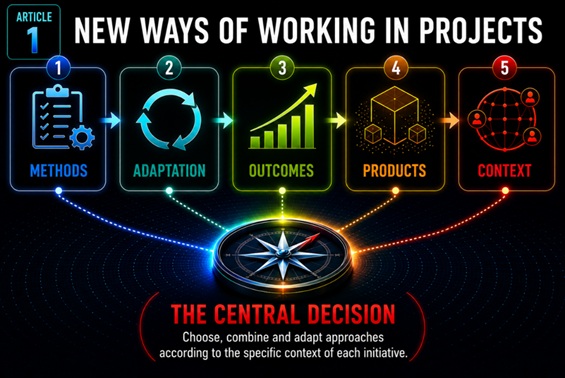
For many years, discussing new ways of working in projects meant, essentially, discussing methodologies.
Organizations sought to answer a relatively simple question: how to increase the probability of project success through better processes, tools, techniques, and management practices?
From this concern emerged more robust planning models, stricter control processes, more sophisticated risk management techniques, and methodologies capable of improving predictability and work coordination.
This evolution was decisive for the consolidation of Project Management as a discipline.
But it was never static.
Over the past few decades, the discipline evolved to respond to changes in the organizational, technological, and economic context. Whenever the context changed, Project Management had to evolve as well.
It is precisely this evolution that needs to be understood.
Because perhaps the most important transformation was not the adoption of new methods, but the progressive shift in how we understand project work itself.
From a concern with methods…
For many years, the discussion centered primarily on choosing the most appropriate methodology.
Predictive.
Iterative.
Incremental.
Agile.
Or different combinations of these approaches.
This discussion remains important. Methodologies offer structure, a common language, coordination mechanisms, and good practices that continue to be indispensable for any Project Manager.
However, over time, it became evident that simply adopting a methodology did not guarantee better results.
Technically well-managed projects could fail to create value.
Carefully prepared plans could quickly become outdated.
Highly competent teams could remain blocked by external decisions.
Success was no longer solely dependent on the quality of the method used.
It also came to depend on the capacity to respond to contexts in permanent transformation.
…to the capacity for adaptation
The spread of agile approaches represented one of the most significant shifts in the recent evolution of Project Management.
More than introducing new ceremonies or new artifacts, these approaches brought a profound shift in how work is viewed.
Change was no longer treated as an exception.
It came to be considered a normal condition of project development.
Instead of trying to eliminate all uncertainty prior to execution, it became recognized that part of that uncertainty can only be understood as the work unfolds.
Consequently, principles gained importance, such as:
- Continuous adaptation;
- Frequent learning;
- Close collaboration;
- Permanent feedback;
- Incremental delivery;
- Continuous improvement.
The question was no longer merely:
How do we follow the plan?
It also became:
How do we continue making good decisions when the context changes?
This shift represents far more than a methodological change.
It represents an evolution in how project work itself is understood.
…to the delivery of outcomes
As organizations became more outcome-oriented, Project Management also began to shift its focus.
For a long time, success was measured primarily through the traditional triple constraint:
These factors remain fundamental.
However, they are no longer sufficient to explain the true contribution of a project.
A project can strictly comply with the approved plan and yet deliver a solution that no longer meets the needs of the organization or its customers.
For this reason, questions began to gain prominence, such as:
- What value is actually being created?
- What benefits are being achieved?
- How are customer needs evolving?
- Does the result remain relevant?
- Does the investment maintain its justification?
Attention progressively shifted from output to outcome.
…to an integrated view of projects and products
Another important evolution is the convergence between project management and product management.
Traditionally, a project was understood as a temporary endeavor whose primary objective was the delivery of a specific output.
Today, many organizations recognize that this output continues to evolve long after the formal closure of the project.
Digital products, technological platforms, intelligent services, and AI-supported solutions are continuously adjusted, improved, and enriched.
In this context, projects and products cease to be entirely separate realities.
They become part of the same value creation lifecycle.
This convergence also alters how we define success.
It is no longer enough to ask:
Is the project finished?
It is equally necessary to ask:
Is the product continuing to create value?
…and finally to context
It is precisely in this dimension that the second edition of the Agile Practice Guide represents a particularly significant evolution.
Rather than presenting agility as an alternative to predictive approaches, the Guide adopts a much broader view.
It recognizes that different projects require different combinations of practices, lifecycles, and ways of organizing work.
The question is no longer:
What is the best methodology?
It becomes:
What is the most appropriate approach for the specific context of this project?
This shift may seem subtle.
In reality, it profoundly alters the logic of Project Management.
Context assumes a central role.
The nature of the solution.
The stability of requirements.
The level of uncertainty.
The maturity of the team.
The characteristics of stakeholders.
The pace of change.
The regulatory environment.
The integration with products.
All of this influences how the project should be organized.
The method is no longer the starting point.
It becomes a consequence of understanding the context.
This is, perhaps, one of the most important messages of the new Guide.
The evolution of Project Management is not about replacing one methodology with another.
It is about developing the capability to select, combine, and adapt approaches according to the concrete reality of each initiative.
Far more than methods
Observing this evolution, it becomes evident that Project Management has walked a consistent path.
First, it concerned itself with methods.
Then with adaptation.
Later with outcomes.
Next with products.
And today, increasingly with context.
This path demonstrates a progressive broadening of the discipline.
Project Management continues to require solid methodologies.
It continues to depend on planning, coordination, risk management, leadership, and execution discipline.
However, it has also come to recognize that no methodology, on its own, can address the growing complexity of organizational environments.
Perhaps this is the primary message that emerges from reading the new Agile Practice Guide.
The true evolution of Project Management does not lie merely in the adoption of new practices.
It lies in the growing capability to understand context and adapt work intelligently, maintaining a relentless focus on value creation.
A new question
This evolution represents an extraordinary advancement.
Teams have become more adaptive.
Projects have drawn closer to products.
Learning has become part of the work.
Outcomes have gained greater importance than the mere execution of a plan.
Context has come to guide the choice of approaches.
Yet, this evolution also raises a new question.
A team can perform exemplarily.
It can adapt continuously.
It can deliver value incrementally.
It can learn rapidly.
It can select the approach most suited to the context.
And yet, it can remain constrained by organizational decisions, structures, and conditions that remain unchanged.
Perhaps that is why the next evolution of Project Management no longer depends solely on team agility.
So, what is missing?
It is precisely this question that I will explore in the next article of this series. |
Posted on: August 02, 2026 05:08 AM
|
Permalink |
Comments (0)
|
"But the fact that some geniuses were laughed at does not imply that all who are laughed at are geniuses. They laughed at Columbus, they laughed at Fulton, they laughed at the Wright brothers. But they also laughed at Bozo the Clown."
- Carl Sagan
|




