


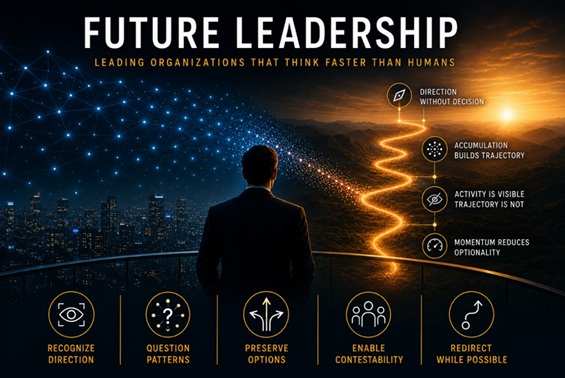
Leading Organizations That Think Faster Than Humans
Leadership has always operated with delay.
Information takes time to travel.
Patterns take time to become visible.
Consequences take time to emerge.
Leaders have never seen everything as it happened.
Yet organizations were largely built around an important temporal assumption:
Consequential movement would become visible early enough for leadership to interpret it before direction became too difficult to change.
A strategy could drift.
A project could deteriorate.
A market could shift.
An operating model could produce unintended effects.
But somewhere between signal and consequence, there was usually an expectation that the organization would notice.
Reports would surface.
People would escalate.
Patterns would accumulate.
Leadership would interpret.
Direction could be reconsidered.
This assumption is becoming less reliable.
AI-native organizations are beginning to operate at a different temporal scale.
Systems sense continuously.
Agents interact.
Models update.
Thresholds adjust.
Workflows respond.
Priorities are recalibrated.
Local decisions trigger other local decisions across interconnected environments.
Each action may be small.
Each adaptation may be legitimate.
Each system may remain within its authorized domain.
Yet together, these interactions can begin forming an organizational trajectory before anyone recognizes the direction taking shape.
This may become one of the defining leadership problems of the AI-native organization.
Decision speed is only part of the issue.
The deeper challenge is the speed at which trajectories form.
A fast decision can often be reviewed.
An isolated action can be reversed.
A visible failure can trigger intervention.
But organizational direction rarely emerges from one decision alone.
It forms through accumulation.
A threshold changes.
An agent adapts.
A recommendation becomes more influential.
A workflow begins routing cases differently.
A local optimization alters behavior elsewhere.
The changed behavior becomes new data.
The new data reinforces the pattern.
Nothing necessarily appears decisive.
Then the organization discovers that something has changed.
Risk tolerance has shifted.
A capability has weakened.
A market position has evolved.
A workforce relationship has become more transactional.
A strategic priority exists formally but no longer organizes actual behavior.
The organization did not explicitly choose a new direction.
A direction formed.
This distinction changes the leadership problem.
Leadership has traditionally been associated with setting direction.
But what happens when direction can also emerge from the recursive interaction of systems operating faster than leadership can interpret their collective effect?
The leader may understand every major system.
Governance may have approved each domain of autonomy.
Individual decisions may be explainable.
Performance may remain strong.
And still, the organization may be moving somewhere no one consciously intended.
The difficulty lies in the temporal gap between trajectory formation and trajectory recognition.
By the time a pattern becomes visible at leadership level, it may already have shaped:
Behavior.
Dependencies.
Expectations.
Data.
Incentives.
Customer experience.
Operational norms.
Future system responses.
The organization is no longer merely observing a pattern.
It is observing conditions partly produced by the pattern itself.
Systems act on the environment.
Their actions alter the environment.
The altered environment produces new signals.
Those signals shape subsequent interpretation and action.
As the loop accelerates, the distinction between sensing reality and sensing a reality partly produced by previous system behavior becomes increasingly difficult to preserve.
The organization progressively participates in producing the reality it subsequently senses.
Leadership may therefore arrive late in a very specific sense.
Not late to the decision.
Late to recognizing what the accumulation of decisions has made possible.
This is a different form of organizational latency.
Traditional management often treated latency primarily as delayed information.
The event happened.
The organization learned about it later.
AI-native organizations may face interpretive latency.
The relevant information may already exist.
Signals may be continuously captured.
Dashboards may update in real time.
Models may detect variation immediately.
Yet the organizational meaning of distributed change may remain invisible.
The organization sees activity.
It does not yet see trajectory.
More visibility does not necessarily solve this problem.
Continuous visibility can make it harder to distinguish consequential movement from normal variation.
When thousands of signals change continuously, change itself becomes ordinary.
Every metric moves.
Every model updates.
Every workflow adapts.
Every agent generates activity.
The challenge becomes determining when distributed variation has begun to acquire direction.
That is a profoundly different capability from monitoring performance.
Performance asks whether the system is producing expected results.
Trajectory asks what the system is gradually becoming capable of reproducing.
Performance can remain excellent while trajectory becomes problematic.
A workforce platform may increase allocation efficiency while gradually redefining people as interchangeable capacity.
A risk system may reduce losses while slowly excluding forms of uncertainty the organization no longer knows how to interpret.
A coordination architecture may increase consistency while making unusual judgment progressively harder to sustain.
None of these trajectories requires a catastrophic decision.
They can emerge from successful operation.
This is where exception-based governance reaches a structural limit.
It assumes that what matters will eventually appear as deviation.
A threshold will be crossed.
An anomaly will emerge.
A limit will be exceeded.
Someone will escalate.
But a trajectory can remain inside acceptable operating conditions while changing the system those conditions were designed to govern.
The system does not fail.
The meaning of normal changes.
By the time the change becomes undeniable, leadership may be confronting an established organizational reality rather than an emerging possibility.
This raises a difficult question.
How early must an organization recognize a trajectory to remain capable of influencing it?
Too early, and every weak signal becomes a strategic concern.
The organization drowns in interpretation.
Autonomy collapses under premature intervention.
Adaptation becomes dependent on executive attention.
Too late, and interpretation becomes retrospective.
Leadership can explain how the organization arrived somewhere.
It may no longer be able to prevent arrival.
Future leadership therefore requires governing the widening distance between organizational speed and interpretive time.
Leaders cannot think at machine speed.
Nor should organizations slow every intelligent system to the rhythm of executive cognition.
The value of distributed intelligence would disappear.
The question is whether the organization remains governable across different temporal scales.
Systems may operate in milliseconds.
Operational patterns may form over hours.
Behavioral consequences may emerge over weeks.
Strategic effects may become visible over months.
Institutional consequences may take years.
Leadership must increasingly govern across these temporal layers without assuming that the fastest layer is the most important or that the slowest consequence can safely wait until it becomes visible.
This requires a different form of organizational attention.
Leadership has traditionally looked for decisions.
Who decided?
What was approved?
Which action was taken?
What result followed?
But in distributed intelligent systems, some of the most consequential organizational changes may have no singular decision point.
Future leadership must become capable of recognizing direction without decision.
Where are repeated local adaptations beginning to converge?
Which temporary exceptions are becoming operational norms?
Where is accumulated system behavior narrowing future optionality?
What is becoming easier to reproduce?
What is becoming progressively harder to question?
These questions do not replace strategy.
They reveal where strategy may already be changing in practice.
They also change the meaning of leadership presence.
No leader can remain cognitively present across every interaction in an AI-native organization.
The organization itself must become better able to notice how trajectories acquire momentum.
Momentum matters because trajectories are not equally governable at every stage.
Early patterns may be ambiguous but flexible.
Established patterns become clearer but harder to redirect.
Embedded patterns begin shaping infrastructure, capability, expectations, and identity.
Eventually, the organization may become dependent on the very trajectory it is trying to reconsider.
An organization may possess the technical ability to stop a system and still lack the practical ability to reverse what the system has already normalized.
It may change an objective while retaining the data, incentives, habits, dependencies, and expectations produced by the previous one.
It may withdraw autonomy while discovering that the human capabilities required to resume judgment have weakened.
It may correct a model while the organizational behavior shaped by years of model-mediated decisions persists.
Intervention remains possible.
Reversal becomes progressively more expensive.
The critical question is when a trajectory remains sufficiently open to meaningful redirection.
This requires a new sensitivity to organizational irreversibility.
The more difficult form may be accumulated irreversibility.
The gradual closing of alternatives.
The erosion of capabilities.
The normalization of dependencies.
The institutionalization of assumptions.
The strengthening of feedback loops that make one future increasingly probable and others increasingly difficult.
Leadership has always shaped the future.
What changes is that future organizational states may now begin consolidating through machine-speed interaction long before they become visible as strategic choices.
The future leader is therefore unlikely to remain the cognitive center of the organization.
Distributed intelligence makes that increasingly unrealistic.
But replacing the heroic leader with a demand for more perceptive, more reflective, or more ambiguity-tolerant leaders would solve little.
The problem is partly institutional.
Organizations often reward certainty.
Performance systems privilege measurable outcomes.
Executive incentives favor near-term optimization.
Governance demands evidence.
Successful systems acquire legitimacy.
Under these conditions, questioning an emerging trajectory can become hardest precisely when that trajectory is still easiest to redirect.
The evidence is incomplete.
The pattern remains ambiguous.
Performance may be strong.
The cost of intervention is visible.
The cost of waiting is not.
Future leadership therefore depends on more than individual capability.
It requires organizational conditions in which ambiguous signals can remain visible without automatically becoming interventions.
Emerging trajectories must be examinable before they are classified as failures.
Successful patterns must remain open to question without requiring proof that they are already harmful.
Different interpretations of direction must be able to coexist long enough to be tested.
And leaders must be able to preserve future options even when the immediate performance case for doing so is incomplete.
This is not indecision.
It is the institutional capacity to keep consequential direction open to interpretation while it is still governable.
The tension cannot be removed.
Evidence strengthens with time.
So does trajectory.
Waiting improves certainty.
It may also reduce governability.
Acting early preserves optionality.
It also increases the risk of acting on noise.
No dashboard can determine the exact moment at which variation becomes direction.
No AI system can decide, without inheriting the organization's own assumptions about significance, when an emerging pattern deserves strategic attention.
Intelligent systems can help enormously.
They can detect convergence.
Surface weak signals across domains.
Model propagation and reinforcing loops.
Reveal changes no human could observe unaided.
But trajectory recognition cannot be reduced to another predictive layer.
Any system designed to identify consequential direction will itself encode assumptions about which patterns matter, which futures appear plausible, and which forms of change deserve attention.
A mechanism built to detect trajectories can therefore develop its own trajectory blindness.
The challenge is not simply to see earlier.
It is to preserve the contestability of what the organization believes it is seeing.
When does an observed pattern become significant enough to question the direction the organization is acquiring?
There may be no permanent threshold.
That question belongs to the future of leadership.
Organizations that think faster than humans will not necessarily become ungovernable.
But they may become ungovernable before leadership realizes that governability is being lost.
The danger is not simply speed.
It is the possibility that organizational becoming increasingly precedes organizational understanding.
Leadership then moves downstream.
The organization acts.
Patterns converge.
Momentum develops.
Consequences begin shaping future conditions.
Only then does direction become visible.
At that point, leadership may still decide.
But it is deciding inside a reality the organization has already partially constructed.
The future of leadership may therefore depend on preserving a difficult organizational capacity:
The capacity to recognize consequential direction before direction becomes destiny.
Leaders do not need to think faster than intelligent systems.
They need organizations capable of making emerging trajectories visible while those trajectories can still be questioned, interpreted, and redirected.
Because in AI-native organizations, the most consequential change may not begin with a decision.
It may begin when thousands of individually reasonable actions start making the same future easier to reproduce.
And by the time leadership asks where the organization is going, the organization may already have been answering for some time.
Posted on: July 31, 2026 03:47 AM |
Permalink


