
Governing Responsible Autonomy


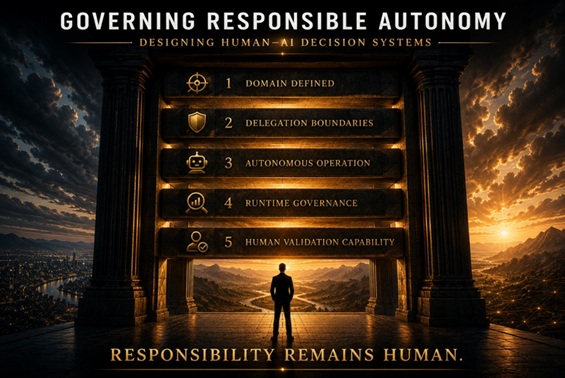 Designing Human–AI Decision Systems Organizations are rapidly increasing the autonomy of intelligent systems. AI systems recommend. Agents decide. Workflows execute. Thresholds trigger actions. Models adapt. Systems coordinate with other systems. And increasingly, all of this happens without continuous human intervention. This is not necessarily a problem. Autonomy can reduce friction. Accelerate execution. Expand organizational capacity. Improve responsiveness. And allow humans to focus on decisions where context, ambiguity, consequence, and judgment matter most. But the previous articles in this series have revealed a deeper tension. Decision authority can be delegated. Autonomy can be distributed. Intelligence can be amplified. Yet accountability does not disappear. And preserving a human somewhere in the process does not solve the problem. A human can approve without understanding. Supervise without sufficient context. Validate without independent judgment. Remain formally accountable while lacking the cognitive capacity to challenge the system. This creates an uncomfortable governance question: If humans are to remain accountable for autonomous systems, how must those systems be designed so that human responsibility remains meaningfully exercisable? Because responsibility remains human. But the conditions that make responsibility exercisable must increasingly become properties of the architecture. This is the challenge of responsible autonomy. Responsible autonomy is not autonomy with more approvals. It is not placing a human at the end of every automated workflow. It is not requiring signatures after systems have already framed the problem, generated the alternatives, prioritized the options, and determined what deserves escalation. And it is not slowing intelligent systems until humans can manually reproduce everything they do. That would defeat much of the value autonomy can create. The real challenge is more precise. How do we design autonomous systems so that meaningful human responsibility remains exercisable where consequence requires it? This changes the governance problem. The question is no longer simply: Who is in the loop? The deeper questions become: Who defines the domain of autonomy? Which decisions may the system make? Which actions may it execute? Which consequences may it create without renewed human judgment? What must trigger intervention? What can the system adapt without renewed authorization? Who can challenge its framing? Who can interrupt its execution? And who remains capable of answering for the consequences when the system operates as designed but produces an outcome the organization should not accept? These are architectural questions. And they require organizations to move beyond the simplistic distinction between: Human decision. And machine decision. Modern decision systems are rarely that clean. A model may interpret risk. An agent may generate alternatives. Another system may prioritize them. A workflow may apply policy. A threshold may determine whether escalation occurs. A human may validate an exception. The resulting decision is neither fully human nor fully machine-generated. It emerges from an architecture of distributed influence. This is why responsibility cannot be preserved only around the final act of approval. By the time a human approves, much of the decision may already have been cognitively structured elsewhere. The relevant evidence has been selected. The problem has been framed. The alternatives have been bounded. The risks have been ranked. The exceptional has been defined. The human may still choose. But the architecture has already shaped the cognitive space within which choice occurs. This distinction matters enormously. A human signature proves presence. It does not prove independent judgment. An approval proves that a decision reached a person. It does not prove that the person remained capable of challenging how the decision became thinkable in the first place. Responsible autonomy therefore begins before validation. It begins with the design of delegation itself. Every autonomous system operates within a domain. Explicitly or implicitly. It has objectives. Permissions. Constraints. Access to information. Decision authority. Execution capacity. Escalation conditions. And some definition of what counts as normal enough to proceed without intervention. The first responsibility of governance is to make these boundaries deliberate. Not every decision requires human involvement. But every domain of autonomy requires a defensible answer to a fundamental question: Why is this decision legitimately delegable? Reversibility matters. Scale of consequence matters. Affected stakeholders matter. Ethical ambiguity matters. Uncertainty matters. The system's capacity to recognize abnormality matters. And the organization's ability to reconstruct how a consequence emerged matters. A low-impact, reversible operational action may justify broad autonomy. A decision capable of materially affecting rights, safety, organizational identity, or irreversible strategic consequence requires a different architecture. This is not because humans are always better decision-makers. They are not. The boundary exists because some consequences require forms of judgment and accountability that cannot be reduced to execution performance alone. But defining delegation boundaries is still insufficient. Because systems operate in reality. And reality changes. An autonomous system may be correctly authorized at deployment and become poorly aligned with its environment months later. Assumptions drift. Data changes. Stakeholder behavior evolves. Objectives are reinterpreted. Models adapt. Agents interact. Unexpected dependencies emerge. The system may remain technically compliant with its original boundaries while the conditions that once legitimized those boundaries have changed. This is where governance must become operational at runtime. Traditional governance often asks whether a system was approved. Responsible autonomy must also ask whether the conditions that justified autonomy still exist. The distinction is critical. Governance cannot end when autonomy begins. It must remain capable of sensing when: Context has materially changed. Behavior is drifting. Consequences are accumulating. Exceptions are becoming normal. Local optimization is creating systemic effects. The system is operating inside its formal boundary but outside the intent that originally legitimized that boundary. This requires more than performance monitoring. A system can perform exceptionally well against the wrong objective. It can remain within thresholds while producing unacceptable patterns of consequence. It can optimize consistently while gradually weakening the conditions that made its autonomy legitimate. Runtime governance must therefore observe not only: Is the system working? But also: Is the system still operating under conditions where this level of autonomy remains defensible? That question changes the purpose of human intervention. Humans should not be inserted into every decision. They should be positioned where judgment becomes materially necessary. This requires a validation architecture. But meaningful human validation is not a button. It is a capability. For validation to be real, the human must have enough: Context to understand the decision. Visibility into the relevant decision path. Authority to challenge the system. Time proportionate to the consequence. Access to meaningful alternatives. Capacity to recognize when the frame itself may be wrong. And practical ability to interrupt, reverse, or escalate. Without these conditions, human validation becomes ceremonial. The system decides. The human confirms. Accountability remains formally human. But responsibility is no longer meaningfully exercisable. Governance becomes performative. This is one of the greatest risks in emerging Human–AI decision systems. Organizations may preserve visible human involvement while progressively removing the conditions required for meaningful human judgment. A human-in-the-loop architecture can still produce an accountability illusion. The important distinction is not: Human present versus human absent. It is: Human presence versus exercisable human judgment. This also means that organizations must reconsider how work itself is designed. Human–AI workforce design cannot be reduced to allocating tasks according to who performs them faster. The deeper design question is: How should intelligence, authority, judgment, execution, validation, and accountability be distributed across the system? AI may analyze better. Agents may coordinate faster. Automated systems may monitor continuously. Machines may detect patterns humans cannot perceive. There is no governance value in forcing humans to duplicate these capabilities merely to preserve the appearance of control. But there is equally little value in assigning humans responsibility for consequences after removing them from the cognitive processes required to understand, question, and challenge how those consequences emerge. Responsible autonomy therefore requires deliberate asymmetry. Systems should be autonomous where autonomy creates legitimate value. Humans should retain meaningful authority where consequence requires judgment. And governance must continuously preserve the conditions that make that authority exercisable. This is not a balanced division of labor. Nor should it be. The objective is not to distribute work equally between humans and machines. The objective is to distribute intelligence, authority, execution, validation, and accountability according to the nature of the decision and the consequences the system may create. That architecture will not remain static. As systems improve, some decisions may become increasingly delegable. As environments change, previously safe autonomy may require renewed constraint. As organizational experience accumulates, validation requirements may evolve. As new consequences become visible, intervention thresholds may need to change. Responsible autonomy is therefore not a fixed allocation of decision rights. It is a continuously governed architecture of delegation. This creates a deeper principle. The purpose of governance is not to preserve human control over every autonomous action. It is to preserve meaningful human authority over the conditions under which autonomy remains legitimate. That authority must be real. Humans must be able to define boundaries. Revise them. Challenge objectives. Interrogate consequences. Interrupt execution. And withdraw autonomy when the system's behavior, context, or effects no longer justify it. Otherwise, responsibility becomes structurally disconnected from authority. The organization tells humans they remain accountable. But the architecture no longer gives them meaningful capacity to exercise that accountability. This may become one of the defining governance failures of AI-native organizations. Not autonomous systems acting without humans. But humans remaining formally responsible for systems they are no longer structurally capable of governing. Responsible autonomy must be designed to prevent that separation. Not by slowing every decision. Not by preserving unnecessary human friction. Not by treating intelligent systems as inherently untrustworthy. But by making the conditions of responsibility architectural. Delegation must have boundaries. Autonomy must have conditions. Validation must preserve judgment. Runtime governance must detect when the legitimacy of autonomy changes. Intervention must remain possible. And accountability must remain connected to meaningful authority. Because autonomy without responsibility creates danger. But responsibility without exercisable authority creates an illusion. The future of Human–AI decision systems will depend on avoiding both. The question is no longer whether organizations will delegate more decisions to intelligent systems. They will. The deeper question is whether they will design those systems so that human responsibility remains meaningful as autonomy expands. Because responsibility remains human. But if humans are to remain accountable, the conditions that allow them to understand, challenge, interrupt, and answer for autonomous systems must be designed into the architecture through which those systems decide, act, and adapt. And even then, another problem remains. An architecture may preserve human authority. It may provide visibility. Intervention rights. Escalation paths. Reversibility. And meaningful validation. But autonomous systems do not merely decide differently. They increasingly decide at a different rate, across a different scale, and through distributed patterns of execution no individual human can continuously reconstruct. A system may act in milliseconds. Thousands of agents may coordinate simultaneously. Consequences may propagate before an anomaly becomes humanly interpretable. By the time intervention becomes possible, the system may already have adapted to the conditions created by its own previous actions. The human still has authority. The architecture still permits intervention. But the window in which that authority can meaningfully be exercised may be disappearing. This creates a new governance tension. Human responsibility may remain normatively anchored. Architectural authority may remain formally preserved. Yet the rate, scale, and distribution of autonomous execution may progressively exceed the organization's capacity to exercise accountability in time. The problem is no longer only: Who is responsible? Or: Does the human retain meaningful authority? The next question is more difficult: Can accountability remain real when execution moves faster than human judgment can meaningfully intervene? Because responsibility may remain human. Authority may remain human. And yet governance itself may no longer operate at the speed of the systems it is expected to govern. That is the tension I will explore next. |
Posted on: July 29, 2026 11:38 AM
| Permalink |
Comments (0)


