Support to Develop
by Luis Branco

This blog addresses management-related topics and has three areas of focus: 1. Technical skills; 2. Competencies in the field of interpersonal relations and communication (including personal organization and delegation, leadership, teamwork, conflict resolution, conducting meetings, and negotiation); and 3. Strategy (including diagnosis, strategic guidelines, and implementation).4.Technology
Recent Posts
From Conscious Governance to Constraint Governance
New Ways of Working in Projects: From Team Agility to Organizational Adaptability
Future Leadership
Governing Responsible Autonomy
Cognitive Sovereignty
Categories
Agile,
Career Development,
Career Development,
Career Development,
Career Development,
Career Development,
Career Development,
Career Development,
Career Development,
Career Development,
Career Development,
Career Development,
Career Development,
Career Development,
Career Development,
Career Development,
Career Development,
Career Development,
Career Development,
Career Development,
Career Development,
Career Development,
Career Development,
Career Development,
Career Development,
Career Development,
Career Development,
Career Development,
Career Development,
Career Development,
Career Development,
Career Development,
Career Development,
Career Development,
Career Development,
Career Development,
Career Development,
Career Development,
Career Development,
Career Development,
Career Development,
Career Development,
Career Development,
Career Development,
Career Development,
Career Development,
Career Development,
Career Development,
Career Development,
Career Development,
Career Development,
Career Development,
Career Development,
Career Development,
Career Development,
Career Development,
Career Development,
Career Development,
Career Development,
Career Development,
Career Development,
Career Development,
Career Development,
Career Development,
Career Development,
Career Development,
Career Development,
Career Development,
Career Development,
Career Development,
Career Development,
Career Development,
Career Development,
Career Development,
Career Development,
Career Development,
Career Development,
Career Development,
Career Development,
Career Development,
Career Development,
Career Development,
Career Development,
Career Development,
Career Development,
Career Development,
Career Development,
Career Development,
Career Development,
Career Development,
Career Development,
Career Development,
Career Development,
Career Development,
Career Development,
Career Development,
Career Development,
Career Development,
Career Development,
Career Development,
Career Development,
Career Development,
Career Development,
Career Development,
Career Development,
Career Development,
Career Development,
Interpersonal Skills,
Interpersonal Skills,
Interpersonal Skills,
Interpersonal Skills,
Interpersonal Skills,
Interpersonal Skills,
Interpersonal Skills,
Interpersonal Skills,
Interpersonal Skills,
Interpersonal Skills,
Interpersonal Skills,
Interpersonal Skills,
Interpersonal Skills,
Interpersonal Skills,
Interpersonal Skills,
Interpersonal Skills,
Interpersonal Skills,
Interpersonal Skills,
Interpersonal Skills,
Interpersonal Skills,
Interpersonal Skills,
Interpersonal Skills,
Interpersonal Skills,
Interpersonal Skills,
Interpersonal Skills,
Interpersonal Skills,
Interpersonal Skills,
Interpersonal Skills,
Interpersonal Skills,
Interpersonal Skills,
Interpersonal Skills,
Interpersonal Skills,
Interpersonal Skills,
Interpersonal Skills,
Interpersonal Skills,
Interpersonal Skills,
Interpersonal Skills,
Interpersonal Skills,
Interpersonal Skills,
Interpersonal Skills,
Interpersonal Skills,
Interpersonal Skills,
Interpersonal Skills,
Interpersonal Skills,
Interpersonal Skills,
Interpersonal Skills,
Interpersonal Skills,
Interpersonal Skills,
Interpersonal Skills,
Interpersonal Skills,
Interpersonal Skills,
Interpersonal Skills,
Interpersonal Skills,
Interpersonal Skills,
Interpersonal Skills,
Interpersonal Skills,
Interpersonal Skills,
Interpersonal Skills,
Interpersonal Skills,
Interpersonal Skills,
Interpersonal Skills,
Interpersonal Skills,
Interpersonal Skills,
Interpersonal Skills,
Interpersonal Skills,
Interpersonal Skills,
Interpersonal Skills,
Interpersonal Skills,
Interpersonal Skills,
Interpersonal Skills,
Interpersonal Skills,
Interpersonal Skills,
Interpersonal Skills,
Interpersonal Skills,
Interpersonal Skills,
Interpersonal Skills,
Interpersonal Skills,
Interpersonal Skills,
Interpersonal Skills,
Interpersonal Skills,
Interpersonal Skills,
Interpersonal Skills,
Interpersonal Skills,
Interpersonal Skills,
Interpersonal Skills,
Interpersonal Skills,
Interpersonal Skills,
Interpersonal Skills,
Interpersonal Skills,
Interpersonal Skills,
Interpersonal Skills,
Interpersonal Skills,
Interpersonal Skills,
Interpersonal Skills,
Interpersonal Skills,
Interpersonal Skills,
Interpersonal Skills,
Interpersonal Skills,
Interpersonal Skills,
Interpersonal Skills,
Interpersonal Skills,
Interpersonal Skills,
Interpersonal Skills,
Interpersonal Skills,
Interpersonal Skills,
Interpersonal Skills,
Leadership,
Leadership,
Leadership,
Leadership,
Leadership,
Leadership,
Leadership,
Leadership,
Leadership,
Leadership,
Leadership,
Leadership,
Leadership,
Leadership,
Leadership,
Leadership,
Leadership,
Leadership,
Leadership,
Leadership,
Leadership,
Leadership,
Leadership,
Leadership,
Leadership,
Leadership,
Leadership,
Leadership,
Leadership,
Leadership,
Leadership,
Leadership,
Leadership,
Leadership,
Leadership,
Leadership,
Leadership,
Leadership,
Leadership,
Leadership,
Leadership,
Leadership,
Leadership,
Leadership,
Leadership,
Leadership,
Leadership,
Leadership,
Leadership,
Leadership,
Leadership,
Leadership,
Leadership,
Leadership,
Leadership,
Leadership,
Leadership,
Leadership,
Leadership,
Leadership,
Leadership,
Leadership,
Leadership,
Leadership,
Leadership,
Leadership,
Leadership,
Leadership,
Leadership,
Leadership,
Leadership,
Leadership,
Leadership,
Leadership,
Leadership,
Leadership,
Leadership,
Leadership,
Leadership,
Leadership,
Leadership,
Leadership,
Leadership,
Leadership,
Leadership,
Leadership,
Leadership,
Leadership,
Leadership,
Leadership,
Leadership,
Leadership,
Leadership,
Leadership,
Leadership,
Leadership,
Leadership,
Leadership,
Leadership,
Leadership,
Leadership,
Leadership,
Leadership,
Leadership,
Leadership,
Leadership,
Leadership,
Strategy,
Strategy,
Strategy,
Strategy,
Strategy,
Strategy,
Strategy,
Strategy,
Strategy,
Strategy,
Strategy,
Strategy,
Strategy,
Strategy,
Strategy,
Strategy,
Strategy,
Strategy,
Strategy,
Strategy,
Strategy,
Strategy,
Strategy,
Strategy,
Strategy,
Strategy,
Strategy,
Strategy,
Strategy,
Strategy,
Strategy,
Strategy,
Strategy,
Strategy,
Strategy,
Strategy,
Strategy,
Strategy,
Strategy,
Strategy,
Strategy,
Strategy,
Strategy,
Strategy,
Strategy,
Strategy,
Strategy,
Strategy,
Strategy,
Strategy,
Strategy,
Strategy,
Strategy,
Strategy,
Strategy,
Strategy,
Strategy,
Strategy,
Strategy,
Strategy,
Strategy,
Strategy,
Strategy,
Strategy,
Strategy,
Strategy,
Strategy,
Strategy,
Strategy,
Strategy,
Strategy,
Strategy,
Strategy,
Strategy,
Strategy,
Strategy,
Strategy,
Strategy,
Strategy,
Strategy,
Strategy,
Strategy,
Strategy,
Strategy,
Strategy,
Strategy,
Strategy,
Strategy,
Strategy,
Strategy,
Strategy,
Strategy,
Strategy,
Strategy,
Strategy,
Strategy,
Strategy,
Strategy,
Strategy,
Strategy,
Strategy,
Strategy,
Strategy,
Strategy,
Strategy,
Strategy,
Sustainability,
Talent Management,
Talent Management,
Talent Management,
Talent Management,
Talent Management,
Talent Management,
Talent Management,
Talent Management,
Talent Management,
Talent Management,
Talent Management,
Talent Management,
Talent Management,
Talent Management,
Talent Management,
Talent Management,
Talent Management,
Talent Management,
Talent Management,
Talent Management,
Talent Management,
Talent Management,
Talent Management,
Talent Management,
Talent Management,
Talent Management,
Talent Management,
Talent Management,
Talent Management,
Talent Management,
Talent Management,
Talent Management,
Talent Management,
Talent Management,
Talent Management,
Talent Management,
Talent Management,
Talent Management,
Talent Management,
Talent Management,
Talent Management,
Talent Management,
Talent Management,
Talent Management,
Talent Management,
Talent Management,
Talent Management,
Talent Management,
Talent Management,
Talent Management,
Talent Management,
Talent Management,
Talent Management,
Talent Management,
Talent Management,
Talent Management,
Talent Management,
Talent Management,
Talent Management,
Talent Management,
Talent Management,
Talent Management,
Talent Management,
Talent Management,
Talent Management,
Talent Management,
Talent Management,
Talent Management,
Talent Management,
Talent Management,
Talent Management,
Talent Management,
Talent Management,
Talent Management,
Talent Management,
Talent Management,
Talent Management,
Talent Management,
Talent Management,
Talent Management,
Talent Management,
Talent Management,
Talent Management,
Talent Management,
Talent Management,
Talent Management,
Talent Management,
Talent Management,
Talent Management,
Talent Management,
Talent Management,
Talent Management,
Talent Management,
Talent Management,
Talent Management,
Talent Management,
Talent Management,
Talent Management,
Talent Management,
Talent Management,
Talent Management,
Talent Management,
Talent Management,
Talent Management,
Talent Management,
Talent Management
Date
As part of its strengthened ethical ecosystem, PMI introduced the Practitioner Ethics Toolkit - a practical resource designed to bring ethics out of theory and into the daily reality of project work..
While the Code defines the principles and the EDMF provides the decision-making process, the Practitioner Ethics Toolkit focuses on application.
It translates ethical values into concrete behaviours, helping professionals navigate the subtle, real-world situations that emerge in fast-paced environments.
The Toolkit supports practitioners by helping them:
• Recognize ethical dilemmas that arise in everyday interactions
• Identify behaviours that reinforce responsibility, respect, fairness, and honesty
• Act with greater awareness in conversations with clients, colleagues, and stakeholders
• Manage conflicts transparently and in alignment with PMI’s values
• Transform ethical choices into consistent, repeatable habits
Its strength lies in its practicality.
This is not abstract guidance - it is actionable direction that can be applied across contexts, roles, industries, and maturity levels.
In environments where speed, pressure, and ambiguity can easily create ethical “grey zones,” the Practitioner Ethics Toolkit offers a simple, accessible foundation for maintaining integrity and coherence.
When ethics becomes part of daily habits - reflected in conversations, communication, reviews, and decision-making - leadership gains depth, and teams gain trust.
In the coming days, I will continue this series with the final component of PMI’s ethical ecosystem: the Chapter Board Ethics Toolkit - a resource dedicated to strengthening ethical governance within PMI Chapters and professional communities.
For those who wish to explore PMI’s official ethics guidelines, here is the correct link:
Note: This reflection is personal and independent, based on my study of PMI’s published materials, and does not represent an official PMI position. |
Posted on: December 05, 2025 09:53 AM
|
Permalink |
Comments (0)
As part of its renewed ethical ecosystem, PMI introduced the Ethical Decision-Making Framework (EDMF), and this tool represents one of the most significant evolutions in our profession.
For years, ethics has been expressed through values and principles.
The EDMF goes further: it turns ethics into a process.
The EDMF provides a structured approach for navigating ethical dilemmas, situations where values collide and where the “right” choice is not immediately clear.
It guides professionals through five disciplined steps:
• Gather all relevant facts and challenge assumptions
• Identify alternative choices
• Analyze potential impacts on stakeholders, society, and the environment
• Test alignment with the four PMI values (Responsibility, Respect, Fairness, Honesty)
• Make a clear, intentional decision and take responsibility for it
In a world defined by complexity, competing pressures, and accelerated decision cycles, the EDMF helps leaders slow down, think critically, reduce bias, and act with integrity.
Its true power lies in its practicality.
The EDMF transforms ethical reflection from an abstract notion into a repeatable, teachable, and improvable discipline, accessible to teams, PMOs, volunteers, and executives.
Ethical leadership is not defined by perfect decisions, but by how decisions are made.
The EDMF provides a shared language and a consistent method for navigating the difficult moments that shape culture and character.
Over the next days, I will continue exploring the remaining components of PMI’s new ethical ecosystem, including the Practitioner Ethics Toolkit and the Chapter Board Ethics Toolkit, and how they strengthen ethical leadership across projects and organizations.
For those who wish to consult PMI’s official EDMF, here is the link:
Note: This reflection is personal and independent, based on my study of PMI’s published materials, and does not represent an official PMI position. |
Posted on: December 03, 2025 09:25 AM
|
Permalink |
Comments (3)

The PMI Code of Ethics and Professional Conduct has just undergone its most significant update in more than a decade and these changes redefine what it means to be a project professional.
The 2025 edition brings ethics into the realities of today’s world.
It introduces clear expectations around:
- Responsible leadership in the use of technology and AI
- Sustainability and long-term impact on society and the environment
- Explicit protection against retaliation
- Transparent handling of conflicts of interest
- Psychologically safe, respectful, and inclusive environments
- Accountability, integrity, and good-faith behavior
- Clarity in commitments, communication, and corrective actions
What used to be implicit is now explicit.
What used to be “best practice” is now a baseline ethical requirement.
This new Code elevates our profession by transforming ethics from an abstract idea into a daily discipline, a practical framework that guides decisions, behaviors, and relationships.
Ethics is no longer simply a value.
It is a competence, a responsibility, and a form of leadership.
Over the next days, I will share deeper insights into the remaining three elements of PMI’s new ethical ecosystem, including the EDMF and the two Ethics Toolkits, and what they mean for project leaders, teams, and chapters worldwide.
For those who wish to explore the original document, here is PMI’s official link:
Note: This reflection is personal and independent, based on my study of PMI’s published materials, and does not represent an official PMI position. |
Posted on: December 01, 2025 08:43 AM
|
Permalink |
Comments (6)
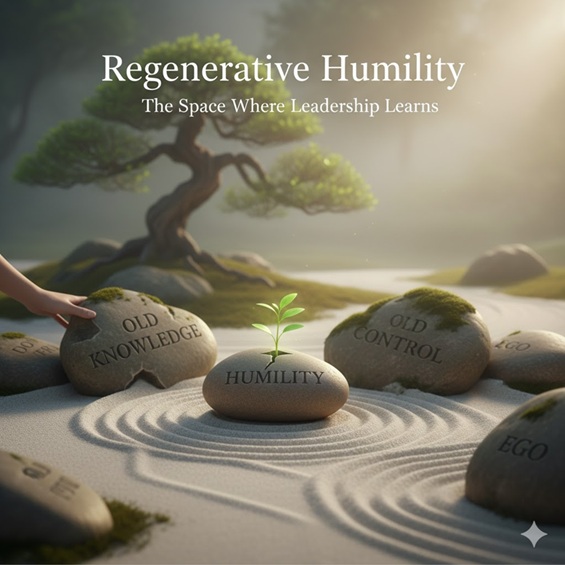
(Epilogue to the series “The 11 Keys to Regenerative Leadership”)
After completing the series, a few reflections from readers stayed with me:
“Regenerative learning happens when experience matures before habit settles.”
“People share insights only when trust is stronger than fear.”
“What keeps learning alive is humility — the humility to unlearn.”
These words touch what may be the invisible heart of regenerative leadership:
Humility, the quiet space where leadership truly learns.
Regenerative humility is not weakness.
It is the awareness that allows us to let go of what no longer serves, to listen to what the system is showing us, and to renew the meaning of our actions.
In a world that rewards quick certainty, humility becomes an act of courage.
It allows us to see again.
To relearn with presence.
And to lead without losing connection to purpose.
To lead regeneratively is to practice this living humility:
- Listening more than asserting.
- Sharing more than controlling.
- Learning while leading.
Practical example:
In an organization undergoing change, a leader replaced the traditional “post-mortem meeting” with a mutual listening session involving teams, clients, and partners.
The goal was not to measure success, but to understand what the system itself was teaching them.
From that practice emerged real improvements and a culture that became more confident, human, and connected.
Regenerative Synthesis
Humility is the breath of living leadership.
Without it, knowledge closes; with it, the system flourishes.
Because the true power of a leader is not in knowing more, but in creating space for collective wisdom to emerge.
In your organization:
Is there room for the silence, listening, and humility that keep knowledge alive?
This post concludes the series ‘The 11 Keys to Regenerative Leadership.’
And it opens space for what is now beginning to emerge. |
Posted on: November 28, 2025 09:47 AM
|
Permalink |
Comments (1)
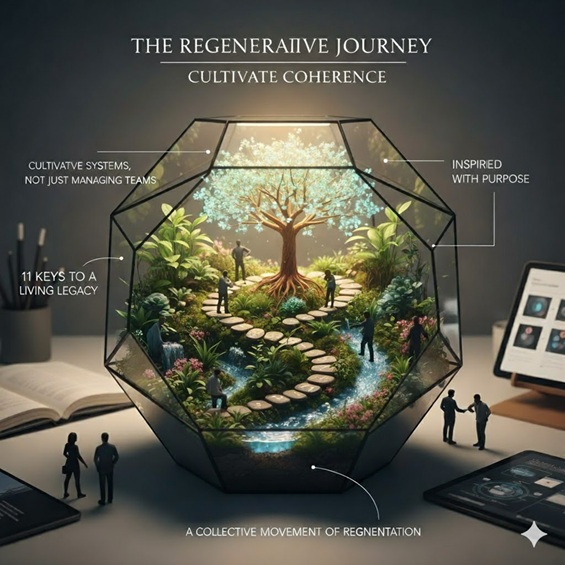
(Closing post of the series “The 11 Keys to Regenerative Leadership”)
We’ve reached the end of the series, but not the end of the journey.
Because regenerative leadership is not something you apply.
It’s something you live.
It’s not a framework to memorize, it’s a cycle to embody.
Each of the 11 Keys to Regenerative Leadership is a living practice,
A call to presence, awareness, and the courage to build the future differently.
To lead regeneratively is to cultivate systems, not just manage teams.
It’s to inspire trust, decide with purpose, delegate as legacy, collaborate with meaning, and learn with humility.
Throughout this series, we explored what happens when leadership stops being an individual performance and becomes a collective movement of regeneration.
We discovered that:
- Trust is not imposed - it’s renewed daily;
- Decision-making is not a final act - it’s a learning cycle;
- Delegation is not relief - it’s legacy;
- Culture is not environment - it’s ecosystem;
- Purpose is not a statement - it’s a living compass;
- Flexibility is not weakness - it’s discernment in motion;
- Authenticity is not exposure - it’s coherence;
- Learning is not an event - it’s the system’s respiration;
- Impact is not an outcome - it’s a living consequence;
- And the legacy of a leader is not what they build, it’s what remains alive in those they’ve helped grow.
Regenerative leadership begins when we stop chasing certainty and start cultivating coherence.
When intention becomes practice.
When purpose listens.
When time includes pauses that let culture take root.
This series may end here, but the conversation continues in teams, in projects, and in every decision that shapes our shared future.
Because regeneration isn’t a concept.
It’s a commitment.
Which key resonated most with you?
What practice has already started transforming the way you lead?
Share in the comments, regeneration is always collective.
This post is part of the series The 11 Keys to Regenerative Leadership |
Posted on: November 26, 2025 09:38 AM
|
Permalink |
Comments (1)
|
"The most incomprehensible thing about the universe is that it is comprehensible."
- Albert Einstein
|




