


What If the Team Is No Longer the Right Unit of Organizational Design?


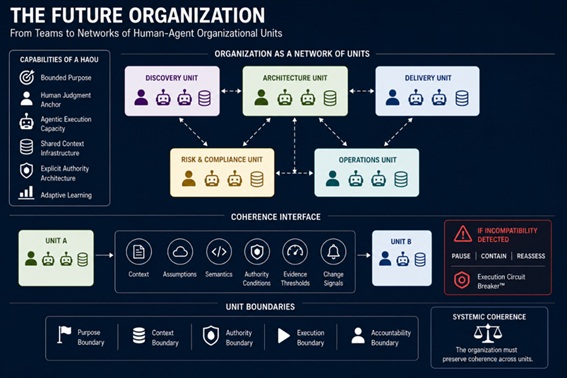 For more than a century, organizations have treated the team as one of the fundamental units of work. People are grouped around a shared objective. Roles distribute responsibility. Skills create specialization. Coordination connects individual contributions. Leadership provides direction. The model has evolved, from functional teams to cross-functional, agile, distributed, and product teams, but the underlying assumption has remained remarkably stable: Work is organized primarily by coordinating people. Artificial intelligence may be challenging that assumption. Not because AI makes teams smaller. But because the system through which work is performed is changing. And if the system is changing, perhaps the organizational unit itself is changing with it. We May Be Using an Old Category for a New Architecture The first wave of workplace AI fitted relatively comfortably inside the traditional concept of team. A human performed the work. AI assisted. The team remained fundamentally human. Its members still held most execution responsibility. Coordination remained largely interpersonal. Authority remained attached to human roles. AI was a tool inside the team. We could describe the model simply: Team + AI tools Agentic AI introduces a different possibility. Imagine a small group of humans working with an orchestrator agent and several specialist agents. One agent analyzes requirements. Another explores architecture options. Another builds. Another tests. Another reviews security. Another prepares deployment. A shared context layer maintains objectives, constraints, assumptions, and dependencies. An orchestration layer decomposes work, distributes tasks, reconciles outputs, and escalates exceptions. Authority rules determine what agents may decide, when evidence is sufficient, when humans must intervene, and when execution must stop. Learning mechanisms reconstruct agentic decisions and challenge the assumptions embedded in automated workflows. We may still call this a team. But perhaps we are using an old organizational category to describe a new organizational architecture. Because this is no longer simply a group of people using better tools. Part of the organization's execution, coordination, and authority architecture has become computational. At what point does a team with AI become something organizationally different? The Traditional Team Was More Than a Group of People To answer that question, it helps to understand why the team became such a powerful unit of organizational design. A team creates a bounded social and operational system. It usually contains a purpose. A set of members. Roles. Skills. Relationships. Coordination mechanisms. Decision patterns. And some form of shared accountability. The team works as a useful organizational unit because many of the elements required to understand how work happens are contained within it. Who performs the work? Look at the team. Who coordinates? Look at the team. Where does expertise reside? Look at the team. Who makes decisions? Look at roles and leadership. Where does learning happen? Largely through the experience of the people doing the work. The concept is not perfect. Matrix organizations, ecosystems, platforms, contractors, and distributed networks have long complicated this picture. But the team has remained a useful unit of analysis because human actors still carried most execution, interpretation, coordination, and judgment. Agentic systems disturb that assumption. When AI Joins the Workflow, the Team Does Not Necessarily Change There is an important distinction between AI-assisted work and AI-native work. If a project manager uses AI to summarize a meeting, the organizational unit has not changed. If a developer uses AI to generate code suggestions, the organizational unit has not necessarily changed. If a marketer uses AI to prepare alternative campaign messages, the organizational unit may still be fundamentally the same. AI improves individual execution. The architecture of work remains largely intact. But consider a different configuration. An orchestrator decomposes an objective into tasks. Several agents execute in parallel. Agents consume outputs produced by other agents. Shared context is updated dynamically. Some decisions occur without human approval. Exceptions are escalated according to predefined thresholds. A circuit breaker can interrupt execution when propagation risk becomes unacceptable. Humans intervene primarily where judgment, consequence, ambiguity, or accountability require them. This is not merely AI assistance. The structure of work itself has changed. Execution is distributed across human and non-human actors. Coordination is partly computational. Context becomes infrastructure. Authority is encoded. Learning must include both human experience and the deconstruction of agentic execution. The difference is not simply that AI has joined the team. The difference is that some of the functions through which the organization works have migrated from human relationships into computational architecture. Perhaps Headcount Is Becoming the Wrong Measure This creates an immediate organizational problem. How large is a team composed of three humans and twelve agents? Is it smaller than a traditional team of eight people? Headcount says yes. Execution capacity may say no. Cognitive demand may say no. Risk may say no. Coordination complexity may say no. A configuration with three humans and twelve highly autonomous, heterogeneous, interdependent agents may be more difficult to govern than a team of fifteen humans performing relatively stable work. The effective size of an AI-native work system cannot therefore be understood through human headcount alone. We also need to consider: Volume of agentic activity How much work is being generated and executed? Heterogeneity How different are the domains, tasks, and forms of reasoning involved? Autonomy How much can agents decide or execute without intervention? Interdependence How extensively do agents consume, modify, or depend on each other's outputs? Reversibility How easily can decisions and actions be undone? Consequence What happens when the system is wrong? This is where Agentic Span of Control becomes more than a supervision problem. It becomes a principle of organizational design. The question is no longer how many people report to one manager. It is how much agentic activity a human-led system can direct, understand, challenge, and remain accountable for without losing decisional coherence. And that raises a deeper question. If headcount no longer adequately describes the size of the work system, is the traditional team still the right unit for describing the system itself? What Would Define a New Organizational Unit? Perhaps the emerging unit of AI-native work should not be defined primarily by the number of humans or agents it contains. Perhaps it should be defined by the organizational capabilities that operate together within a bounded system. Consider six elements. Bounded purpose The system has an explicit outcome, mission, or domain of responsibility. Human judgment anchor Human responsibility remains identifiable where judgment, challenge, and consequential accountability are required. Agentic execution capacity Agents or agentic workflows perform work with defined levels of autonomy. Shared context infrastructure Humans and agents operate with sufficiently aligned objectives, constraints, assumptions, dependencies, and system state. Explicit authority architecture Decision ownership, autonomy boundaries, evidence thresholds, escalation conditions, override authority, and execution interruption are deliberately designed. Adaptive learning The system learns not only from outcomes, but by reconstructing agentic decisions, surfacing assumptions, challenging automated workflows, and adapting both human and agent behavior. Together, these elements describe something more than a team using AI. They describe a bounded system of human judgment and agentic execution designed to operate coherently. For now, I will call this a Human-Agent Organizational Unit. Not as a finished framework. Not as a new label searching for a problem. But as a hypothesis worth testing. A Human-Agent Organizational Unit may be emerging when bounded purpose, human judgment, agentic execution, shared context, explicit authority, and adaptive learning become structurally integrated into one operational system designed to preserve coherence. The critical point is not the presence of agents. It is the structural integration of these capabilities. A person using five AI tools does not automatically constitute a new organizational unit. A team deploying an isolated chatbot does not either. The unit becomes organizationally distinct when work, context, coordination, authority, and learning are redesigned as interdependent properties of a human-agent system. The Boundary May Matter More Than the Org Chart If such a unit exists, its boundaries may also need to be understood differently. Traditional organizations often use reporting lines to indicate organizational boundaries. But a human-agent system may require other boundaries. Purpose boundary Which outcomes belong to the unit? Context boundary What context may the system consume, modify, and preserve? Authority boundary Which decisions may humans and agents make within the unit? Execution boundary Which actions may the system perform autonomously? Accountability boundary For which consequences does identifiable human responsibility remain? These boundaries may not align with the organizational chart. Two human-agent units may share the same manager. They may use the same AI model. They may even use some of the same specialist agents. Yet if their purpose, context, authority, execution, and accountability boundaries differ, they may represent distinct organizational units. This has significant implications. Organizational design can no longer be understood only by asking: Who reports to whom? We may also need to ask: Who and what share context? Where does authority begin and end? Which agentic actions can propagate across boundaries? Where can execution be interrupted? Who remains capable of reconstructing why the system acted? The organizational chart was designed to represent human authority relationships. It was never designed to represent computational execution, shared context, machine autonomy, or agent-to-agent dependencies. Coherent Units Can Still Produce an Incoherent Organization There is another danger. Suppose organizations become very good at designing these human-agent units. Each has a clear purpose. Each has excellent agents. Each maintains shared context. Each has explicit authority. Each learns and adapts. The organization may still fail. Why? Because local coherence does not guarantee systemic coherence. One unit optimizes customer acquisition. Another optimizes risk. Another optimizes operational efficiency. Another optimizes product velocity. Each may act intelligently within its own boundaries. Their combined actions may still produce contradiction, duplication, resource conflict, or strategic drift. AI does not remove this problem. It may accelerate it. Agentic systems also introduce new forms of interdependence. An agent in one unit may generate an output consumed automatically by an agent in another. A context update may alter decisions across several workflows. A local optimization may propagate before any human recognizes its systemic consequence. Authority may be clear within each unit but ambiguous between them. This is where the Execution Capacity-Coherence Capacity Asymmetry becomes critical. Execution capacity can scale rapidly inside individual units. But organizational coherence depends on the capacity to understand and govern relationships across units. If execution scales faster than cross-unit coherence, the Coherence Gap can accelerate. Worse, orchestration layers may present clean summaries that hide unresolved contradictions between units. The organization may experience Hallucinated Coherence. Everything appears aligned. Dashboards are clean. Recommendations are consolidated. Local systems are performing. But incompatible assumptions and competing optimization logics remain underneath. Coherent human-agent units do not automatically produce a coherent organization. Organizational Design May Be Moving from Teams to Systems of Units If this hypothesis is correct, the next organizational design challenge is not simply to build smaller teams with more AI. It is to understand how bounded human-agent systems should be designed and how multiple systems should interact. A product discovery unit may combine human judgment, research agents, customer insight agents, and an orchestration layer. An architecture unit may combine senior architects with design, simulation, security, and dependency agents. A delivery unit may integrate humans with development, testing, documentation, and deployment agents. These units may not need to form a traditional hierarchy. They may operate as a network. But networks of human-agent units require explicit coupling mechanisms. Where one unit depends on another, outputs cannot be transferred without the conditions required to interpret them. Context matters. Assumptions matter. Authority conditions matter. Semantic meaning matters. Changes to any of them matter. The interface between units is therefore not merely a data interface. It is a coherence interface. A Coherence Interface must preserve the interpretability of work as it crosses organizational boundaries. If one unit changes its context, assumptions, semantics, or governing conditions, dependent units must be able to detect that change, determine whether existing dependencies remain compatible, and pause propagation when coherence can no longer be assured. The problem is not simply whether Unit B receives the output produced by Unit A. The problem is whether Unit B still interprets that output under conditions compatible with those under which Unit A produced it. This reveals a deeper possibility. The Coherence Gap may not emerge inside a unit. It may emerge at the boundary between two locally coherent units. Networks therefore create governance questions that traditional organizational structures were not designed to answer. What context must be shared across units? What context must remain bounded? When can one unit trigger execution in another? Whose evidence threshold applies? Which authority prevails when agents reach conflicting conclusions? How are changes in assumptions, semantics, or governing conditions signaled to dependent units? Where does accountability sit when a consequence emerges from a chain of actions across several units? When must an Execution Circuit Breaker stop propagation across the network? And how does the organization ensure that units coevolve rather than optimize themselves into collective incoherence? These are not questions of AI tool adoption. They are questions of organizational architecture. The Team May Not Disappear The concept of team will not suddenly become irrelevant. Humans will continue to collaborate. Relationships will continue to matter. Trust, conflict, identity, psychological safety, and leadership will remain deeply human organizational realities. But the real operational system may increasingly include actors and mechanisms that the traditional concept of team does not adequately represent. Agents execute. Orchestrators coordinate. Shared context aligns. Authority architectures constrain. Coherence interfaces preserve interpretability across boundaries. Circuit breakers contain. Learning loops adapt. Humans judge, challenge, interpret, and remain accountable for consequences that increasingly emerge from distributed systems of action. Perhaps the organizational language has not yet caught up with the organizational reality. The question is therefore not whether AI will make teams smaller. It is whether team remains the right unit of analysis when execution, coordination, context, and authority are increasingly distributed across humans and agents. For now, the Human-Agent Organizational Unit remains a hypothesis. But it begins with a question organizations may need to confront sooner than expected: If span of control is changing because the system being supervised is changing, are we still supervising the same kind of organizational unit? The team may not disappear. But it may no longer be enough to explain how work is organized. |
Posted on: July 05, 2026 09:32 AM
| Permalink |
Comments (0)
AI Does Not Eliminate Span of Control. It Creates a New One.
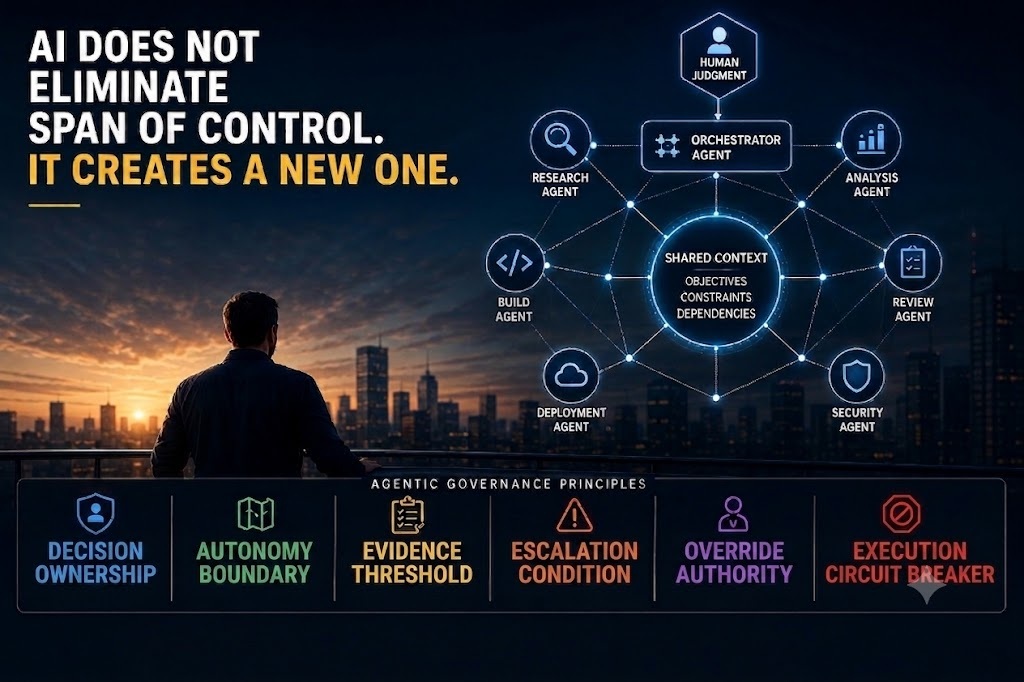 For decades, organizations have asked a familiar management question: How many people can one manager effectively lead? The answer influenced hierarchies, reporting lines, team structures, and organizational design. Artificial intelligence may be forcing us to ask the question again. But this time, the team is no longer entirely human. AI agents are moving beyond individual productivity tools and becoming active components of organizational workflows. Emerging AI-native models already point toward smaller human teams working with multiple agents and increasingly autonomous systems. The logic is compelling. Agents can analyze requirements, generate alternatives, build, test, identify vulnerabilities, prepare documentation, and support deployment. Human teams may become smaller. Execution accelerates. Coordination overhead appears to decrease. But a new constraint is emerging. How much agentic complexity can one human effectively direct, understand, challenge, and remain accountable for? The question is not simply how many agents a person can use. It is how much autonomous activity a human-led system can absorb without losing decisional coherence. The Bottleneck Is Moving Again The first wave of generative AI focused on individual productivity. A person performed a task. AI helped that person perform it faster. Then organizations began redesigning entire workflows. Now, agentic systems can execute increasingly complex sequences of work across multiple tasks, tools, and decisions. Each time execution accelerates, the bottleneck moves. From production to review. From review to coordination. From coordination to deciding what should be done. But another bottleneck is already becoming visible. Human coherence capacity. Imagine one professional working simultaneously with several AI agents. One is analyzing requirements. Another is generating architecture options. A third is building. A fourth is testing. A fifth is reviewing security. A sixth is preparing deployment. Technically, the work is happening in parallel. Cognitively, however, the human must move continuously between evolving contexts. Each agent may make assumptions. Each may interpret the objective differently. Each may produce an output that is locally correct but inconsistent with decisions made elsewhere. The human is no longer primarily executing the work. The human is trying to preserve coherence across the work. That is a fundamentally different job. From Span of Control to Agentic Span of Control Management theory has long recognized that managerial attention is finite. Research into human supervision of autonomous systems has explored a related problem through the concept of fan-out: how many autonomous units one person can effectively supervise before interaction demands and cognitive workload undermine performance. Agentic AI brings a related problem into organizational work. But the nature of the demand changes. AI agents do not require motivation in the human sense. They do not need career conversations. They do not experience interpersonal conflict in the human sense. Yet context must remain aligned. Objectives must remain clear. Permissions must be controlled. Assumptions must be surfaced. Outputs must be evaluated. Conflicting recommendations must be reconciled. Exceptions must be escalated. Decisions must remain traceable. This suggests an emerging organizational problem that I describe here as Agentic Span of Control: The amount of agentic activity a human can effectively direct, understand, challenge, and remain accountable for without losing decisional coherence. That activity may involve individual AI agents, agentic workflows, or orchestrated multi-agent systems. The critical word is not control. It is understand. Because accountability without sufficient understanding quickly becomes ceremonial. Execution Capacity Can Scale Faster Than Coherence Capacity Organizations may soon repeat with AI agents a mistake they have repeatedly made with human systems. Assume that adding capacity automatically increases performance. It does not. More agents can generate more output. They can also generate more assumptions to validate, dependencies to coordinate, exceptions to resolve, and decisions to understand. At some point, the human becomes the bottleneck again. Not because the human is executing too slowly. Because the human can no longer maintain a sufficiently coherent mental model of what the system is doing. The system has more execution capacity than the human layer has coherence capacity. Execution capacity is the ability of the system to generate and perform work. Coherence capacity is the ability of the human-led organization to understand how actions, assumptions, decisions, dependencies, and consequences fit together. The first can scale rapidly with AI. The second cannot be assumed to scale at the same rate. And when execution capacity exceeds coherence capacity, the organization can continue moving while progressively losing the ability to understand its own movement. The Hidden Risk Is Cognitive Debt Technical debt is visible because it eventually affects systems. Cognitive debt may be harder to detect because the system can continue performing. It accumulates when people increasingly accept outputs they cannot independently evaluate. When assumptions remain embedded in agentic workflows but disappear from human memory. When decisions are approved without reconstructing the evidence and reasoning behind them. When professionals remain accountable for systems whose logic they only partially understand. And when the experiences through which judgment was traditionally developed are progressively automated. This creates a paradox. AI-native organizations may need human judgment more than ever while automating many of the experiences through which that judgment was historically formed. The experienced architect developed judgment through years of design decisions, trade-offs, failures, debugging, and consequences. The experienced project leader developed judgment through ambiguity, conflict, negotiation, risk, and imperfect decisions. If agents increasingly absorb those experiences, organizations must ask: How will the next generation develop the judgment required to supervise systems that perform the work through which previous generations developed judgment? The answer cannot simply be more AI training. Learning through Deconstruction AI-native learning must shift part of its emphasis from execution to deconstruction. If previous generations learned largely by building up, the next generation may also need to learn by tearing down. Reconstruct agentic decisions. Trace outputs back to assumptions. Challenge automated workflows. Red-team recommendations. Compare competing agent interpretations. Investigate why a locally correct decision produced a systemically weak outcome. Work inside deliberate failure sandboxes where errors can be triggered, traced, contained, and understood. The objective is not to preserve manual work for nostalgia. It is to preserve the cognitive conditions under which deep judgment can still form. AI removes friction from execution. Organizations may need to deliberately reintroduce friction into learning. The challenge is no longer simply workforce reskilling. It is the deliberate preservation, development, and renewal of organizational judgment. Smaller Teams Change More Than Headcount The idea of reducing a team from eight people to three should therefore be treated carefully. Not all work is equally modular. Not all decisions are equally reversible. Not all environments tolerate the same error propagation. A small AI-native team operating a well-defined, low-risk workflow is not equivalent to a team working across ambiguous requirements, legacy dependencies, regulatory constraints, safety-critical systems, or high organizational interdependence. Speed comparisons can be useful. But time-to-output is not the same as time-to-sustainable-value. A team that delivers faster may also create hidden dependencies, weaker challenge mechanisms, knowledge concentration, or future recovery costs. The relevant question is not: How many people can AI remove from the team? It is: Which human capabilities must remain present for the system to continue understanding, challenging, learning, and absorbing consequences responsibly? Because specialization does not necessarily disappear when specialist roles disappear. It may migrate. Into agents. Into standards. Into encoded workflows. Into orchestration rules. And when knowledge migrates into infrastructure, someone must remain capable of challenging that infrastructure. Orchestration May Extend the Limit. It Does Not Remove It. If one human cannot effectively supervise many agents directly, a different architecture is emerging: Human → Orchestrator Agent → Specialist Agents The human does not continuously supervise every specialist agent. An orchestration layer decomposes work, distributes tasks, maintains shared context, identifies contradictions, consolidates outputs, and escalates exceptions. The human focuses on decisions requiring judgment, accountability, and strategic direction. This may extend the effective Agentic Span of Control. But it does not eliminate the underlying constraint. It moves it. Because the next question is unavoidable: Who governs the orchestrator? Orchestration Is a Governance Function An orchestrator does more than distribute tasks. It may determine what information is relevant. Which contradiction deserves attention. Which exception should be escalated. Which output should be prioritized. Which uncertainty can be tolerated. In other words, the orchestrator increasingly influences what reaches human attention. And attention shapes decisions. The moment an agent decides what a human needs to see, it begins to influence the conditions under which human judgment operates. Orchestration is therefore not merely a technical function. It is a governance function. But orchestration filters are double-edged. In optimizing for human attention, an orchestrator may flatten dissent, collapse unresolved contradictions into a single recommendation, and present a consensus that does not actually exist. The risk is no longer only hallucinated facts. It is Hallucinated Coherence. A system appears aligned because disagreement, uncertainty, and incompatible assumptions have been engineered out of human sight. The dashboard is clean. The recommendation is clear. The agents appear aligned. But the coherence may exist only in the presentation layer. This is particularly dangerous because the better the orchestration layer becomes at simplifying complexity, the more difficult it may become for humans to see which complexity should never have been simplified. The governance challenge is therefore not only to decide what reaches human attention. It is also to preserve meaningful dissent, unresolved uncertainty, and structural contradiction when these are decision-relevant. The Architecture of Agentic Governance This is where the conceptual architecture becomes important. Coherence is the objective. The organization must preserve sufficient understanding across actions, decisions, dependencies, and consequences. Governance is the system. It establishes how that coherence is protected, challenged, and restored. Authority architecture is the design mechanism. It defines who, human or agent, may decide, act, escalate, challenge, interrupt, override, or stop. Agentic Span of Control is a constraint. It defines the amount of agentic activity the human-led system can absorb without losing decisional coherence. Cognitive debt is a degradation risk. It accumulates when the system continues performing while human understanding and judgment progressively weaken. Hallucinated Coherence is an epistemic risk. It emerges when the system presents alignment that exists in the interface but not in the underlying reality. These are not separate AI problems. They are parts of the same organizational design problem. Decision Authority Must Precede Decision Execution Traditional organizations often design work first and governance around it later. Agentic systems make that sequence increasingly dangerous. Before assigning execution to an agent, organizations should define the authority surrounding the decision. At minimum, six dimensions should be explicit. Decision ownership Who remains accountable for the outcome? Autonomy boundary What may the agent decide or execute without approval? Evidence threshold What evidence, confidence, or validation is required before action? Escalation condition What uncertainty, contradiction, impact, or exception requires human intervention? Override authority Who may stop, reverse, or supersede an agentic decision? Execution circuit breaker What conditions require the system to automatically pause, contain, or freeze execution before an error can propagate across agents, workflows, or dependencies? The distinction between escalation and interruption is critical. Escalation asks when a human must be called. An execution circuit breaker asks when the system must stop before the human can arrive. In multi-agent systems, that difference may determine whether an anomaly remains local or becomes systemic. An agent may produce an incorrect output. Another agent may consume it. A third may update a system. A fourth may trigger an external action. By the time a human reviews the escalation, the consequence may already have propagated across the workflow. The system therefore needs the capacity not only to request human judgment, but to preserve the time in which human judgment can still matter. These mechanisms should not be identical for every task. Authority should reflect consequence. A reversible, low-impact decision should not require the same governance as a decision with high dependency propagation, regulatory exposure, or limited human recoverability. The design principle is simple: Govern decision authority before automating decision execution. Without explicit authority boundaries, autonomy is not governed. It is merely accumulated. Power Does Not Disappear When Teams Become Smaller Smaller teams do not automatically create flatter power structures. Power migrates into new control points. The person who defines an agent's context gains influence. The person who sets permissions shapes autonomy. The person who determines escalation thresholds influences what leaders see. The team that owns the orchestration layer may shape decisions across multiple workflows. And the organization that controls the standards embedded in agents may exercise influence far beyond any formal reporting line. AI can therefore redistribute organizational power without changing the organizational chart. This matters because incentives shape how that power is used. If teams are rewarded primarily for speed, they will optimize agentic systems for throughput. If leaders are rewarded for cost reduction, smaller teams may become a headcount objective rather than a system design choice. If failures remain individually attributed while execution becomes increasingly distributed across agents, accountability may become politically convenient rather than operationally meaningful. Technology does not remove organizational behavior. It enters it. AI-native design must therefore examine not only what agents can do, but what human incentives encourage the system to optimize. Culture Determines Whether Human Oversight Is Real A technically sophisticated agentic system can still fail inside a weak challenge culture. If people are reluctant to question automated recommendations, human-in-the-loop becomes a procedural fiction. If speed is celebrated more visibly than thoughtful intervention, people learn not to slow the system down. If overriding an agent requires justification but accepting its recommendation does not, automation bias becomes structurally rewarded. And if teams progressively lose technical depth, challenging the system becomes harder even when the culture encourages it. The quality of agentic governance therefore depends on more than controls. It depends on whether the organization preserves both the human capacity and the psychological permission to say: I do not understand this decision well enough to approve it. That may become one of the most important sentences in an AI-native organization. The Real Constraint Is Coherence An organization can have technically excellent agents and still produce incoherent outcomes. Each agent may optimize its task. Each workflow may meet its local objective. Each team may improve its productivity. And the organization as a whole may move in the wrong direction. This is the danger of local intelligence without systemic coherence. The question has now moved beyond supervision. It is: How much agentic complexity can a human-led organization absorb while preserving the ability to understand, challenge, learn from, and govern its own decisions? That is not merely a technology question. It is a question of organizational design. Leadership. Culture. Learning. Power. And governance. Coordination Does Not Disappear. It Migrates. AI may reduce the size of human teams. It may automate entire workflows. It may eliminate some coordination activities. But coordination does not disappear. It migrates. From people to agents. From meetings to protocols. From reporting lines to permissions. From supervision to orchestration. From tacit judgment to encoded rules. From organizational charts to authority architectures. And power migrates with it. The organizations that succeed with agentic AI may not be those with the most agents or the smallest teams. They may be those that understand a more fundamental constraint: Execution capacity can scale faster than coherence capacity. When that happens, adding more intelligence to the system may not make the organization more intelligent. It may simply make incoherence move faster. AI does not eliminate span of control. It creates a new one. |
Posted on: July 04, 2026 10:38 AM
| Permalink |
Comments (0)
Intelligence, Judgment and Wisdom
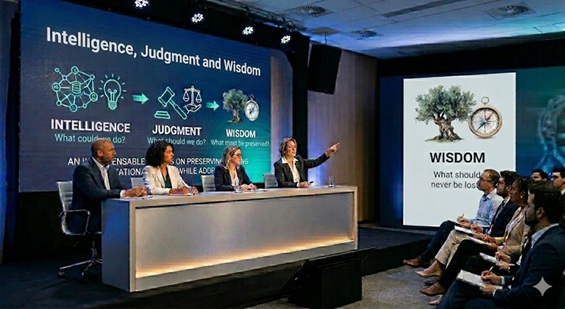 What Distinguishes Intelligent Decisions from Wise Decisions? Modern organizations increasingly celebrate intelligence. They invest in data. They invest in analytics. They invest in forecasting. They invest in artificial intelligence. They invest in decision support systems. And they should. Intelligence matters. Intelligence expands visibility. Intelligence improves understanding. Intelligence reduces ignorance. Intelligence strengthens the capacity to navigate complexity. Yet intelligence alone has never guaranteed wisdom. History provides abundant evidence. Some of the most intelligent organizations ever created have also produced some of the most catastrophic decisions. Some of the most sophisticated systems ever designed have generated consequences that their creators never intended. Some of the most analytically rigorous strategies have ultimately weakened the very institutions they were meant to strengthen. This observation raises an uncomfortable question: If intelligence is so valuable, why does intelligence alone sometimes fail? The answer may lie in a distinction that modern organizations rarely examine explicitly. The distinction between: • Intelligence, • Judgment, • Wisdom. These concepts are often treated as interchangeable. They are not. Each performs a fundamentally different function. Intelligence seeks understanding. Judgment seeks choice. Wisdom seeks preservation. This distinction becomes increasingly important in AI-native environments. Because artificial intelligence dramatically amplifies intelligence. It may also support judgment. But wisdom operates differently. To understand why, consider how decisions actually emerge. Intelligence helps organizations understand reality. It identifies patterns. Surfaces possibilities. Analyzes trade-offs. Models scenarios. Generates options. Expands visibility. In essence, intelligence answers a critical question: What could we do? This capability is enormously valuable. But intelligence alone does not choose. At some point, organizations must move from understanding to commitment. This is where judgment emerges. Judgment evaluates alternatives. Balances competing considerations. Interprets context. Accepts uncertainty. Commits to action. Judgment answers a different question: What should we do? This capability remains fundamentally human. Not because machines cannot generate recommendations. But because judgment ultimately carries responsibility. Responsibility for consequences. Responsibility for trade-offs. Responsibility for uncertainty. Responsibility for action. Yet even judgment does not fully resolve the challenge. Because a decision may be intelligent. A decision may be well-reasoned. A decision may even be responsible. And still fail to answer a deeper question. What should never be lost while making this decision? This is where wisdom begins. Wisdom operates differently from both intelligence and judgment. Wisdom is not primarily concerned with options. Wisdom is not primarily concerned with decisions. Wisdom is concerned with continuity. Identity. Meaning. Purpose. Stewardship. Wisdom asks: What deserves preservation? What must remain true? What should survive adaptation? What should not be optimized away? These questions become increasingly important as organizations become more intelligent. Because intelligence naturally expands possibilities. But not all possibilities deserve pursuit. Some possibilities create value. Others create erosion. Some possibilities improve efficiency. Others undermine legitimacy. Some possibilities strengthen capability. Others weaken identity. Intelligence alone cannot always distinguish between these outcomes. This is why highly intelligent systems may still drift. Not because they lack information. But because information alone cannot determine what should be protected. This challenge becomes particularly visible in AI-native organizations. As analytical capabilities expand, organizations gain increasing power to: • Automate, • Optimize, • Predict, • Adapt, • Accelerate. Each capability creates opportunity. Each capability also creates temptation. The temptation to optimize every process. The temptation to automate every judgment. The temptation to measure every activity. The temptation to treat efficiency as the ultimate objective. Yet organizational history repeatedly demonstrates a different reality. Not everything valuable is measurable. Not everything measurable is valuable. Not everything that can be optimized should be optimized. This is where wisdom becomes essential. Because wisdom functions as a boundary condition for intelligence. Wisdom determines what intelligence serves. Without wisdom, intelligence may accelerate drift. With wisdom, intelligence amplifies purpose. Without wisdom, judgment may become reactive. With wisdom, judgment remains anchored. Without wisdom, adaptation may erode identity. With wisdom, adaptation preserves continuity. This may ultimately become one of the defining governance challenges of AI-native organizations. Not whether organizations can become more intelligent. They will. Not whether organizations can become more adaptive. They will. The deeper question is whether organizations can become more intelligent without losing the wisdom required to govern intelligence responsibly. Because intelligence helps organizations understand reality. Judgment helps organizations choose among possibilities. But wisdom helps organizations preserve what remains worth protecting while they choose. And in an age increasingly defined by artificial intelligence, that distinction may prove more important than intelligence itself. The future of governance may therefore depend on more than data. More than analytics. More than prediction. More than optimization. It may depend on preserving the capacity to answer a question that intelligence alone cannot resolve: Not merely what can be done. Not merely what should be done. But what should never be lost while doing it. |
Posted on: July 03, 2026 05:09 AM
| Permalink |
Comments (2)
Before Judgment
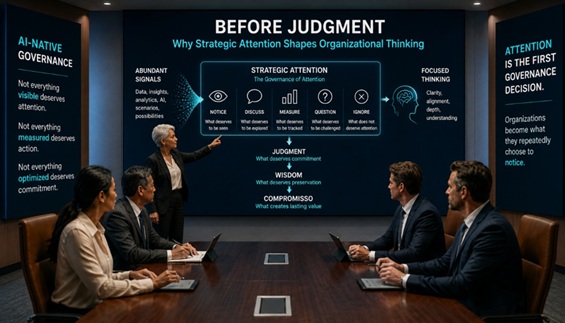 Why Strategic Attention Shapes Organizational Thinking Modern organizations are becoming extraordinarily intelligent. They collect more data. Generate more insights. Model more scenarios. Monitor more signals. Simulate more futures. Artificial intelligence is accelerating each of these capabilities at an unprecedented pace. At first glance, this appears to solve one of management's oldest challenges. If organizations can understand more, surely they can decide better. Yet an important question often goes unnoticed. What determines what organizations choose to understand in the first place? This question precedes intelligence itself. Because before organizations evaluate alternatives... Before they exercise judgment... Before they make decisions... They first allocate attention. And attention is never unlimited. No organization, regardless of its technological sophistication, can simultaneously attend to every signal, every opportunity, every stakeholder concern, every emerging risk, and every possible future. Attention remains scarce. Perhaps it is becoming the scarcest organizational capability of all. This becomes even more significant in AI-native environments. Artificial intelligence dramatically expands the volume of information available to decision-makers. It identifies anomalies. Generates recommendations. Produces scenarios. Surfaces weak signals. Continuously monitors operational conditions. The challenge is no longer obtaining information. It is deciding what deserves attention. This distinction fundamentally changes the nature of governance. For decades, governance has largely assumed that better decisions emerge from better information. Increasingly, the limiting factor may no longer be information itself. It may be the disciplined allocation of organizational attention. Because organizations rarely fail simply because they lack intelligence. They often fail because their intelligence is directed toward the wrong questions. Every strategic decision begins long before alternatives are evaluated. It begins when an organization determines: What deserves to be noticed. What deserves to be discussed. What deserves to be measured. What deserves to be questioned. And equally important... What does not. Attention therefore becomes far more than an individual cognitive capability. It becomes an organizational governance capability. Not because attention guarantees better decisions. But because it determines the landscape within which judgment can operate. An organization that systematically directs attention toward superficial indicators may become extraordinarily efficient at optimizing the wrong priorities. Conversely, an organization that consistently notices weak signals, systemic interactions, unintended consequences, and emerging tensions develops a fundamentally different capacity for judgment. The difference is not intelligence. The difference is where intelligence is directed. Attention, however, is never neutral. Organizations systematically attend to what their governance systems reward. What leaders repeatedly emphasize. What performance indicators measure. What dashboards highlight. What algorithms prioritize. What culture continually reinforces. In this sense, governance does not merely regulate decisions. It governs attention itself. This creates an important paradox. Artificial intelligence may continue expanding organizational visibility almost without limit. Yet greater visibility does not eliminate scarcity. It simply shifts scarcity elsewhere. When almost everything becomes visible... Attention becomes the bottleneck. Not every signal deserves action. Not every anomaly deserves escalation. Not every optimization deserves implementation. Not every recommendation deserves commitment. Discernment becomes indispensable. This is why strategic attention differs fundamentally from information management. Information management asks: What do we know? Strategic attention asks: What deserves to shape our thinking? These are fundamentally different questions. The first expands knowledge. The second determines organizational focus. This distinction also reshapes leadership. Leadership is often described as the ability to make difficult decisions. Perhaps an equally important responsibility is deciding which questions deserve sustained attention long before decisions become necessary. Because organizations inevitably become better at what they repeatedly attend to. Culture follows attention. Learning follows attention. Innovation follows attention. Governance follows attention. Even organizational identity gradually follows attention. What leaders repeatedly notice communicates what truly matters. What organizations consistently ignore eventually becomes invisible. Not because it lacks importance. But because attention was systematically allocated elsewhere. This is why the governance challenge of AI-native organizations extends beyond intelligence. It extends beyond judgment. It begins with attention. Future organizations may not distinguish themselves by possessing more intelligence than their competitors. They may distinguish themselves by directing intelligence toward the questions that matter most. Because intelligence expands possibilities. Attention determines which possibilities enter the conversation. Judgment determines which possibilities deserve commitment. Wisdom determines which commitments remain worthy over time. Governance does not begin with decisions. It begins with attention. |
Posted on: July 01, 2026 03:28 AM
| Permalink |
Comments (0)
Beyond Intelligence
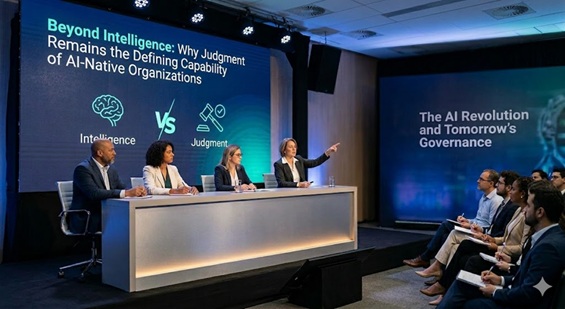 Why Judgment Remains the Defining Capability of AI-native Organizations Modern organizations have spent decades pursuing intelligence. More data. More analytics. More visibility. More forecasting. More dashboards. More optimization. More computational power. The assumption has often been simple. If organizations can become sufficiently intelligent, they will make better decisions. And to some extent, this assumption is correct. Intelligence matters. Intelligence reduces ignorance. Intelligence improves visibility. Intelligence expands optionality. Intelligence strengthens prediction. Intelligence increases organizational capability. But intelligence alone has never been the ultimate challenge. Because organizations rarely fail simply because they lack information. They often fail despite possessing enormous amounts of it. This distinction becomes increasingly important in AI-native environments. Because artificial intelligence dramatically expands the organizational capacity to: • Analyze, • Predict, • Optimize, • Simulate, • Monitor, • Generate Recommendations, • Identify patterns at unprecedented scale. As these capabilities continue to accelerate, organizations may begin confronting a new and unexpected paradox. The more intelligence becomes available, the more visible the limits of intelligence itself may become. At first glance, this appears counterintuitive. After all, intelligence has traditionally been treated as a solution. Yet intelligence does not automatically resolve many of the questions organizations face most frequently. Intelligence may identify options. It does not determine which option deserves to be chosen. Intelligence may model consequences. It does not determine which consequences are acceptable. Intelligence may reveal trade-offs. It does not determine which trade-offs should be embraced. Intelligence may improve visibility. It does not determine what deserves attention. These distinctions matter enormously. Because organizations do not merely operate within technical environments. They operate within human environments. And human environments are shaped by: • Values, • Responsibility, • Legitimacy, • Trust, • Meaning, • Purpose, • Competing interpretations of reality. None of these challenges disappear simply because intelligence increases. In many cases, they become more visible. This is why one of the most important misunderstandings surrounding artificial intelligence is the belief that greater intelligence naturally reduces the need for judgment. It does not. In fact, the opposite may occur. As intelligence expands, judgment often becomes more important. Because judgment operates precisely where intelligence reaches its limits. Intelligence helps us understand what is. Judgment helps us decide what should be done. That distinction may ultimately become one of the defining governance challenges of AI-native organizations. Consider a strategic decision. Multiple options exist. Each option is supported by data. Each option is defensible. Each option produces benefits. Each option creates risks. Intelligence can help illuminate these possibilities. But at some point, someone must still decide: • Which future to pursue, • Which risks to accept, • Which stakeholders to prioritize, • Which consequences deserve greater weight, • Which values should guide action. These are not intelligence problems. They are judgment problems. And judgment remains fundamentally different from analysis. Analysis seeks understanding. Judgment seeks commitment. Analysis explores possibilities. Judgment chooses among them. Analysis can remain open indefinitely. Judgment eventually requires action. This distinction becomes increasingly significant as organizations accelerate. Because speed amplifies a temptation that many organizations already struggle with: The temptation to confuse analytical sophistication with decision quality. But decision quality depends on more than intelligence. It depends on interpretation. It depends on context. It depends on responsibility. It depends on the willingness to act under conditions of incomplete certainty. And this is where human accountability remains irreplaceable. Artificial intelligence may support decisions. It may strengthen decisions. It may challenge assumptions. It may expose blind spots. But it does not assume responsibility for consequences. Responsibility remains human. Accountability remains human. Legitimacy remains human. Organizations may distribute intelligence across systems. They cannot distribute accountability in the same way. This reality introduces a profound challenge for future governance. If intelligence becomes increasingly abundant, what capability becomes scarce? The answer may not be information. It may not be analytics. It may not even be prediction. It may be judgment. The capacity to interpret complexity. The capacity to navigate ambiguity. The capacity to choose under uncertainty. The capacity to act responsibly when multiple defensible paths exist. These capabilities cannot be reduced entirely to algorithms. Because they are inseparable from human responsibility. This does not diminish the value of intelligence. Quite the opposite. The more intelligence expands, the more important judgment becomes. Because intelligence informs. Judgment commits. Intelligence reveals possibilities. Judgment determines direction. Intelligence expands choice. Judgment accepts responsibility for choosing. And as organizations continue evolving toward increasingly intelligent, adaptive, and AI-native operating models, this distinction may become one of the most important governance capabilities of all. Because the future of organizational performance may depend less on how much intelligence organizations possess. And more on how effectively they exercise judgment once intelligence has done all it can do. The challenge, therefore, may no longer be becoming more intelligent. The challenge may be learning how to govern intelligence wisely. Because intelligence helps organizations understand reality. But judgment remains responsible for deciding what reality they wish to create. |
Posted on: June 29, 2026 04:28 AM
| Permalink |
Comments (0)


