Support to Develop
by Luis Branco

This blog addresses management-related topics and has three areas of focus: 1. Technical skills; 2. Competencies in the field of interpersonal relations and communication (including personal organization and delegation, leadership, teamwork, conflict resolution, conducting meetings, and negotiation); and 3. Strategy (including diagnosis, strategic guidelines, and implementation).4.Technology
Recent Posts
PHASE 3 - THE CONSEQUENCES
What Does AI Actually Change About Authority and Accountability?
Who Develops the Capabilities We Still Need?
Is the Project Manager Still the Right Unit of Professional Identity?
When Sponsorship Meets Ownership: Does PMI's Responsible Sponsorship Guide Close the Governance Gap?
Categories
Agile,
Career Development,
Career Development,
Career Development,
Career Development,
Career Development,
Career Development,
Career Development,
Career Development,
Career Development,
Career Development,
Career Development,
Career Development,
Career Development,
Career Development,
Career Development,
Career Development,
Career Development,
Career Development,
Career Development,
Career Development,
Career Development,
Career Development,
Career Development,
Career Development,
Career Development,
Career Development,
Career Development,
Career Development,
Career Development,
Career Development,
Career Development,
Career Development,
Career Development,
Career Development,
Career Development,
Career Development,
Career Development,
Career Development,
Career Development,
Career Development,
Career Development,
Career Development,
Career Development,
Career Development,
Career Development,
Career Development,
Career Development,
Career Development,
Career Development,
Career Development,
Career Development,
Career Development,
Career Development,
Career Development,
Career Development,
Career Development,
Career Development,
Career Development,
Career Development,
Career Development,
Career Development,
Career Development,
Career Development,
Career Development,
Career Development,
Career Development,
Career Development,
Career Development,
Career Development,
Career Development,
Career Development,
Career Development,
Career Development,
Career Development,
Career Development,
Career Development,
Career Development,
Career Development,
Career Development,
Career Development,
Career Development,
Career Development,
Career Development,
Career Development,
Career Development,
Career Development,
Career Development,
Career Development,
Career Development,
Career Development,
Career Development,
Career Development,
Career Development,
Career Development,
Career Development,
Career Development,
Career Development,
Career Development,
Career Development,
Career Development,
Career Development,
Career Development,
Career Development,
Career Development,
Career Development,
Career Development,
Career Development,
Career Development,
Career Development,
Career Development,
Career Development,
Career Development,
Career Development,
Career Development,
Career Development,
Career Development,
Career Development,
Career Development,
Career Development,
Career Development,
Career Development,
Career Development,
Education,
Governance,
Governance,
Governance,
Governance,
Governance,
Governance,
Governance,
Governance,
Governance,
Governance,
Governance,
In,
Integration Management,
Interpersonal Skills,
Interpersonal Skills,
Interpersonal Skills,
Interpersonal Skills,
Interpersonal Skills,
Interpersonal Skills,
Interpersonal Skills,
Interpersonal Skills,
Interpersonal Skills,
Interpersonal Skills,
Interpersonal Skills,
Interpersonal Skills,
Interpersonal Skills,
Interpersonal Skills,
Interpersonal Skills,
Interpersonal Skills,
Interpersonal Skills,
Interpersonal Skills,
Interpersonal Skills,
Interpersonal Skills,
Interpersonal Skills,
Interpersonal Skills,
Interpersonal Skills,
Interpersonal Skills,
Interpersonal Skills,
Interpersonal Skills,
Interpersonal Skills,
Interpersonal Skills,
Interpersonal Skills,
Interpersonal Skills,
Interpersonal Skills,
Interpersonal Skills,
Interpersonal Skills,
Interpersonal Skills,
Interpersonal Skills,
Interpersonal Skills,
Interpersonal Skills,
Interpersonal Skills,
Interpersonal Skills,
Interpersonal Skills,
Interpersonal Skills,
Interpersonal Skills,
Interpersonal Skills,
Interpersonal Skills,
Interpersonal Skills,
Interpersonal Skills,
Interpersonal Skills,
Interpersonal Skills,
Interpersonal Skills,
Interpersonal Skills,
Interpersonal Skills,
Interpersonal Skills,
Interpersonal Skills,
Interpersonal Skills,
Interpersonal Skills,
Interpersonal Skills,
Interpersonal Skills,
Interpersonal Skills,
Interpersonal Skills,
Interpersonal Skills,
Interpersonal Skills,
Interpersonal Skills,
Interpersonal Skills,
Interpersonal Skills,
Interpersonal Skills,
Interpersonal Skills,
Interpersonal Skills,
Interpersonal Skills,
Interpersonal Skills,
Interpersonal Skills,
Interpersonal Skills,
Interpersonal Skills,
Interpersonal Skills,
Interpersonal Skills,
Interpersonal Skills,
Interpersonal Skills,
Interpersonal Skills,
Interpersonal Skills,
Interpersonal Skills,
Interpersonal Skills,
Interpersonal Skills,
Interpersonal Skills,
Interpersonal Skills,
Interpersonal Skills,
Interpersonal Skills,
Interpersonal Skills,
Interpersonal Skills,
Interpersonal Skills,
Interpersonal Skills,
Interpersonal Skills,
Interpersonal Skills,
Interpersonal Skills,
Interpersonal Skills,
Interpersonal Skills,
Interpersonal Skills,
Interpersonal Skills,
Interpersonal Skills,
Interpersonal Skills,
Interpersonal Skills,
Interpersonal Skills,
Interpersonal Skills,
Interpersonal Skills,
Interpersonal Skills,
Interpersonal Skills,
Interpersonal Skills,
Interpersonal Skills,
Interpersonal Skills,
Interpersonal Skills,
Interpersonal Skills,
Interpersonal Skills,
Interpersonal Skills,
Interpersonal Skills,
Interpersonal Skills,
Interpersonal Skills,
Interpersonal Skills,
Interpersonal Skills,
Interpersonal Skills,
Interpersonal Skills,
Interpersonal Skills,
Interpersonal Skills,
Interpersonal Skills,
Interpersonal Skills,
Knowledge Management,
le,
lea,
Leadership,
Leadership,
Leadership,
Leadership,
Leadership,
Leadership,
Leadership,
Leadership,
Leadership,
Leadership,
Leadership,
Leadership,
Leadership,
Leadership,
Leadership,
Leadership,
Leadership,
Leadership,
Leadership,
Leadership,
Leadership,
Leadership,
Leadership,
Leadership,
Leadership,
Leadership,
Leadership,
Leadership,
Leadership,
Leadership,
Leadership,
Leadership,
Leadership,
Leadership,
Leadership,
Leadership,
Leadership,
Leadership,
Leadership,
Leadership,
Leadership,
Leadership,
Leadership,
Leadership,
Leadership,
Leadership,
Leadership,
Leadership,
Leadership,
Leadership,
Leadership,
Leadership,
Leadership,
Leadership,
Leadership,
Leadership,
Leadership,
Leadership,
Leadership,
Leadership,
Leadership,
Leadership,
Leadership,
Leadership,
Leadership,
Leadership,
Leadership,
Leadership,
Leadership,
Leadership,
Leadership,
Leadership,
Leadership,
Leadership,
Leadership,
Leadership,
Leadership,
Leadership,
Leadership,
Leadership,
Leadership,
Leadership,
Leadership,
Leadership,
Leadership,
Leadership,
Leadership,
Leadership,
Leadership,
Leadership,
Leadership,
Leadership,
Leadership,
Leadership,
Leadership,
Leadership,
Leadership,
Leadership,
Leadership,
Leadership,
Leadership,
Leadership,
Leadership,
Leadership,
Leadership,
Leadership,
Leadership,
Leadership,
Leadership,
Leadership,
Leadership,
Leadership,
Leadership,
Leadership,
Leadership,
Leadership,
Leadership,
Leadership,
Leadership,
Leadership,
Leadership,
Leadership,
Leadership,
or,
Organizational Project Management,
Portfolio Management,
Program,
Program Management,
Strategy,
Strategy,
Strategy,
Strategy,
Strategy,
Strategy,
Strategy,
Strategy,
Strategy,
Strategy,
Strategy,
Strategy,
Strategy,
Strategy,
Strategy,
Strategy,
Strategy,
Strategy,
Strategy,
Strategy,
Strategy,
Strategy,
Strategy,
Strategy,
Strategy,
Strategy,
Strategy,
Strategy,
Strategy,
Strategy,
Strategy,
Strategy,
Strategy,
Strategy,
Strategy,
Strategy,
Strategy,
Strategy,
Strategy,
Strategy,
Strategy,
Strategy,
Strategy,
Strategy,
Strategy,
Strategy,
Strategy,
Strategy,
Strategy,
Strategy,
Strategy,
Strategy,
Strategy,
Strategy,
Strategy,
Strategy,
Strategy,
Strategy,
Strategy,
Strategy,
Strategy,
Strategy,
Strategy,
Strategy,
Strategy,
Strategy,
Strategy,
Strategy,
Strategy,
Strategy,
Strategy,
Strategy,
Strategy,
Strategy,
Strategy,
Strategy,
Strategy,
Strategy,
Strategy,
Strategy,
Strategy,
Strategy,
Strategy,
Strategy,
Strategy,
Strategy,
Strategy,
Strategy,
Strategy,
Strategy,
Strategy,
Strategy,
Strategy,
Strategy,
Strategy,
Strategy,
Strategy,
Strategy,
Strategy,
Strategy,
Strategy,
Strategy,
Strategy,
Strategy,
Strategy,
Strategy,
Strategy,
Strategy,
Strategy,
Strategy,
Strategy,
Strategy,
Strategy,
Strategy,
Strategy,
Strategy,
Strategy,
Strategy,
Strategy,
Strategy,
Strategy,
Strategy,
Strategy,
Sustainability,
Talent Management,
Talent Management,
Talent Management,
Talent Management,
Talent Management,
Talent Management,
Talent Management,
Talent Management,
Talent Management,
Talent Management,
Talent Management,
Talent Management,
Talent Management,
Talent Management,
Talent Management,
Talent Management,
Talent Management,
Talent Management,
Talent Management,
Talent Management,
Talent Management,
Talent Management,
Talent Management,
Talent Management,
Talent Management,
Talent Management,
Talent Management,
Talent Management,
Talent Management,
Talent Management,
Talent Management,
Talent Management,
Talent Management,
Talent Management,
Talent Management,
Talent Management,
Talent Management,
Talent Management,
Talent Management,
Talent Management,
Talent Management,
Talent Management,
Talent Management,
Talent Management,
Talent Management,
Talent Management,
Talent Management,
Talent Management,
Talent Management,
Talent Management,
Talent Management,
Talent Management,
Talent Management,
Talent Management,
Talent Management,
Talent Management,
Talent Management,
Talent Management,
Talent Management,
Talent Management,
Talent Management,
Talent Management,
Talent Management,
Talent Management,
Talent Management,
Talent Management,
Talent Management,
Talent Management,
Talent Management,
Talent Management,
Talent Management,
Talent Management,
Talent Management,
Talent Management,
Talent Management,
Talent Management,
Talent Management,
Talent Management,
Talent Management,
Talent Management,
Talent Management,
Talent Management,
Talent Management,
Talent Management,
Talent Management,
Talent Management,
Talent Management,
Talent Management,
Talent Management,
Talent Management,
Talent Management,
Talent Management,
Talent Management,
Talent Management,
Talent Management,
Talent Management,
Talent Management,
Talent Management,
Talent Management,
Talent Management,
Talent Management,
Talent Management,
Talent Management,
Talent Management,
Talent Management,
Talent Management,
Talent Management,
Talent Management,
Talent Management,
Talent Management,
Talent Management,
Talent Management,
Talent Management,
Talent Management,
Talent Management,
Talent Management,
Talent Management,
Talent Management,
Talent Management,
Talent Management,
Talent Management,
Talent Management,
Talent Management
Date
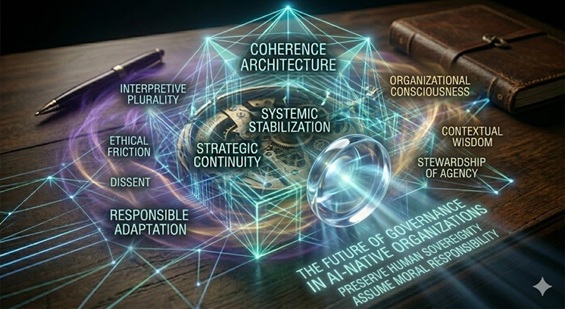
Throughout this series, we explored a growing set of tensions emerging inside modern organizations.
We explored:
• The transition from project integration toward adaptive governance,
• The rise of adaptive legitimacy and coherence erosion,
• The hidden return of command-and-control through observability systems,
• Governance becoming increasingly behavioral,
• The limits of frameworks under uncertainty,
• The emergence of cybernetic organizational architectures,
• The evolution of PMOs toward coherence infrastructures inside adaptive systems.
At every stage, one pattern gradually became visible:
The deeper challenge of AI-native organizations is no longer merely technological.
It is civilizational inside the organization itself.
Because AI-native systems are not simply introducing new tools.
They are reshaping:
• Decision architectures,
• Coordination dynamics,
• Organizational cognition,
• Legitimacy systems,
• Behavioral synchronization,
• Governance models,
• The relationship between human judgment and systemic adaptation itself.
This changes the meaning of governance fundamentally.
Historically, governance existed primarily to:
• Structure authority,
• Coordinate execution,
• Allocate responsibility,
• Reduce risk,
• Preserve accountability,
• Sustain organizational direction over time.
But AI-native systems increasingly operate through:
• Continuous sensing,
• Recursive adaptation,
• Predictive coordination,
• Distributed intelligence,
• Algorithmic recommendation systems,
• Behavioral analytics,
• Autonomous operational participation across the enterprise.
The organization itself begins functioning as a continuously adaptive cognitive system.
This creates extraordinary opportunities.
Organizations may become:
• More responsive,
• More adaptive,
• More intelligent,
• More predictive,
• More scalable,
• More operationally coordinated than at any previous point in history.
But the same systems also create a deeper governance risk that remains insufficiently understood.
Because adaptive intelligence and human sovereignty are not automatically aligned.
This may ultimately become the defining governance tension of the AI-native era.
As systems become increasingly capable of:
• Interpreting,
• Recommending,
• Coordinating,
• Optimizing,
• Predicting,
• Behaviorally influencing organizational environments,
Humans may gradually stop exercising conscious judgment inside the system itself.
Not because humans disappear.
But because the system increasingly shapes:
• Attention,
• Interpretation,
• Legitimacy,
• Prioritization,
• Acceptable behavior,
• Adaptive response continuously.
This creates a subtle but profound transformation.
The question is no longer merely:
“Can organizations automate decisions?”
The deeper question becomes:
What remains meaningfully human inside systems increasingly capable of shaping organizational cognition itself?
This is where governance enters entirely new territory.
Because governance can no longer focus exclusively on:
• Compliance,
• Efficiency,
• Delivery,
• Optimization,
• Visibility,
• Operational coordination.
Future governance may increasingly need to preserve:
• Human sovereignty,
• Interpretive plurality,
• Ethical responsibility,
• Cognitive autonomy,
• Dissent,
• Judgment,
• Coherent meaning under continuous systemic acceleration.
This distinction matters enormously.
Because highly adaptive systems naturally optimize toward:
• Synchronization,
• Predictability,
• Responsiveness,
• Behavioral convergence,
• Reduction of disruptive variance.
But human flourishing often depends precisely on preserving:
• Ambiguity,
• Reflection,
• Ethical friction,
• Interpretive diversity,
• Cognitive tension,
• The capacity to challenge the system itself.
This is why the future governance challenge is not simply technological.
It is fundamentally anthropological.
What kind of human organization do we still want to preserve once coordination, interpretation, optimization, and adaptation become increasingly system-mediated?
This question cannot be solved through frameworks alone.
Nor through AI alone.
Nor through governance procedures alone.
Because the deeper issue is no longer merely operational.
It is philosophical.
AI-native organizations increasingly risk confusing:
• Intelligence,
with:
• Wisdom.
• Observability,
with:
• Understanding.
• Synchronization,
with:
• Coherence.
• Optimization,
with:
• Legitimacy.
• Behavioral alignment,
with:
• Authentic commitment.
• Predictive capability,
with:
• Responsible judgment.
This is why the future of governance may ultimately depend less on how intelligently organizations automate and more on how consciously they preserve human sovereignty inside adaptive systems.
And sovereignty here does not mean rejecting technology.
It means preserving the human capacity to:
• Interpret,
• Question,
• Dissent,
• Contextualize,
• Exercise ethical judgment,
• Consciously assume responsibility for consequence under uncertainty.
Because responsibility cannot be fully automated.
Systems may optimize.
But systems do not carry moral consequence.
Humans do.
This is why future governance may increasingly require institutional mechanisms specifically designed to protect:
• Human judgment,
• Interpretive integrity,
• Organizational memory,
• Cognitive diversity,
• Ethical responsibility inside continuously adaptive environments.
Not as resistance to AI.
But as the necessary condition for responsible coexistence with increasingly intelligent systems.
This changes the role of leadership profoundly.
The future leader may no longer be defined primarily by:
• Authority,
• Control,
• Operational supervision.
Future leadership may increasingly become the capacity to:
• Preserve coherence under acceleration,
• Protect meaningful human agency,
• Govern adaptive tension responsibly,
• Sustain interpretive integrity,
• Prevent organizational systems from optimizing themselves beyond the boundaries of human purpose.
This is why governance itself may need to evolve from:
• Procedural control,
toward:
• Stewardship of organizational consciousness.
Because the ultimate governance challenge of AI-native organizations may not be whether systems become intelligent enough to coordinate themselves.
It may be whether humans remain conscious enough to govern what those systems are ultimately becoming.
And that may define the future of organizational leadership itself. |
Posted on: June 22, 2026 10:30 AM
|
Permalink |
Comments (1)
|
Vote early and vote often.
- Al Capone
|




