Support to Develop
by Luis Branco

This blog addresses management-related topics and has three areas of focus: 1. Technical skills; 2. Competencies in the field of interpersonal relations and communication (including personal organization and delegation, leadership, teamwork, conflict resolution, conducting meetings, and negotiation); and 3. Strategy (including diagnosis, strategic guidelines, and implementation).4.Technology
Recent Posts
When Integrative Capacity Falls Behind Interdependence
PHASE 3 - THE CONSEQUENCES
What Does AI Actually Change About Authority and Accountability?
Who Develops the Capabilities We Still Need?
Is the Project Manager Still the Right Unit of Professional Identity?
Categories
Agile,
Career Development,
Career Development,
Career Development,
Career Development,
Career Development,
Career Development,
Career Development,
Career Development,
Career Development,
Career Development,
Career Development,
Career Development,
Career Development,
Career Development,
Career Development,
Career Development,
Career Development,
Career Development,
Career Development,
Career Development,
Career Development,
Career Development,
Career Development,
Career Development,
Career Development,
Career Development,
Career Development,
Career Development,
Career Development,
Career Development,
Career Development,
Career Development,
Career Development,
Career Development,
Career Development,
Career Development,
Career Development,
Career Development,
Career Development,
Career Development,
Career Development,
Career Development,
Career Development,
Career Development,
Career Development,
Career Development,
Career Development,
Career Development,
Career Development,
Career Development,
Career Development,
Career Development,
Career Development,
Career Development,
Career Development,
Career Development,
Career Development,
Career Development,
Career Development,
Career Development,
Career Development,
Career Development,
Career Development,
Career Development,
Career Development,
Career Development,
Career Development,
Career Development,
Career Development,
Career Development,
Career Development,
Career Development,
Career Development,
Career Development,
Career Development,
Career Development,
Career Development,
Career Development,
Career Development,
Career Development,
Career Development,
Career Development,
Career Development,
Career Development,
Career Development,
Career Development,
Career Development,
Career Development,
Career Development,
Career Development,
Career Development,
Career Development,
Career Development,
Career Development,
Career Development,
Career Development,
Career Development,
Career Development,
Career Development,
Career Development,
Career Development,
Career Development,
Career Development,
Career Development,
Career Development,
Career Development,
Career Development,
Career Development,
Career Development,
Career Development,
Career Development,
Career Development,
Career Development,
Career Development,
Career Development,
Career Development,
Career Development,
Career Development,
Career Development,
Career Development,
Career Development,
Career Development,
Education,
Governance,
Governance,
Governance,
Governance,
Governance,
Governance,
Governance,
Governance,
Governance,
Governance,
Governance,
Governance,
In,
Integration Management,
Interpersonal Skills,
Interpersonal Skills,
Interpersonal Skills,
Interpersonal Skills,
Interpersonal Skills,
Interpersonal Skills,
Interpersonal Skills,
Interpersonal Skills,
Interpersonal Skills,
Interpersonal Skills,
Interpersonal Skills,
Interpersonal Skills,
Interpersonal Skills,
Interpersonal Skills,
Interpersonal Skills,
Interpersonal Skills,
Interpersonal Skills,
Interpersonal Skills,
Interpersonal Skills,
Interpersonal Skills,
Interpersonal Skills,
Interpersonal Skills,
Interpersonal Skills,
Interpersonal Skills,
Interpersonal Skills,
Interpersonal Skills,
Interpersonal Skills,
Interpersonal Skills,
Interpersonal Skills,
Interpersonal Skills,
Interpersonal Skills,
Interpersonal Skills,
Interpersonal Skills,
Interpersonal Skills,
Interpersonal Skills,
Interpersonal Skills,
Interpersonal Skills,
Interpersonal Skills,
Interpersonal Skills,
Interpersonal Skills,
Interpersonal Skills,
Interpersonal Skills,
Interpersonal Skills,
Interpersonal Skills,
Interpersonal Skills,
Interpersonal Skills,
Interpersonal Skills,
Interpersonal Skills,
Interpersonal Skills,
Interpersonal Skills,
Interpersonal Skills,
Interpersonal Skills,
Interpersonal Skills,
Interpersonal Skills,
Interpersonal Skills,
Interpersonal Skills,
Interpersonal Skills,
Interpersonal Skills,
Interpersonal Skills,
Interpersonal Skills,
Interpersonal Skills,
Interpersonal Skills,
Interpersonal Skills,
Interpersonal Skills,
Interpersonal Skills,
Interpersonal Skills,
Interpersonal Skills,
Interpersonal Skills,
Interpersonal Skills,
Interpersonal Skills,
Interpersonal Skills,
Interpersonal Skills,
Interpersonal Skills,
Interpersonal Skills,
Interpersonal Skills,
Interpersonal Skills,
Interpersonal Skills,
Interpersonal Skills,
Interpersonal Skills,
Interpersonal Skills,
Interpersonal Skills,
Interpersonal Skills,
Interpersonal Skills,
Interpersonal Skills,
Interpersonal Skills,
Interpersonal Skills,
Interpersonal Skills,
Interpersonal Skills,
Interpersonal Skills,
Interpersonal Skills,
Interpersonal Skills,
Interpersonal Skills,
Interpersonal Skills,
Interpersonal Skills,
Interpersonal Skills,
Interpersonal Skills,
Interpersonal Skills,
Interpersonal Skills,
Interpersonal Skills,
Interpersonal Skills,
Interpersonal Skills,
Interpersonal Skills,
Interpersonal Skills,
Interpersonal Skills,
Interpersonal Skills,
Interpersonal Skills,
Interpersonal Skills,
Interpersonal Skills,
Interpersonal Skills,
Interpersonal Skills,
Interpersonal Skills,
Interpersonal Skills,
Interpersonal Skills,
Interpersonal Skills,
Interpersonal Skills,
Interpersonal Skills,
Interpersonal Skills,
Interpersonal Skills,
Interpersonal Skills,
Interpersonal Skills,
Interpersonal Skills,
Interpersonal Skills,
Knowledge Management,
le,
lea,
Leadership,
Leadership,
Leadership,
Leadership,
Leadership,
Leadership,
Leadership,
Leadership,
Leadership,
Leadership,
Leadership,
Leadership,
Leadership,
Leadership,
Leadership,
Leadership,
Leadership,
Leadership,
Leadership,
Leadership,
Leadership,
Leadership,
Leadership,
Leadership,
Leadership,
Leadership,
Leadership,
Leadership,
Leadership,
Leadership,
Leadership,
Leadership,
Leadership,
Leadership,
Leadership,
Leadership,
Leadership,
Leadership,
Leadership,
Leadership,
Leadership,
Leadership,
Leadership,
Leadership,
Leadership,
Leadership,
Leadership,
Leadership,
Leadership,
Leadership,
Leadership,
Leadership,
Leadership,
Leadership,
Leadership,
Leadership,
Leadership,
Leadership,
Leadership,
Leadership,
Leadership,
Leadership,
Leadership,
Leadership,
Leadership,
Leadership,
Leadership,
Leadership,
Leadership,
Leadership,
Leadership,
Leadership,
Leadership,
Leadership,
Leadership,
Leadership,
Leadership,
Leadership,
Leadership,
Leadership,
Leadership,
Leadership,
Leadership,
Leadership,
Leadership,
Leadership,
Leadership,
Leadership,
Leadership,
Leadership,
Leadership,
Leadership,
Leadership,
Leadership,
Leadership,
Leadership,
Leadership,
Leadership,
Leadership,
Leadership,
Leadership,
Leadership,
Leadership,
Leadership,
Leadership,
Leadership,
Leadership,
Leadership,
Leadership,
Leadership,
Leadership,
Leadership,
Leadership,
Leadership,
Leadership,
Leadership,
Leadership,
Leadership,
Leadership,
Leadership,
Leadership,
Leadership,
Leadership,
or,
Organizational Project Management,
Portfolio Management,
Program,
Program Management,
Strategy,
Strategy,
Strategy,
Strategy,
Strategy,
Strategy,
Strategy,
Strategy,
Strategy,
Strategy,
Strategy,
Strategy,
Strategy,
Strategy,
Strategy,
Strategy,
Strategy,
Strategy,
Strategy,
Strategy,
Strategy,
Strategy,
Strategy,
Strategy,
Strategy,
Strategy,
Strategy,
Strategy,
Strategy,
Strategy,
Strategy,
Strategy,
Strategy,
Strategy,
Strategy,
Strategy,
Strategy,
Strategy,
Strategy,
Strategy,
Strategy,
Strategy,
Strategy,
Strategy,
Strategy,
Strategy,
Strategy,
Strategy,
Strategy,
Strategy,
Strategy,
Strategy,
Strategy,
Strategy,
Strategy,
Strategy,
Strategy,
Strategy,
Strategy,
Strategy,
Strategy,
Strategy,
Strategy,
Strategy,
Strategy,
Strategy,
Strategy,
Strategy,
Strategy,
Strategy,
Strategy,
Strategy,
Strategy,
Strategy,
Strategy,
Strategy,
Strategy,
Strategy,
Strategy,
Strategy,
Strategy,
Strategy,
Strategy,
Strategy,
Strategy,
Strategy,
Strategy,
Strategy,
Strategy,
Strategy,
Strategy,
Strategy,
Strategy,
Strategy,
Strategy,
Strategy,
Strategy,
Strategy,
Strategy,
Strategy,
Strategy,
Strategy,
Strategy,
Strategy,
Strategy,
Strategy,
Strategy,
Strategy,
Strategy,
Strategy,
Strategy,
Strategy,
Strategy,
Strategy,
Strategy,
Strategy,
Strategy,
Strategy,
Strategy,
Strategy,
Strategy,
Strategy,
Strategy,
Sustainability,
Talent Management,
Talent Management,
Talent Management,
Talent Management,
Talent Management,
Talent Management,
Talent Management,
Talent Management,
Talent Management,
Talent Management,
Talent Management,
Talent Management,
Talent Management,
Talent Management,
Talent Management,
Talent Management,
Talent Management,
Talent Management,
Talent Management,
Talent Management,
Talent Management,
Talent Management,
Talent Management,
Talent Management,
Talent Management,
Talent Management,
Talent Management,
Talent Management,
Talent Management,
Talent Management,
Talent Management,
Talent Management,
Talent Management,
Talent Management,
Talent Management,
Talent Management,
Talent Management,
Talent Management,
Talent Management,
Talent Management,
Talent Management,
Talent Management,
Talent Management,
Talent Management,
Talent Management,
Talent Management,
Talent Management,
Talent Management,
Talent Management,
Talent Management,
Talent Management,
Talent Management,
Talent Management,
Talent Management,
Talent Management,
Talent Management,
Talent Management,
Talent Management,
Talent Management,
Talent Management,
Talent Management,
Talent Management,
Talent Management,
Talent Management,
Talent Management,
Talent Management,
Talent Management,
Talent Management,
Talent Management,
Talent Management,
Talent Management,
Talent Management,
Talent Management,
Talent Management,
Talent Management,
Talent Management,
Talent Management,
Talent Management,
Talent Management,
Talent Management,
Talent Management,
Talent Management,
Talent Management,
Talent Management,
Talent Management,
Talent Management,
Talent Management,
Talent Management,
Talent Management,
Talent Management,
Talent Management,
Talent Management,
Talent Management,
Talent Management,
Talent Management,
Talent Management,
Talent Management,
Talent Management,
Talent Management,
Talent Management,
Talent Management,
Talent Management,
Talent Management,
Talent Management,
Talent Management,
Talent Management,
Talent Management,
Talent Management,
Talent Management,
Talent Management,
Talent Management,
Talent Management,
Talent Management,
Talent Management,
Talent Management,
Talent Management,
Talent Management,
Talent Management,
Talent Management,
Talent Management,
Talent Management,
Talent Management,
Talent Management
Date
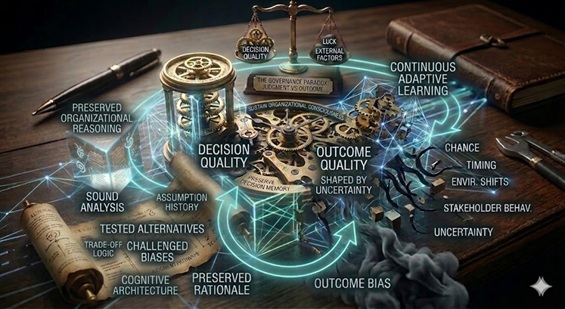
Most organizations claim to learn from experience.
Projects finish.
Initiatives succeed.
Programs fail.
Transformations exceed expectations.
Strategies underperform.
Then comes the familiar ritual.
A workshop.
A retrospective.
A review session.
A lessons learned report.
The organization documents what happened.
Archives the findings.
And moves on.
The process appears sensible.
After all, learning is widely recognized as one of the most important capabilities in modern organizations.
Yet an uncomfortable question remains:
What if many organizations are not actually learning from experience?
What if they are merely documenting outcomes?
The distinction matters.
Because outcomes and learning are not the same thing.
And confusing them may be one of the most persistent barriers to organizational adaptation.
This challenge becomes increasingly important in environments characterized by:
• Uncertainty,
• Distributed decision-making,
• AI-enabled acceleration,
• Systemic interdependence,
• Adaptive governance,
• Continuously evolving operating conditions.
Under these conditions, organizational reality rarely produces simple cause-and-effect relationships.
Success may emerge from:
• Sound judgment,
• Favorable timing,
• Unexpected market conditions,
• Stakeholder behavior,
• Fortunate circumstances,
• Combinations of all of them.
Failure may emerge from:
• Poor decisions,
• Flawed assumptions,
• Unforeseen events,
• Systemic disruptions,
• Factors beyond organizational control.
Yet many lessons learned processes operate as though outcomes alone explain reality.
Success becomes evidence of competence.
Failure becomes evidence of error.
The conclusion appears obvious.
But reality is rarely that cooperative.
This creates a subtle learning trap.
Organizations begin extracting lessons from outcomes rather than from reasoning.
The result is often false learning.
A successful initiative may reinforce flawed decision-making.
A failed initiative may discourage sound judgment.
Luck becomes confused with capability.
Circumstance becomes confused with competence.
And uncertainty becomes confused with failure.
This is where many organizational learning systems quietly break down.
Because what organizations often preserve is not understanding.
It is memory of outcomes.
And outcomes alone rarely explain why events unfolded as they did.
The deeper question is not:
What happened?
The deeper question is:
Why did we believe this would happen?
That distinction changes everything.
Because genuine learning requires organizations to preserve not only decisions and results, but also:
• Assumptions,
• Reasoning,
• Interpretations,
• Trade-Offs,
• Uncertainties,
• Contextual understanding.
Without this information, retrospective analysis becomes vulnerable to hindsight reconstruction.
Events that appeared uncertain at the time suddenly seem obvious.
Risks that were invisible become retrospectively self-evident.
Alternative futures disappear from memory.
And decision-makers are judged using information they never possessed when the decision was made.
This creates the illusion of learning while quietly degrading learning quality itself.
The problem becomes even more significant in AI-native environments.
As organizational systems become increasingly capable of:
• Prediction,
• Simulation,
• Optimization,
• Recommendation generation,
• Continuous adaptation,
The volume of available information expands dramatically.
Organizations gain unprecedented visibility.
But visibility alone does not create understanding.
In fact, greater visibility may sometimes create a new illusion.
The belief that sufficient information automatically produces correct interpretation.
It does not.
Information supports learning.
Interpretation creates learning.
And interpretation remains fundamentally human.
This is why future governance may need to move beyond traditional lessons learned processes.
Because the objective is no longer simply preserving organizational memory.
The objective is preserving organizational reasoning.
This distinction may become one of the defining governance capabilities of AI-native organizations.
Future organizations may increasingly need mechanisms capable of preserving:
• Decision rationale,
• Assumption history,
• Contextual conditions,
• Uncertainty assessments,
• Trade-Off logic,
• Judgment pathways.
Not merely because these records improve accountability.
But because they improve learning.
This may ultimately become one of the defining responsibilities of the future PMO.
Not as a repository of delivery metrics.
Not as a governance reporting structure.
But as a guardian of organizational decision memory and cognitive continuity.
The organizations most capable of adaptation may not be those that collect the most information.
They may be those that preserve the richest understanding of how decisions were actually made.
This is where governance, learning, and organizational coherence begin to converge.
Because learning is not merely the accumulation of experience.
Learning is the disciplined interpretation of experience.
And interpretation requires context.
Without context, memory becomes fragmented.
Without reasoning, outcomes become misleading.
Without preserved rationale, organizations lose the ability to distinguish between:
• Wisdom and luck,
• Competence and circumstance,
• Adaptation and drift,
• Learning and hindsight.
This creates a governance challenge that extends far beyond project reviews or retrospective workshops.
It becomes a question of organizational consciousness itself.
How does an organization preserve its ability to think across time?
How does it avoid relearning the same lessons repeatedly?
How does it maintain coherence while continuously adapting?
These questions may ultimately prove more important than any individual lesson learned.
Because organizations do not become adaptive simply by collecting experiences.
They become adaptive by preserving the reasoning that transforms experience into understanding.
Results tell organizations what happened.
Reasoning helps them understand why.
Wisdom emerges only when both are preserved together.
Because in increasingly complex, AI-native environments, the ultimate goal of governance is no longer merely to automate execution or optimize adaptation.
It is to sustain organizational consciousness.
And preserving the reasoning that transforms experience into wisdom may become the most important lesson of all.
This becomes particularly important as people change roles, retire, or leave the organization. Without preserved reasoning, successors inherit decisions, but not the judgment that originally justified them. |
Posted on: June 26, 2026 04:41 AM
|
Permalink |
Comments (1)
|
"Let us be thankful for fools. But for them the rest of us could not succeed."
- Mark Twain
|




