
This blog addresses management-related topics and has three areas of focus: 1. Technical skills; 2. Competencies in the field of interpersonal relations and communication (including personal organization and delegation, leadership, teamwork, conflict resolution, conducting meetings, and negotiation); and 3. Strategy (including diagnosis, strategic guidelines, and implementation).4.Technology
Recent Posts
Delegation with Purpose: Building Autonomy and Developing Capability
RCPCV™: A Method for Decision-Making and Continuous Improvement
The Same Change Can Succeed and Fail at the Same Time
What Must Exist Even When No Single Role Owns the Whole?
PHASE 4 – THE EMERGENCE
Categories
Agile,
Career Development,
Career Development,
Career Development,
Career Development,
Career Development,
Career Development,
Career Development,
Career Development,
Career Development,
Career Development,
Career Development,
Career Development,
Career Development,
Career Development,
Career Development,
Career Development,
Career Development,
Career Development,
Career Development,
Career Development,
Career Development,
Career Development,
Career Development,
Career Development,
Career Development,
Career Development,
Career Development,
Career Development,
Career Development,
Career Development,
Career Development,
Career Development,
Career Development,
Career Development,
Career Development,
Career Development,
Career Development,
Career Development,
Career Development,
Career Development,
Career Development,
Career Development,
Career Development,
Career Development,
Career Development,
Career Development,
Career Development,
Career Development,
Career Development,
Career Development,
Career Development,
Career Development,
Career Development,
Career Development,
Career Development,
Career Development,
Career Development,
Career Development,
Career Development,
Career Development,
Career Development,
Career Development,
Career Development,
Career Development,
Career Development,
Career Development,
Career Development,
Career Development,
Career Development,
Career Development,
Career Development,
Career Development,
Career Development,
Career Development,
Career Development,
Career Development,
Career Development,
Career Development,
Career Development,
Career Development,
Career Development,
Career Development,
Career Development,
Career Development,
Career Development,
Career Development,
Career Development,
Career Development,
Career Development,
Career Development,
Career Development,
Career Development,
Career Development,
Career Development,
Career Development,
Career Development,
Career Development,
Career Development,
Career Development,
Career Development,
Career Development,
Career Development,
Career Development,
Career Development,
Career Development,
Career Development,
Career Development,
Career Development,
Career Development,
Career Development,
Career Development,
Career Development,
Career Development,
Career Development,
Career Development,
Career Development,
Career Development,
Career Development,
Career Development,
Career Development,
Career Development,
Career Development,
Education,
Governance,
Governance,
Governance,
Governance,
Governance,
Governance,
Governance,
Governance,
Governance,
Governance,
Governance,
Governance,
Governance,
Governance,
Governance,
Governance,
Governance,
Governance,
Governance,
Governance,
Governance,
Governance,
In,
Integration Management,
Interpersonal Skills,
Interpersonal Skills,
Interpersonal Skills,
Interpersonal Skills,
Interpersonal Skills,
Interpersonal Skills,
Interpersonal Skills,
Interpersonal Skills,
Interpersonal Skills,
Interpersonal Skills,
Interpersonal Skills,
Interpersonal Skills,
Interpersonal Skills,
Interpersonal Skills,
Interpersonal Skills,
Interpersonal Skills,
Interpersonal Skills,
Interpersonal Skills,
Interpersonal Skills,
Interpersonal Skills,
Interpersonal Skills,
Interpersonal Skills,
Interpersonal Skills,
Interpersonal Skills,
Interpersonal Skills,
Interpersonal Skills,
Interpersonal Skills,
Interpersonal Skills,
Interpersonal Skills,
Interpersonal Skills,
Interpersonal Skills,
Interpersonal Skills,
Interpersonal Skills,
Interpersonal Skills,
Interpersonal Skills,
Interpersonal Skills,
Interpersonal Skills,
Interpersonal Skills,
Interpersonal Skills,
Interpersonal Skills,
Interpersonal Skills,
Interpersonal Skills,
Interpersonal Skills,
Interpersonal Skills,
Interpersonal Skills,
Interpersonal Skills,
Interpersonal Skills,
Interpersonal Skills,
Interpersonal Skills,
Interpersonal Skills,
Interpersonal Skills,
Interpersonal Skills,
Interpersonal Skills,
Interpersonal Skills,
Interpersonal Skills,
Interpersonal Skills,
Interpersonal Skills,
Interpersonal Skills,
Interpersonal Skills,
Interpersonal Skills,
Interpersonal Skills,
Interpersonal Skills,
Interpersonal Skills,
Interpersonal Skills,
Interpersonal Skills,
Interpersonal Skills,
Interpersonal Skills,
Interpersonal Skills,
Interpersonal Skills,
Interpersonal Skills,
Interpersonal Skills,
Interpersonal Skills,
Interpersonal Skills,
Interpersonal Skills,
Interpersonal Skills,
Interpersonal Skills,
Interpersonal Skills,
Interpersonal Skills,
Interpersonal Skills,
Interpersonal Skills,
Interpersonal Skills,
Interpersonal Skills,
Interpersonal Skills,
Interpersonal Skills,
Interpersonal Skills,
Interpersonal Skills,
Interpersonal Skills,
Interpersonal Skills,
Interpersonal Skills,
Interpersonal Skills,
Interpersonal Skills,
Interpersonal Skills,
Interpersonal Skills,
Interpersonal Skills,
Interpersonal Skills,
Interpersonal Skills,
Interpersonal Skills,
Interpersonal Skills,
Interpersonal Skills,
Interpersonal Skills,
Interpersonal Skills,
Interpersonal Skills,
Interpersonal Skills,
Interpersonal Skills,
Interpersonal Skills,
Interpersonal Skills,
Interpersonal Skills,
Interpersonal Skills,
Interpersonal Skills,
Interpersonal Skills,
Interpersonal Skills,
Interpersonal Skills,
Interpersonal Skills,
Interpersonal Skills,
Interpersonal Skills,
Interpersonal Skills,
Interpersonal Skills,
Interpersonal Skills,
Interpersonal Skills,
Interpersonal Skills,
Interpersonal Skills,
Interpersonal Skills,
Knowledge Management,
le,
lea,
Leadership,
Leadership,
Leadership,
Leadership,
Leadership,
Leadership,
Leadership,
Leadership,
Leadership,
Leadership,
Leadership,
Leadership,
Leadership,
Leadership,
Leadership,
Leadership,
Leadership,
Leadership,
Leadership,
Leadership,
Leadership,
Leadership,
Leadership,
Leadership,
Leadership,
Leadership,
Leadership,
Leadership,
Leadership,
Leadership,
Leadership,
Leadership,
Leadership,
Leadership,
Leadership,
Leadership,
Leadership,
Leadership,
Leadership,
Leadership,
Leadership,
Leadership,
Leadership,
Leadership,
Leadership,
Leadership,
Leadership,
Leadership,
Leadership,
Leadership,
Leadership,
Leadership,
Leadership,
Leadership,
Leadership,
Leadership,
Leadership,
Leadership,
Leadership,
Leadership,
Leadership,
Leadership,
Leadership,
Leadership,
Leadership,
Leadership,
Leadership,
Leadership,
Leadership,
Leadership,
Leadership,
Leadership,
Leadership,
Leadership,
Leadership,
Leadership,
Leadership,
Leadership,
Leadership,
Leadership,
Leadership,
Leadership,
Leadership,
Leadership,
Leadership,
Leadership,
Leadership,
Leadership,
Leadership,
Leadership,
Leadership,
Leadership,
Leadership,
Leadership,
Leadership,
Leadership,
Leadership,
Leadership,
Leadership,
Leadership,
Leadership,
Leadership,
Leadership,
Leadership,
Leadership,
Leadership,
Leadership,
Leadership,
Leadership,
Leadership,
Leadership,
Leadership,
Leadership,
Leadership,
Leadership,
Leadership,
Leadership,
Leadership,
Leadership,
Leadership,
Leadership,
Leadership,
Leadership,
or,
Organizational Project Management,
Portfolio Management,
Program,
Program Management,
Strategy,
Strategy,
Strategy,
Strategy,
Strategy,
Strategy,
Strategy,
Strategy,
Strategy,
Strategy,
Strategy,
Strategy,
Strategy,
Strategy,
Strategy,
Strategy,
Strategy,
Strategy,
Strategy,
Strategy,
Strategy,
Strategy,
Strategy,
Strategy,
Strategy,
Strategy,
Strategy,
Strategy,
Strategy,
Strategy,
Strategy,
Strategy,
Strategy,
Strategy,
Strategy,
Strategy,
Strategy,
Strategy,
Strategy,
Strategy,
Strategy,
Strategy,
Strategy,
Strategy,
Strategy,
Strategy,
Strategy,
Strategy,
Strategy,
Strategy,
Strategy,
Strategy,
Strategy,
Strategy,
Strategy,
Strategy,
Strategy,
Strategy,
Strategy,
Strategy,
Strategy,
Strategy,
Strategy,
Strategy,
Strategy,
Strategy,
Strategy,
Strategy,
Strategy,
Strategy,
Strategy,
Strategy,
Strategy,
Strategy,
Strategy,
Strategy,
Strategy,
Strategy,
Strategy,
Strategy,
Strategy,
Strategy,
Strategy,
Strategy,
Strategy,
Strategy,
Strategy,
Strategy,
Strategy,
Strategy,
Strategy,
Strategy,
Strategy,
Strategy,
Strategy,
Strategy,
Strategy,
Strategy,
Strategy,
Strategy,
Strategy,
Strategy,
Strategy,
Strategy,
Strategy,
Strategy,
Strategy,
Strategy,
Strategy,
Strategy,
Strategy,
Strategy,
Strategy,
Strategy,
Strategy,
Strategy,
Strategy,
Strategy,
Strategy,
Strategy,
Strategy,
Strategy,
Strategy,
Sustainability,
Talent Management,
Talent Management,
Talent Management,
Talent Management,
Talent Management,
Talent Management,
Talent Management,
Talent Management,
Talent Management,
Talent Management,
Talent Management,
Talent Management,
Talent Management,
Talent Management,
Talent Management,
Talent Management,
Talent Management,
Talent Management,
Talent Management,
Talent Management,
Talent Management,
Talent Management,
Talent Management,
Talent Management,
Talent Management,
Talent Management,
Talent Management,
Talent Management,
Talent Management,
Talent Management,
Talent Management,
Talent Management,
Talent Management,
Talent Management,
Talent Management,
Talent Management,
Talent Management,
Talent Management,
Talent Management,
Talent Management,
Talent Management,
Talent Management,
Talent Management,
Talent Management,
Talent Management,
Talent Management,
Talent Management,
Talent Management,
Talent Management,
Talent Management,
Talent Management,
Talent Management,
Talent Management,
Talent Management,
Talent Management,
Talent Management,
Talent Management,
Talent Management,
Talent Management,
Talent Management,
Talent Management,
Talent Management,
Talent Management,
Talent Management,
Talent Management,
Talent Management,
Talent Management,
Talent Management,
Talent Management,
Talent Management,
Talent Management,
Talent Management,
Talent Management,
Talent Management,
Talent Management,
Talent Management,
Talent Management,
Talent Management,
Talent Management,
Talent Management,
Talent Management,
Talent Management,
Talent Management,
Talent Management,
Talent Management,
Talent Management,
Talent Management,
Talent Management,
Talent Management,
Talent Management,
Talent Management,
Talent Management,
Talent Management,
Talent Management,
Talent Management,
Talent Management,
Talent Management,
Talent Management,
Talent Management,
Talent Management,
Talent Management,
Talent Management,
Talent Management,
Talent Management,
Talent Management,
Talent Management,
Talent Management,
Talent Management,
Talent Management,
Talent Management,
Talent Management,
Talent Management,
Talent Management,
Talent Management,
Talent Management,
Talent Management,
Talent Management,
Talent Management,
Talent Management,
Talent Management,
Talent Management,
Talent Management,
Talent Management
Date
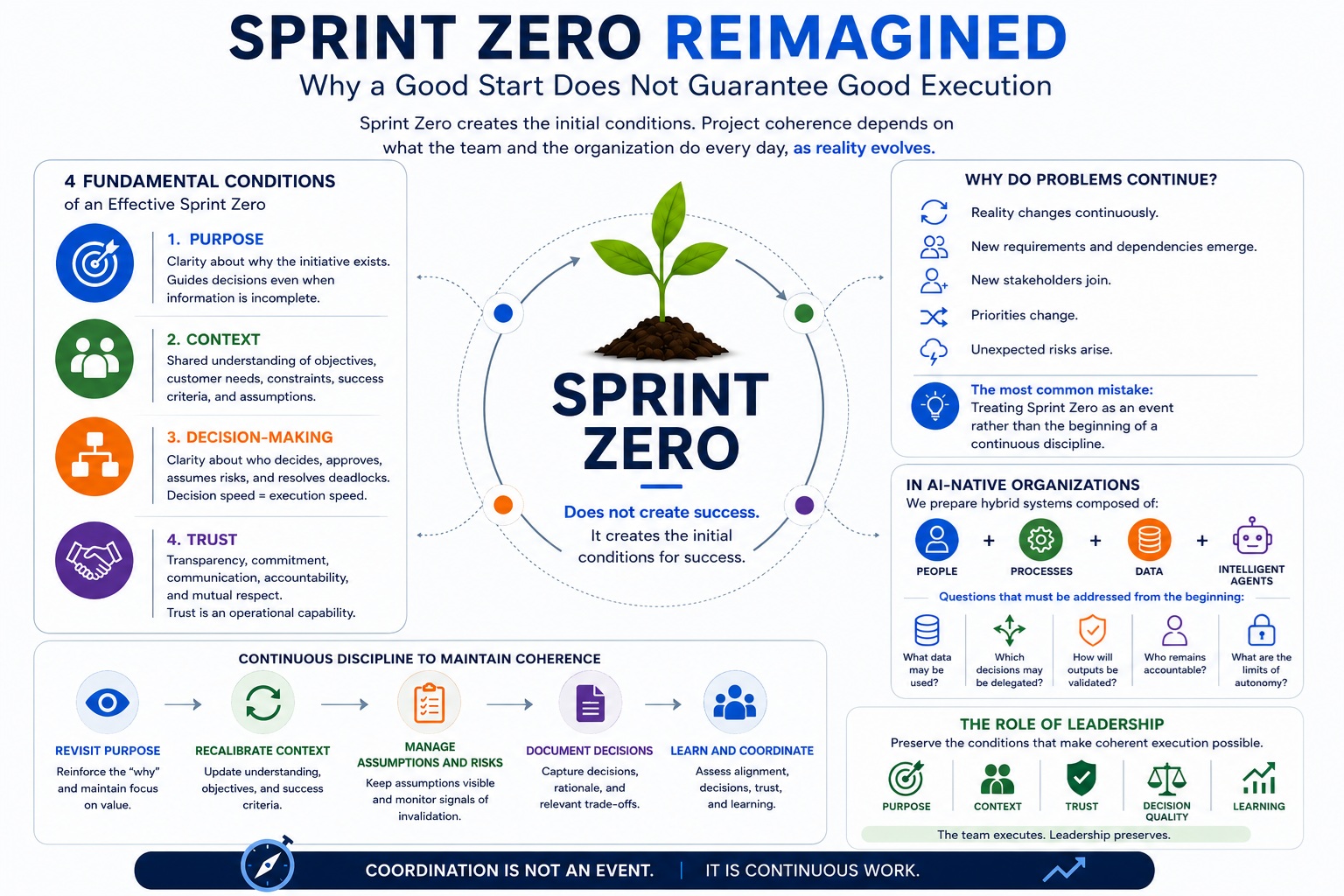 Why a Good Start Does Not Guarantee Good Execution
Sprint Zero has become a common practice in many organizations adopting Agile approaches.
Preparing the environment.
Defining the vision.
Organizing the initial backlog.
Aligning stakeholders.
Identifying risks.
Establishing ways of working.
All of this makes sense.
And all of this adds value.
Yet one question continues to emerge repeatedly.
If so many teams conduct Sprint Zero, why do so many projects still experience delays, conflicts, rework, misalignment, and loss of focus?
The answer is simple.
Because a well-executed Sprint Zero is a necessary condition.
But it is not a sufficient one.
The True Purpose of Sprint ZeroThere is a tendency to view Sprint Zero as a project preparation phase.
In reality, its role is more important.
Sprint Zero does not merely prepare the project.
It prepares the team to begin learning.
No Sprint Zero can anticipate every need.
No Sprint Zero can eliminate all uncertainty.
No Sprint Zero can predict every change that will occur.
Its purpose is not to create certainty.
Its purpose is to create a sufficiently solid foundation that enables the team to move forward, learn, and adapt.
In complex environments, preparation does not replace learning.
It merely creates the conditions for learning to happen more quickly.
What a Good Sprint Zero Should CreateRegardless of the methodology being used, there are four fundamental conditions that should result from an effective Sprint Zero.
1. Clarity of PurposeBefore discussing features, requirements, or technology, the team must understand why the project exists.
The backlog is important.
But purpose is more important.
When purpose is clear, teams are able to make better decisions even when information is incomplete.
When purpose is ambiguous, every prioritization exercise becomes a continuous negotiation.
Purpose functions as an alignment mechanism when plans are no longer sufficient.
2. Shared ContextA team may possess all the necessary information and still not be aligned.
Because information is not the same as context.
Sprint Zero should create a shared understanding of:
• Business objectives;
• Customer needs;
• Operational constraints;
• Success criteria;
• Key assumptions.
Without shared context, each person interprets reality differently.
And when interpretations diverge, coordination begins to deteriorate.
Data enables execution.
Shared context enables coordination.
3. Responsibility and Decision-MakingMany projects are not delayed because of a lack of technical capability.
They are delayed because nobody knows who can make decisions.
When doubts, exceptions, or conflicts arise, teams need to know:
• Who decides;
• Who approves;
• Who assumes risk;
• How deadlocks are resolved.
Without decision clarity, execution speed becomes limited by approval speed.
And no team can deliver faster than the organization can make decisions.
4. Operational TrustAgile methods assume collaboration.
Collaboration assumes trust.
But trust does not emerge automatically.
It is built through:
• Transparency;
• Commitment;
• Communication;
• Accountability;
• Mutual respect.
Sprint Zero represents the first opportunity to establish this foundation.
Because trust is not merely a cultural value.
It is an operational capability.
Without trust, autonomy decreases.
Without autonomy, velocity deteriorates.
Why Do Problems Persist?Because reality changes.
And Sprint Zero happens only once.
As the project progresses:
• New requirements emerge;
• New dependencies appear;
• New stakeholders join;
• Priorities change;
• Unexpected risks arise;
• Assumptions become invalid.
The initial alignment naturally begins to erode.
Context is no longer fully shared.
Decisions become more difficult.
Pressure increases.
New trade-offs emerge.
As a result, many problems attributed to an insufficient Sprint Zero are actually caused by the absence of continuous mechanisms for coordination, communication, learning, and adaptation.
The Most Common MistakeMany organizations treat Sprint Zero as an event.
In practice, it should be viewed as the beginning of a continuous discipline.
The vision must be reinforced.
Context must be updated.
Assumptions must be reviewed.
Decisions must be clarified.
Trust must be renewed.
Coordination must be maintained.
When this does not happen, the project continues to move forward.
But coherence begins to disappear.
And when coherence disappears, velocity easily turns into rework.
How to Sustain Alignment Throughout the ProjectThe most effective teams do not simply conduct a good Sprint Zero.
They keep alive what Sprint Zero initiated.
Some particularly useful practices include:
• Revisiting the project's purpose on a regular basis;
• Using Sprint Reviews to recalibrate understanding rather than merely demonstrate functionality;
• Keeping key assumptions and risks visible;
• Documenting important decisions and their rationale;
• Periodically assessing the quality of coordination and decision-making.
The objective is not to preserve the original plan.
The objective is to preserve coherence as reality evolves.
Sprint Zero in AI-native OrganizationsAs artificial intelligence and intelligent agents become an integral part of teams, the role of Sprint Zero expands.
Preparing people is no longer enough.
Organizations must prepare hybrid systems composed of:
• People;
• Processes;
• Data;
• Intelligent agents.
If maintaining alignment among people was already difficult, maintaining alignment among people, systems, and agents will be even more demanding.
Questions such as these become part of the initial preparation:
• What data may be used?
• Which decisions may be delegated?
• How will outputs be validated?
• Who remains accountable?
• What are the limits of autonomy?
The challenge is no longer simply preparing the project.
It becomes preparing the execution system.
Autonomy without governance creates risk.
Governance without autonomy creates friction.
The Role of LeadershipThere is one responsibility that cannot be delegated.
Preserving the conditions that make coherent execution possible.
The team executes.
Leadership preserves:
• Purpose;
• Context;
• Trust;
• Decision quality;
• Learning.
When these conditions deteriorate, the team continues to work.
But the system begins to lose coherence.
And when coherence disappears, the following inevitably emerge:
• Rework;
• Conflicting priorities;
• Disputes;
• Delays;
• Frustration.
A New Way to Assess SuccessHistorically, Sprint Zero was considered successful when:
• The backlog had been created;
• The tools had been configured;
• The team was ready to begin work.
Today, that is no longer enough.
A Sprint Zero is truly successful when it creates the conditions that allow the team to learn, decide, adapt, and coordinate throughout the project.
Because the objective is not to eliminate uncertainty.
The objective is to enable coherent progress despite uncertainty.
Sprint Zero does not create success.
It creates the initial conditions for success.
The difference between projects that thrive and projects that deteriorate rarely lies in the quality of Sprint Zero itself.
It lies in the ability of the team and the organization to preserve alignment, context, trust, and decision quality as reality changes.
Because coordination is not an event.
It is continuous work.
And perhaps that is the most important lesson Sprint Zero can teach us.
Author's NoteIn 2024, I published an earlier article titled
"Sprint Zero: The Solid Foundation for Successful Agile Projects."This article revisits the topic from a broader perspective, exploring alignment, coordination, decision-making, and continuous adaptation in increasingly complex and AI-native environments.
Readers interested in the original perspective can find it in my ProjectManagement.com article archive.
Posted on: June 18, 2026 12:17 PM |
Permalink




