6 Tools for Forecasting


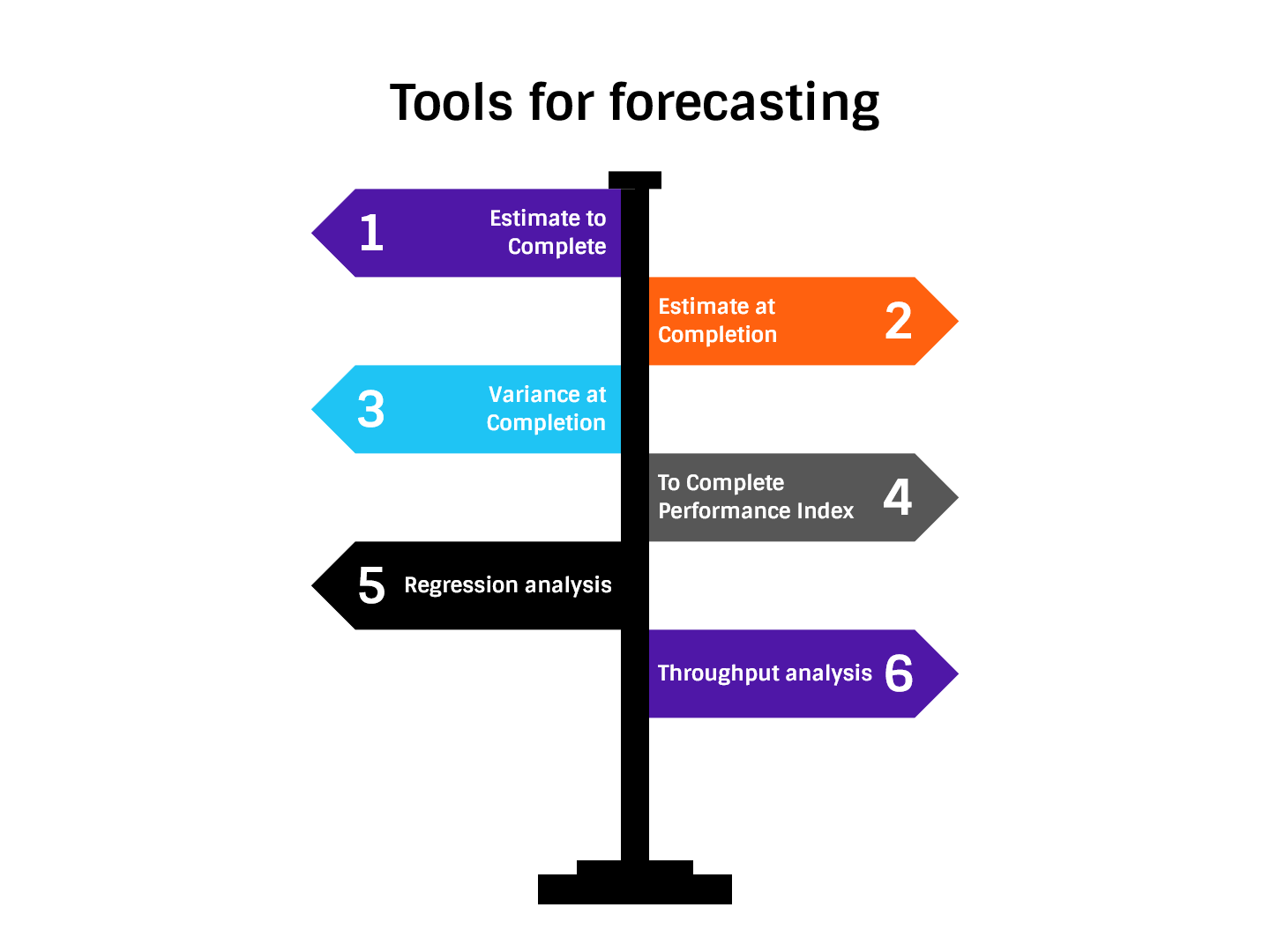
| I have an electronic copy of the PMBOK® 7th edition, so from time to time I open it up to check on something. Recently, I’ve been looking at different ways to forecast as we’ve got some work on that needs to be planned out. There are 6 quantitative forecasting options called out in the Guide. These are as follows.
Estimate to complete (ETC)This is top of the list and the one I personally use the most often. It works even if you are not in a full, compliant, earned value management environment. The risk here is that we assume past performance is indicative of future performance, and honestly, why wouldn’t you? Unless you know something is definitely going to change measurable performance, you would assume that work is going to continue at broadly the same rate. Just jot that down as an assumption so it’s transparent to everyone. Estimate at completion (EAC)For me, this goes hand in hand with ETC. It’s calculated by taking the actuals and adding the ETC, so again, while it comes under the umbrella of earned value acronyms, it’s completely accessible to those who don’t work in EV setting. Variance at completion (VAC)As forecasting tools go, this gives interesting data. It’s the measure that shows the amount of forecasted budget over or under at the end of the project, and it’s one most project sponsors will be interested in: “Will we have any cash left to do anything else when we’re finished?” To-complete performance index (TCPI)I have never had the opportunity (or reason) to use this forecasting metric. Perfect for those of you working with earned value day in, day out, it’s the cost performance required to meet whatever management target you’ve set for the work. It’s a ratio, so I think it is less meaningful to execs who are used to see tangible numbers of days or money. Regression analysisNow more and more tools are introducing AI features, it is possible to access regression analysis more easily. Perhaps you’ve got access to an AI-powered tool that will crunch these numbers for your automatically, removing the need for statistical knowledge. The output allows you to predict performance going forward based on what has happened in the past, so it’s arguably more grounded than other guesstimates! Throughput analysisThe final forecasting technique mentioned is throughput analysis. This looks at the number of items completed in a fixed time, so it’s useful for teams measuring features completed, velocity and story points. You can compare the output to those of other teams, although I’d be wary about comparing teams unless they work on very similar products or services. It wouldn’t be fair to judge a team on their throughput when dealing with very complex features against the performance of a team that has higher throughput but lower complexity. However, the team can compare its performance against itself: that would be a worthwhile exercise. Ideally, you’d want to see that the learnings from retros have been fully incorporated and, more importantly, that the changes have actually made a difference. Which of these are most used for your project forecasting? Let us know in the comments below! |
How to give a status update
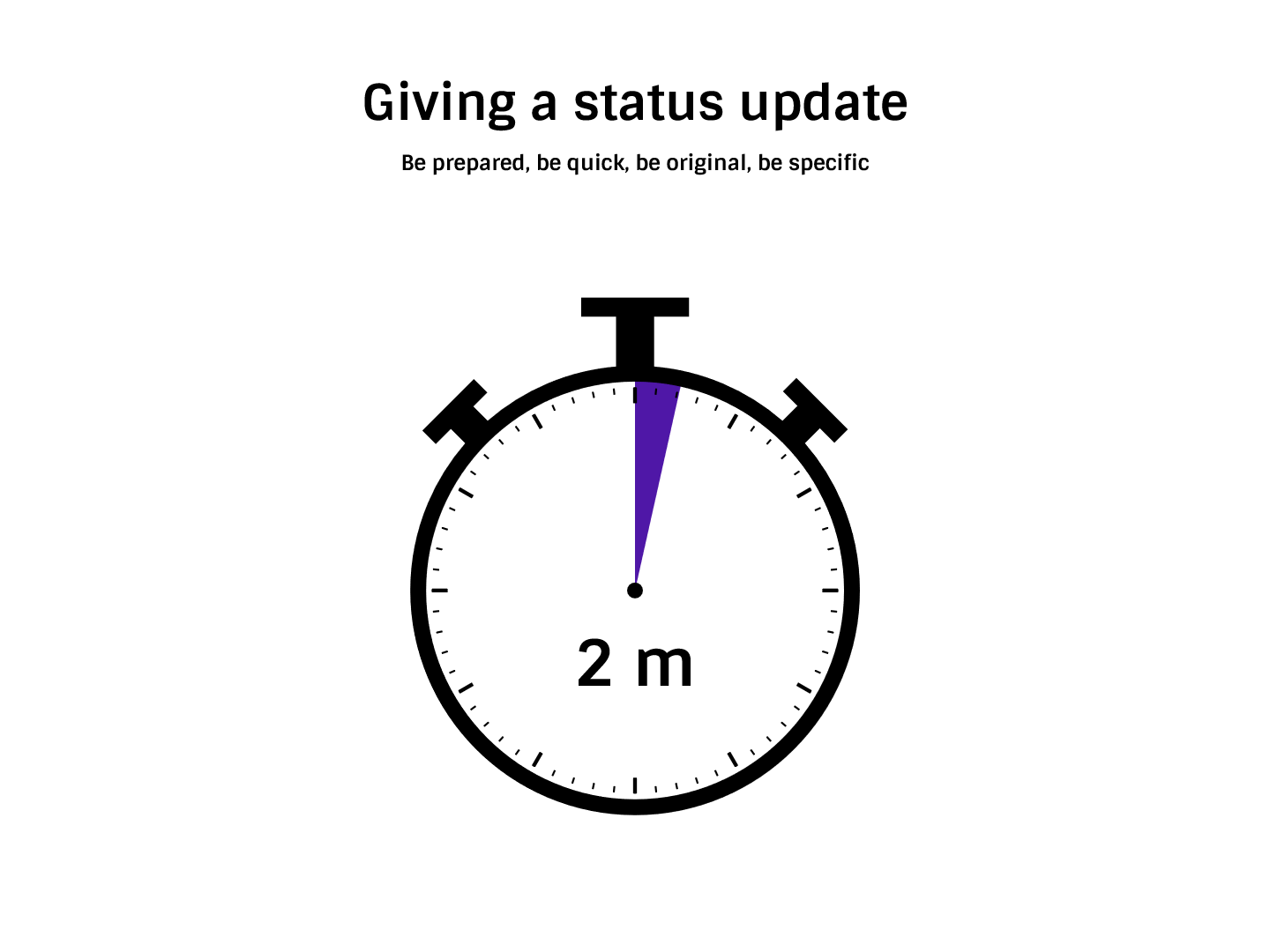
| I’m sure you’ve sat in meetings where you go round the table and give updates on progress. You could argue that it’s not the most interesting or effective use of everyone’s time, but it is used in many settings. For example, if you have a team of project managers meeting and it is useful to share a couple of points about the work that is going on, as the rest of the team wouldn’t necessarily be aware of it while they are busy on other projects. However, I also know that many people hate the ‘creeping death’ of going around the room for updates. Below are a few tips from my experience that will help you in your next ‘round table update’ meeting.
Be preparedIf your team meetings or PMO meetings have a section where you go round the table giving updates about progress and what you’ve achieved and so on, then you should know it’s coming. It might be specifically called out on the agenda or just part of your normal meeting practice. Spend some time before the meeting – just a few minutes – writing down a couple of bullet points so you have something to say when called on. These can be about your projects, successes, blockers or dependencies on other projects that would be worth highlighting to the group. Be quickIf you aren’t given a time limit, assume you have hardly any time! Three minutes feels like a very long time to the other people having to listen to you, so I would suggest less than that if you can, especially if you have nothing much to report. If you are the first to go, you set the unofficial time limit for the group, so it’s even more important to be speedy. Be originalDon’t repeat what another colleague has already said or things that the team already knows or has heard about. For example, if you said a milestone was completed when you all met up last week, you don’t need to say it again. It’s worth keeping track of what you did say for this exact purpose – I often find people repeat status updates that we covered last week and I have to assume they don’t remember telling us about it previously. It's also common that several people with the project office will be working on the large projects, and the person who goes first may well share the big successes or challenges for that project. You don’t need to say them again; just say, “To build on what X has already said about the Y project,” and share something different. Make a note of a couple of different updates you could give and cross them off your list if anyone else says them first! Be specificFocus on specific things. Talk about what issues you are having or successes the team achieved. Share where you need help or what you know they are most interested in. Focus on things that overlap with other projects, for example, where you share resources, as these are the information points that will help others in the team manage their own work more successfully. What other tips do you have for round table updates, or don’t you use that format any longer? Let us know your experiences in the chat! |
3 Things a Holiday Magic Show Taught Me About Project Management
|
Earlier this month, I wrote about our summer trip to a holiday park. Two of the shows we saw while we were there were magic shows. One was a comedy-style show with some fun magic thrown in. The other was a ‘proper’ serious magic show with all the atmospheric lighting and big illusions. It got me thinking – I know, this is not how most people spend their holidays, but perhaps project managers are this way inclined – about the parallels between the shows and my job back at base. Here’s what I learned. 1. The wait is part of the journeyWe learned on other holidays that if you want a good seat, you have to get to the show early and sit and wait for a loooong period of time for it to start. This is because there is no allocated seating. While we were waiting for the show to start, having arrived 40 minutes early, the family at the table next to us got out a game to play. They used the downtime as family time, getting everyone involved. It was part of the experience for them: being around a table to play a game. We had brought books and electronic devices, and we were all occupied but not together. We weren’t using the time as family time. We were just waiting. The wait is part of the experience. Plan for downtime on your project. How can you use that time productively? For example, can you bring forward tasks, fit in a peer review or a risk review, run an audit, or something? Where there are slower periods on projects, what are you going to do with them? 2. Same prop, different deliveryBoth magicians used an identical prop, and they both performed Houdini’s Metamorphosis trick (where one person is locked in a box and the other stands on top with a curtain – they drop the curtain and they’ve switched places). But the delivery was different. One was fun and light; the other was dark and dramatic. But the box looked the same, and the trick was the same. Tailor what you’ve got to make it yours. The lesson for me here was how one item could be used so differently. Tailor what you use to make it relevant to your project and the way you want to deliver your work. 3. If you’ve not seen it before, it’s magicalThe second magic show contained big set piece illusions: a box pierced with swords, but amazingly the magician inside was still safe, making snow from a piece of paper, levitation, escaping from a strait jacket before a flame burns through a rope and the magician is squashed. I am a huge magic fan, and I’ve seen all these before, in live shows and on TV. But for my kids, they are new. And they were truly amazed. Don’t take for granted what you know. For some of your stakeholders, the magic of project management will be new for them. Train people in the process. Let them know what to expect and help them understand things about the process that feel new and different. You’ve seen it all before; you’d read about it, done it, written the documents, and got the T-shirt. But they haven’t. Give them the support they need to come along the journey with you. Project management isn’t really magic, but some days it feels like the team comes together, and we’ve pulled off something amazing. Don’t you think? |
Economic vs Financial Appraisals
|
Let me see if I can make the difference between economic appraisals and financial appraisals interesting…. They are both covered in the UK Government’s Better Business Cases document. Here’s my take on what they both mean and why you’d want to use them.
Economic appraisalsThe document says that economic appraisals are all about value and benefits from the perspective of the stakeholders, users, and wider societal impact. They consider “all social, economic, environmental costs and all effects on public welfare.” Remember, this is a government publication, so the assumption is that projects will be for the public good. Your project might not have an effect on public welfare, but you can imagine that it will have an effect on the project’s customers or end users. This is the core of a business case. It includes an element of financial information as well, such as relative prices, direct and indirect costs, opportunity costs where there are any, environmental costs, and benefits however these play out. You’d also include staff time. It would exclude inflation, tax, sunk costs (let’s hope there aren’t any of those), depreciation of assets, and other accounting treatments. Financial appraisalsFinancial appraisals are purely the monetary calculations: can we afford it? Where is the money coming from? They consider cash flow, budgets, and accounting practices. This would feed into a business case because there is no point in progressing a project that you can’t afford to complete or that would not provide adequate financial returns where these are measured. A financial analysis would look at current pricing, cash-releasing benefits (like delivering a portion of the project early so it could start to ‘earn’ for you), capex and opex costs, tax payment, and inflation. The do nothing optionA business case should also include the minimum possible approach, which is normally the ‘do nothing’ case against which to compare your alternative(s). Complete an economic appraisal for that option, too, taking into account what stays the same and the benefit cost ratio of doing nothing. In my experience, it’s always worth including a ‘do nothing’ option as it really makes it clear to execs what they are giving up if they choose to reject a project. Is an economic appraisal a new thing?I don’t think an economic appraisal is a new thing, but I think project managers are more used to seeing it be called a business case or an options analysis. Once you have created an economic appraisal for a variety of options (including the ‘do nothing’), there is likely to be a clear option that stands out as the best course of action. If not, there might be a few to choose from with subtle differences – leave the choice up to the execs to debate in that case! I think the thing about an economic appraisal is that it forces you to think wider than the numbers. You’re looking for social and environmental benefit, community impact, and return instead of just a simple ‘if we do this, we’ll get paid that in a year’. It’s a way of reframing the business case conversation into something that is wider and more rounded, helping teams become aware of the full impact and benefit of their initiative instead of simply the bottom line. And I think that’s a good thing. We should be making rounded, fully informed decisions instead of simply relying on the top level numbers. We need to be aware of the full impact from idea to decommissioning and what impact that is going to have on the world around us, not just the bank account. By adopting the language of economic appraisal instead of business case, we might be shifting the thought process into a richer dialogue with ultimately better decisions being made. What do you think? Let me know in the comments! |

Holiday Rep Techniques We Should Use in Project Management
|
OK, it’s been a while since the summer holidays for us here in the northern hemisphere, and for a while, I’ve been musing on some things I noticed while we were away. During the school holidays, we took our children to a holiday park – one with a swimming pool, mass catering options, and evening entertainment. During the entertainment portions of the trip, guest services reps – what’s the proper name for those? – milled around before the show started. They managed the queue, checked tickets, and then talked to us while we were waiting for the event to begin.
They were excellent at customer service and making the time feel like it was going faster. Here are a few things I took away from the holiday that I think we could be implementing in project management. It’s all about the merchGet your guests in for one thing and then cross-sell them something else. “While you’re here, would you like a hat?” No, I don’t want a dinosaur hat, but plenty of people in the audience must have bought them for their kids. The merch stands were obviously secondary money-spinners. The shows themselves were included in the cost of the holiday, but things to wave in the crowd, books, soft toys, and more were on sale at every show we went to. Takeaway for project managers: “While you’re here, can I also ask you about…?” Think about who is coming to your meetings and what else you need from them that is beyond the scope of the meeting. Can you ask about an upcoming project? Secure some support for a different initiative? What can you showcase to a captive audience in a team meeting or even a one-to-one conversation with a stakeholder? You could even ask them if they need any help with anything else if you are looking to build your network or take on different projects in their area. Warm people upTen minutes before a show started, we’d get a warm up. “Who’s excited to see the show?” Plus lots of reminders about photography, how to order drinks, signposting guests to various social media accounts to follow, or even pointing out the merch stands by the side of the stage in case you had changed your mind about that dinosaur hat after all. Takeaway for project managers: Build excitement and let people know what is going on. Let people know how long they have to wait or to do something. Repeat the basic instructions several times. Engage across large groups with broadcast updates and keep reminding people about the benefits, tasks, and activities. Start highWe did enjoy our time, and we decided during the stay to book again to a different park in the same chain for next year. They encourage people to do that, as you would imagine, by having an on-site shop that discounts holiday bookings for people who book again before they leave. When I went to book again, I got pitched the most expensive accommodation at the other park, almost £1,000 more than I wanted to spend. We then reviewed all the options and found different ways to bring the cost down to our budget. Takeaway for project managers: Ask for what you’d like and then work down from there. When you ask for time, resources, budget, or another type of contingency, be generous with yourself. Start from the position you’d feel most safe in, and then negotiate from there. Note: this approach might not work so well for risk appetite! You’d want to do it the other way round. Start low and increase the risk as you feel more confident. The main thing I took from all of this is that there are useful tips and lessons from other management disciplines that are applicable to how we work on projects. While we focus on learning about project management as part of our career journeys, actually, the role of project manager can be far broader as it involves liaising with lots of different business areas, and they all have something to teach us. |