

New Ways of Working in Projects: From Team Agility to Organizational Adaptability


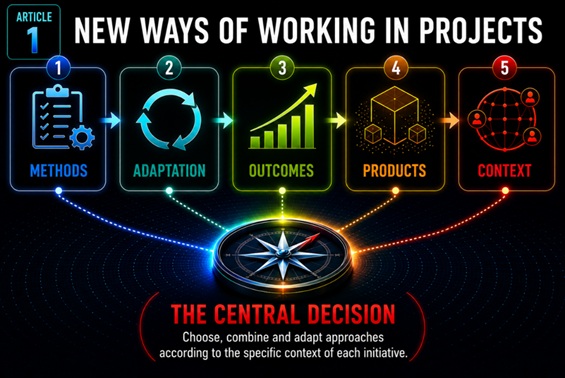 For many years, discussing new ways of working in projects meant, essentially, discussing methodologies. Organizations sought to answer a relatively simple question: how to increase the probability of project success through better processes, tools, techniques, and management practices? From this concern emerged more robust planning models, stricter control processes, more sophisticated risk management techniques, and methodologies capable of improving predictability and work coordination. This evolution was decisive for the consolidation of Project Management as a discipline. But it was never static. Over the past few decades, the discipline evolved to respond to changes in the organizational, technological, and economic context. Whenever the context changed, Project Management had to evolve as well. It is precisely this evolution that needs to be understood. Because perhaps the most important transformation was not the adoption of new methods, but the progressive shift in how we understand project work itself. From a concern with methods… For many years, the discussion centered primarily on choosing the most appropriate methodology. Predictive. Iterative. Incremental. Agile. Or different combinations of these approaches. This discussion remains important. Methodologies offer structure, a common language, coordination mechanisms, and good practices that continue to be indispensable for any Project Manager. However, over time, it became evident that simply adopting a methodology did not guarantee better results. Technically well-managed projects could fail to create value. Carefully prepared plans could quickly become outdated. Highly competent teams could remain blocked by external decisions. Success was no longer solely dependent on the quality of the method used. It also came to depend on the capacity to respond to contexts in permanent transformation. …to the capacity for adaptation The spread of agile approaches represented one of the most significant shifts in the recent evolution of Project Management. More than introducing new ceremonies or new artifacts, these approaches brought a profound shift in how work is viewed. Change was no longer treated as an exception. It came to be considered a normal condition of project development. Instead of trying to eliminate all uncertainty prior to execution, it became recognized that part of that uncertainty can only be understood as the work unfolds. Consequently, principles gained importance, such as:
How do we follow the plan? It also became: How do we continue making good decisions when the context changes? This shift represents far more than a methodological change. It represents an evolution in how project work itself is understood. …to the delivery of outcomes As organizations became more outcome-oriented, Project Management also began to shift its focus. For a long time, success was measured primarily through the traditional triple constraint:
However, they are no longer sufficient to explain the true contribution of a project. A project can strictly comply with the approved plan and yet deliver a solution that no longer meets the needs of the organization or its customers. For this reason, questions began to gain prominence, such as:
…to an integrated view of projects and products Another important evolution is the convergence between project management and product management. Traditionally, a project was understood as a temporary endeavor whose primary objective was the delivery of a specific output. Today, many organizations recognize that this output continues to evolve long after the formal closure of the project. Digital products, technological platforms, intelligent services, and AI-supported solutions are continuously adjusted, improved, and enriched. In this context, projects and products cease to be entirely separate realities. They become part of the same value creation lifecycle. This convergence also alters how we define success. It is no longer enough to ask: Is the project finished? It is equally necessary to ask: Is the product continuing to create value? …and finally to context It is precisely in this dimension that the second edition of the Agile Practice Guide represents a particularly significant evolution. Rather than presenting agility as an alternative to predictive approaches, the Guide adopts a much broader view. It recognizes that different projects require different combinations of practices, lifecycles, and ways of organizing work. The question is no longer: What is the best methodology? It becomes: What is the most appropriate approach for the specific context of this project? This shift may seem subtle. In reality, it profoundly alters the logic of Project Management. Context assumes a central role. The nature of the solution. The stability of requirements. The level of uncertainty. The maturity of the team. The characteristics of stakeholders. The pace of change. The regulatory environment. The integration with products. All of this influences how the project should be organized. The method is no longer the starting point. It becomes a consequence of understanding the context. This is, perhaps, one of the most important messages of the new Guide. The evolution of Project Management is not about replacing one methodology with another. It is about developing the capability to select, combine, and adapt approaches according to the concrete reality of each initiative. Far more than methods Observing this evolution, it becomes evident that Project Management has walked a consistent path. First, it concerned itself with methods. Then with adaptation. Later with outcomes. Next with products. And today, increasingly with context. This path demonstrates a progressive broadening of the discipline. Project Management continues to require solid methodologies. It continues to depend on planning, coordination, risk management, leadership, and execution discipline. However, it has also come to recognize that no methodology, on its own, can address the growing complexity of organizational environments. Perhaps this is the primary message that emerges from reading the new Agile Practice Guide. The true evolution of Project Management does not lie merely in the adoption of new practices. It lies in the growing capability to understand context and adapt work intelligently, maintaining a relentless focus on value creation. A new question This evolution represents an extraordinary advancement. Teams have become more adaptive. Projects have drawn closer to products. Learning has become part of the work. Outcomes have gained greater importance than the mere execution of a plan. Context has come to guide the choice of approaches. Yet, this evolution also raises a new question. A team can perform exemplarily. It can adapt continuously. It can deliver value incrementally. It can learn rapidly. It can select the approach most suited to the context. And yet, it can remain constrained by organizational decisions, structures, and conditions that remain unchanged. Perhaps that is why the next evolution of Project Management no longer depends solely on team agility. So, what is missing? It is precisely this question that I will explore in the next article of this series. |
Posted on: August 02, 2026 05:08 AM
| Permalink |
Comments (0)
Future Leadership
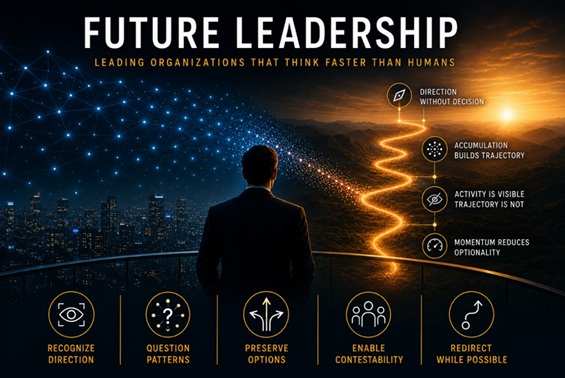 Leading Organizations That Think Faster Than Humans Leadership has always operated with delay. Information takes time to travel. Patterns take time to become visible. Consequences take time to emerge. Leaders have never seen everything as it happened. Yet organizations were largely built around an important temporal assumption: Consequential movement would become visible early enough for leadership to interpret it before direction became too difficult to change. A strategy could drift. A project could deteriorate. A market could shift. An operating model could produce unintended effects. But somewhere between signal and consequence, there was usually an expectation that the organization would notice. Reports would surface. People would escalate. Patterns would accumulate. Leadership would interpret. Direction could be reconsidered. This assumption is becoming less reliable. AI-native organizations are beginning to operate at a different temporal scale. Systems sense continuously. Agents interact. Models update. Thresholds adjust. Workflows respond. Priorities are recalibrated. Local decisions trigger other local decisions across interconnected environments. Each action may be small. Each adaptation may be legitimate. Each system may remain within its authorized domain. Yet together, these interactions can begin forming an organizational trajectory before anyone recognizes the direction taking shape. This may become one of the defining leadership problems of the AI-native organization. Decision speed is only part of the issue. The deeper challenge is the speed at which trajectories form. A fast decision can often be reviewed. An isolated action can be reversed. A visible failure can trigger intervention. But organizational direction rarely emerges from one decision alone. It forms through accumulation. A threshold changes. An agent adapts. A recommendation becomes more influential. A workflow begins routing cases differently. A local optimization alters behavior elsewhere. The changed behavior becomes new data. The new data reinforces the pattern. Nothing necessarily appears decisive. Then the organization discovers that something has changed. Risk tolerance has shifted. A capability has weakened. A market position has evolved. A workforce relationship has become more transactional. A strategic priority exists formally but no longer organizes actual behavior. The organization did not explicitly choose a new direction. A direction formed. This distinction changes the leadership problem. Leadership has traditionally been associated with setting direction. But what happens when direction can also emerge from the recursive interaction of systems operating faster than leadership can interpret their collective effect? The leader may understand every major system. Governance may have approved each domain of autonomy. Individual decisions may be explainable. Performance may remain strong. And still, the organization may be moving somewhere no one consciously intended. The difficulty lies in the temporal gap between trajectory formation and trajectory recognition. By the time a pattern becomes visible at leadership level, it may already have shaped: Behavior. Dependencies. Expectations. Data. Incentives. Customer experience. Operational norms. Future system responses. The organization is no longer merely observing a pattern. It is observing conditions partly produced by the pattern itself. Systems act on the environment. Their actions alter the environment. The altered environment produces new signals. Those signals shape subsequent interpretation and action. As the loop accelerates, the distinction between sensing reality and sensing a reality partly produced by previous system behavior becomes increasingly difficult to preserve. The organization progressively participates in producing the reality it subsequently senses. Leadership may therefore arrive late in a very specific sense. Not late to the decision. Late to recognizing what the accumulation of decisions has made possible. This is a different form of organizational latency. Traditional management often treated latency primarily as delayed information. The event happened. The organization learned about it later. AI-native organizations may face interpretive latency. The relevant information may already exist. Signals may be continuously captured. Dashboards may update in real time. Models may detect variation immediately. Yet the organizational meaning of distributed change may remain invisible. The organization sees activity. It does not yet see trajectory. More visibility does not necessarily solve this problem. Continuous visibility can make it harder to distinguish consequential movement from normal variation. When thousands of signals change continuously, change itself becomes ordinary. Every metric moves. Every model updates. Every workflow adapts. Every agent generates activity. The challenge becomes determining when distributed variation has begun to acquire direction. That is a profoundly different capability from monitoring performance. Performance asks whether the system is producing expected results. Trajectory asks what the system is gradually becoming capable of reproducing. Performance can remain excellent while trajectory becomes problematic. A workforce platform may increase allocation efficiency while gradually redefining people as interchangeable capacity. A risk system may reduce losses while slowly excluding forms of uncertainty the organization no longer knows how to interpret. A coordination architecture may increase consistency while making unusual judgment progressively harder to sustain. None of these trajectories requires a catastrophic decision. They can emerge from successful operation. This is where exception-based governance reaches a structural limit. It assumes that what matters will eventually appear as deviation. A threshold will be crossed. An anomaly will emerge. A limit will be exceeded. Someone will escalate. But a trajectory can remain inside acceptable operating conditions while changing the system those conditions were designed to govern. The system does not fail. The meaning of normal changes. By the time the change becomes undeniable, leadership may be confronting an established organizational reality rather than an emerging possibility. This raises a difficult question. How early must an organization recognize a trajectory to remain capable of influencing it? Too early, and every weak signal becomes a strategic concern. The organization drowns in interpretation. Autonomy collapses under premature intervention. Adaptation becomes dependent on executive attention. Too late, and interpretation becomes retrospective. Leadership can explain how the organization arrived somewhere. It may no longer be able to prevent arrival. Future leadership therefore requires governing the widening distance between organizational speed and interpretive time. Leaders cannot think at machine speed. Nor should organizations slow every intelligent system to the rhythm of executive cognition. The value of distributed intelligence would disappear. The question is whether the organization remains governable across different temporal scales. Systems may operate in milliseconds. Operational patterns may form over hours. Behavioral consequences may emerge over weeks. Strategic effects may become visible over months. Institutional consequences may take years. Leadership must increasingly govern across these temporal layers without assuming that the fastest layer is the most important or that the slowest consequence can safely wait until it becomes visible. This requires a different form of organizational attention. Leadership has traditionally looked for decisions. Who decided? What was approved? Which action was taken? What result followed? But in distributed intelligent systems, some of the most consequential organizational changes may have no singular decision point. Future leadership must become capable of recognizing direction without decision. Where are repeated local adaptations beginning to converge? Which temporary exceptions are becoming operational norms? Where is accumulated system behavior narrowing future optionality? What is becoming easier to reproduce? What is becoming progressively harder to question? These questions do not replace strategy. They reveal where strategy may already be changing in practice. They also change the meaning of leadership presence. No leader can remain cognitively present across every interaction in an AI-native organization. The organization itself must become better able to notice how trajectories acquire momentum. Momentum matters because trajectories are not equally governable at every stage. Early patterns may be ambiguous but flexible. Established patterns become clearer but harder to redirect. Embedded patterns begin shaping infrastructure, capability, expectations, and identity. Eventually, the organization may become dependent on the very trajectory it is trying to reconsider. An organization may possess the technical ability to stop a system and still lack the practical ability to reverse what the system has already normalized. It may change an objective while retaining the data, incentives, habits, dependencies, and expectations produced by the previous one. It may withdraw autonomy while discovering that the human capabilities required to resume judgment have weakened. It may correct a model while the organizational behavior shaped by years of model-mediated decisions persists. Intervention remains possible. Reversal becomes progressively more expensive. The critical question is when a trajectory remains sufficiently open to meaningful redirection. This requires a new sensitivity to organizational irreversibility. The more difficult form may be accumulated irreversibility. The gradual closing of alternatives. The erosion of capabilities. The normalization of dependencies. The institutionalization of assumptions. The strengthening of feedback loops that make one future increasingly probable and others increasingly difficult. Leadership has always shaped the future. What changes is that future organizational states may now begin consolidating through machine-speed interaction long before they become visible as strategic choices. The future leader is therefore unlikely to remain the cognitive center of the organization. Distributed intelligence makes that increasingly unrealistic. But replacing the heroic leader with a demand for more perceptive, more reflective, or more ambiguity-tolerant leaders would solve little. The problem is partly institutional. Organizations often reward certainty. Performance systems privilege measurable outcomes. Executive incentives favor near-term optimization. Governance demands evidence. Successful systems acquire legitimacy. Under these conditions, questioning an emerging trajectory can become hardest precisely when that trajectory is still easiest to redirect. The evidence is incomplete. The pattern remains ambiguous. Performance may be strong. The cost of intervention is visible. The cost of waiting is not. Future leadership therefore depends on more than individual capability. It requires organizational conditions in which ambiguous signals can remain visible without automatically becoming interventions. Emerging trajectories must be examinable before they are classified as failures. Successful patterns must remain open to question without requiring proof that they are already harmful. Different interpretations of direction must be able to coexist long enough to be tested. And leaders must be able to preserve future options even when the immediate performance case for doing so is incomplete. This is not indecision. It is the institutional capacity to keep consequential direction open to interpretation while it is still governable. The tension cannot be removed. Evidence strengthens with time. So does trajectory. Waiting improves certainty. It may also reduce governability. Acting early preserves optionality. It also increases the risk of acting on noise. No dashboard can determine the exact moment at which variation becomes direction. No AI system can decide, without inheriting the organization's own assumptions about significance, when an emerging pattern deserves strategic attention. Intelligent systems can help enormously. They can detect convergence. Surface weak signals across domains. Model propagation and reinforcing loops. Reveal changes no human could observe unaided. But trajectory recognition cannot be reduced to another predictive layer. Any system designed to identify consequential direction will itself encode assumptions about which patterns matter, which futures appear plausible, and which forms of change deserve attention. A mechanism built to detect trajectories can therefore develop its own trajectory blindness. The challenge is not simply to see earlier. It is to preserve the contestability of what the organization believes it is seeing. When does an observed pattern become significant enough to question the direction the organization is acquiring? There may be no permanent threshold. That question belongs to the future of leadership. Organizations that think faster than humans will not necessarily become ungovernable. But they may become ungovernable before leadership realizes that governability is being lost. The danger is not simply speed. It is the possibility that organizational becoming increasingly precedes organizational understanding. Leadership then moves downstream. The organization acts. Patterns converge. Momentum develops. Consequences begin shaping future conditions. Only then does direction become visible. At that point, leadership may still decide. But it is deciding inside a reality the organization has already partially constructed. The future of leadership may therefore depend on preserving a difficult organizational capacity: The capacity to recognize consequential direction before direction becomes destiny. Leaders do not need to think faster than intelligent systems. They need organizations capable of making emerging trajectories visible while those trajectories can still be questioned, interpreted, and redirected. Because in AI-native organizations, the most consequential change may not begin with a decision. It may begin when thousands of individually reasonable actions start making the same future easier to reproduce. And by the time leadership asks where the organization is going, the organization may already have been answering for some time. |
Posted on: July 31, 2026 03:47 AM
| Permalink |
Comments (0)
Governing Responsible Autonomy
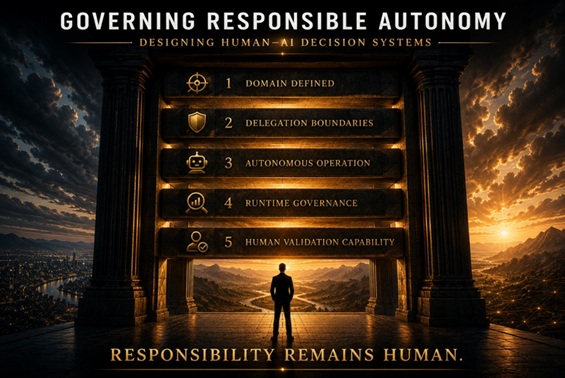 Designing Human–AI Decision Systems Organizations are rapidly increasing the autonomy of intelligent systems. AI systems recommend. Agents decide. Workflows execute. Thresholds trigger actions. Models adapt. Systems coordinate with other systems. And increasingly, all of this happens without continuous human intervention. This is not necessarily a problem. Autonomy can reduce friction. Accelerate execution. Expand organizational capacity. Improve responsiveness. And allow humans to focus on decisions where context, ambiguity, consequence, and judgment matter most. But the previous articles in this series have revealed a deeper tension. Decision authority can be delegated. Autonomy can be distributed. Intelligence can be amplified. Yet accountability does not disappear. And preserving a human somewhere in the process does not solve the problem. A human can approve without understanding. Supervise without sufficient context. Validate without independent judgment. Remain formally accountable while lacking the cognitive capacity to challenge the system. This creates an uncomfortable governance question: If humans are to remain accountable for autonomous systems, how must those systems be designed so that human responsibility remains meaningfully exercisable? Because responsibility remains human. But the conditions that make responsibility exercisable must increasingly become properties of the architecture. This is the challenge of responsible autonomy. Responsible autonomy is not autonomy with more approvals. It is not placing a human at the end of every automated workflow. It is not requiring signatures after systems have already framed the problem, generated the alternatives, prioritized the options, and determined what deserves escalation. And it is not slowing intelligent systems until humans can manually reproduce everything they do. That would defeat much of the value autonomy can create. The real challenge is more precise. How do we design autonomous systems so that meaningful human responsibility remains exercisable where consequence requires it? This changes the governance problem. The question is no longer simply: Who is in the loop? The deeper questions become: Who defines the domain of autonomy? Which decisions may the system make? Which actions may it execute? Which consequences may it create without renewed human judgment? What must trigger intervention? What can the system adapt without renewed authorization? Who can challenge its framing? Who can interrupt its execution? And who remains capable of answering for the consequences when the system operates as designed but produces an outcome the organization should not accept? These are architectural questions. And they require organizations to move beyond the simplistic distinction between: Human decision. And machine decision. Modern decision systems are rarely that clean. A model may interpret risk. An agent may generate alternatives. Another system may prioritize them. A workflow may apply policy. A threshold may determine whether escalation occurs. A human may validate an exception. The resulting decision is neither fully human nor fully machine-generated. It emerges from an architecture of distributed influence. This is why responsibility cannot be preserved only around the final act of approval. By the time a human approves, much of the decision may already have been cognitively structured elsewhere. The relevant evidence has been selected. The problem has been framed. The alternatives have been bounded. The risks have been ranked. The exceptional has been defined. The human may still choose. But the architecture has already shaped the cognitive space within which choice occurs. This distinction matters enormously. A human signature proves presence. It does not prove independent judgment. An approval proves that a decision reached a person. It does not prove that the person remained capable of challenging how the decision became thinkable in the first place. Responsible autonomy therefore begins before validation. It begins with the design of delegation itself. Every autonomous system operates within a domain. Explicitly or implicitly. It has objectives. Permissions. Constraints. Access to information. Decision authority. Execution capacity. Escalation conditions. And some definition of what counts as normal enough to proceed without intervention. The first responsibility of governance is to make these boundaries deliberate. Not every decision requires human involvement. But every domain of autonomy requires a defensible answer to a fundamental question: Why is this decision legitimately delegable? Reversibility matters. Scale of consequence matters. Affected stakeholders matter. Ethical ambiguity matters. Uncertainty matters. The system's capacity to recognize abnormality matters. And the organization's ability to reconstruct how a consequence emerged matters. A low-impact, reversible operational action may justify broad autonomy. A decision capable of materially affecting rights, safety, organizational identity, or irreversible strategic consequence requires a different architecture. This is not because humans are always better decision-makers. They are not. The boundary exists because some consequences require forms of judgment and accountability that cannot be reduced to execution performance alone. But defining delegation boundaries is still insufficient. Because systems operate in reality. And reality changes. An autonomous system may be correctly authorized at deployment and become poorly aligned with its environment months later. Assumptions drift. Data changes. Stakeholder behavior evolves. Objectives are reinterpreted. Models adapt. Agents interact. Unexpected dependencies emerge. The system may remain technically compliant with its original boundaries while the conditions that once legitimized those boundaries have changed. This is where governance must become operational at runtime. Traditional governance often asks whether a system was approved. Responsible autonomy must also ask whether the conditions that justified autonomy still exist. The distinction is critical. Governance cannot end when autonomy begins. It must remain capable of sensing when: Context has materially changed. Behavior is drifting. Consequences are accumulating. Exceptions are becoming normal. Local optimization is creating systemic effects. The system is operating inside its formal boundary but outside the intent that originally legitimized that boundary. This requires more than performance monitoring. A system can perform exceptionally well against the wrong objective. It can remain within thresholds while producing unacceptable patterns of consequence. It can optimize consistently while gradually weakening the conditions that made its autonomy legitimate. Runtime governance must therefore observe not only: Is the system working? But also: Is the system still operating under conditions where this level of autonomy remains defensible? That question changes the purpose of human intervention. Humans should not be inserted into every decision. They should be positioned where judgment becomes materially necessary. This requires a validation architecture. But meaningful human validation is not a button. It is a capability. For validation to be real, the human must have enough: Context to understand the decision. Visibility into the relevant decision path. Authority to challenge the system. Time proportionate to the consequence. Access to meaningful alternatives. Capacity to recognize when the frame itself may be wrong. And practical ability to interrupt, reverse, or escalate. Without these conditions, human validation becomes ceremonial. The system decides. The human confirms. Accountability remains formally human. But responsibility is no longer meaningfully exercisable. Governance becomes performative. This is one of the greatest risks in emerging Human–AI decision systems. Organizations may preserve visible human involvement while progressively removing the conditions required for meaningful human judgment. A human-in-the-loop architecture can still produce an accountability illusion. The important distinction is not: Human present versus human absent. It is: Human presence versus exercisable human judgment. This also means that organizations must reconsider how work itself is designed. Human–AI workforce design cannot be reduced to allocating tasks according to who performs them faster. The deeper design question is: How should intelligence, authority, judgment, execution, validation, and accountability be distributed across the system? AI may analyze better. Agents may coordinate faster. Automated systems may monitor continuously. Machines may detect patterns humans cannot perceive. There is no governance value in forcing humans to duplicate these capabilities merely to preserve the appearance of control. But there is equally little value in assigning humans responsibility for consequences after removing them from the cognitive processes required to understand, question, and challenge how those consequences emerge. Responsible autonomy therefore requires deliberate asymmetry. Systems should be autonomous where autonomy creates legitimate value. Humans should retain meaningful authority where consequence requires judgment. And governance must continuously preserve the conditions that make that authority exercisable. This is not a balanced division of labor. Nor should it be. The objective is not to distribute work equally between humans and machines. The objective is to distribute intelligence, authority, execution, validation, and accountability according to the nature of the decision and the consequences the system may create. That architecture will not remain static. As systems improve, some decisions may become increasingly delegable. As environments change, previously safe autonomy may require renewed constraint. As organizational experience accumulates, validation requirements may evolve. As new consequences become visible, intervention thresholds may need to change. Responsible autonomy is therefore not a fixed allocation of decision rights. It is a continuously governed architecture of delegation. This creates a deeper principle. The purpose of governance is not to preserve human control over every autonomous action. It is to preserve meaningful human authority over the conditions under which autonomy remains legitimate. That authority must be real. Humans must be able to define boundaries. Revise them. Challenge objectives. Interrogate consequences. Interrupt execution. And withdraw autonomy when the system's behavior, context, or effects no longer justify it. Otherwise, responsibility becomes structurally disconnected from authority. The organization tells humans they remain accountable. But the architecture no longer gives them meaningful capacity to exercise that accountability. This may become one of the defining governance failures of AI-native organizations. Not autonomous systems acting without humans. But humans remaining formally responsible for systems they are no longer structurally capable of governing. Responsible autonomy must be designed to prevent that separation. Not by slowing every decision. Not by preserving unnecessary human friction. Not by treating intelligent systems as inherently untrustworthy. But by making the conditions of responsibility architectural. Delegation must have boundaries. Autonomy must have conditions. Validation must preserve judgment. Runtime governance must detect when the legitimacy of autonomy changes. Intervention must remain possible. And accountability must remain connected to meaningful authority. Because autonomy without responsibility creates danger. But responsibility without exercisable authority creates an illusion. The future of Human–AI decision systems will depend on avoiding both. The question is no longer whether organizations will delegate more decisions to intelligent systems. They will. The deeper question is whether they will design those systems so that human responsibility remains meaningful as autonomy expands. Because responsibility remains human. But if humans are to remain accountable, the conditions that allow them to understand, challenge, interrupt, and answer for autonomous systems must be designed into the architecture through which those systems decide, act, and adapt. And even then, another problem remains. An architecture may preserve human authority. It may provide visibility. Intervention rights. Escalation paths. Reversibility. And meaningful validation. But autonomous systems do not merely decide differently. They increasingly decide at a different rate, across a different scale, and through distributed patterns of execution no individual human can continuously reconstruct. A system may act in milliseconds. Thousands of agents may coordinate simultaneously. Consequences may propagate before an anomaly becomes humanly interpretable. By the time intervention becomes possible, the system may already have adapted to the conditions created by its own previous actions. The human still has authority. The architecture still permits intervention. But the window in which that authority can meaningfully be exercised may be disappearing. This creates a new governance tension. Human responsibility may remain normatively anchored. Architectural authority may remain formally preserved. Yet the rate, scale, and distribution of autonomous execution may progressively exceed the organization's capacity to exercise accountability in time. The problem is no longer only: Who is responsible? Or: Does the human retain meaningful authority? The next question is more difficult: Can accountability remain real when execution moves faster than human judgment can meaningfully intervene? Because responsibility may remain human. Authority may remain human. And yet governance itself may no longer operate at the speed of the systems it is expected to govern. That is the tension I will explore next. |
Posted on: July 29, 2026 11:38 AM
| Permalink |
Comments (0)
Cognitive Sovereignty
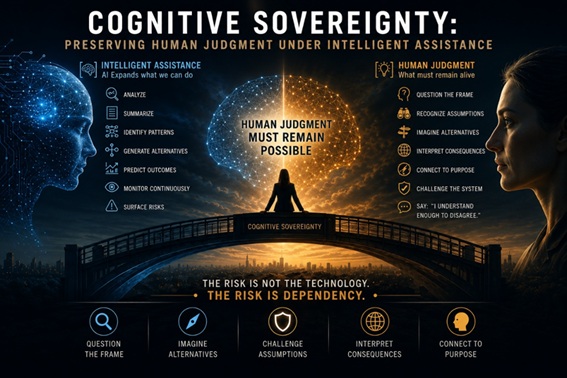 Preserving Human Judgment Under Intelligent Assistance Artificial intelligence is becoming extraordinarily good at helping humans think. It can analyze. Summarize. Compare. Prioritize. Recommend. Challenge. Predict. Generate alternatives. Reveal patterns. And increasingly, it can do these things faster, across more information, than any individual human could realistically process. This is an extraordinary expansion of human capability. But it also creates a question organizations have barely begun to confront. What happens when the intelligence supporting human judgment becomes so capable that humans gradually lose the capacity to judge without it? The question is not whether AI makes humans less intelligent. That would be simplistic. AI may dramatically expand what humans can understand. It may expose blind spots. Reduce cognitive overload. Improve access to knowledge. Challenge weak assumptions. Strengthen analysis. And support better decisions. The problem begins elsewhere. It begins when assistance quietly becomes dependency. A system recommends. The human considers. The recommendation is usually good. Trust grows. The human reviews less deeply. The system improves. The recommendation becomes the expected starting point. Independent analysis begins to appear redundant. Eventually, the human still decides. But increasingly, only after the system has defined what deserves attention. What alternatives appear reasonable. Which risks seem relevant. Which evidence is visible. And how the problem itself is framed. At that point, an uncomfortable question emerges. Is the human still exercising judgment, or merely selecting within a cognitive space already constructed by the system? This is the problem of cognitive sovereignty. Cognitive sovereignty does not mean thinking without artificial intelligence. It does not require rejecting intelligent assistance. It does not mean preserving human cognition in some technologically untouched state. That would be neither realistic nor desirable. Cognitive sovereignty is the capacity to remain meaningfully capable of interpreting, questioning, and judging when intelligence is increasingly mediated by systems. The distinction matters. Access to intelligence is not the same as ownership of judgment. A human may receive extraordinary analysis and still become less capable of challenging its assumptions. A leader may have better recommendations and weaker independent orientation. A team may make faster decisions while progressively losing the ability to recognize when the system has framed the wrong problem. An organization may become more intelligent while becoming increasingly dependent on the infrastructure through which intelligence is delivered. This dependency is difficult to detect. Because it often develops through success. Poor systems are challenged. Unreliable recommendations are questioned. Obvious errors preserve vigilance. Highly capable systems create a different behavioral environment. When recommendations are consistently useful, scrutiny becomes expensive. Independent analysis takes time. Reconstructing context creates friction. Questioning a high-performing system may appear irrational. Why repeat work the system already performs better? Why delay a decision to reconsider an analysis that is almost always correct? Why preserve capabilities that are rarely needed? These questions are reasonable. That is precisely why cognitive dependency can grow unnoticed. The greatest risk may not come from systems humans do not trust. It may come from systems humans have learned to trust almost completely. Trust changes attention. Attention changes practice. Practice changes capability. Capabilities that are rarely exercised weaken. Context that is continuously supplied is less frequently reconstructed. Alternatives that are consistently generated are less often independently imagined. Patterns that are automatically surfaced are less often actively searched for. Over time, the human role may change. From interpreting reality. To reviewing interpretation. From constructing alternatives. To choosing among generated alternatives. From identifying what matters. To validating what has been prioritized. From exercising judgment. To confirming a recommendation. The human remains in the loop. But the cognitive work performed by the human has changed. This is why cognitive sovereignty cannot be reduced to human approval. A person can approve a decision while contributing almost no independent judgment to it. A manager can remain formally responsible while lacking the contextual depth required to challenge the recommendation. A board can review AI-supported analysis while seeing only the reality the analytical architecture has made visible. A human signature proves presence. It does not prove cognitive sovereignty. This becomes particularly important after the accountability gap. If distributed influence makes consequences increasingly difficult to reconstruct, organizations may respond by assigning humans to supervise intelligent systems. But supervision assumes something. The supervisor must retain the capacity to judge the system being supervised. This assumption deserves far more attention. What happens when the system performs most of the analysis? When it maintains more context than the human? When it identifies patterns the human cannot independently perceive? When it generates the alternatives? When it continuously monitors the environment? When it remembers every relevant interaction? When it operates across a scale no individual can reconstruct? The human may retain authority. But authority alone does not guarantee judgment capacity. This creates a new asymmetry. The human may be formally empowered to challenge the system while becoming progressively less capable of knowing when challenge is necessary. That is a deeper problem than automation bias. Automation bias describes a tendency to over-rely on automated recommendations. Cognitive sovereignty concerns the preservation of the underlying capacity required to form, test, and defend judgment when intelligent assistance becomes structurally embedded in how the organization thinks. The difference is significant. Bias may distort a decision. Dependency may alter the decision-maker. A weak recommendation can be rejected. A weakened capacity for independent interpretation is harder to observe. Because the organization may continue performing exceptionally well. Decisions remain fast. Outputs improve. Errors decline. Productivity increases. The system appears successful. Yet beneath performance, something may be changing. The organization may be losing cognitive optionality. Its ability to think through alternative interpretative structures. Its ability to operate when the dominant intelligence infrastructure is unavailable. Its ability to recognize assumptions embedded within the systems it relies upon. Its ability to challenge the categories through which reality is being represented. Its ability to ask a question the system was never designed to prioritize. This is why cognitive sovereignty is not simply an individual skill. It is an organizational capability. Organizations shape how judgment is exercised. They determine which information reaches decision-makers. Which systems frame problems. Which recommendations become defaults. Which metrics receive attention. Which forms of expertise are preserved. Which capabilities are allowed to weaken. And which forms of dissent remain legitimate. An organization can unintentionally design cognitive dependency into its operating model. Not through a single decision. But through accumulated convenience. Analysis is automated. Then prioritization. Then recommendation. Then scenario generation. Then monitoring. Then exception detection. At each stage, human effort is reduced. Performance improves. But a question is rarely asked: What human capability are we no longer exercising because the system now performs it for us? This question should not lead automatically to preservation. Not every human capability must be retained. Organizations do not preserve manual calculation because calculators exist. They do not require humans to memorize information that systems can retrieve more reliably. Technological progress has always changed which capabilities matter. Wisdom is not nostalgia. And cognitive sovereignty is not cognitive conservatism. The relevant question is more precise. Which human capacities must remain sufficiently alive for responsibility to remain meaningfully exercisable? This is the boundary condition. If a capability has no meaningful role in future judgment, allowing it to disappear may be entirely rational. But if its loss makes humans unable to interpret context, question assumptions, recognize abnormality, imagine alternatives, or challenge the systems they govern, then efficiency gains may be purchasing a hidden dependency. This distinction becomes especially important because human judgment is not produced at the moment of approval. Judgment develops through exposure. Interpretation. Comparison. Failure. Reflection. Pattern recognition. Contextual experience. And repeated confrontation with ambiguity. If humans are systematically removed from these cognitive processes, organizations cannot assume that judgment will remain intact and simply become available when an exceptional situation requires it. Judgment cannot be placed on standby indefinitely and expected to remain fully operational. The problem is not only that cognitive work changes. The architecture of exposure changes with it. A leader who sees only escalations may gradually lose contact with normal variation. A reviewer who sees only system-selected exceptions may become dependent on the system's definition of exceptional. A decision-maker who receives pre-structured alternatives may become less practiced at recognizing missing alternatives. A board that sees increasingly optimized abstractions may become more informed and less connected to the conditions from which those abstractions emerge. The paradox is uncomfortable. The better intelligent systems become at supporting judgment, the easier it may become to stop exercising some of the capacities that make meaningful judgment possible. This does not mean organizations should artificially preserve human inefficiency. It means they must become deliberate about cognitive capability. Some judgment capacities may need to be exercised even when the system performs better. Not because humans must outperform AI. But because humans may remain accountable for recognizing when the system's frame, objective, boundary, or consequence requires challenge. This changes the purpose of human involvement. The human should not remain in the loop merely to repeat the machine's analysis. That creates friction without sovereignty. Nor should humans be asked to approve decisions they lack the context to challenge. That creates accountability without meaningful judgment. Human involvement becomes valuable when it preserves capabilities the system cannot legitimately be allowed to make irrelevant to governance. The capacity to question the frame. To recognize when a measured objective has displaced a meaningful purpose. To interpret consequences beyond the optimization domain. To connect present action with organizational identity. To challenge assumptions that have become invisible through repeated system success. To ask whether the decision remains legitimate even when the system is technically correct. These are not arguments for human superiority. AI may challenge frames. Detect objective drift. Model broader consequences. Identify hidden assumptions. And expose contradictions more effectively than humans in many contexts. The issue is not whether AI can participate in these functions. It should. The issue is whether organizations should allow their own capacity to exercise independent judgment to become entirely contingent on the same intelligence infrastructure they are expected to govern. The capacity to challenge a system becomes fragile when the human understanding required to question it depends entirely on the same intelligence infrastructure being challenged. This may become one of the defining tensions of AI-native organizations. The future will not be a choice between human intelligence and artificial intelligence. It will be a question of cognitive architecture. Which forms of intelligence interact? Which forms of judgment remain exercised? Where does interpretation occur? How are assumptions exposed? How can alternative frames emerge? What capabilities must remain independently available? And under what conditions can a human genuinely say: I understand enough to disagree. That may be one of the most important tests of cognitive sovereignty. Not whether humans make every decision. Not whether humans outperform intelligent systems. Not whether every recommendation is independently reproduced. But whether humans remain meaningfully capable of questioning the intelligence on which they increasingly depend. Because assistance can expand capability. Dependence can reduce optionality. And when judgment becomes entirely dependent on the systems it is meant to govern, human authority may remain formally intact while its cognitive foundation quietly erodes. The future of responsible autonomy therefore depends on more than preserving human authority. It depends on preserving the human capacity required to exercise that authority meaningfully. Because accountability without judgment is ceremonial. Authority without comprehension is fragile. And sovereignty without the capacity to disagree may be sovereignty in name only. The next question is therefore no longer whether humans should remain responsible. Nor simply what organizations should refuse to delegate. It is this: How should human-AI decision systems be designed so that autonomy can expand without responsibility becoming merely symbolic? |
Posted on: July 27, 2026 03:25 AM
| Permalink |
Comments (1)
New Ways of Working in Projects
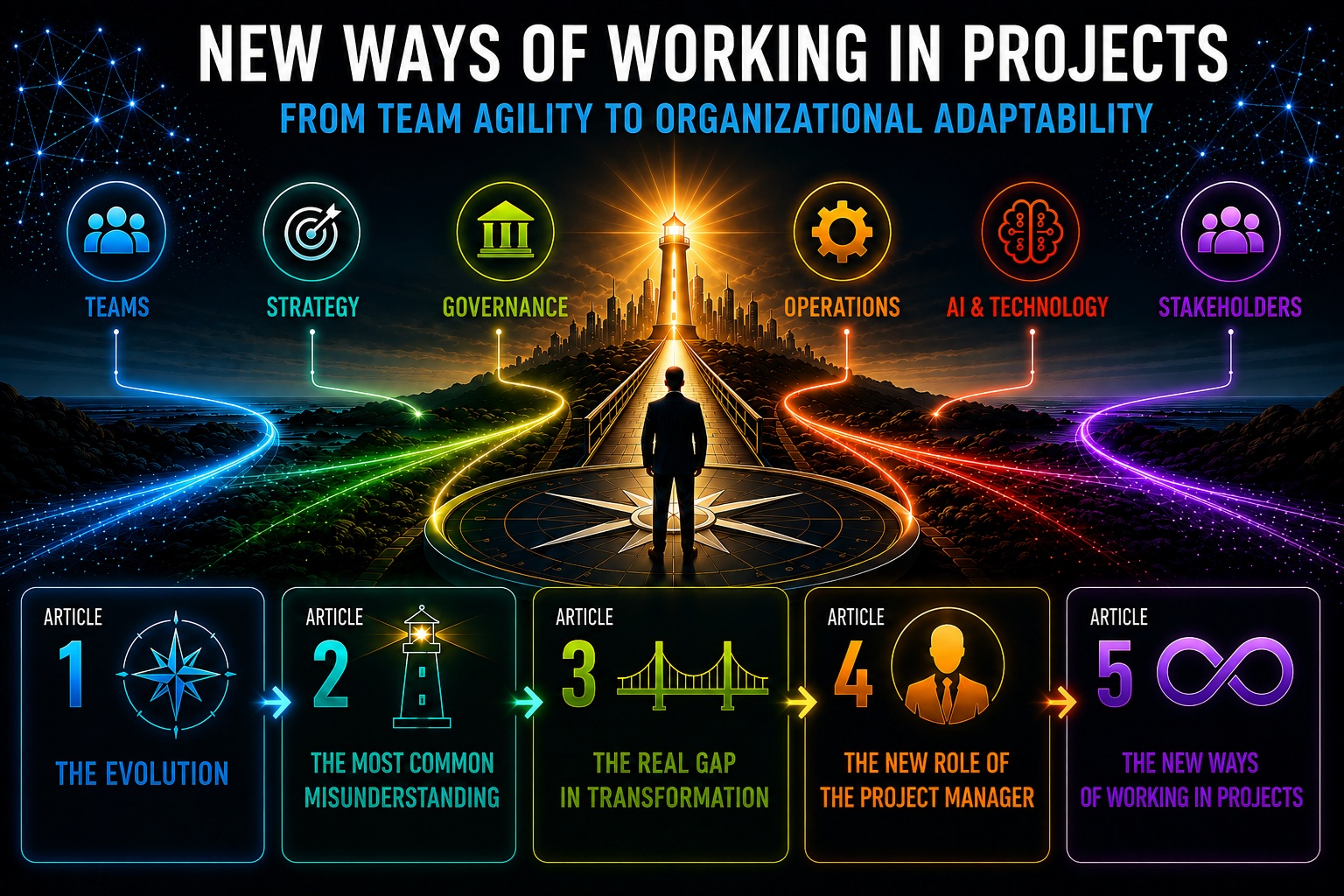 For decades, Project Management evolved by seeking to answer an essential question: how to increase the probability of project success through better methodologies, processes, tools, and competencies. This evolution built a solid body of knowledge that remains indispensable. Planning, along with the management of scope, schedule, cost, risk, quality, stakeholders, and the delivery of results, continue to be fundamental pillars of the discipline. Over the past two decades, the spread of agile approaches introduced a new stage in this evolution. Adaptability, continuous collaboration, frequent feedback, incremental value delivery, and learning began to complement traditional principles of planning and control. The focus shifted from being exclusively on the efficient execution of plans to also including the ability to respond to change. Meanwhile, the organizational context transformed once again. Unlike previous shifts, this transformation does not merely alter how projects are managed. It alters the very nature of project work, the relationship between strategy and execution, the distribution of authority, how decisions are made, the collaboration between human and computational capabilities, and the role of organizations in creating sustainable value. The growing adoption of artificial intelligence, the continuous evolution of products and services, digital transformation, interdependence among organizations, technological acceleration, increasing regulatory requirements, and the growing complexity of business environments have profoundly altered the conditions under which projects are conceived, executed, and evaluated. Today, Project Managers no longer work solely on projects. They work in organizations striving to adapt continuously, preserve strategic coherence, integrate human and computational capabilities, respond to permanent changes, and create value sustainably. In this context, one question becomes inevitable. Will it be enough to continue discussing only methodologies and lifecycles? In recent months, several particularly relevant documents were published to help understand this evolution, most notably the second edition of the Agile Practice Guide, the Manifesto for Enterprise Agility, and the Closing the Change-Readiness Gap report. Although each has distinct objectives, reading them together reveals a transformation far deeper than what each document describes individually. Together, they show that the next stage of Project Management is not merely about improving how teams work. It is about understanding the organizational conditions that make it possible to transform local adaptation into a true organizational capability. This distinction is fundamental. A team can perform exemplarily and yet remain constrained by inadequate decision structures, rigid funding models, loss of strategic context, organizational barriers, a lack of trust, or operating models incapable of keeping pace with the speed of change. In other words, team excellence is no longer a sufficient condition to guarantee truly adaptive organizations. It is precisely this evolution that this series aims to explore. Throughout the upcoming articles, I will analyze the transition from team agility to organizational adaptability, the evolution of the Project Manager's role, the challenges of leadership, governance, and decision-making in highly complex environments, as well as the implications of growing collaboration between people and artificial intelligence in new ways of working in projects. The objective of this series is not to present a review of the documents that serve as its inspiration, nor to defend a specific methodology. Rather, it aims to develop a critical reflection on the evolution of Project Management and contribute to a discussion that I consider decisive for the next decade. New ways of working in projects will not depend solely on adopting new practices. They will depend on the ability of organizations to preserve the conditions that allow projects, teams, products, and people to adapt continuously without losing strategic coherence, accountability, and a sustainable capacity to create value. The next evolution of Project Management will not depend merely on better practices. It will depend on the ability of organizations to create the conditions in which those practices can produce sustainable results. It is this evolution that this series sets out to explore. This introduction sets the stage for the journey ahead: unpacking why this transformation is happening, the context driving it, and where our discipline must head next. The first article will be published next Sunday, August 2nd, followed by a new piece every Sunday. I hope this series sparks a constructive and timely reflection on the future of Project Management and the core challenges awaiting organizations, leaders, and project professionals in the coming decade. I warmly invite you to join the conversation, share your perspectives, and shape this discussion as it unfolds. |
Posted on: July 26, 2026 12:52 PM
| Permalink |
Comments (0)


