Support to Develop
by Luis Branco

This blog addresses management-related topics and has three areas of focus: 1. Technical skills; 2. Competencies in the field of interpersonal relations and communication (including personal organization and delegation, leadership, teamwork, conflict resolution, conducting meetings, and negotiation); and 3. Strategy (including diagnosis, strategic guidelines, and implementation).4.Technology
Recent Posts
When Accountability Becomes Structurally Misaligned
Transformation Is Not a Sequence
When Integrative Capacity Falls Behind Interdependence
PHASE 3 - THE CONSEQUENCES
What Does AI Actually Change About Authority and Accountability?
Categories
Agile,
Career Development,
Career Development,
Career Development,
Career Development,
Career Development,
Career Development,
Career Development,
Career Development,
Career Development,
Career Development,
Career Development,
Career Development,
Career Development,
Career Development,
Career Development,
Career Development,
Career Development,
Career Development,
Career Development,
Career Development,
Career Development,
Career Development,
Career Development,
Career Development,
Career Development,
Career Development,
Career Development,
Career Development,
Career Development,
Career Development,
Career Development,
Career Development,
Career Development,
Career Development,
Career Development,
Career Development,
Career Development,
Career Development,
Career Development,
Career Development,
Career Development,
Career Development,
Career Development,
Career Development,
Career Development,
Career Development,
Career Development,
Career Development,
Career Development,
Career Development,
Career Development,
Career Development,
Career Development,
Career Development,
Career Development,
Career Development,
Career Development,
Career Development,
Career Development,
Career Development,
Career Development,
Career Development,
Career Development,
Career Development,
Career Development,
Career Development,
Career Development,
Career Development,
Career Development,
Career Development,
Career Development,
Career Development,
Career Development,
Career Development,
Career Development,
Career Development,
Career Development,
Career Development,
Career Development,
Career Development,
Career Development,
Career Development,
Career Development,
Career Development,
Career Development,
Career Development,
Career Development,
Career Development,
Career Development,
Career Development,
Career Development,
Career Development,
Career Development,
Career Development,
Career Development,
Career Development,
Career Development,
Career Development,
Career Development,
Career Development,
Career Development,
Career Development,
Career Development,
Career Development,
Career Development,
Career Development,
Career Development,
Career Development,
Career Development,
Career Development,
Career Development,
Career Development,
Career Development,
Career Development,
Career Development,
Career Development,
Career Development,
Career Development,
Career Development,
Career Development,
Career Development,
Career Development,
Education,
Governance,
Governance,
Governance,
Governance,
Governance,
Governance,
Governance,
Governance,
Governance,
Governance,
Governance,
Governance,
Governance,
In,
Integration Management,
Interpersonal Skills,
Interpersonal Skills,
Interpersonal Skills,
Interpersonal Skills,
Interpersonal Skills,
Interpersonal Skills,
Interpersonal Skills,
Interpersonal Skills,
Interpersonal Skills,
Interpersonal Skills,
Interpersonal Skills,
Interpersonal Skills,
Interpersonal Skills,
Interpersonal Skills,
Interpersonal Skills,
Interpersonal Skills,
Interpersonal Skills,
Interpersonal Skills,
Interpersonal Skills,
Interpersonal Skills,
Interpersonal Skills,
Interpersonal Skills,
Interpersonal Skills,
Interpersonal Skills,
Interpersonal Skills,
Interpersonal Skills,
Interpersonal Skills,
Interpersonal Skills,
Interpersonal Skills,
Interpersonal Skills,
Interpersonal Skills,
Interpersonal Skills,
Interpersonal Skills,
Interpersonal Skills,
Interpersonal Skills,
Interpersonal Skills,
Interpersonal Skills,
Interpersonal Skills,
Interpersonal Skills,
Interpersonal Skills,
Interpersonal Skills,
Interpersonal Skills,
Interpersonal Skills,
Interpersonal Skills,
Interpersonal Skills,
Interpersonal Skills,
Interpersonal Skills,
Interpersonal Skills,
Interpersonal Skills,
Interpersonal Skills,
Interpersonal Skills,
Interpersonal Skills,
Interpersonal Skills,
Interpersonal Skills,
Interpersonal Skills,
Interpersonal Skills,
Interpersonal Skills,
Interpersonal Skills,
Interpersonal Skills,
Interpersonal Skills,
Interpersonal Skills,
Interpersonal Skills,
Interpersonal Skills,
Interpersonal Skills,
Interpersonal Skills,
Interpersonal Skills,
Interpersonal Skills,
Interpersonal Skills,
Interpersonal Skills,
Interpersonal Skills,
Interpersonal Skills,
Interpersonal Skills,
Interpersonal Skills,
Interpersonal Skills,
Interpersonal Skills,
Interpersonal Skills,
Interpersonal Skills,
Interpersonal Skills,
Interpersonal Skills,
Interpersonal Skills,
Interpersonal Skills,
Interpersonal Skills,
Interpersonal Skills,
Interpersonal Skills,
Interpersonal Skills,
Interpersonal Skills,
Interpersonal Skills,
Interpersonal Skills,
Interpersonal Skills,
Interpersonal Skills,
Interpersonal Skills,
Interpersonal Skills,
Interpersonal Skills,
Interpersonal Skills,
Interpersonal Skills,
Interpersonal Skills,
Interpersonal Skills,
Interpersonal Skills,
Interpersonal Skills,
Interpersonal Skills,
Interpersonal Skills,
Interpersonal Skills,
Interpersonal Skills,
Interpersonal Skills,
Interpersonal Skills,
Interpersonal Skills,
Interpersonal Skills,
Interpersonal Skills,
Interpersonal Skills,
Interpersonal Skills,
Interpersonal Skills,
Interpersonal Skills,
Interpersonal Skills,
Interpersonal Skills,
Interpersonal Skills,
Interpersonal Skills,
Interpersonal Skills,
Interpersonal Skills,
Interpersonal Skills,
Interpersonal Skills,
Interpersonal Skills,
Interpersonal Skills,
Knowledge Management,
le,
lea,
Leadership,
Leadership,
Leadership,
Leadership,
Leadership,
Leadership,
Leadership,
Leadership,
Leadership,
Leadership,
Leadership,
Leadership,
Leadership,
Leadership,
Leadership,
Leadership,
Leadership,
Leadership,
Leadership,
Leadership,
Leadership,
Leadership,
Leadership,
Leadership,
Leadership,
Leadership,
Leadership,
Leadership,
Leadership,
Leadership,
Leadership,
Leadership,
Leadership,
Leadership,
Leadership,
Leadership,
Leadership,
Leadership,
Leadership,
Leadership,
Leadership,
Leadership,
Leadership,
Leadership,
Leadership,
Leadership,
Leadership,
Leadership,
Leadership,
Leadership,
Leadership,
Leadership,
Leadership,
Leadership,
Leadership,
Leadership,
Leadership,
Leadership,
Leadership,
Leadership,
Leadership,
Leadership,
Leadership,
Leadership,
Leadership,
Leadership,
Leadership,
Leadership,
Leadership,
Leadership,
Leadership,
Leadership,
Leadership,
Leadership,
Leadership,
Leadership,
Leadership,
Leadership,
Leadership,
Leadership,
Leadership,
Leadership,
Leadership,
Leadership,
Leadership,
Leadership,
Leadership,
Leadership,
Leadership,
Leadership,
Leadership,
Leadership,
Leadership,
Leadership,
Leadership,
Leadership,
Leadership,
Leadership,
Leadership,
Leadership,
Leadership,
Leadership,
Leadership,
Leadership,
Leadership,
Leadership,
Leadership,
Leadership,
Leadership,
Leadership,
Leadership,
Leadership,
Leadership,
Leadership,
Leadership,
Leadership,
Leadership,
Leadership,
Leadership,
Leadership,
Leadership,
Leadership,
Leadership,
or,
Organizational Project Management,
Portfolio Management,
Program,
Program Management,
Strategy,
Strategy,
Strategy,
Strategy,
Strategy,
Strategy,
Strategy,
Strategy,
Strategy,
Strategy,
Strategy,
Strategy,
Strategy,
Strategy,
Strategy,
Strategy,
Strategy,
Strategy,
Strategy,
Strategy,
Strategy,
Strategy,
Strategy,
Strategy,
Strategy,
Strategy,
Strategy,
Strategy,
Strategy,
Strategy,
Strategy,
Strategy,
Strategy,
Strategy,
Strategy,
Strategy,
Strategy,
Strategy,
Strategy,
Strategy,
Strategy,
Strategy,
Strategy,
Strategy,
Strategy,
Strategy,
Strategy,
Strategy,
Strategy,
Strategy,
Strategy,
Strategy,
Strategy,
Strategy,
Strategy,
Strategy,
Strategy,
Strategy,
Strategy,
Strategy,
Strategy,
Strategy,
Strategy,
Strategy,
Strategy,
Strategy,
Strategy,
Strategy,
Strategy,
Strategy,
Strategy,
Strategy,
Strategy,
Strategy,
Strategy,
Strategy,
Strategy,
Strategy,
Strategy,
Strategy,
Strategy,
Strategy,
Strategy,
Strategy,
Strategy,
Strategy,
Strategy,
Strategy,
Strategy,
Strategy,
Strategy,
Strategy,
Strategy,
Strategy,
Strategy,
Strategy,
Strategy,
Strategy,
Strategy,
Strategy,
Strategy,
Strategy,
Strategy,
Strategy,
Strategy,
Strategy,
Strategy,
Strategy,
Strategy,
Strategy,
Strategy,
Strategy,
Strategy,
Strategy,
Strategy,
Strategy,
Strategy,
Strategy,
Strategy,
Strategy,
Strategy,
Strategy,
Strategy,
Sustainability,
Talent Management,
Talent Management,
Talent Management,
Talent Management,
Talent Management,
Talent Management,
Talent Management,
Talent Management,
Talent Management,
Talent Management,
Talent Management,
Talent Management,
Talent Management,
Talent Management,
Talent Management,
Talent Management,
Talent Management,
Talent Management,
Talent Management,
Talent Management,
Talent Management,
Talent Management,
Talent Management,
Talent Management,
Talent Management,
Talent Management,
Talent Management,
Talent Management,
Talent Management,
Talent Management,
Talent Management,
Talent Management,
Talent Management,
Talent Management,
Talent Management,
Talent Management,
Talent Management,
Talent Management,
Talent Management,
Talent Management,
Talent Management,
Talent Management,
Talent Management,
Talent Management,
Talent Management,
Talent Management,
Talent Management,
Talent Management,
Talent Management,
Talent Management,
Talent Management,
Talent Management,
Talent Management,
Talent Management,
Talent Management,
Talent Management,
Talent Management,
Talent Management,
Talent Management,
Talent Management,
Talent Management,
Talent Management,
Talent Management,
Talent Management,
Talent Management,
Talent Management,
Talent Management,
Talent Management,
Talent Management,
Talent Management,
Talent Management,
Talent Management,
Talent Management,
Talent Management,
Talent Management,
Talent Management,
Talent Management,
Talent Management,
Talent Management,
Talent Management,
Talent Management,
Talent Management,
Talent Management,
Talent Management,
Talent Management,
Talent Management,
Talent Management,
Talent Management,
Talent Management,
Talent Management,
Talent Management,
Talent Management,
Talent Management,
Talent Management,
Talent Management,
Talent Management,
Talent Management,
Talent Management,
Talent Management,
Talent Management,
Talent Management,
Talent Management,
Talent Management,
Talent Management,
Talent Management,
Talent Management,
Talent Management,
Talent Management,
Talent Management,
Talent Management,
Talent Management,
Talent Management,
Talent Management,
Talent Management,
Talent Management,
Talent Management,
Talent Management,
Talent Management,
Talent Management,
Talent Management,
Talent Management,
Talent Management,
Talent Management
Date
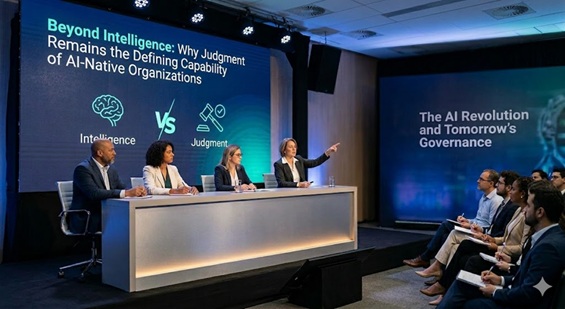
Why Judgment Remains the Defining Capability of AI-native Organizations
Modern organizations have spent decades pursuing intelligence.
More data.
More analytics.
More visibility.
More forecasting.
More dashboards.
More optimization.
More computational power.
The assumption has often been simple.
If organizations can become sufficiently intelligent, they will make better decisions.
And to some extent, this assumption is correct.
Intelligence matters.
Intelligence reduces ignorance.
Intelligence improves visibility.
Intelligence expands optionality.
Intelligence strengthens prediction.
Intelligence increases organizational capability.
But intelligence alone has never been the ultimate challenge.
Because organizations rarely fail simply because they lack information.
They often fail despite possessing enormous amounts of it.
This distinction becomes increasingly important in AI-native environments.
Because artificial intelligence dramatically expands the organizational capacity to:
• Analyze,
• Predict,
• Optimize,
• Simulate,
• Monitor,
• Generate Recommendations,
• Identify patterns at unprecedented scale.
As these capabilities continue to accelerate, organizations may begin confronting a new and unexpected paradox.
The more intelligence becomes available, the more visible the limits of intelligence itself may become.
At first glance, this appears counterintuitive.
After all, intelligence has traditionally been treated as a solution.
Yet intelligence does not automatically resolve many of the questions organizations face most frequently.
Intelligence may identify options.
It does not determine which option deserves to be chosen.
Intelligence may model consequences.
It does not determine which consequences are acceptable.
Intelligence may reveal trade-offs.
It does not determine which trade-offs should be embraced.
Intelligence may improve visibility.
It does not determine what deserves attention.
These distinctions matter enormously.
Because organizations do not merely operate within technical environments.
They operate within human environments.
And human environments are shaped by:
• Values,
• Responsibility,
• Legitimacy,
• Trust,
• Meaning,
• Purpose,
• Competing interpretations of reality.
None of these challenges disappear simply because intelligence increases.
In many cases, they become more visible.
This is why one of the most important misunderstandings surrounding artificial intelligence is the belief that greater intelligence naturally reduces the need for judgment.
It does not.
In fact, the opposite may occur.
As intelligence expands, judgment often becomes more important.
Because judgment operates precisely where intelligence reaches its limits.
Intelligence helps us understand what is.
Judgment helps us decide what should be done.
That distinction may ultimately become one of the defining governance challenges of AI-native organizations.
Consider a strategic decision.
Multiple options exist.
Each option is supported by data.
Each option is defensible.
Each option produces benefits.
Each option creates risks.
Intelligence can help illuminate these possibilities.
But at some point, someone must still decide:
• Which future to pursue,
• Which risks to accept,
• Which stakeholders to prioritize,
• Which consequences deserve greater weight,
• Which values should guide action.
These are not intelligence problems.
They are judgment problems.
And judgment remains fundamentally different from analysis.
Analysis seeks understanding.
Judgment seeks commitment.
Analysis explores possibilities.
Judgment chooses among them.
Analysis can remain open indefinitely.
Judgment eventually requires action.
This distinction becomes increasingly significant as organizations accelerate.
Because speed amplifies a temptation that many organizations already struggle with:
The temptation to confuse analytical sophistication with decision quality.
But decision quality depends on more than intelligence.
It depends on interpretation.
It depends on context.
It depends on responsibility.
It depends on the willingness to act under conditions of incomplete certainty.
And this is where human accountability remains irreplaceable.
Artificial intelligence may support decisions.
It may strengthen decisions.
It may challenge assumptions.
It may expose blind spots.
But it does not assume responsibility for consequences.
Responsibility remains human.
Accountability remains human.
Legitimacy remains human.
Organizations may distribute intelligence across systems.
They cannot distribute accountability in the same way.
This reality introduces a profound challenge for future governance.
If intelligence becomes increasingly abundant, what capability becomes scarce?
The answer may not be information.
It may not be analytics.
It may not even be prediction.
It may be judgment.
The capacity to interpret complexity.
The capacity to navigate ambiguity.
The capacity to choose under uncertainty.
The capacity to act responsibly when multiple defensible paths exist.
These capabilities cannot be reduced entirely to algorithms.
Because they are inseparable from human responsibility.
This does not diminish the value of intelligence.
Quite the opposite.
The more intelligence expands, the more important judgment becomes.
Because intelligence informs.
Judgment commits.
Intelligence reveals possibilities.
Judgment determines direction.
Intelligence expands choice.
Judgment accepts responsibility for choosing.
And as organizations continue evolving toward increasingly intelligent, adaptive, and AI-native operating models, this distinction may become one of the most important governance capabilities of all.
Because the future of organizational performance may depend less on how much intelligence organizations possess.
And more on how effectively they exercise judgment once intelligence has done all it can do.
The challenge, therefore, may no longer be becoming more intelligent.
The challenge may be learning how to govern intelligence wisely.
Because intelligence helps organizations understand reality.
But judgment remains responsible for deciding what reality they wish to create. |
Posted on: June 29, 2026 04:28 AM
|
Permalink |
Comments (0)




