
This blog addresses management-related topics and has three areas of focus: 1. Technical skills; 2. Competencies in the field of interpersonal relations and communication (including personal organization and delegation, leadership, teamwork, conflict resolution, conducting meetings, and negotiation); and 3. Strategy (including diagnosis, strategic guidelines, and implementation).4.Technology
Recent Posts
Delegation with Purpose: Building Autonomy and Developing Capability
RCPCV™: A Method for Decision-Making and Continuous Improvement
The Same Change Can Succeed and Fail at the Same Time
What Must Exist Even When No Single Role Owns the Whole?
PHASE 4 – THE EMERGENCE
Categories
Agile,
Career Development,
Career Development,
Career Development,
Career Development,
Career Development,
Career Development,
Career Development,
Career Development,
Career Development,
Career Development,
Career Development,
Career Development,
Career Development,
Career Development,
Career Development,
Career Development,
Career Development,
Career Development,
Career Development,
Career Development,
Career Development,
Career Development,
Career Development,
Career Development,
Career Development,
Career Development,
Career Development,
Career Development,
Career Development,
Career Development,
Career Development,
Career Development,
Career Development,
Career Development,
Career Development,
Career Development,
Career Development,
Career Development,
Career Development,
Career Development,
Career Development,
Career Development,
Career Development,
Career Development,
Career Development,
Career Development,
Career Development,
Career Development,
Career Development,
Career Development,
Career Development,
Career Development,
Career Development,
Career Development,
Career Development,
Career Development,
Career Development,
Career Development,
Career Development,
Career Development,
Career Development,
Career Development,
Career Development,
Career Development,
Career Development,
Career Development,
Career Development,
Career Development,
Career Development,
Career Development,
Career Development,
Career Development,
Career Development,
Career Development,
Career Development,
Career Development,
Career Development,
Career Development,
Career Development,
Career Development,
Career Development,
Career Development,
Career Development,
Career Development,
Career Development,
Career Development,
Career Development,
Career Development,
Career Development,
Career Development,
Career Development,
Career Development,
Career Development,
Career Development,
Career Development,
Career Development,
Career Development,
Career Development,
Career Development,
Career Development,
Career Development,
Career Development,
Career Development,
Career Development,
Career Development,
Career Development,
Career Development,
Career Development,
Career Development,
Career Development,
Career Development,
Career Development,
Career Development,
Career Development,
Career Development,
Career Development,
Career Development,
Career Development,
Career Development,
Career Development,
Career Development,
Career Development,
Education,
Governance,
Governance,
Governance,
Governance,
Governance,
Governance,
Governance,
Governance,
Governance,
Governance,
Governance,
Governance,
Governance,
Governance,
Governance,
Governance,
Governance,
Governance,
Governance,
Governance,
Governance,
Governance,
In,
Integration Management,
Interpersonal Skills,
Interpersonal Skills,
Interpersonal Skills,
Interpersonal Skills,
Interpersonal Skills,
Interpersonal Skills,
Interpersonal Skills,
Interpersonal Skills,
Interpersonal Skills,
Interpersonal Skills,
Interpersonal Skills,
Interpersonal Skills,
Interpersonal Skills,
Interpersonal Skills,
Interpersonal Skills,
Interpersonal Skills,
Interpersonal Skills,
Interpersonal Skills,
Interpersonal Skills,
Interpersonal Skills,
Interpersonal Skills,
Interpersonal Skills,
Interpersonal Skills,
Interpersonal Skills,
Interpersonal Skills,
Interpersonal Skills,
Interpersonal Skills,
Interpersonal Skills,
Interpersonal Skills,
Interpersonal Skills,
Interpersonal Skills,
Interpersonal Skills,
Interpersonal Skills,
Interpersonal Skills,
Interpersonal Skills,
Interpersonal Skills,
Interpersonal Skills,
Interpersonal Skills,
Interpersonal Skills,
Interpersonal Skills,
Interpersonal Skills,
Interpersonal Skills,
Interpersonal Skills,
Interpersonal Skills,
Interpersonal Skills,
Interpersonal Skills,
Interpersonal Skills,
Interpersonal Skills,
Interpersonal Skills,
Interpersonal Skills,
Interpersonal Skills,
Interpersonal Skills,
Interpersonal Skills,
Interpersonal Skills,
Interpersonal Skills,
Interpersonal Skills,
Interpersonal Skills,
Interpersonal Skills,
Interpersonal Skills,
Interpersonal Skills,
Interpersonal Skills,
Interpersonal Skills,
Interpersonal Skills,
Interpersonal Skills,
Interpersonal Skills,
Interpersonal Skills,
Interpersonal Skills,
Interpersonal Skills,
Interpersonal Skills,
Interpersonal Skills,
Interpersonal Skills,
Interpersonal Skills,
Interpersonal Skills,
Interpersonal Skills,
Interpersonal Skills,
Interpersonal Skills,
Interpersonal Skills,
Interpersonal Skills,
Interpersonal Skills,
Interpersonal Skills,
Interpersonal Skills,
Interpersonal Skills,
Interpersonal Skills,
Interpersonal Skills,
Interpersonal Skills,
Interpersonal Skills,
Interpersonal Skills,
Interpersonal Skills,
Interpersonal Skills,
Interpersonal Skills,
Interpersonal Skills,
Interpersonal Skills,
Interpersonal Skills,
Interpersonal Skills,
Interpersonal Skills,
Interpersonal Skills,
Interpersonal Skills,
Interpersonal Skills,
Interpersonal Skills,
Interpersonal Skills,
Interpersonal Skills,
Interpersonal Skills,
Interpersonal Skills,
Interpersonal Skills,
Interpersonal Skills,
Interpersonal Skills,
Interpersonal Skills,
Interpersonal Skills,
Interpersonal Skills,
Interpersonal Skills,
Interpersonal Skills,
Interpersonal Skills,
Interpersonal Skills,
Interpersonal Skills,
Interpersonal Skills,
Interpersonal Skills,
Interpersonal Skills,
Interpersonal Skills,
Interpersonal Skills,
Interpersonal Skills,
Interpersonal Skills,
Interpersonal Skills,
Knowledge Management,
le,
lea,
Leadership,
Leadership,
Leadership,
Leadership,
Leadership,
Leadership,
Leadership,
Leadership,
Leadership,
Leadership,
Leadership,
Leadership,
Leadership,
Leadership,
Leadership,
Leadership,
Leadership,
Leadership,
Leadership,
Leadership,
Leadership,
Leadership,
Leadership,
Leadership,
Leadership,
Leadership,
Leadership,
Leadership,
Leadership,
Leadership,
Leadership,
Leadership,
Leadership,
Leadership,
Leadership,
Leadership,
Leadership,
Leadership,
Leadership,
Leadership,
Leadership,
Leadership,
Leadership,
Leadership,
Leadership,
Leadership,
Leadership,
Leadership,
Leadership,
Leadership,
Leadership,
Leadership,
Leadership,
Leadership,
Leadership,
Leadership,
Leadership,
Leadership,
Leadership,
Leadership,
Leadership,
Leadership,
Leadership,
Leadership,
Leadership,
Leadership,
Leadership,
Leadership,
Leadership,
Leadership,
Leadership,
Leadership,
Leadership,
Leadership,
Leadership,
Leadership,
Leadership,
Leadership,
Leadership,
Leadership,
Leadership,
Leadership,
Leadership,
Leadership,
Leadership,
Leadership,
Leadership,
Leadership,
Leadership,
Leadership,
Leadership,
Leadership,
Leadership,
Leadership,
Leadership,
Leadership,
Leadership,
Leadership,
Leadership,
Leadership,
Leadership,
Leadership,
Leadership,
Leadership,
Leadership,
Leadership,
Leadership,
Leadership,
Leadership,
Leadership,
Leadership,
Leadership,
Leadership,
Leadership,
Leadership,
Leadership,
Leadership,
Leadership,
Leadership,
Leadership,
Leadership,
Leadership,
Leadership,
or,
Organizational Project Management,
Portfolio Management,
Program,
Program Management,
Strategy,
Strategy,
Strategy,
Strategy,
Strategy,
Strategy,
Strategy,
Strategy,
Strategy,
Strategy,
Strategy,
Strategy,
Strategy,
Strategy,
Strategy,
Strategy,
Strategy,
Strategy,
Strategy,
Strategy,
Strategy,
Strategy,
Strategy,
Strategy,
Strategy,
Strategy,
Strategy,
Strategy,
Strategy,
Strategy,
Strategy,
Strategy,
Strategy,
Strategy,
Strategy,
Strategy,
Strategy,
Strategy,
Strategy,
Strategy,
Strategy,
Strategy,
Strategy,
Strategy,
Strategy,
Strategy,
Strategy,
Strategy,
Strategy,
Strategy,
Strategy,
Strategy,
Strategy,
Strategy,
Strategy,
Strategy,
Strategy,
Strategy,
Strategy,
Strategy,
Strategy,
Strategy,
Strategy,
Strategy,
Strategy,
Strategy,
Strategy,
Strategy,
Strategy,
Strategy,
Strategy,
Strategy,
Strategy,
Strategy,
Strategy,
Strategy,
Strategy,
Strategy,
Strategy,
Strategy,
Strategy,
Strategy,
Strategy,
Strategy,
Strategy,
Strategy,
Strategy,
Strategy,
Strategy,
Strategy,
Strategy,
Strategy,
Strategy,
Strategy,
Strategy,
Strategy,
Strategy,
Strategy,
Strategy,
Strategy,
Strategy,
Strategy,
Strategy,
Strategy,
Strategy,
Strategy,
Strategy,
Strategy,
Strategy,
Strategy,
Strategy,
Strategy,
Strategy,
Strategy,
Strategy,
Strategy,
Strategy,
Strategy,
Strategy,
Strategy,
Strategy,
Strategy,
Strategy,
Sustainability,
Talent Management,
Talent Management,
Talent Management,
Talent Management,
Talent Management,
Talent Management,
Talent Management,
Talent Management,
Talent Management,
Talent Management,
Talent Management,
Talent Management,
Talent Management,
Talent Management,
Talent Management,
Talent Management,
Talent Management,
Talent Management,
Talent Management,
Talent Management,
Talent Management,
Talent Management,
Talent Management,
Talent Management,
Talent Management,
Talent Management,
Talent Management,
Talent Management,
Talent Management,
Talent Management,
Talent Management,
Talent Management,
Talent Management,
Talent Management,
Talent Management,
Talent Management,
Talent Management,
Talent Management,
Talent Management,
Talent Management,
Talent Management,
Talent Management,
Talent Management,
Talent Management,
Talent Management,
Talent Management,
Talent Management,
Talent Management,
Talent Management,
Talent Management,
Talent Management,
Talent Management,
Talent Management,
Talent Management,
Talent Management,
Talent Management,
Talent Management,
Talent Management,
Talent Management,
Talent Management,
Talent Management,
Talent Management,
Talent Management,
Talent Management,
Talent Management,
Talent Management,
Talent Management,
Talent Management,
Talent Management,
Talent Management,
Talent Management,
Talent Management,
Talent Management,
Talent Management,
Talent Management,
Talent Management,
Talent Management,
Talent Management,
Talent Management,
Talent Management,
Talent Management,
Talent Management,
Talent Management,
Talent Management,
Talent Management,
Talent Management,
Talent Management,
Talent Management,
Talent Management,
Talent Management,
Talent Management,
Talent Management,
Talent Management,
Talent Management,
Talent Management,
Talent Management,
Talent Management,
Talent Management,
Talent Management,
Talent Management,
Talent Management,
Talent Management,
Talent Management,
Talent Management,
Talent Management,
Talent Management,
Talent Management,
Talent Management,
Talent Management,
Talent Management,
Talent Management,
Talent Management,
Talent Management,
Talent Management,
Talent Management,
Talent Management,
Talent Management,
Talent Management,
Talent Management,
Talent Management,
Talent Management,
Talent Management,
Talent Management
Date
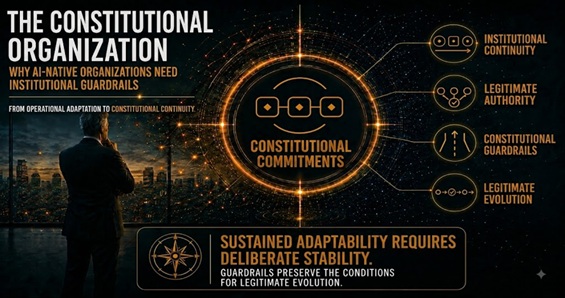 Why AI-Native Organizations Need Institutional Guardrails
Every organization must adapt.
Markets change.
Technologies evolve.
Customer expectations shift.
New risks emerge.
Competitive advantage rarely lasts.
For decades, adaptability has therefore been recognized as an important capability for organizations seeking to remain viable and relevant over time.
More recently, artificial intelligence has reinforced this imperative by expanding the speed and scale at which organizations can analyse information, generate alternatives and coordinate action.
The ability to change has become a strategic capability.
Yet this creates an important question.
If organizations become increasingly capable of changing more of how they operate, what should intentionally remain more difficult to change?
This is not merely a philosophical question.
It has become an organizational one.
The more adaptive an organization becomes, the more important it becomes to distinguish between what should evolve continuously and what should evolve more deliberately.
This is the constitutional challenge of AI-native organizations.
The previous article argued that governance creates its greatest value not only by reviewing important decisions, but by designing and preserving the organizational conditions within which those decisions are formed.
That argument naturally leads to a further question.
If governance increasingly shapes organizational architecture, should every element of that architecture remain equally open to revision?
Intuition often suggests that adaptability requires maximum flexibility.
In practice, sustained adaptability also depends on deliberate stability.
Organizations capable of sustained adaptation are rarely those in which everything changes.
They are those in which change occurs around institutional commitments that remain sufficiently stable to preserve organizational coherence.
Without such commitments, adaptability can gradually become volatility.
Local optimization may displace organizational purpose.
Distributed autonomy may fragment collective action.
Continuous change may slowly lose direction.
Adaptability therefore depends not only on the capacity to change.
It also depends on preserving the conditions that give change coherence.
This distinction becomes increasingly important as organizations distribute authority across people and computational capabilities.
Artificial intelligence can optimize schedules, generate recommendations, detect patterns, coordinate workflows and support resource allocation.
As computational capabilities evolve, they are likely to perform many of these activities with increasing effectiveness.
Computational capabilities may inform questions about what an organization should preserve.
They cannot, by themselves, determine which institutional commitments should evolve more cautiously than ordinary operational arrangements, because that determination requires institutional legitimacy rather than computational performance.
Optimization answers different questions.
It identifies preferable choices within a defined objective, model and set of constraints.
It does not determine which objectives, constraints or institutional commitments deserve deliberate preservation.
That determination remains an institutional responsibility rather than a computational one.
This distinction reveals that organizations evolve at more than one level.
Operational adaptation concerns how the organization changes the way it performs its work.
Constitutional evolution concerns how the organization preserves, interprets and legitimately revises the institutional conditions within which that adaptation occurs.
Confusing these two forms of change can produce organizations that become increasingly responsive operationally while progressively weakening their institutional coherence.
For this reason, constitutional commitments should not be confused with operational rules.
Operational rules govern how work is performed within established institutional boundaries.
They should remain open to revision when evidence, context or improved methods justify change.
Constitutional commitments serve a different purpose.
They express the institutional conditions that the organization considers sufficiently important to preserve across ordinary adaptation.
Their revision requires broader legitimacy because those conditions shape how future decisions will be formed and how organizational authority will be exercised.
Protecting those commitments requires constitutional guardrails.
Constitutional commitments express what the organization intends to preserve.
Constitutional guardrails are the principles, structures, authorities and practices through which those commitments are protected and legitimately revised.
The distinction is fundamental.
The commitment identifies what should remain more stable than ordinary organizational change.
The guardrail preserves that differentiation by preventing the commitment from being altered accidentally, silently or through the cumulative effects of routine decisions.
Constitutional guardrails should not be equated with bureaucracy.
Bureaucratic arrangements can preserve consistency, due process and institutional memory.
They can also perpetuate procedures after their original purpose has weakened.
Constitutional guardrails are distinguished not by resistance to change, but by the institutional commitments they protect and by the legitimacy required to revise them.
Organizations frequently remove constraints in the name of agility.
Sometimes they should.
Some operational constraints outlive their purpose and slow execution without creating commensurate value.
Constitutional guardrails are different.
They exist because not every capability should automatically become organizational authority.
Not every optimization should become organizational policy.
Not every efficient solution should become an acceptable one.
Without constitutional guardrails, organizations risk confusing what is technically possible with what remains organizationally legitimate.
One of the deeper dangers is therefore not simply that artificial intelligence becomes increasingly capable.
It is that organizations may gradually lose the institutional reference points required to exercise those capabilities responsibly.
This does not imply that constitutional commitments are immutable.
Organizations must remain capable of evolution.
Markets change.
Technologies mature.
Social, legal and ethical expectations evolve.
Constitutional arrangements that cannot evolve may eventually obstruct the organizations they are intended to protect.
The constitutional challenge is therefore not preserving permanence.
It is preserving continuity.
Institutional commitments do not all require the same pace or process of evolution.
Some may be revised through ordinary governance.
Others should require broader deliberation, stronger justification and wider institutional legitimacy.
The defining characteristic of a constitutional commitment is not that it never changes.
It is that it must not be allowed to change accidentally.
Its revision requires broader institutional legitimacy than ordinary operational change because it modifies the conditions within which future decisions will be formed.
This distinction separates constitutional evolution from operational adaptation.
Viewed in this way, the Constitutional Organization is not defined by the existence of a written constitutional document.
Nor is it defined by any particular governance model.
It is defined by the intentional preservation, interpretation and legitimate evolution of institutional commitments that remain more stable than the ordinary decisions, practices and arrangements they govern.
Those commitments provide continuity while allowing adaptation.
They help preserve legitimacy while enabling innovation.
They create coherence without preventing learning.
Most importantly, they protect against organizational evolution gradually removing the conditions that make responsible evolution possible.
Constitutional commitments therefore do more than preserve organizational continuity.
They define the conditions under which organizational evolution itself remains legitimate.
As organizations become increasingly AI-enabled, the strategic challenge extends beyond deciding faster, optimizing better or adapting more frequently.
It also involves preserving the institutional foundations that allow adaptation itself to remain coherent, legitimate and sustainable.
Architectural Governance concerns the organizational conditions that shape how decisions emerge.
The Constitutional Organization distinguishes the institutional conditions that may evolve through ordinary adaptation from those whose revision requires broader legitimacy because they shape the legitimacy of future organizational action.
Yet one fundamental question remains.
If constitutional commitments must be preserved, interpreted and legitimately revised across time, who carries that responsibility?
Not who owns the constitution.
Not who originally designed it.
But who preserves its legitimacy through continuous organizational evolution.
That is the question explored in the next article:
Constitutional Stewardship - Preserving Legitimacy Across Organizational Evolution.
Posted on: August 14, 2026 03:57 AM |
Permalink




