Support to Develop
by Luis Branco

This blog addresses management-related topics and has three areas of focus: 1. Technical skills; 2. Competencies in the field of interpersonal relations and communication (including personal organization and delegation, leadership, teamwork, conflict resolution, conducting meetings, and negotiation); and 3. Strategy (including diagnosis, strategic guidelines, and implementation).4.Technology
Recent Posts
From Conscious Governance to Constraint Governance
New Ways of Working in Projects: From Team Agility to Organizational Adaptability
Future Leadership
Governing Responsible Autonomy
Cognitive Sovereignty
Categories
Agile,
Career Development,
Career Development,
Career Development,
Career Development,
Career Development,
Career Development,
Career Development,
Career Development,
Career Development,
Career Development,
Career Development,
Career Development,
Career Development,
Career Development,
Career Development,
Career Development,
Career Development,
Career Development,
Career Development,
Career Development,
Career Development,
Career Development,
Career Development,
Career Development,
Career Development,
Career Development,
Career Development,
Career Development,
Career Development,
Career Development,
Career Development,
Career Development,
Career Development,
Career Development,
Career Development,
Career Development,
Career Development,
Career Development,
Career Development,
Career Development,
Career Development,
Career Development,
Career Development,
Career Development,
Career Development,
Career Development,
Career Development,
Career Development,
Career Development,
Career Development,
Career Development,
Career Development,
Career Development,
Career Development,
Career Development,
Career Development,
Career Development,
Career Development,
Career Development,
Career Development,
Career Development,
Career Development,
Career Development,
Career Development,
Career Development,
Career Development,
Career Development,
Career Development,
Career Development,
Career Development,
Career Development,
Career Development,
Career Development,
Career Development,
Career Development,
Career Development,
Career Development,
Career Development,
Career Development,
Career Development,
Career Development,
Career Development,
Career Development,
Career Development,
Career Development,
Career Development,
Career Development,
Career Development,
Career Development,
Career Development,
Career Development,
Career Development,
Career Development,
Career Development,
Career Development,
Career Development,
Career Development,
Career Development,
Career Development,
Career Development,
Career Development,
Career Development,
Career Development,
Career Development,
Career Development,
Career Development,
Interpersonal Skills,
Interpersonal Skills,
Interpersonal Skills,
Interpersonal Skills,
Interpersonal Skills,
Interpersonal Skills,
Interpersonal Skills,
Interpersonal Skills,
Interpersonal Skills,
Interpersonal Skills,
Interpersonal Skills,
Interpersonal Skills,
Interpersonal Skills,
Interpersonal Skills,
Interpersonal Skills,
Interpersonal Skills,
Interpersonal Skills,
Interpersonal Skills,
Interpersonal Skills,
Interpersonal Skills,
Interpersonal Skills,
Interpersonal Skills,
Interpersonal Skills,
Interpersonal Skills,
Interpersonal Skills,
Interpersonal Skills,
Interpersonal Skills,
Interpersonal Skills,
Interpersonal Skills,
Interpersonal Skills,
Interpersonal Skills,
Interpersonal Skills,
Interpersonal Skills,
Interpersonal Skills,
Interpersonal Skills,
Interpersonal Skills,
Interpersonal Skills,
Interpersonal Skills,
Interpersonal Skills,
Interpersonal Skills,
Interpersonal Skills,
Interpersonal Skills,
Interpersonal Skills,
Interpersonal Skills,
Interpersonal Skills,
Interpersonal Skills,
Interpersonal Skills,
Interpersonal Skills,
Interpersonal Skills,
Interpersonal Skills,
Interpersonal Skills,
Interpersonal Skills,
Interpersonal Skills,
Interpersonal Skills,
Interpersonal Skills,
Interpersonal Skills,
Interpersonal Skills,
Interpersonal Skills,
Interpersonal Skills,
Interpersonal Skills,
Interpersonal Skills,
Interpersonal Skills,
Interpersonal Skills,
Interpersonal Skills,
Interpersonal Skills,
Interpersonal Skills,
Interpersonal Skills,
Interpersonal Skills,
Interpersonal Skills,
Interpersonal Skills,
Interpersonal Skills,
Interpersonal Skills,
Interpersonal Skills,
Interpersonal Skills,
Interpersonal Skills,
Interpersonal Skills,
Interpersonal Skills,
Interpersonal Skills,
Interpersonal Skills,
Interpersonal Skills,
Interpersonal Skills,
Interpersonal Skills,
Interpersonal Skills,
Interpersonal Skills,
Interpersonal Skills,
Interpersonal Skills,
Interpersonal Skills,
Interpersonal Skills,
Interpersonal Skills,
Interpersonal Skills,
Interpersonal Skills,
Interpersonal Skills,
Interpersonal Skills,
Interpersonal Skills,
Interpersonal Skills,
Interpersonal Skills,
Interpersonal Skills,
Interpersonal Skills,
Interpersonal Skills,
Interpersonal Skills,
Interpersonal Skills,
Interpersonal Skills,
Interpersonal Skills,
Interpersonal Skills,
Interpersonal Skills,
Interpersonal Skills,
Leadership,
Leadership,
Leadership,
Leadership,
Leadership,
Leadership,
Leadership,
Leadership,
Leadership,
Leadership,
Leadership,
Leadership,
Leadership,
Leadership,
Leadership,
Leadership,
Leadership,
Leadership,
Leadership,
Leadership,
Leadership,
Leadership,
Leadership,
Leadership,
Leadership,
Leadership,
Leadership,
Leadership,
Leadership,
Leadership,
Leadership,
Leadership,
Leadership,
Leadership,
Leadership,
Leadership,
Leadership,
Leadership,
Leadership,
Leadership,
Leadership,
Leadership,
Leadership,
Leadership,
Leadership,
Leadership,
Leadership,
Leadership,
Leadership,
Leadership,
Leadership,
Leadership,
Leadership,
Leadership,
Leadership,
Leadership,
Leadership,
Leadership,
Leadership,
Leadership,
Leadership,
Leadership,
Leadership,
Leadership,
Leadership,
Leadership,
Leadership,
Leadership,
Leadership,
Leadership,
Leadership,
Leadership,
Leadership,
Leadership,
Leadership,
Leadership,
Leadership,
Leadership,
Leadership,
Leadership,
Leadership,
Leadership,
Leadership,
Leadership,
Leadership,
Leadership,
Leadership,
Leadership,
Leadership,
Leadership,
Leadership,
Leadership,
Leadership,
Leadership,
Leadership,
Leadership,
Leadership,
Leadership,
Leadership,
Leadership,
Leadership,
Leadership,
Leadership,
Leadership,
Leadership,
Leadership,
Leadership,
Strategy,
Strategy,
Strategy,
Strategy,
Strategy,
Strategy,
Strategy,
Strategy,
Strategy,
Strategy,
Strategy,
Strategy,
Strategy,
Strategy,
Strategy,
Strategy,
Strategy,
Strategy,
Strategy,
Strategy,
Strategy,
Strategy,
Strategy,
Strategy,
Strategy,
Strategy,
Strategy,
Strategy,
Strategy,
Strategy,
Strategy,
Strategy,
Strategy,
Strategy,
Strategy,
Strategy,
Strategy,
Strategy,
Strategy,
Strategy,
Strategy,
Strategy,
Strategy,
Strategy,
Strategy,
Strategy,
Strategy,
Strategy,
Strategy,
Strategy,
Strategy,
Strategy,
Strategy,
Strategy,
Strategy,
Strategy,
Strategy,
Strategy,
Strategy,
Strategy,
Strategy,
Strategy,
Strategy,
Strategy,
Strategy,
Strategy,
Strategy,
Strategy,
Strategy,
Strategy,
Strategy,
Strategy,
Strategy,
Strategy,
Strategy,
Strategy,
Strategy,
Strategy,
Strategy,
Strategy,
Strategy,
Strategy,
Strategy,
Strategy,
Strategy,
Strategy,
Strategy,
Strategy,
Strategy,
Strategy,
Strategy,
Strategy,
Strategy,
Strategy,
Strategy,
Strategy,
Strategy,
Strategy,
Strategy,
Strategy,
Strategy,
Strategy,
Strategy,
Strategy,
Strategy,
Strategy,
Sustainability,
Talent Management,
Talent Management,
Talent Management,
Talent Management,
Talent Management,
Talent Management,
Talent Management,
Talent Management,
Talent Management,
Talent Management,
Talent Management,
Talent Management,
Talent Management,
Talent Management,
Talent Management,
Talent Management,
Talent Management,
Talent Management,
Talent Management,
Talent Management,
Talent Management,
Talent Management,
Talent Management,
Talent Management,
Talent Management,
Talent Management,
Talent Management,
Talent Management,
Talent Management,
Talent Management,
Talent Management,
Talent Management,
Talent Management,
Talent Management,
Talent Management,
Talent Management,
Talent Management,
Talent Management,
Talent Management,
Talent Management,
Talent Management,
Talent Management,
Talent Management,
Talent Management,
Talent Management,
Talent Management,
Talent Management,
Talent Management,
Talent Management,
Talent Management,
Talent Management,
Talent Management,
Talent Management,
Talent Management,
Talent Management,
Talent Management,
Talent Management,
Talent Management,
Talent Management,
Talent Management,
Talent Management,
Talent Management,
Talent Management,
Talent Management,
Talent Management,
Talent Management,
Talent Management,
Talent Management,
Talent Management,
Talent Management,
Talent Management,
Talent Management,
Talent Management,
Talent Management,
Talent Management,
Talent Management,
Talent Management,
Talent Management,
Talent Management,
Talent Management,
Talent Management,
Talent Management,
Talent Management,
Talent Management,
Talent Management,
Talent Management,
Talent Management,
Talent Management,
Talent Management,
Talent Management,
Talent Management,
Talent Management,
Talent Management,
Talent Management,
Talent Management,
Talent Management,
Talent Management,
Talent Management,
Talent Management,
Talent Management,
Talent Management,
Talent Management,
Talent Management,
Talent Management,
Talent Management,
Talent Management
Date
| 
This is the eighth post in the series “The 11 Keys to Regenerative Leadership”
In a time of hyper-exposure and professional masks, authenticity has become a transformational force.
But it’s not enough to “be authentic”
Leaders must lead from who they are, with real and responsible presence.
In regenerative leadership, presence is not just being in the room.
- It means listening truthfully.
- Showing vulnerability without losing clarity.
- Being consistent between words, actions and decisions.
When a leader is truly present:
- People relax into contribution, not into defense
- Conflict becomes a space for learning, not punishment
- Trust grows from congruence, not from authority
Practical example:
In an organization undergoing transition, the CEO began each critical meeting with a personal check-in.
Brief. Genuine. Never imposed.
The result?
The team began to trust decisions more, because they could see who was making them.
Performance improved - not through control, but through presence.
Regenerative authenticity is not about saying everything.
It’s about not hiding who we are in what we do.
And in your context: is leadership presence a source of coherence — or a performance mask?
This post is part of the series The 11 Keys to Regenerative Leadership
|
Posted on: October 20, 2025 09:30 AM
|
Permalink |
Comments (4)
| 
Complementary Post to Pillar 7 - Evolutionary Mindset
A recent comment on this pillar said:
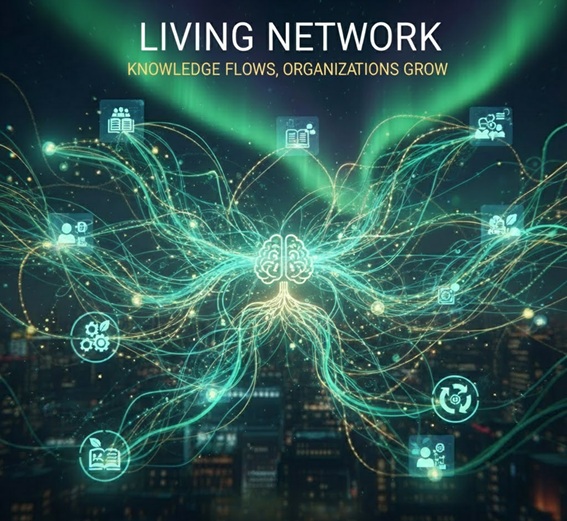
“Fundamental transformation happens when we see teams as living systems rather than structures to control.”
That sentence stayed with me because it captures the very heart of regenerative leadership.
Living organizations learn.
They don’t react mechanically.
They transform organically.
Instead of chasing isolated efficiency, they cultivate coherence, adaptability, and shared value.
For them, learning is not about fixing failures, it’s about regenerating possibilities.
In practice, this means evolving from a management model centered on control to one centered on awareness:
- From imposed order → to emergent intelligence
- From individual performance → to systemic value
- From episodic change → to continuous learning
As emphasized in the PMO Practice Guide (PMI) and the GPM P5 Standard, sustainability, value, and human development are not separate goals, they are interdependent dimensions of the same living system.
Practical Example:
In an industrial organization undergoing transition, the PMO shifted from measuring only deliverables to measuring organizational learning, how many practices were created, adapted, and reused across teams.
The result was a visible leap in maturity: less dependence on rigid processes, more autonomy, and regenerative innovation.
Regenerative Synthesis
Leading living teams means learning to see the organization as an ecosystem - where every interaction is an opportunity to regenerate culture, purpose, and trust.
In your organization:
Are you managing structures, or cultivating living systems that learn with you?
This post is part of the series The 11 Keys to Regenerative Leadership.
|
Posted on: October 17, 2025 09:19 AM
|
Permalink |
Comments (0)
| 
Complementary Post to Pillar 7 - Evolutionary Mindset
This reflection was born from the dialogues and insights inspired by Pillar 7: Evolutionary Mindset.
Because leading regeneratively is exactly that: learning in motion.
Learning from what the system gives back, from what we can’t control, and from the voices that make us think differently.
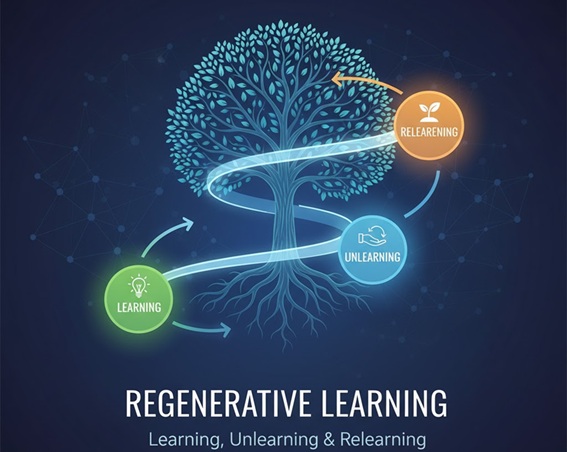
Learning is more than acquiring knowledge
To learn regeneratively is to transform the way we see
Not to accumulate answers, but to improve the quality of our questions.
It means replacing the need to master with the curiosity to understand.
As one reader beautifully wrote:
“Regenerative thinking isn’t about collecting knowledge; it’s about learning through movement, not mastery.”
Leaders with this mindset don’t react to change, they dialogue with it.
Unlearning is liberation
Unlearning is one of the most mature forms of growth.
It’s the art of letting go of what was once useful but now limits us.
As someone commented:
“Letting go is not loss, it’s making space for better questions.”
Cognitive detachment is what allows us to see anew.
Without it, even learning becomes repetition under a new name.
Relearning is regeneration
Relearning is the humble act that turns error into feedback and uncertainty into design.
It means seeing the world again with steady purpose but renewed eyes.
It’s the moment when learning stops being a technical process and becomes an act of consciousness.
Practical example:
In an innovation team, a leader replaced performance reports with weekly conversations about:
- What they learned,
- What they unlearned,
- What they intend to relearn.
The result was more collaboration, more humility, and decisions that felt alive.
Regenerative Synthesis
- Knowledge is the raw material.
- Consciousness is the process.
- Regeneration is the outcome.
True learning isn’t about knowing more (it’s about seeing better) and allowing the system itself to teach us, even as we transform it.
And in your own experience:
What do you need to unlearn to keep evolving as a leader?
Growth is not accumulation.
It’s renewing the way we see, feel, and learn in every cycle.
This post is part of the series The 11 Keys to Regenerative Leadership
|
Posted on: October 15, 2025 11:15 AM
|
Permalink |
Comments (4)
| 
This is the seventh post in the series “The 11 Keys to Regenerative Leadership”
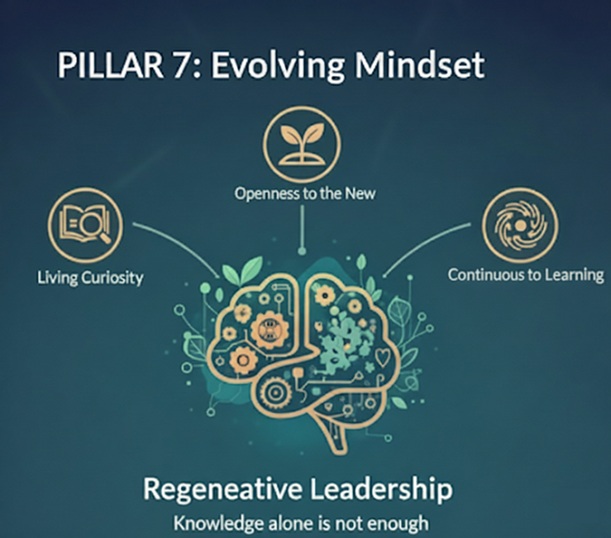
Knowledge alone is not enough.
Regenerative leadership requires a living curiosity, openness to the new, and continuous learning.
An evolving mindset is more than a willingness to learn.
It’s a mental posture that sees complexity as opportunity.
That adapts without losing purpose.
That integrates failure, listening, and reflection as essential parts of real growth, both individual and collective.
A leader with an evolving mindset:
- Learns from what they cannot control
- Reframes beliefs without losing integrity
- Creates safety so others can grow as well
This pillar connects with models such as:
- Shu-Ha-Ri → conscious evolution of mastery
- SECI 2.0 → regenerative knowledge creation
- Toyota Kata → improvement as daily habit
- Cognitive Agility → adjusting how we think in response to what emerges
Practical example:
In an organizational innovation program, the leadership team redesigned their initial approach three times.
But rather than seeing that as failure, they embraced each cycle as real learning.
The impact was deeper, not because they got it right the first time, but because they evolved with intention.
Regenerative mindset is not about knowing more
It’s about learning better, every day.
In your experience: what habits strengthen a truly evolving mindset?
This post is part of the series The 11 Keys to Regenerative Leadership
|
Posted on: October 13, 2025 08:50 AM
|
Permalink |
Comments (2)
| 
Complementary post to Pillar 6 — Flexibility
Not every change is evolution.
Not every flexibility is regeneration.
True flexibility is not just the ability to adapt.
It is awareness in motion.
It is discernment applied to context, transforming change into learning, innovation, and real impact.
As one reader of this series shared:
“Flexibility anchored in purpose drives regeneration and learning.”
Exactly so.
Regenerative flexibility is not about reacting faster
It’s about responding wiser to what the system needs.
It allows us to redesign without losing coherence, to innovate without breaking identity.
When flexibility is anchored in purpose:
- Adaptation stops being escape and becomes choice;
- Change stops generating fear and starts inspiring curiosity;
- Mistakes stop being punishment and become insight.
Practical example:
In a transforming organization, leadership introduced weekly micro-redesign cycles.
Small, continuous reviews with collective feedback replaced rigid plans with iterative learning.
The result: greater agility, stronger cohesion, and innovation emerging from the process itself.
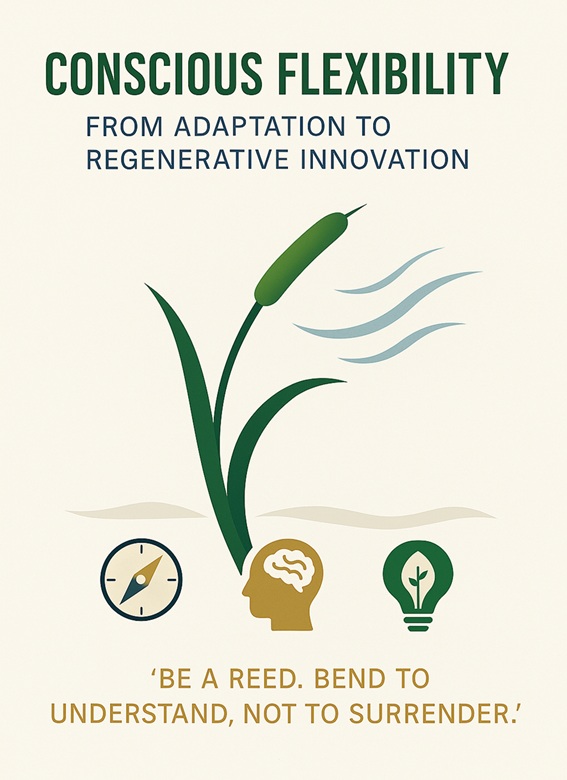
Be a reed.
Bend to understand, not to surrender.
Because the flexibility that listens is the one that endures.
In your organization: is flexibility a reaction… or awareness in action?
This post is part of the series The 11 Keys to Regenerative Leadership
|
Posted on: October 10, 2025 10:32 AM
|
Permalink |
Comments (0)
|
"Very deep. You should send that into Reader's Digest, they've got a page for people like you."
- Douglas Adams
|




