The Reluctant Agilist
by Dave Prior

Recent Posts
Mastering Troubled Projects: Strategies from Richard Broo
Adapt to Win! with Evan Campbell
Navigating AI in Business Strategy with John Tanner
The Art of Giving Feedback with Lonnie Weaver-Johnson
Navigating Uncertainty: Preparing for Success in 2026 with Johanna Rothman and Mark Kilby
Categories
&Human,
reluctantagilist,
Agile Practice Guide,
Dave Prior,
Johanna Rothman,
LeadingAgile,
PMI,
reluctant agilist,
20 Hour,
2017 Digital PM Summit,
2018 Digital PM Summit,
2018 Digital Pm Summit,
2018 North American Global Scrum Gathering,
2018 Scrum Gathering,
2019 NAGS,
2019 North American Global Scrum Gathering,
2019 Scrum Gathering,
3PVantage,
4-Hour Body,
4-Hour Chef,
4-Hour Work Week,
5S,
6 Enablers of Business Agility,
7 Rules for Positive Productive Change,
A Life of Productivity,
a-team,
Aakash Srinivasan,
Aaron Irizarry,
Abby Fretz,
accelerating product value,
accountability,
Active Listening,
Adam Weisbart,
Adapt,
Adapt to Win!,
adaptability,
Adaptivity,
Adaptivity,
Adaptivity Group,
ADDAF,
ADDIE,
Adding Work to Sprints,
Adrenalline Junkies,
Adrian Howard,
Agency,
agency,
agency culture,
AgencyAgile,
agentic,
Agents,
Agile,
Agile,
Agile,
Agile,
Agile,
Agile,
Agile,
Agile,
Agile,
Agile,
Agile,
Agile,
agile,
agile,
agile,
agile,
Agile 2013,
agile 2014,
agile 2015,
Agile 2017,
Agile 2018,
Agile 2018 Keynote,
AGile 2019,
Agile 2019,
Agile 2025,
Agile 2025,
Agile 2025,
Agile Adlibs,
Agile Alliance,
Agile Alliance,
Agile Alliance,
Agile Alliance,
agile alliance,
agile alliance,
Agile and AI,
Agile and Artificial Intelligence,
Agile and Jazz,
agile and lean program management,
Agile and Waterfall,
Agile and Waterfall Planning,
Agile Antipatterns,
Agile Assessment,
Agile at Home,
Agile Atlas,
Agile Austin,
Agile Baltimore,
Agile Bear,
Agile Business,
agile caravanserai,
Agile Centre,
Agile Certificaiton,
Agile Certification,
Agile Classroom,
Agile Coach,
Agile Coach,
Agile Coaching,
agile coaching,
Agile Coaching Ethics Initiative,
Agile Coaching Income Report,
agile coaching institute,
Agile Coaching Layoffs,
Agile Coffee,
Agile Cognitive Bias,
Agile Conference,
Agile Conference,
Agile conference,
agile conference,
Agile Development and Design Techniques,
Agile Digital Agency,
Agile Enterprise,
Agile Estimation,
Agile Ethics,
Agile Fluency,
Agile for All,
Agile for Humans,
agile hardware,
Agile Heretic,
Agile in 3 Minutes,
Agile in Digital,
Agile in Education,
agile in education,
Agile in the Wild,
Agile Layoffs,
Agile Leadership,
Agile Management,
Agile Manifesto,
agile marketing,
agile marketing academy,
Agile methodologies,
Agile Metrics,
Agile Mindset,
Agile Mini Con,
Agile Negotiation,
Agile outside of Software,
Agile Path FM,
Agile Physics,
Agile Planning,
Agile Planning,
Agile PM,
Agile PMO,
agile portfolio management,
Agile Practice,
Agile Product Development,
Agile product ownership,
Agile Project Management,
agile project management,
Agile Project Manager,
Agile Quantified,
Agile Retrospectives,
Agile Risk Management,
Agile Roles,
Agile Schools,
agile schools,
Agile Steve,
Agile Teams,
Agile Tracking,
Agile Transformation,
Agile Transformation,
Agile Transformation,
agile transformation,
agile transformation,
agile transformation,
agile transformation,
agile transformation,
Agile Transformation Office,
Agile Transformation Playbook,
Agile Transition,
Agile Tribes,
Agile Uprising,
Agile Velocity,
Agile Virtual Summit,
Agile-Lean-NYT,
agile2014,
agile2015,
agile2015 agile 2015,
Agile2025,
Agile2025,
agile42,
Agile4All,
AgileAI,
AgileBrain,
AgileClassroom,
AgileCraft,
AgilePathFM,
AgileScout,
AgileUprising,
Agilist,
Agilistocrats,
Agilitrix,
agility,
Agility Prime Solutions,
Agility Prime Solutions,
Agility Scales,
AgilityScales,
AI,
AI,
AI,
AI,
AI,
AI,
AI,
AI,
AI,
AI Agile Guy,
AI and Agile,
AI and Scrum,
AI deployment,
AI in creativity,
AI in project management,
AI integration,
AI Literacy,
AI tools,
AI transformation,
Ainsley Nies,
Al Goerner,
Al Goernor,
Al Shalloway,
Alan Dayley,
Alan Dayley,
Alex Brown,
alex silva,
alexandre silva,
Alistair Cockburn,
Amitai Schleier,
Analytics,
Anderson Diniz Hummel,
Anderson Hummel,
Andreas Schliep,
Andrew Leff,
Andrew Stellman,
Andy Jordan,
Andy Repton,
Angela Harms,
Angie Stecovich,
Anna Beatrice Scott,
anthropic,
anti-fragility,
Anti-pattern,
antifragility,
Antipattern,
Antipattern. Agile,
Anu Smalley,
Applied Frameworks,
Applying Metrics for Predictability,
Archetype,
Art of Coaching,
Art of War,
art of war,
Artificial Intelligence,
Artificial Intelligence,
artificial intelligence,
artificial intelligence,
Ashley Lucio,
Assumptions,
Assumptions Mapping,
Atif Rafiq,
Atlassian,
Atlassian Analytics,
Atlassian Experience Canvas,
ATS,
Audreww Tara Sahota,
autism,
AVS,
awareness,
Backlog Management,
Backlog Prioritization,
Backlog Refinement,
baker,
Bas Vodde,
Becky Hartman,
Bees,
Behavioral Change,
behavioral science,
Bernie Maloney,
Beyond Legacy Code,
Beyond User Stories,
Big Consulting,
Big Visible,
BigVIsible,
BigVisible,
Billy McLaughlin,
bimodal,
Bjorn Jensen,
Black Lives Matter,
Blackie,
Blake Halvorson,
Bland,
blocked,
blockedapp,
blueprint,
blueprint education,
Bob Payne,
Bob Sarni,
Bob Tarne,
book review,
book signings,
Book Writing,
book writing,
Boozy Scrum,
Braden Cundiff,
brainstorming,
Brandon Brown,
Brandon R. Brown,
Brent Beer,
Brett Harned,
Bria Johnson,
Brian Bozzuto,
Broza,
Build Your Own Scrum,
Building Resilience,
Building Trust,
Bureau of Digital,
Bureau of Digital,
Bureau of Digital,
Business Agility,
business agility,
Business Agility Canvas,
Business Model Canvas,
Business Planning,
Business Portfolio Management,
Business Solutions,
business strategy,
business value estimation,
Buzzword,
C4G Enterprises,
CAL,
candidate experience,
Canton Coders,
Capacity Planning,
Capala Consulting,
CapEx,
Cara Turner,
career advice,
Career Development,
Career Growth,
Career Path,
Cargotec,
Carl Smith,
Carol Dweck,
Carol McEwan,
carson pierce,
Cass Van Gelder,
Catherine Louis,
Celeste Giampetro,
Center for Non-Violent Communication,
Certification,
Certified Agile Leadership,
Certified Scrum Master,
Certified Scrum Master,
Certified Scrum Product Owner,
Certified Scrum Product Owner,
Certified Scrum Product Owner,
Certified Scrum Product Owner Scrum,
Certified Scrum Professional,
Certified Scrum Trainer,
Cesar Idrovo,
CFD,
CFDs,
Change,
Change Fatigue,
Change Management,
Change Management,
Change Management,
change management,
change management,
change management,
Change Managment,
Changing Sprint Commitment,
Charlie Rudd,
Charlotte DiBartolomeo,
Charter,
Chat GPT,
ChatGPT,
Cheif Product Owner,
Cheif Scrum Master,
Chet Hendrickson,
Chief Product Owner,
Chief Scrum Master,
Chief ScrumMaster,
Chief SM,
ChowNow,
Chris Bailey,
Chris Clarke,
Chris Geary,
Chris Li,
chris matts,
Chris Murman,
Chris Murman,
Chris Sims,
Chris Spagnuolo,
Christina Bang,
Christine Converse,
Christine Li,
Christine Neidhardt,
Christopher Avery,
Christopher Hadnagy,
christopher hadnagy,
Cleaning Toxic Waste,
Client,
Client Relationships,
client relationships,
Climate,
cnvc,
Coach Cain,
Coach's Clinic,
Coaches Clinic,
Coaching,
coaching,
coaching,
coaching,
coaching,
Coaching Certification,
CodeX,
Collabnet,
Collaboration,
Collaboration,
Collaboration,
collaboration,
collaboration,
collaboration,
collaboration,
collaboration,
collaboration,
Collaboration Equation,
Collaboration Equation,
Collaborative Teamwork,
Colleen Johnson,
Colleen Johnson,
commitment,
communication,
communication,
communication,
communication,
communication,
communication,
Communication Plan,
communication skills,
communications,
Communications Management,
Community,
community support,
company culture,
company values,
Comparative Agility,
Comparing Teams,
Conference,
conference preparation,
Conference Proposal,
Confidence Rubric,
Conflict,
conflict,
conflict facilitation as a leadership skill,
conflict management,
Connecting,
Connection,
Conscious Communication,
construal level theory,
Consulting,
Consulting,
conteneo,
context,
continuous evaluation,
Continuous Improvement,
Continuous Improvement,
Continuous Improvement,
Converge,
coppertone,
Core Cycle of Agile Product Development,
corporate culture,
Counteracting The Systemic Oppression of Traditional Development Thinking,
Couple of Coaches,
Cozy Juicy Real,
Craig Larman,
Creative Courage Summit,
creative processes,
Creativity Safety,
credible information,
crisis communications,
cross functional teams,
Cross Functionality,
Cross-Functionality,
CrossFunctionality,
Crosswind,
CrosswindPM,
CSM,
CSM,
CSP,
CSP Fast Pass,
CSPO,
CSPO,
CSPO,
CST,
cst,
Cultivating Transformation,
Cultural Change,
Culture,
culture,
Cumulative Flow Diagram,
cumulative flow diagrams,
Customers,
Cutlefish,
Cycle Time,
cycle time,
DA,
DAD,
Daily Scrum,
Damon Poole,
Dan Brown,
Dan Eberle,
daniel goleman,
Daniel Gullo,
Darkest Timeline,
Darren Petersen,
Daryl Kulak,
data,
data management,
Data Science,
Data-Driven Change,
Dave Prior,
Dave Prior,
Dave Prior,
Dave Prior,
Dave Prior,
Dave Prior,
Dave Prior,
Dave Prior,
Dave Prior,
Dave Prior,
Dave Prior,
Dave Prior,
Dave Prior,
Dave Prior,
Dave Prior,
Dave Prior,
Dave Prior,
Dave Prior,
Dave Prior,
Dave Prior,
Dave Prior,
Dave Prior,
Dave Prior,
Dave Prior,
Dave Prior,
Dave Prior,
Dave Prior,
Dave Prior,
Dave Prior,
Dave Prior,
Dave Prior,
Dave Prior,
Dave Prior,
Dave Prior,
Dave prior,
Dave prior,
dave prior,
dave prior,
dave prior,
Dave West,
David Anderson,
David Bernstein,
David Bland,
David Hawks,
David J Anderson,
David Luke,
David Marquet,
Dean Leffingwell,
Dean Stevens,
Decision Making,
decision making,
decision making,
Declan Whelan,
decommoditization,
Decoupling Cadences,
defining value,
Definition of Done,
Deliver Better Results,
Delivery,
Delivery Better Results,
Denise Jacobs,
Denma,
Dennis Stevens,
Dennis Stevens,
Dependencies,
Derek Heuther,
Derek Huether,
derek huether,
Descaling Agile,
Design,
Design Thinking,
Designing Together,
Devin Hedge,
DevSecOps,
Dhaval Panchal,
Diana Larsen,
diana larsen,
Digital Agency,
digital agency,
digital marketing,
Digital PM,
Digital PM,
Digital PM Summit,
Digital PM Summit,
Digital Pm Summit,
digital PM summit,
Digital PM Summit 2014,
Digital Project Management,
Digital Project Manager,
Digital Transformation,
digital transformation,
digitalpm,
digitalpm dpm,
Directing,
Disciplined Agile,
Disciplined Agile Certification,
Disciplined Agile Delivery,
Disciplined Agile Framework,
Discover to Deliver,
Discovery Curves,
Distributed,
Distributed Team,
Distributed Teams,
Distributed teams,
Diversity,
documentation,
Dom Price,
Don Gray,
Don Kim,
Don McGreal,
DPM,
dpm,
DPM 2014,
DPM 2017,
DPM Philly,
DPM Summit,
DPM Summit 2017,
DPM Summit 2018,
dpm2013,
Dr. Abbie Marono,
Dr. Rick Brinkman,
DragonForceSUCKS!,
druneknPM,
Drunken PM,
drunken PM,
drunken pm,
Drunken PM Radio,
Drunken PM Radio,
Drunken PM Radio,
Drunken PM Radio,
Drunken PM Radio,
Drunken PM Radio,
Drunken PM Radio,
Drunken PM Radio,
Drunken PM Radio,
Drunken PM Radio,
Drunken PM Radio,
Drunken PM Radio,
Drunken PM Radio,
Drunken PM Radio,
Drunken PM Radio,
Drunken PM Radio,
Drunken PM radio,
Drunken PM radio,
drunken PM Radio,
drunken PM Radio,
drunken PM Radio,
drunken PM Radio,
drunken PM Radio,
drunken PM Radio,
drunken PM radio,
drunken PM radio,
drunken pm radio,
drunken pm radio,
drunken pm radio,
drunken pm radio,
drunken pm radio,
drunken pm radio,
drunken pm radio,
drunken pm radio,
drunken pm radio,
drunken pm radio,
drunken pm radio,
drunken pm radio,
drunken pm radio,
drunken pm radio,
DrunkenPM,
DrunkenPM,
DrunkenPm,
drunkenPM,
drunkenPM,
drunkenPM,
drunkenPM,
drunkenPM,
drunkenPM,
drunkenPm,
drunkenpm,
drunkenpm,
drunkenpm,
drunkenpm,
drunkenpm,
drunkenpm,
drunkenpm,
drunkenpm,
drunkenpm,
drunkenpm,
drunkenpm,
drunkenpm,
drunkenpm,
drunkenpm,
drunkenpm,
drunkenpm,
drunkenpm,
drunkenpm,
drunkenpm,
drunkenpm,
drunkenpm,
drunkenpm,
drunkenpm,
drunkenpm,
drunkenpm,
drunkenpm,
drunkenpm,
drunkenpm,
drunkenpm,
drunkenpm,
DrunkenPM Radio,
drunkenPM Radio,
drunkenPM Radio,
drunkenPM Radio,
drunkenPM radio,
drunkenpm radio,
drunkenpm radio,
drunkenpmradio,
drunkenpmradio,
drunkenpmradio,
drunkepm,
ducks,
Eastern Standard,
eckstein,
ecosystem,
ecosystem thinking,
Ed Stockwell,
edge,
Edge Collection,
edu scrum,
Education,
eduscrum,
Edward Kay,
efficiency,
efficiency,
efficiency,
Eight Shapes,
Elizabeth Harrin,
Elizabeth Hendrickson,
Elizabeth McClellan,
Ellen Gottesdiener,
Elsevier,
Elusive Agile Enterprise,
Emily Epstein,
Emotional Intelligence,
emotional intelligence,
emotional intelligence,
Emotional Science,
Empathy,
empathy,
empathy,
empathy,
employee engagement,
employment,
Empowerment,
empowerment,
energy management,
english heritage,
Enterprise Agile,
enterprise readiness,
epic bedtime story,
Eric Tucker,
Erich Hahn,
Erika Lenz,
Essential Scrum,
Esther Derby,
esther derby,
Estimating,
Ethics,
Evan Campbell,
EVEF,
Even Better Podcast,
Evernote,
Every Voice Engaged,
Evolve Agility,
EvolveAgility,
Excella,
excella,
Excella Consulting,
Executive Coaching,
Experience,
Experience Map,
Experiments,
Explore It!,
extreme manufacturing,
Extreme Programming,
Facilitation,
fading problems,
Failing Sprints,
fast feedback,
Fearless Agiity,
Fearless Agility,
FearlessAgility,
feedback,
feedback models,
field guide,
Film Making,
Film Production,
First 20 Hours,
First15,
Fit for Purpose,
Five Lenses,
Five Lenses of Humane Management,
Fixing Your Scrum,
flavio steffens,
FLEX,
Flight Levels,
FLIP,
Flip,
Flow,
flow,
Flow Metrics,
flow metrics,
Focused Objective,
focused objective,
FocusedObjective,
Forbes,
Forecasting,
Formula Ink,
FormulaInk,
Frank Vega,
Fred George,
Frederick Taylor,
Frederick Taylor,
freudenberg,
friction,
From Theater to Flow,
Funding,
Future of Agile,
Galen Low,
Games,
Gangplank,
Gary Gagliardi,
gender bias,
Gene Bounds,
generation agile,
Geoffrey Moore,
Geographically Distributed Teams,
George Floyd,
George Schlitz,
George Schlitz,
Getting Things Done,
Gil Broza,
Giora Morein,
girl scouts,
Girls Guide to PM,
girlscouts,
Github,
giving feedback,
Glassel Ventures,
Global Congress,
Global Scrum Gathering,
Global Scrum Gathering Austin,
governance,
Grandview Prep,
Greenhopper,
Greg Storey,
growth mindset,
GTD,
Habit,
hackathon,
HappyCog,
Harvard Business Review,
HBR,
Head First Agile,
Healing Container,
Hearst Digital Media,
Heart of Agile,
Henry Poydar,
hero,
High-Performing Team,
hiring,
Homeschooling,
honesty,
Hong Li,
Hope Schools,
Howard Sublett,
HUGE,
HUGE Inc,
Hugo Bowne-Anderson,
human behavior,
human hacking,
Human Side of Agile,
human-centered design,
humane workspace,
humane workspace,
humane workspaces,
Hummingbird Agility,
Hybrid,
hybrid,
Hybrid Agile,
hybrid projects,
Hyderabad,
hyperfocus,
I Think Therefore I Plan,
Iain Fraser,
ICAgile,
Ice Breaker,
Ideation Framework,
Ignite,
Igniteii,
Ilker Demirel,
Impact Mapping,
Implementing Scrum,
imposter syndrome,
Improv,
Improv Effect,
ImprovEffect,
Improving Scrum.org,
improvisation,
Increment of Work,
independent consulting,
Individuals and Interactions,
influence,
InfoQ,
infrastructure,
Innovation,
innovation,
innovation games,
innovative hiring,
Insighttimer,
InspireMe!,
Insurgent Agility,
Insurgent Pictures,
intent,
Intent Based Leadership,
intentional actions,
intentions,
internal communications,
International Consortium for Agi,
interview strategies,
Introvert,
introvert resources,
intuition,
IT Funding,
IT Strategy,
it's not all about me,
IT-Agile,
J.B. Rainsberger,
Jabe Bloom,
Jack Skeels,
Jacquelyn Talpalar,
James Gifford,
James Grenning,
James Tamm,
Jardena London,
Jargon,
Jason LIttle,
Jason Tanner,
Jasper,
Jean Tabaka,
Jed and Sophia,
Jed Lazar,
Jeff Howey,
Jeff Leach,
Jeff Patton,
Jeff Sutherland,
jellybend,
Jennifer Tharp,
Jenny Greene,
Jerry Weinberg,
Jesse Fewell,
Jesse Wroblewski,
Jessica Katz,
Jessica Kerr,
Jessica Small,
Jessica Wolfe,
jessica wolfe,
Jessie Shternshus,
Jill Paul,
Jim Benson,
Jim Benson,
jim benson,
Jim Elvridge,
Jim Tamm,
Jimi Fosdick,
Jimi Fosdick,
JIRA,
Jira,
Jira Insights,
JJ Sutherland,
job application,
job market,
job market,
job search,
job search,
job titles,
job to be done,
Joe Justice,
Joe Vallone,
Joel Norman,
Johanna Rothman,
johanna rothman,
johanna rothman,
John Cutler,
John D Cook,
John Le Drew,
John Miller,
john miller,
John Rudd,
John Tanner,
John Tanner,
Johnu,
Johnu Marattil,
Jorgen Hesselberg,
Josh Hill,
Josh Wexler,
journaling,
Journey to Enterprise Agility,
Juan Banda,
Judith Lasater,
Judy Neher,
Jukka Lindstrom,
Jurgen Appelo,
Jurgen Appelo,
Justin Handler,
Justin Koke,
Jutta Eckstein,
kamal manglani,
Kanban,
Kanban,
Kanban,
Kanban,
Kanban,
kanban,
kanban,
Kanban Certification,
Kanban Metrics,
Kanban metrics,
Kanban Pad,
kanbanfor1,
karen prior,
Karim Harbott,
Kate Sullivan,
Katherine Kirk,
kay keizer,
Kelly Harris,
Ken Rubin,
Ken Schwaber,
Kenny Rubin,
kevin mitnick,
Keynote,
Kid Cedek,
Kim Brainard,
Knorr-Bremse,
Krista Pierce,
Kyle Macey,
L. David Marquet,
lacey,
LAI,
Lance Hammond,
Language,
Language is a virus,
language of intent,
Large Scale Scrum,
Larissa Scordato,
Larman,
Larry Maccherone,
Larsen,
Lasater,
Laura Powers,
LAVM,
Layoffs,
Lead Without Blame,
Lead Without Blame,
Leadership,
Leadership,
Leadership,
leadership,
leadership,
leadership,
leadership,
leadership,
leadership,
leadership,
leadership,
Leadership Gift,
Leadership Gift Program,
Leadership is Language,
Leadership is Language,
Leadership Mindset,
leadership training,
Leading Change,
LeadingAgile,
Lean,
lean,
Lean Agile Intelligence,
Lean Agile Visual Management,
Lean Coffee,
Lean Kanban North America,
Lean Kanban University,
lean metrics,
Lean Portfolio Management,
Lean Startup,
Lean Systems Engineering,
Lean-Agile,
Lean-Agile Visual Management,
LeanAgile Intelligence,
LeanCoffee Meetings,
Leanintuit,
LeanKit,
learning opportunities,
learning quickly,
Lee Lis,
Leffingwell,
lego game,
LESS,
LeSS,
LeSS 2018,
Lessons Learned,
Lia James,
lie to me,
Lifestyle Design,
Liftoff,
Linda Rising,
Lisa Hershman,
Listening,
Lithespeed,
Little's Law,
Live Art,
Live Online,
lkna,
Lonnie Weaver-Johnson,
Lothar Schubert,
Louder Than Ten,
louder than ten,
Lounder>10,
LSE,
Lucid Software,
Luis Garcia,
Luke Hohman,
luke hohmann,
Lullabot,
Lyssa Adkins,
lyssa adkins,
Machine Learning,
Macromanagers,
Magennis,
Major League Baseball,
Malena Jacobsen,
Manage Others,
Manage your Organization,
Manage Yourself,
Management,
Managing for Happiness,
Managing Multiple Projects,
Managing the Unmanagable,
Managing Up,
Manny Gonzalez,
Manoj Vadakkan,
Marc Johnson,
marcello scacchetti,
Margareth Carneiro,
Maria Matarelli,
Mario Melo,
Mark Crowe,
Mark Hodgdon,
mark inside,
MARK KILBY,
Mark Kilby,
mark kilby,
Mark Lines,
Mark Price Perry,
marketing,
marketing,
Marketing and Sales,
Marketing for Supervillains,
marketing user stories,
Marshall Rosenberg,
marshamallow challenge,
Marty Bradley,
Mary Kaufmann,
Mastodon Consulting,
matt barcomb,
Matt Payton,
MBOK,
McGraw-Hill,
Measuring Agile,
Meditation,
meeting culture,
meetings,
Meghan McInerny,
Melissa Boggs,
Melissa Watts,
mental health,
Mentoring,
mentorship,
Merchi Reyes,
MetalToad,
Metrics,
metrics,
Metrics Cookbook,
Michael de la Maza,
Michael Dougherty,
Michael Gillespie,
michael gillespie,
Michael Grill,
michael lewis,
Michael Sahota,
michael spayd,
Michael Tardiff,
Michael Tibbert,
Michele Sliger,
Michelle Dennis,
Mickey W. Mantle,
Mid Sprint Review,
Mid-Sprint Review,
Middle Management,
MidSprint Review,
Mighty Citizen,
Mika Trottier,
Mike Anderson,
Mike Caddell,
Mike Cottmeyer,
Mike Griffiths,
Mike McCalla,
Mike Monteiro,
Mike Vizdos,
Millenial,
mindfulness,
mindset,
Minneapolis Scrum Gathering,
misinformation,
mistakes,
mitch lacey,
MLB,
MMM,
Mob Programming,
mob programming,
Mobbing,
Mode 0,
Mode 1,
Mode 2,
Modern Management Methods,
Modus,
Modus Cooperandi,
modus cooperandi,
Modus Institute,
Modus Institute,
Molood Ceccarelli,
moneyball,
Monte Carlo Analysis,
Monte Carlo Simulation,
motivational interviewing,
Mun-Wai Chung,
Munich,
MVP,
NAGC,
Nanette Brown,
narrative storytelling,
Natalie Warnert,
Negotiation,
networking,
networking,
neuro-diversity,
Neurodiversity,
Neuroinclusivity,
neurolinguistic programming,
New York Times,
Nic Sementa,
Nigel Baker,
ninja,
ninja baker priest,
NLP,
No,
No Estimates,
No One Is Coming to Save You,
Non Violent Communication,
non-fiction,
non-fiction writing,
non-technical project manager,
Non-violent communication,
Nonviolent Communication,
noop,
North American Global Scrum Gathering,
Not a Cylon,
NVC,
O3 World,
Oakbay,
Oakbay Consulting,
oakland a's,
Obeya,
Object-Oriented Data-Driven Change,
off shore,
Offshoring,
OKRs,
Olaf Lewitz,
Olav Maassen,
OnAgile 2017,
one shiny object,
Online Scrum Class,
OnPay,
optimization,
Øredev,
Øredev 2013,
Organizational Agility,
organizational agility,
Organizational Change,
Organizational Change,
Organizational Change,
organizational change,
organizational change,
organizational culture,
Organizational Design,
organizational psychology,
organizational transformation,
organizational transformation,
OrgWright,
Outcome Based Planning,
overcoming fear,
Overcomitment,
overcommitment,
Overplaying,
PAC,
Pairing,
Pam Corbin,
Parikshit Basrur,
paris,
Patrice Colancecco Embry,
Patrice Embry,
patrice embry,
Paul Argiry,
paul ekman,
paul f. kelly,
Paul Hammond,
Pebble Post,
Peopleware,
Performance,
performance reviews,
persona,
Personal Accountability,
Personal Accountability Teams,
Personal Agility,
personal agility canvas,
personal development,
personal development,
personal development,
personal growth,
Personal Kanban,
Personal Kanban,
personal kanban,
personal kanban,
Personal Productivity,
personal productivity,
personal project management,
Personas,
personas,
Persuasion,
Pete Oliver-Krueger,
Peter Beck,
Peter Green,
peter green,
Peter Saddington,
Peter Stevens,
Philadelphia,
Philamade,
Philip Diab,
Phoenix,
PI Planning,
PI Planning,
PK,
pk,
Plank,
Planning,
Planning Poker,
play,
PMBOK,
PMI,
PMI,
PMI,
PMI,
PMI,
PMI,
pmi,
PMI ACP,
PMI Agile Alliance,
PMI Agile Alliance,
PMI Agile Alliance,
PMI Agile Alliance,
PMI Agile Practice Guide,
PMI Board of Directors,
PMI Fellow,
PMI Global Congress,
PMI-ACP,
PMO,
PMO,
PMO,
PMP,
PMP,
PMP vs Agile Project Manager,
podcast,
Poker Planning,
Portfolio,
Portfolio Management,
Portfolio Management,
portfolio management,
Post Agile,
Post-Agile,
Post-SAFeism,
Power of Focus,
Power of No,
Precoil,
predictability,
predicting value,
Presentation,
Presenting,
priest,
Principles of Scientific Management,
Prioritization,
Prioritizing Work,
Probabilistic Forecasting,
Produce Backlog Item,
Product,
Product Agility,
Product Alignment,
Product Backlog,
Product Backlog Refinement,
Product Design,
Product Development,
product development,
Product Funding,
Product Goal,
Product Innovation,
Product Management,
Product Management,
Product Management,
Product Management,
product management,
product management,
Product Manager,
Product Manager,
product manager,
Product Outcomes,
Product Owner,
Product Owner,
product owner,
Product Ownership,
Product Ownership,
product ownership,
Product Ownership Strategic Priority,
Product Positioning,
Product Roadmap,
Product Strategy,
Productivity,
productivity,
productivity,
productivity,
productivity,
productivity,
Productivity Project,
Professional Coaching,
Professional Development,
professional development,
professional development,
Professional Kanban Certification,
Professional Scrum Master,
Professional Scrum Product Owner,
Program Management,
Project CodeX,
project empathy,
Project Funding,
Project Management,
Project Management,
Project Management,
Project Management,
project management,
project management,
project management,
project management,
project management,
project management,
project management,
project management,
project management,
project management,
project management,
project management,
Project Management for Humans,
Project Management Institute,
Project Management Institute,
Project Management Institute,
Project Management Institute,
project management professional,
Project Management Rebels,
Project Manager,
project manager,
project manager role,
Project Managment,
project portfolio management,
project reporting,
Project Review,
project risk,
project success,
project success,
ProjectManagement.com,
Projet Chartering,
ProKanban,
ProKanban,
Proxy Interviews,
PSM,
PSM,
PSPO,
psychological distancing,
psychological safety,
psychology,
PTSD,
Public Speaking,
QA Manager,
Qcon,
Quality,
Quality of Life,
Quarterly Planning,
Quarterly Planning,
Questions,
Rachel Gertz,
rachel gertz,
rachel howard,
Radical Collaboration,
Radtac,
Rally,
Rapid Testing Business Ideas,
Ray Lewallen,
Reaktor,
real options,
Rebecca Wirfs-Brock,
receiving feedback,
Recess,
recruitment,
recruitment challenges,
Redefining the PMO,
Redefining Your PMO,
redkiteproject,
REE,
Reese Schmit,
Reese Schmit,
Reimagining Agile,
Release Planning,
Reluctant Agililist,
Reluctant Agilist,
Reluctant Agilist,
Reluctant Agilist,
Reluctant Agilist,
Reluctant Agilist,
Reluctant Agilist,
Reluctant Agilist,
Reluctant Agilist,
Reluctant Agilist,
Reluctant Agilist,
Reluctant Agilist,
Reluctant Agilist,
Reluctant Agilist,
Reluctant Agilist,
Reluctant Agilist,
Reluctant Agilist,
Reluctant Agilist,
Reluctant Agilist,
Reluctant Agilist,
Reluctant Agilist,
Reluctant Agilist,
Reluctant Agilist,
Reluctant Agilist,
Reluctant Agilist,
Reluctant Agilist,
reluctant Agilist,
reluctant Agilist,
reluctant Agilist,
reluctant agilist,
reluctant agilist,
reluctant agilist,
reluctant agilist,
reluctant agilist,
reluctant agilist,
reluctant agilist,
reluctant agilist,
reluctant agilist,
Remote,
Remote Facilitation,
Remote Forever,
Remote Forever Summit,
Remote Learning,
Remote Team,
Remote Teams,
remote teams,
Remote Work,
remote work,
remote work,
RemoteForever,
Renaissance Enterprise,
Renata Lerch,
Reporting,
resilience,
resilience,
Resiliency,
Resilient,
Resource Management,
Responsibility Process,
resume tips,
retrospective,
retrospectives,
review,
Ricard Vargas,
Richard Broo,
Richard Cheng,
Richard Cheng,
richard cheng,
Rick Brinkman,
Right Environment Exercises,
Risk Management,
risk planning,
Robert Sfeir,
robin dreeke,
Roman Pichler,
Ron Jeffries,
Ron Lichty,
Ronica Roth,
Rosenberg,
Rosetta Agile,
RosettaAgile,
Ross Beurmann,
Ross Beurmann,
rothman,
Russell Healy,
Ryan Ripley,
SAFE,
SAFe,
SAFe,
safe spaces,
SAFe Summit,
Safety,
Sage Commander,
Sal,
Salary,
Salary Negotiation,
sales engagement,
Sallyann Freudenberg,
sallyanne freudenberg,
Sam Barnes,
Same Team Partners,
San Tsubota,
Sandra Cain,
Sandy Mamoli,
Sanjiv Augustine,
Santa Pays it Forward,
Sara Doubleday,
Sarah Goff-DuPont,
Sarah Klarich,
Sauce Labs,
Savannah Rayat,
Saying No,
Scaled Agile Framework,
Scaled Agile Framework,
Scaling,
Scaling Agile,
scaling agile,
Scaling Scrum,
scatter focus,
scatterfocus,
schmonz,
Schmonz.com,
School of Rock,
Science of High Performing Teams,
Scientific Management,
scope management,
Scott Ambler,
Scott Bellware,
Scott Dunn,
Scott Sehlhorst,
Scott Sehlhorst,
scripts,
Scrum,
Scrum,
Scrum,
Scrum,
Scrum,
scrum,
scrum,
scrum,
Scrum Agile Transformation,
Scrum Alliance,
Scrum Alliance,
Scrum and AI,
Scrum Artifacts,
Scrum at Scale,
Scrum Certification,
Scrum Certification,
Scrum Certified Scrum Trainer,
Scrum Educational Units,
scrum field guide,
Scrum Fieldbook,
Scrum Gathering,
scrum gathering,
Scrum Gathering 2018,
Scrum Gathering Dublin,
scrum gathering paris 2013,
Scrum Guide,
Scrum in Education,
Scrum in Realty,
Scrum in Schools,
Scrum Inc,
Scrum Labs,
Scrum Master,
scrum master,
Scrum Master Antipatterns,
scrum metrics,
Scrum Team,
Scrum Trainer,
Scrum Training,
Scrum vs. Kanban,
Scrum.org,
Scrum.org,
Scrum@Scale,
ScrumAlliance,
ScrumatScale,
Scrummando,
ScrumMaster,
Scrummaster,
ScrumMaster Scrum Master,
Seer Interactive,
self organizing teams,
self-awareness,
self-awareness,
self-awareness,
self-awareness,
self-reflection,
self-reflection,
Self-Responsibility,
Servant Leader,
Servant Leadership,
servant leadership,
servant leadership,
SEUs,
SGNYC20,
SGPHX,
SGPHX 2015,
Shane Hastie,
Shannon Carter,
Shit bad Scrum Master's Say,
Showing Up,
Si Alhir,
Si Alhir,
Sidebar,
Sinikka Waugh,
SIQ,
situational leadership,
Six Enablers of Business Agility,
Slay the Meeting Monster,
small bets,
Snehal Talati,
Social Change,
social engineering,
social engineering,
Software Development,
Software Testing,
software tools,
Solutions IQ,
SolutionsIQ,
SONSI,
Sophia Lazar,
Soulful Transformation,
SoundNotes,
Spark Plug Agility,
SparkPlug Agility,
Sparkplug Agility,
Speaking,
speedboat,
Sprint,
Sprint Backlog,
Sprint Commitment,
Sprint Forecast,
Sprint Goal,
Sprint Length,
Sprint Planning,
Sprint Planning,
sprint planning,
Sprint Review,
Sprints and Milestones,
Square,
Staffing,
stakeholder perception,
Steady,
Steffan Surdek,
Stellman-Greene,
stephen forte,
Stephen Younge,
Steve Elliott,
Steve Holyer,
Steve Winters,
Steven Martin,
steven slade,
Stewart Copeland,
stonehenge,
Story Mapping,
Story Points,
Story Points Are Trash,
Storylines,
Strategic Funding,
Strategy,
strategy,
Strategy Decay,
Strategyzer,
stress,
stress,
Stuart Young,
submarine,
success,
Successful Distributed Teams,
Sun Tzu,
Sun Tzu,
SuperHired,
supervillains,
Supply Chain,
survival tips,
Sustainable Practices,
Sustained Agility,
Suzanna Haworth,
Suze Haworth,
Swarming,
Systems Thinking,
Tabaka,
TAC,
tactical,
tactics,
tailoring resumes,
takedown,
Taking Whole,
Tall Projects,
TAN,
TaskTop,
tastycupcakes,
Taylorism,
TDD,
team,
team alignment,
Team Charter,
team communication,
team coordination,
team dynamics,
team dynamics,
team dynamics,
team dynamics,
team empowerment,
Team Performance,
team performance,
Team Size,
Team Structure,
teamangle,
Teams,
teams in crisis,
teamwork,
Technical Debt,
Technical Health,
Technical Lead,
Technical Manager,
Technical Program Manager,
Technical Project Manager,
technology,
Temenos,
Template Zombies,
Tera Caldwell Simon,
Test Drive Development,
Test Driven Development,
Test Obsessed,
Testing Assumptions,
Testing Business Ideas,
The Agile Network,
The Agile Network,
The Agile Network,
The Agile Network,
The Agile Path,
the airplane game,
The Art of War,
the grifters,
The Improv Effect,
The Leadership Gift,
The Productivity Project,
The Red Kite Project,
The Reluctant Agilist,
The Reluctant Agilist,
the reluctant agilist,
The Ron,
The Ticket That Exploded,
Theory of Constraints,
theStrayMuse Louder than Ten,
Things,
Think Louder,
ThinkLouder,
Thrive,
Throughput,
throughput,
Tim Ferriss,
Tim Ferriss Experiment,
Tim Lister,
Tim Wise,
TJay Gerber,
To Be Agile,
Todd Miller,
Together To Gather,
Tom Beurmann,
Tom Mellor,
Tom Perry,
Tom Smallwood,
tom wujec,
Tonianne DeMaria,
Tonianne DiMaria,
Tony Johnson,
tools for clarity,
Toyota,
Tracking and Reporting,
traditional project management,
Training from the Back of the Room,
Transformation,
transformation,
transformation,
Transformation Blockers,
Trauma,
trauma,
Travis Gertz,
Trello,
Tribes,
Tricia Broderick,
Tricia Broderick,
troubled projects,
Troy and Abed In The Morning,
Troy Lightfoot,
Troy Magennis,
troy magennis,
true north pmp consulting,
Trust,
trust,
trust in AI,
TrustTemenos,
Turn The Ship Around,
Turn the Ship Around,
Twitch,
Tyler Grant,
Tyner Blain,
TynerBlain,
Ukraine,
Unicat,
unmasking the social engineer,
Untapped Agility,
Upstream Work,
Urs Reupke,
User Stories,
User Story Points,
Utilization,
Val Hinze,
value,
Value Delivery,
value delivery,
Value Delivery System,
Value Management Office,
Value Matrix,
Value Stream Management,
Value Stream Map,
Value Stream Mapping,
value stream mapping,
Velocity,
velocity,
VersionOne,
Vic Bonacci,
Victor Njoroge,
villain,
virtual board,
Virtual Training,
Vision Statement,
Visual Agile Lexicon,
Visual Collaboration,
Visual Management,
Visual Thinking,
visualization,
Vivek Angiras,
Vizdos,
VMO,
Volunteer,
Volunteering,
volunteering,
WahResume,
Waltzing with Bears,
waste,
Waterfall,
waterfall,
Weisbart,
Wesibart,
What We Say Matters,
why limit wip,
Wikispeed,
William Burroughs,
Wingman-SW,
WIP,
WIP,
women in agile,
Woody Zuill,
work culture,
Work in Process,
work in progress,
work in progress,
Work Item Age,
Worker Owned Coop,
Worker Owned Cooperative,
Workflow Automation,
workflow issues,
workflow management,
Workflows,
workplace stress,
XP,
XPRolo,
yellowpencil,
Your Clear Next Step,
Yvonne Marcus,
Zach Stone,
zach stone,
Zeldman,
Zen-PM
Date
|
Note: The link to the file has been updated. It can be found here. (3-4/13)

(This is an update to my 10/28/12 post on How to Avoid Overcommitment DuringSprint Planning. )
For awhile now I have been using an excel spreadsheet I put together to work out the calculations I detailed in the post on avoiding overcommitment. I have also been sharing it with the students in my CSM classes. I recently updated it so that the times allocated for the different Scrum meetings is in sync with the current version of the Scrum Guide and I thought it would be a good idea to post here just in case it can be of help to anyone.
In case you missed the earlier post, the intention of this calculator is to help individual team members on a Scrum Team gain a better (more true) understanding of the amount of time the can realistically commit/forecast to be able to contribute to the work the team will do during a Sprint. I have found this to be very helpful for teams who are struggling with understanding their capacity.
An example of how this could be used in s Sprint Planning is...
1. Once a Scrum Team has forecasted the amount of Story Points it can expect to get through during a given Sprint based on average historical velocity.
2. And defined tasks for all the stories.
3. And estimated the ideal engineering hours required to complete each individual task.
4. And totalled up the collective ideal engineering hours required to complete all the work they are forecasting to complete in the Sprint.
5. Each team member can use this calculator to determine how much time he/she can expect to be able to contribute in the Sprint.
6. Once each team member has come up with his/her number, you would total those up to get the total amount of ideal engineering hours the Team expects to be able to working during the Sprint.
7. If the value resulting from Step 4 is greater than the value from Step 6, then you may need to reconsider the amount of work your team is forecasting to complete in the Sprint, or modify the scope (and tasks) for one of the stories.
8. If the value resulting from Step 4 is significantly less than the value resulting from Step 6, you may need to consider adding some additional stories/work into what is being forecasted for the Sprint.
* Some teams I have worked with have taken the additional step of applying this technique by work type within a Sprint, i.e. Development, QA, UX, etc.

This work is licensed under Dave Prior is licensed under a Creative Commons Attribution-NonCommercial-ShareAlike 3.0 Unported License.">Creative Commons Attribution-NonCommercial-ShareAlike 3.0 Unported License
|
Posted on: February 19, 2013 02:14 AM
|
Permalink |
Comments (6)
|
This Dysfunction Goes to Eleven
When this experiment started one of my goals for the first time box/iteration was just to see if I could actually give up my Things task list and follow the practice with a board. I had tried a number of other productivity frameworks and found that only pieces of them stuck. (Someday someone will write on a book on how to finish David Allen’s “Getting Things Done” book and I’ll actually get all the way through it.) And while I know that limiting work in progress is a cornerstone of this type of approach, and I did set WIP limits, I decided to be a little loose with the limits since I was just guessing at what they should be.
Because my larger plan is to test out different approaches to Personal Kanban, I wanted to start as simply as I could manage. I created a task board and began to fill it with post-its. The first lesson I learned was that I had far too much in my to do list to fit on my Kanban board. I decided to limit it to the things that seemed to be the most important at the time.
The Architect of my Own Demise
The most basic way to set up my board would have been to create three columns: On Deck, Doing and Done. I know this. However, when I sat down to work on it, I began struggling with how I would be able to visually understand the different types of things I had to do. My plan was to use this not just for work, but for my whole life. So, I made a decision to start with multiple swim-lanes. This is a choice I can’t say I was entirely comfortable with. It seems to violate (my current understanding of) one of the basic premises under which this system is designed to work. But… (I bargain with myself) baby steps. I decided that this would be an okay thing to try while I am working on coming up with a better solution
I started off by dividing my Backlog up into 5 swim-lanes, each feeding into it’s own On Deck and Doing columns (instead of having just one of each). I was able to limit myself to one column for Done though. The reason for this is that there were/are so many things I felt compelled to work on that I was afraid if I put them all in one box, without some kind of designation, I’d lose sight of something critical. (Yes, I realize this is a broken way to look at it.) There was also a part of me that was curious about how I would work through the prioritized items once they hit the On Deck boxes. The swim-lanes I set up were:
-
Work-ish: Obviously for things somewhat related to work
-
Reading (later changed to Reading and Research): self explanatory
-
SA/IT2: for work/volunteering I do for the Scrum Alliance and IT2
-
Personal Daily: These are things I do every day that I track
-
Personal: Personal projects and tasks I need to take care of
So here is my basic organizational system:
Even with the swim lanes I was still concerned about understanding the tasks on the board. Not so much from a priority standpoint, because I can handle that pretty easily with the On Deck backlogs. The desire for clarity is more about having a visual way to quickly understand that a given task is related to (work, personal, reading, etc.) This should have been easily handled by the swim-lanes, but there were sub groups I felt I needed to identify even within the lanes. So, I began with a variety of different sized and colored post-its, each one loosely designated to belong to some kind of additional detail on a task.
One of my challenges was (and continues to be) defining “value”. I believe the multi-colored, multi-sized post-its are part of trying to define that. There are tasks that obviously provide direct value to customers, like send Client X a demo license. There are items which provide indirect value to my ability to do my job: Read the new book by Diana Larsen book, “Liftoff: Launching Agile Teams and Projects”. There is work I do volunteering for organizations which provides value for others: Review submissions for Scrum Gathering. But there are other things I do which appear to be valuable only from the perspective of their impact on my body, brain or mood. How to capture this value in relationship to other items in the list continues to be a struggle and is one of the reasons for the multiple swim-lanes in my board. (How for example do I quantify and prioritize based on value if what I am comparing is the value of sending a client a demo license, compared to the mental health boost I get from meditating each day, or maybe just sitting back to read a comic book for fun.
It would be easy to argue that the non-work items do not provide value to a client and do not need to go on the board. But that seems to me to be a pretty thin definition of value. My goal was to try to put everything on the board. The problem was, it didn’t all fit. . One of the most important things I learned that week was that if I don’t put it on the board, it isn’t going to happen. So, I needed a kind of backlog nursery, where I could dump ideas and then periodically replenish the backlog on the board from that nursery.
 I decided to hold a little personal retrospective at the end of each week to evaluate how things are going. The first week was really difficult for me, not because following the process was hard – that was actually pretty easy. The hard part was that Nigel Tufnel stopped by to crank the volume on my “obsessive tendencies” up to 11. Here are the important (and painful) things I learned about myself during week 1. I decided to hold a little personal retrospective at the end of each week to evaluate how things are going. The first week was really difficult for me, not because following the process was hard – that was actually pretty easy. The hard part was that Nigel Tufnel stopped by to crank the volume on my “obsessive tendencies” up to 11. Here are the important (and painful) things I learned about myself during week 1.
-
While some of the PK books will tell you to plan to do the unpleasant work first and then work your way towards the stuff you want to do, I found that if I don’t force myself to do the things I want to do, that I cram every possible minute full of the not-fun work and never get around to the enjoyable, recharge-oriented items on my list. (Remember, this is my vacation too.) I actually had to block out time to stop being productive and just sit around and read a book or play my guitar for fun.
-
I was so focused on getting the items across my board as efficiently and quickly as possible that I actually spent a few nights tossing and turning in a restless series of dreams about the board, the tasks and how to move them. (The last time I had dreams like this was during my brief, but disturbing addiction to playing Doom and Quake. Unfortunately, this time I didn’t get to wake up and grab the BFG to kill off some monsters.)

-
In my crowning moment of idiocy that week, I climbed off the treadmill halfway through a long workout because I realized I had not moved the card into the doing column. I was unable to continue the workout until I had the car in the right column. (Yes, I have issues.)
-
Throughout the week I found I was still using Things. As eager as I was to embrace the new system, I was still afraid to let go of the method I had developed in order to keep things from slipping through the cracks.
At the end of the first week, I know I have a long way to go. I’m nowhere near ready to deal with WIP, the waste I am creating or finding a better way of doing this. But, it’s a start. And, by the end of the week I was able to start talking myself down off the ledge of obsessing about moving the cards....But, they say admitting you have a problem is the first step to recovery.

Here is a snapshot of my board as I got ready to start on the 2nd week. |
Posted on: February 12, 2013 03:15 AM
|
Permalink |
Comments (2)
|
For the past 18 years I have been developing my skills at helping people manage the work they have to do into a state of ninja-like perfection-ish. As I have progressed in my career I have had the good fortune to work on projects of varying size, duration and cost. Some have been successful, but more have not – and that is okay because those are the ones where I’ve learned the most. To demonstrate my proficiency in my chosen profession I have obtained multiple certifications to prove I know how to manage work in both a traditional approach and an Agile approach. I’ve even spent years teaching others how to get those same certifications. Along the way I also got an MBA to demonstrate… whatever it is an MBA is actually supposed to demonstrate beyond that I am willing to be in debt until I go to my grave. And I’ve given up thousands of hours of personal time leading volunteer organizations that focus in managing work and teaching people how to get better at it.
After all that, I feel it is fair to say I am fairly well versed in how to manage projects and I’m pretty good at it. My experiences have taught me many things… most of them the hard way. And with this, I have found only one single truth that spans all of it:
Being skilled at helping others manage their work is no guarantee you will demonstrate any level of skill at managing your own.
In fact, I think it is fair to say I pretty much suck at managing my own work. I’m not saying I am not good at getting things done. I get stuff done all day long, and usually, it is the most important stuff. But I’m not good at managing it.
When I started working in project management, this was not a problem. It was 1995. I did not have a cell phone. I had one email account and I could log into AOL from home or work via my 14.4 modem. There was literally only so much information I could access in a day. Compared to now, the information overhead I faced on a daily basis was pretty light. My weekly to do list usually looked something like this:
This is a sheet of notebook paper folded in half 3 times, so that each side contains 8 boxes just like the one above. When the section of the paper got too crowded, I’d copy the open items to a new section and start again. A single sheet of paper torn from a notebook could usually take care of my list of to-dos for 2-3 weeks. (This was how we did things back in the olden days before the Palm III.)
 And now, as I am writing this, blog posting about having too much to do, Things has 170 items in it waiting for me to get to. Granted, they aren’t all due today but it is so many that even trying to manage what I am not going to do has become pretty much impossible. I’ve And now, as I am writing this, blog posting about having too much to do, Things has 170 items in it waiting for me to get to. Granted, they aren’t all due today but it is so many that even trying to manage what I am not going to do has become pretty much impossible. I’ve tried many different approaches and finally reached a point where I thought I had it sorted. At that point, my goal, with any single piece of information, was to get it out of my head and into something more responsible as fast as possible. For me, this means put it in Things if it is an action I have to take careof, in Evernote if it does not go in Things and on those occasions where I am not able to access electronics, I have my overpriced Field Notes notebook and one of those weird sticks that ink comes out of. With this I have gotten very good at making sure I capture everything worth capturing. But dealing with it after… that is where things get wonky. tried many different approaches and finally reached a point where I thought I had it sorted. At that point, my goal, with any single piece of information, was to get it out of my head and into something more responsible as fast as possible. For me, this means put it in Things if it is an action I have to take careof, in Evernote if it does not go in Things and on those occasions where I am not able to access electronics, I have my overpriced Field Notes notebook and one of those weird sticks that ink comes out of. With this I have gotten very good at making sure I capture everything worth capturing. But dealing with it after… that is where things get wonky.
This past December I found myself in the bizarre position of having to take a whole month off from work. It was that or lose the vacation time. While I’d expect this would sound like a truly wonderful opportunity to most people, it scared the crap out of me. The problem was, I had so many things I wanted to do during my vacation that I was pretty sure I’d end up just curling up in a ball on the couch and watching all 10 seasons of MI-5 again just to avoid having to pick which thing I was going to take on first.
 As much as I love MI-5, I didn’t think I’d be able to cope with losing Tom, Zoey and Danny again, so I decided to do something about it. And, since one of the main things I do for a living is teaching Agile, I decided to practice what I preach and started getting set up to give Personal Kanban a try. As much as I love MI-5, I didn’t think I’d be able to cope with losing Tom, Zoey and Danny again, so I decided to do something about it. And, since one of the main things I do for a living is teaching Agile, I decided to practice what I preach and started getting set up to give Personal Kanban a try.
I’m writing this after 5 weeks of my own attempt at Personal Kanban. I've been holding a retrospective once a week and keeping a journal on how it is going. My current plan is to keep working with it and experimenting with different practices to see what works for me and what doesn’t. I’ll be posting back to this blog about once every two weeks with updates on what I’ve learned and what I’m going to try next.
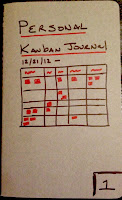
A friend of mine once told me that when he met with new clients about Agile Transformation, he tried to focus on making sure they understood that Agile was not going to make them faster, but it would make the broken ugly things so obvious that they’d have no choice but to deal with them. I’ve seen that happen over and over in my own work. I am happy (and totally annoyed) to report that the exact same thing happens when you apply the practices at a personal level.
If you are interested in learning more about how to apply Kanban to managing your personal work, you might try Personal Kanban by Jim Benson and Tonianne DeMaria Barry.
|
Posted on: January 29, 2013 01:10 AM
|
Permalink |
Comments (4)
|
Awhile back I was working on an Agile coaching gig with Tom Smallwood. We were working with a team that moving to Scrum and was having a particularly difficult time meeting their commitments. Stories were being estimated in Story Points using the Fibonacci sequence and they were breaking stories down into tasks that were then estimated in ideal engineering hours. Stories were (mostly) small enough to go from card on wall to potentially shippable in about 2 days. Tasks were kept to between 4 and 12 hours. Unfortunately, despite following the basic guidelines we were giving them, they were still WAY over committing each Sprint.
Tom was the first one to notice that even though they were all confident in their ability to get the work done at the end of a Sprint Planning meeting, what they were confident about was in fact, completely impossible. What was happening was that each person was assumed to have a capacity of 8 ideal engineering hours per day. Since we were working in two-week iterations, this meant each person was on the hook for 80 hours of productive working time in a Sprint.
The way we addressed this initially was to ask them to plan for no more than 6 productive working hours per person each day. This helped, but it still wasn't cutting it. The problem was that each person had more that they were responsible for than just the project we were working on. (Yes, this is not ideal, but it was reality at the time.)
The solution we came up with was very simple and it is one I have used on every team I worked with since. It adds an extra step to the Sprint Planning ceremony, but it has been invaluable in helping teams understand their capacity and preventing over commitment.
(Disclaimer - this involves using relative Story Point Estimation for Stories and Ideal Engineering Hours for Tasks. There are many who do things differently and have great success - which is awesome... what follows is just what I have found to work well for me and the teams I've worked with.)
What we added was a step in the 2nd half of Sprint Planning. After the team has taken the User Stories (estimated in Story Points) and broken them down into Tasks (estimated in Ideal Engineering Hours), we would go around the circle and ask each team member to estimate how many ideal engineering hours he/she could commit to being responsible for in the upcoming Sprint. One of the most critical parts of this is the idea that the commitment being made is not to the PO, but to the other members of the development/engineering team. So, if I tell my team I'm good for 35 hours, then my team can count on me to be responsible for 35 hours of task work. If I commit to that and do not contribute that amount of time, my team members will have to cover for the work I've not done. While this should go without saying, I have found it to be helpful to mention when starting this part of Sprint Planning.
So, going around the circle, each team member has to be aware of how much time they can commit to contributing. This means they need to account for a lot of the things that get in their way.
Here is how I normally coach people to think through this:
In a two-week iteration, you begin with 10 working days. However, I normally block out 1 day for Sprint Planning, 1 day for the Sprint Review and Sprint Retrospective, 1/4 day for the 8 remaining days during which the team will hold a 15 minute daily standup and 1/4 day for an Estimation/Story Meeting. While blocking out 1 whole day for Sprint Planning and 1 whole day for the Sprint Review and Sprint Retrospective meetings is more than the Scrum Guide calls for, I have found that it is more realistic to working under the assumption that the team will get little else done on those days.
If the Sprint is 2 weeks long, we start with 10 working days. Once we block out the time mentioned above, we end up at 7.5 working days.
If we assume each person can be productive for a maximum of 6 hours per day, then:
6 hours/day * 7.5 days = 45
So, the absolute Maximum Possible Productive Hours (MPPH) for any individual in a two- week Sprint is 45 hours.
We then ask each person to total up the amount of time they expect to lose during the upcoming Sprint to the following events that are not part of the Scrum Framework:
-
Standing Meetings - recurring meetings held each week that will keep them from working on the project
-
Holiday/PTO - expected
-
Vacation/Sick time - expected or averaged
-
Medical/Dental/Other Personal Appointments - expected or averaged
-
Emergency Fixes* - average time lost per Sprint to emergencies which require them to temporarily abandon their work on the project
-
Misc. Additional Time - Any additional time they feel they should block out to address other issues, work or personal, which will inhibit their ability to contribute to the project during the Sprint
* Getting pulled away from a project to deal with emergencies that are not related to the project is a dysfunction that will impair the team's ability to realize the full benefits of Scrum. However, in several organizations I have worked with, it is a constant reality. When things break, and the money stops flowing, it's all hands on deck.
The total of the above is the Interruption Time (IT) that each team member must subtract from his or her MPPH. The amount of time left is the Revised Maximum Possible Productive Hours (RMPH).
If the individual is only working on a single project, then the RMPH is the amount of time that individual should feel comfortable sharing with their team members as their Committable Productive Time (CPT).
If the individual is split on multiple projects, then they should multiply the percentage of their time that is allocated to the project by the RMPH. They should then subtract an additional 10% from the result (for context switching) to get their Committable Productive Time (CPT).
Here is an example of the above...
-
4 hours standing meetings
-
8 hours PTO
-
3 hours for dentist appointment
-
5 hours average time lost to Emergency Fixes
-
5 hours subtracted because I will just be returning from overseas and I expect the jet lag to have a negative impact on my productivity for a few days
Interruption Time (IT) = 25 hours
If I am split across 2 projects at 50% each...
9 hours of Committable Productive Time
In talking through this, it is very common to see jaws drop. However, if each person on the team is doing this, then the team will have a realistic understanding of its' work capacity in a given Sprint. While the idea of having to tell someone responsible for your performance review that in a two-week period that you can only be counted on for 9 hours of time may be scary, it is honest. If we are practicing Scrum and sticking with transparency (one of the 3 legs of Scrum), and we are being responsible to our fellow team members, this is the most responsible, transparent thing we can do.
Once each team member has shared their CPT, they are totaled up and this is the Team's Committable Productive Time (TCPT). As long as the total number of estimated ideal task hours does not exceed the TCPT, then the team should feel comfortable making a commitment to the Product Owner for the Stories they will complete during the Sprint. If the number of estimated ideal task hours does exceed the TCPT, then the team may have to negotiate with the Product Owner to reduce the work being planned for the Sprint before they make a commitment.
I have also seen teams break things down even further into number of hours for development, testing, etc., but what is above is typically as deep as I go with it.
It adds an extra step, but it helps the team members inspect and adapt their own workload and capacity. This will also better enable them to meet their commitment in a Sprint; IMHO, the benefits of this far exceed the few extra minutes it will take for a team to make sure they are not overcommitting.
|
Posted on: October 28, 2012 01:28 AM
|
Permalink |
Comments (4)
|
Written by Mitch Lacey, published by Addison-Wesley Professional as part of their Agile Software Development Series)
 One of the things that is difficult about taking a Certified Scrum Master or Certified Product Owner classes is that to a large extent, the material looks at Scrum in a state that is (for many) based on an ideal they may never reach. Once students leave the class and go back to work, the number of obstacles they face in the struggle towards Agile transformation can be a daunting thing to overcome. If they are brave enough to take up the challenge, they soon bang up against the fact that when they try to apply Scrum in the wild, what they end up facing may not sync up so well with what was taught in class. One of the things that is difficult about taking a Certified Scrum Master or Certified Product Owner classes is that to a large extent, the material looks at Scrum in a state that is (for many) based on an ideal they may never reach. Once students leave the class and go back to work, the number of obstacles they face in the struggle towards Agile transformation can be a daunting thing to overcome. If they are brave enough to take up the challenge, they soon bang up against the fact that when they try to apply Scrum in the wild, what they end up facing may not sync up so well with what was taught in class.
Enter Mitch Lacey’s new book: The Scrum Field Guide:Practical Advice For Your First Year. The Field Guide picks up where the classes leave off and addresses some of the real world issues that people face when they go back to their workplace and start trying to implement Scrum and Agile. In a narrative that is unassuming and easy to read, Mitch Lacey shares stories, his own experiences, and advice from other expert sources on how to actually get Scrum up and running and producing results. The book covers some of the most common questions that come up during implementation like:
-
When we don’t know what our velocity is, what do we tell our stakeholders we can commit to?
-
What if you have to play two roles at once?
-
How do you deal with team members that are only needed for brief, very specific types of work?
-
How is Scrum Master a full time job and how to you convince others of that?
The cases are presented through stories that set up the different situations. Lacey then draws on his own experiences leading and coaching Agile teams to explore the different options and offer his recommendations.
The book also includes a “First Aid” section for those who are trying to solve very specific issues with things like “Running a Productive Daily Standup Meeting” and dealing with some of the cultural challenges that are part of Agile Transformation.
While it is called the Scrum Field Guide, the book is not just about Scrum. Lacey introduces his own practice of Agile by saying that for him, one of the keys to getting Scrum to work has been pairing it with Extreme Programming. Throughout the book, Lacey introduces XP practices where he has seen them effectively utilized with Scrum.
While the book does include information on the actual Scrum Framework (in the Appendix) it is really designed to work best for folks who have a bit of experience in using Scrum and are seeing various issues, or “smells” as they are often called, creep up.
There are a lot of books out there that are aimed at clarifying what the Scrum Framework is. If you have clarity on what Scrum is supposed to be, and need a resource to help you make it work, The Scrum Field Guide will be a great addition to your tool belt. The title of the book indicates that this book is intended for people who are in their first year of doing Scrum. I’ve been working with Scrum for many years now and I’m also a Certified Scrum Trainer. I still found a lot of valuable information in this book and expect it is something I’ll be referencing in the future when I’m coaching.
|
Posted on: May 17, 2012 12:10 PM
|
Permalink |
Comments (1)
|
"More than any time in history mankind faces a crossroads. One path leads to despair and utter hopelessness, the other to total extinction. Let us pray that we have the wisdom to choose correctly."
- Woody Allen
|





