


Categories: Governance, Integration Management, Leadership, Organizational Project Management, Program Management, Strategy
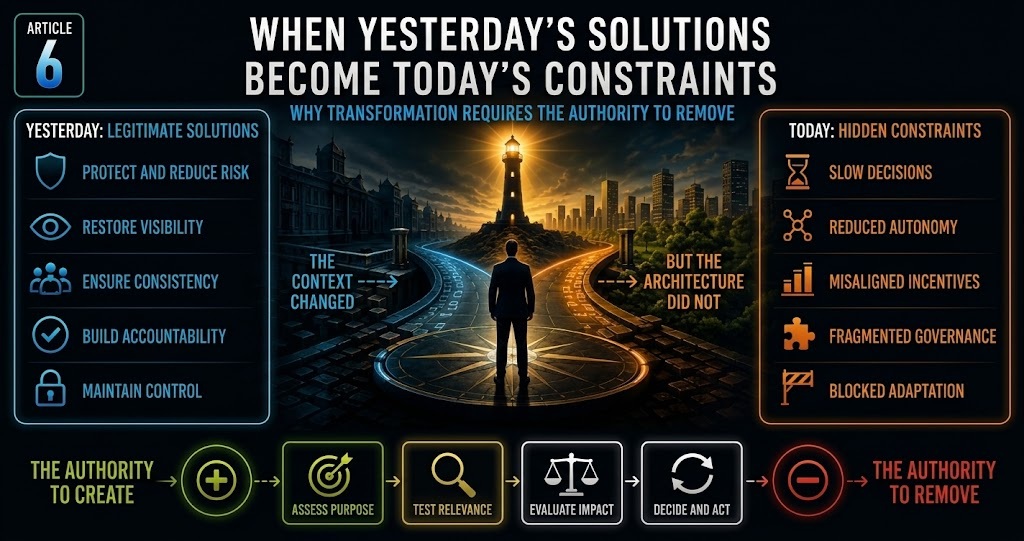
Why Transformation Requires the Authority to Remove
In the previous article, I brought together the central argument of this series through eight transitions that help explain the evolution of new ways of working in projects.
Those transitions described a movement from execution toward sustainable value, from plans toward guiding purpose, from hierarchical authority toward contextual authority, and from local optimization toward organizational coherence, adaptation and learning.
Together, they addressed an essential question:
What organizational conditions allow projects, understood as temporary organizations, to remain adaptive without losing direction, accountability or the capacity to create value?
Yet one important question remained insufficiently explored:
What happens when the organization already contains controls, structures and decision mechanisms that were reasonable when introduced but have become incompatible with the transformation it now seeks to achieve?
Controls are the primary focus of this article, not because they are the only inherited constraints, but because they make the problem particularly visible.
The same underlying logic can apply to roles, metrics, structures, funding mechanisms, decision rights and other organizational arrangements.
By control, I mean an organizational mechanism that conditions or constrains action to serve a purpose, keep a risk within defined boundaries, protect an interest or preserve an accountability relationship.
This question matters because organizational incoherence is rarely created in a single moment.
It accumulates.
An approval is introduced after a failure.
A review is added after an audit finding.
A reporting requirement follows a loss of visibility.
A decision is centralized after an operational incident.
A new control is created to protect quality, safety, compliance, financial integrity or accountability.
Each response may be defensible in the context in which it emerges.
Over time, however, these individually defensible responses form a cumulative architecture.
Their original assumptions become less visible as the context changes, new capabilities emerge, risks evolve, work becomes more interdependent and decisions need to happen faster.
But the controls persist.
The organization then introduces agile teams, new technologies, collaborative structures, innovation programs and broader expectations of autonomy while preserving mechanisms created for a different organizational reality.
The result is not simply resistance to change.
It is inherited architecture constraining the transformation the organization intends to achieve.
Incoherence Has a History
It is tempting to interpret every control that now appears obsolete as evidence of poor design.
That interpretation is usually too simple.
Many controls that appear excessive today responded to legitimate concerns when they were introduced.
Multiple approval layers may have reduced errors in an environment where information was limited and operational failures were costly.
Centralized decisions may have preserved consistency when expertise was scarce.
Detailed reporting may have restored visibility after leaders lost confidence in execution.
Functional specialization may have increased efficiency when work was more stable and dependencies were easier to predict.
The problem is that the legitimacy these arrangements acquired in their original context is often treated as permanent.
A control does not remain appropriate merely because it was once justified by a material risk.
Its continued appropriateness depends on whether its underlying assumptions, protected interests, operating context, effectiveness and systemic consequences still justify its use.
Organizations should not abandon controls simply because they slow work down.
Some controls protect interests whose importance exceeds the value of speed.
Regulatory compliance, safety, financial integrity, privacy, quality and legitimate accountability cannot be dismissed as avoidable friction.
At the same time, the existence of a legitimate purpose does not prove that the current mechanism remains the best way to protect it.
The purpose may remain valid while the mechanism becomes obsolete.
The risk may remain material while the approval chain becomes disproportionate.
The protected interest may remain non-negotiable while the way it is protected needs to evolve.
Historical defensibility should generate understanding, not immunity from review.
How Yesterday’s Solutions Create Path Dependence
Organizational architecture is not shaped only through formal transformation programs.
It is also shaped by accumulated responses to previous events.
Every additional approval, exception, escalation route, control function, reporting requirement or decision boundary changes how work moves through the organization.
Once embedded, these mechanisms influence roles, expectations, systems, incentives and perceptions of risk.
They become part of how the organization understands responsible action.
This creates path dependence.
The organization becomes increasingly influenced by choices made under earlier conditions.
Even when a different architecture would now be preferable, changing direction becomes difficult because the existing configuration has already shaped authority, routines, technologies, performance measures and professional expectations.
The control no longer exists in isolation.
It has acquired dependencies.
Systems may have been configured around it.
Roles or functions may derive part of their organizational relevance from administering it.
Managers may rely on it to preserve visibility.
Teams may have learned to organize work around its delays.
Audit practices may assume its continued existence.
Removing the control therefore affects more than an individual rule. It alters relationships among authority, information, accountability and risk.
This is why architectural incoherence can survive long after leaders recognize it.
The organization is not preserving only a rule. It is preserving a network of arrangements that has grown around that rule.
The Asymmetry Between Keeping and Removing
There is a deeper reason why inherited controls persist.
The costs and risks of keeping and removing them are distributed and attributed differently.
The cost of retaining an outdated control is usually dispersed.
Decisions take longer.
Teams wait.
Opportunities are missed.
Workarounds appear.
Responsibility becomes separated from authority.
Managers spend more time resolving exceptions.
No single consequence may appear sufficiently significant to justify intervention.
The organizational cost emerges gradually across many decisions, teams and initiatives.
The risk of removal is experienced differently.
If a failure occurs after the control is withdrawn, the removal decision becomes visible and may become the focus of attribution, even before its causal relevance has been established.
Someone may be asked who authorized the change, what evidence supported it and why the previous safeguard was removed.
The cost of retention is diffuse.
The cost of removal is attributable.
Under these conditions, preserving the control can become the safer personal decision even when it is no longer the better organizational one.
This may be less a failure of courage than a rational response to an accountability architecture that exposes decision-makers to the consequences of removal without making them equally answerable for the cumulative costs of retention.
The organization asks leaders to transform the system while making continuation safer than revision.
Why Transformation Adds More Easily Than It Subtracts
Transformation programs are often designed around addition.
New practices.
New roles.
New technologies.
New governance forums.
New capabilities.
New performance indicators.
Addition is visible. It demonstrates action. It can be planned, funded, communicated and measured.
Subtraction is more difficult.
Removing an approval, retiring a report, reducing a control, decentralizing a decision or closing a governance forum requires the organization to make an explicit judgment about what is no longer necessary.
That judgment creates exposure.
Teams may receive greater autonomy while previous approvals remain.
Leaders may promote experimentation while failure continues to carry disproportionate personal consequences.
Cross-functional teams may be created while functional performance measures remain dominant.
Digital workflows may accelerate information flow while decision authority remains centralized.
The organization changes what it asks people to do without changing what they must navigate to do it.
Transformation then increases complexity while claiming to reduce it.
The new architecture does not replace the old architecture.
It becomes another layer.
Authority to Create Is Not Authority to Remove
Organizations usually know who can introduce a control.
A regulator may require it.
A board may approve it.
An executive may mandate it.
An audit committee may recommend it.
A functional leader may embed it in policy or process.
Far less clarity often exists regarding who may revise, relax, replace or retire it.
The authority to administer a control is not necessarily the authority to remove it.
Those who experience its operational cost do not necessarily have the authority to redesign it.
The authority to approve exceptions is not necessarily the authority to change the underlying rule.
Those closest to the work may see evidence that a control no longer fits its context but remain unable to change it.
Those with formal authority to intervene may be too distant from the recurring operational consequences to recognize the need for review.
The result is an authority gap.
Responsibility for managing the consequences of the control becomes distributed. Authority to reconsider the control remains unclear or remote.
An organization cannot legitimately demand or attribute responsibility for outcomes beyond the authority, knowledge, capability, discretion, causal influence and opportunity to act that its organizational architecture has preserved, or that the actor had a prior duty to preserve.
At the same time, proximity to the problem does not, by itself, legitimize removal.
Controls may protect people, interests, risks or obligations that extend beyond the local context.
Legitimate removal therefore requires authority proportionate to the significance of the change, informed by operational knowledge and accountable for the interests and risks that extend beyond the local context.
Removal Is Not Deregulation
The argument for removing inherited controls can easily be misunderstood.
Removing a control does not mean removing governance. Nor does it mean assuming that fewer rules always produce better organizations.
Depending on the evidence, a control may need to be retained, strengthened, redesigned, replaced or retired.
The relevant question is not whether the organization has many or few controls.
It is whether each material control remains coherent with the purpose it serves, the risk or interest it protects, the authority it distributes and the conditions under which work now occurs.
In this sense, legitimate removal is not the opposite of governance.
It is an expression of governance maturity.
It demonstrates that the organization can distinguish the institutional purpose served by a control from the particular mechanism through which an interest has historically been protected or a risk bounded.
Governing the Revision and Retirement of Controls
If organizations are to revise or remove controls responsibly, that process must itself be governed.
The decision cannot depend solely on frustration with bureaucracy or a general preference for speed. It requires evidence, authority, deliberation and traceability proportionate to the significance of the control.
A legitimate review should examine:
- The original purpose of the control and the failure, risk or protected interest that justified it.
- The assumptions under which the control was designed.
- Evidence of whether those assumptions and risks remain materially relevant.
- The control’s current effectiveness and recurring organizational costs.
- The consequences of retention, revision, replacement and removal for affected stakeholders.
- The availability of alternative mechanisms that could protect the same interest more coherently.
- The authority required to decide and the accountability arrangements that should follow.
- The extent to which the change can be tested, monitored, challenged or reversed.
Its purpose is to restore legitimate choice.
The control may be retained because the risk remains material.
It may be simplified because the purpose remains valid but the mechanism has become disproportionate.
It may be replaced because new capabilities can protect the same interest more effectively.
It may be temporarily relaxed, where legally and operationally permissible, within authorized and monitored boundaries to generate evidence.
Or it may be retired because its current protective value no longer justifies its systemic cost.
I propose understanding legitimate control retirement as:
The evidence-based, proportionate and traceable decision to remove an organizational control when the risks or interests it protects no longer justify its systemic costs, or when those risks or interests can be protected more coherently through alternative safeguards.
This definition preserves an essential balance.
It prevents historical controls from becoming immune to review while preventing transformation from becoming indiscriminate dismantling.
Projects as Sensors of Inherited Architecture
Projects occupy a particularly important position in this challenge.
Because they cross functional, hierarchical, technological and organizational boundaries, projects can reveal the cumulative effects of inherited controls before those effects become visible across the permanent organization.
A project may repeatedly wait for the same approval.
Different teams may create similar workarounds.
Decision escalations may reveal that formal authority is misaligned with operational responsibility.
Conflicting metrics may make cross-functional collaboration difficult.
Temporary exceptions may become necessary simply to maintain progress.
These are not always isolated execution problems.
They may be evidence of architectural incoherence.
As argued earlier in this series, the Project Manager can contribute to the organization’s sensing system.
In this context, that role becomes particularly relevant because its position across boundaries can reveal repeated delays, duplicated controls, unresolved authority gaps and recurring exceptions that a single permanent function may interpret only as local incidents.
However, visibility does not confer unilateral authority to remove a control.
The Project Manager’s contribution lies in preserving evidence, clarifying systemic consequences, identifying the authority required for intervention and ensuring that the issue reaches those who can legitimately decide.
Projects should not silently bypass organizational controls whenever those controls become inconvenient.
Neither should they be forced to absorb indefinitely the cost of controls that no competent authority is prepared to reconsider.
Their repeated experience can transform operational friction into evidence for architectural review.
An Adaptive Organization Must Know How to Stop
Organizations often associate adaptability with the capacity to begin: launching initiatives, adopting technologies, creating teams, introducing practices and building capabilities.
But adaptability also depends on the capacity to stop: retiring reports that no longer inform decisions, ending escalations that no longer add legitimate control, reconsidering roles whose function has disappeared and ceasing to reward behaviors that contradict current strategic intent.
This does not require organizations to value change over continuity.
It requires them to preserve the capacity to determine when continuity remains legitimate and when it has become structural inertia.
Revisiting inherited arrangements is not an occasional transformation activity. It is a permanent requirement of responsible organizational design.
An organization is not genuinely adaptive merely because it can create new structures.
It is adaptive when it can also question, revise and retire existing ones without losing legitimate control.
Conclusion
Throughout this series, I have argued that new ways of working in projects cannot be reduced to methodologies, team practices or technological adoption.
They depend on the organizational conditions through which purpose, authority, decisions, capabilities, learning and accountability are connected.
The previous articles examined how those conditions enable adaptation.
This sixth article adds another requirement.
Those conditions must not only be created and preserved. They must remain open to legitimate revision when the context that justified them changes.
Many of today’s constraints were yesterday’s solutions.
They may have protected the organization from real failures.
They may still protect interests that remain important.
But historical value cannot replace present evaluation.
When controls survive without renewed examination of their purpose, assumptions, effectiveness, consequences and proportionality, transformation becomes additive.
New practices accumulate around inherited architecture.
Complexity increases.
Responsibility moves, but authority does not.
The organization demands adaptation while continuing to reward preservation.
A defining capability of an adaptive organization therefore lies not only in designing what should come next.
It lies equally in governing what should no longer remain.
Transformation requires legitimate authority to create.
It also requires legitimate authority to remove.
Posted on: September 06, 2026 04:49 AM |
Permalink




